Numerology Compatibility: Methods and Limits
Different calculators compare different numbers. Learn the arithmetic and the limits without turning a cultural reading into a verdict on a relationship.
Two numbers are not a relationship
Numerology compatibility compares numbers assigned to two people and turns the comparison into a story about how they might get along. In Indian practice those numbers often come from the birth day, the full birth date, or a spelling of the name. A website may call the result harmonious, difficult, magnetic, or even a percentage. Those labels describe rules inside that website's tradition. They do not measure love, honesty, safety, or the chance that a marriage will last. This distinction matters most when a pleasant curiosity becomes a family decision. A couple should not be accepted or rejected because a table puts their numbers in the same coloured box.
This guide explains the arithmetic, shows why different calculators disagree, and separates cultural interpretation from evidence. It does not calculate a verdict on anyone. If the practice is meaningful to your family, it can remain part of a conversation without gaining a veto over the people in it. A respectful reading leaves room for disagreement and for the couple's own account of their relationship.
First ask which compatibility is being compared
The word compatibility hides several different operations. NumroQ's Mulank and Bhagyank tool compares two numbers belonging to one person. Its subject is supposed inner harmony between nature and life direction, not a match between partners. Rahul Arya's relationship tool instead takes two birth dates, derives two numbers for each person, and compares four pairs. Numerology4u compares only two life paths. Numerolo's grid compares Destiny numbers derived from names. Four pages can therefore use the same word while answering four different questions.
Before reading a result, write down its inputs and its definition of each number. In Indian usage Bhagyank commonly means a full-date total, while the Numerolo page uses Destiny for a name-derived number. Translating both as destiny does not make them the same calculation. If a report never explains whether it used your day, date, or name, its impressive-looking score cannot be independently checked.
Calculate the birth-day and full-date numbers separately
Mulank is the reduced day of the month. Someone born on the fourteenth has 1 + 4 = 5; someone born on the twenty-third has 2 + 3 = 5. Under this convention those two people share a Mulank even if their months, years, and experiences differ. Bhagyank uses every digit of the full birth date. For a deliberately fictional example, 14 September 1992 gives 1 + 4 + 0 + 9 + 1 + 9 + 9 + 2 = 35, then 3 + 5 = 8. The pair is therefore Mulank 5 and Bhagyank 8.
A second fictional person born on 23 April 1991 has Mulank 5. Their full date gives 2 + 3 + 0 + 4 + 1 + 9 + 9 + 1 = 29, then 11, then 2 under a fully reduced convention. A school that preserves master number 11 might display 11/2 instead. Neither fictional date belongs to a reader or a real couple in this article. Keeping examples anonymous also avoids turning another person's birth date into public material.
A worked comparison without a romantic verdict
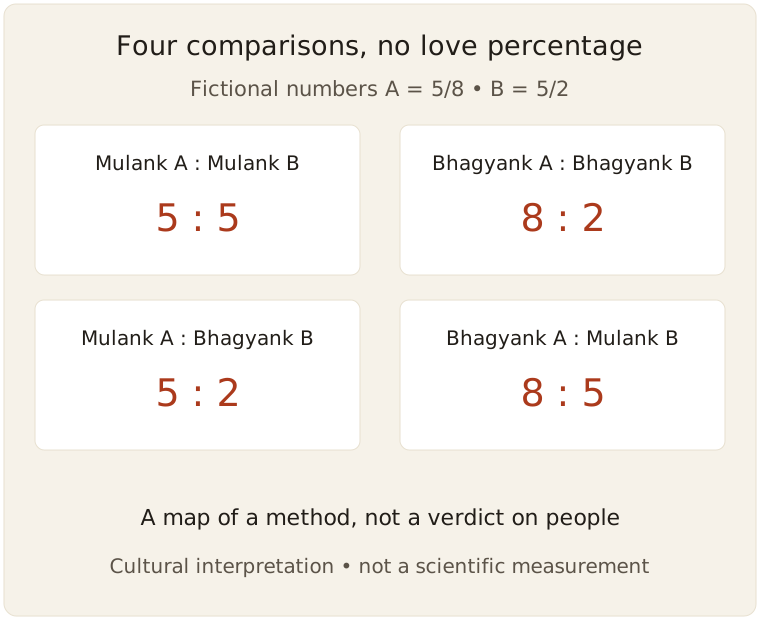
Our fictional pair has numbers 5/8 and 5/2. A four-pair method considers 5 with 5, 8 with 2, 5 with 2, and 8 with 5. Those are the two like-for-like comparisons and the two cross comparisons. Rahul Arya's published method gives the Mulank pair and the Bhagyank pair weights of 35 percent each, and the cross pairs 15 percent each. The weights add to 100, but that arithmetic says nothing about whether these weights predict a relationship. They are a design choice in this calculator.
A life-path-only tool would look at 8 with 2 and ignore the shared Mulank. A name-number tool would need names and might ignore the dates altogether. These are different models, not different levels of access to a hidden truth. The diagram accompanying this article maps the four comparisons so a reader can see what the first method includes. It intentionally stops before assigning a love score.
Where the planetary friendship table enters
Rahul Arya's page assigns 1 to Sun, 2 Moon, 3 Jupiter, 4 Rahu, 5 Mercury, 6 Venus, 7 Ketu, 8 Saturn, and 9 Mars. It then scores relationships between the ruling grahas, considering friendship in both directions. Its table gives 1 with 2 a harmonious score of 4, but 1 with 6 a challenging score of 0. Some pairs receive a note that friendship is not returned equally. That note describes the table's planetary symbolism. It is not evidence that one partner cares more than the other.
The practitioner explicitly describes numerology as a traditional belief system. Its article also says that a challenging result is not a reason to part. Preserve both qualifications when repeating the table. Quoting the favourable or alarming cell while omitting the source's limits changes a cultural explanation into a personal judgement that the evidence does not support.
Why a different chart may reverse the answer
Numerology4u's published life-path table calls 1 with 2 a hard match, whereas Rahul Arya's Mulank table calls 1 with 2 harmonious. Numerolo's name-derived Destiny grid labels 1 with 6 harmonious, while Rahul Arya's Mulank table calls that pair challenging. These examples do not prove that one author made an arithmetic mistake: the pages compare different constructs and use different rules. They do show why an unattributed universal chart of lucky partners would be misleading.
A responsible comparison keeps the column heading attached to the numbers. Say that a particular source gives a particular label to a particular kind of pair. Do not collapse every table into a single list of friends and enemies, and do not silently choose the table that gives the answer a family already wants. Shopping between calculators until a desired verdict appears is selection, not verification.
A percentage is not a probability
A compatibility score of 80 out of 100 is not evidence of an 80 percent chance of a happy marriage. To support such a claim a method would need a defined outcome, a relevant sample, predictions made before outcomes were known, and testing against sensible alternatives. The pages consulted here publish interpretive rules and labels, not that kind of relationship validation. A tidy score can be reproducible because a computer applies its rule consistently while still lacking demonstrated predictive value.
Numerology4u is unusually clear about its own scoring: perfect gets 3 points, good 2, neutral 1, and hard 0. Those points are category codes. Rahul Arya's thresholds are 70 or above harmonious, 45 to 69 balanced, and below 45 challenging. Moving the cutoffs would change some labels without changing anything about the people. Never read a measurement's precision into an author's chosen scale.
Master numbers and name spellings add conventions
Some systems preserve 11, 22, or 33, but Numerology4u says its compatibility table uses their reduced values, 11/2, 22/4, and 33/6. Thus a report can display a master number prominently while scoring it like an ordinary single digit. Ask which rule is used before comparing outputs. Do not treat a master-number label as evidence of greater worth, a special obligation to a partner, or exemption from ordinary boundaries.
Name comparisons introduce another choice: the written name. A name-derived total may change with a transliteration, shortened name, or spelling. The previous article explains Chaldean and Pythagorean charts in detail. Here the practical point is simpler: a result that changes when a letter changes is not an independent assessment of how two people treat each other. Changing a legal name to repair a relationship score can create real administrative costs while leaving the relationship untouched.
What the evidence can and cannot establish
Jeremy Genovese's paper, A Test of Numerology: Do Birth Numbers Predict Nobel Prize Winners?, examined 806 laureates with awards between 1901 and 2010. Their birth-number distribution did not differ significantly from chance: chi-square 4.92, eight degrees of freedom, p = 0.77. Differences across prize categories were also not significant, p = 0.90. The author says the investigation provides no positive evidence for numerology.
That study is not a trial of marriage compatibility, and it should not be advertised as one. It tests one neighbouring claim about birth numbers and distinguished achievement. Its discussion expressly acknowledges that other numerological constructs or outcomes were not ruled out. The fair conclusion is limited: this test did not support its claim, and it does not validate any compatibility calculator. None of the practitioner pages fetched for this guide supplied a prospective relationship study establishing that their labels predict outcomes. Absence of such evidence in these sources is not a claim that every possible study has been searched.
Why a reading can feel accurate anyway
The Skeptic's Dictionary discusses selective attention: readers can remember the parts that fit and overlook the rest. Relationship language makes this especially easy. Most couples can recall moments of independence, closeness, friction, and compromise. A paragraph describing a need for freedom alongside a wish for affection may feel specific because both experiences are familiar. Recognition can be useful for conversation without being proof of the numerological explanation.
Try a fairer reading exercise. Hide the numbers, read several descriptions, and ask which statements describe actual incidents rather than flattering possibilities. Record misses as carefully as hits. Do not test a partner secretly or turn this exercise into a diagnosis. Its purpose is to separate a useful question from the unsupported claim that the question was revealed by a birth date.
Turn symbolism into questions, not instructions
If a traditional reading says one number wants freedom, ask what freedom means in this relationship. Is it time alone, choice of work, friendships, travel, or privacy? If another number is described as practical, ask how both people want to divide routine tasks. These are editorial conversation prompts, not validated traits of the numbers. Either person may reject the description completely.
For a serious partnership, discuss money, children if relevant, living arrangements, work expectations, care responsibilities, religious practice, conflict, and boundaries directly. A numerical match cannot answer these on someone's behalf. Agreement should be voluntary and revisable, not extracted because a chart supposedly proves one person must lead and another must accommodate. What people say and consistently do matters more than a favourable label.
Family expectations without surrendering consent
Families may use matching as a familiar way to express concern about an unfamiliar marriage. It can help to ask what specific concern lies behind a low score. If the concern is distance, debt, differing plans, or unequal responsibilities, discuss that concern with facts. If the objection is only a number, say plainly that the number does not establish harm or incompatibility. Respect for elders need not require surrendering the couple's consent.
A neutral phrase is: we understand that this tradition matters to you, but we want the decision to rest on our consent and the life we are prepared to build. Avoid promising that a second practitioner will produce certainty. A consultation may explain a tradition in more detail; it cannot convert an unvalidated score into a guarantee. Nobody owes a marriage, breakup, purchase, or name change to a calculator.
Privacy, sales pressure, and unsafe interpretations
Check what a tool asks for before entering anything. Rahul Arya's page says the dates appear in the page address and that contact details supplied through its form are retained for contact. That is a reminder to read the actual notice and not assume every free calculator keeps nothing. Birth dates and names can be calculated on paper for this purpose. Do not upload another person's details without their agreement merely because a public form accepts them.
Keep safety separate from symbolic harmony. A high match never excuses threats, coercion, humiliation, financial control, or violence; a low match does not prove that any of those things exists. If there is a real safety concern, seek appropriate local support based on the conduct, not the chart. Be wary of a reading that creates fear and immediately sells a required remedy, paid correction, or urgent ritual. Optional cultural practice must remain optional.
A useful stopping rule
State the method, check the arithmetic once, read the interpretation as tradition, and return to the people. If repeated searches are increasing anxiety or becoming a way to avoid a necessary conversation, stop using the scores. The appropriate question is not which number makes a perfect partner. It is whether these two people freely want this relationship, can discuss their differences, and are building conditions in which both can live with dignity. Numerology can be a cultural language around that question. It should not supply the answer.
Sources consulted
- NumroQ: within-person Mulank and Bhagyank comparison
- Rahul Arya: four-pair method, weights, friendship table and limits
- Numerolo: name-derived Destiny compatibility grid
- Numerology4u: life-path-only table and category scoring
- The Skeptic's Dictionary: numerology and selective attention
- Genovese: birth-number test, results and stated limitations (PDF)


