Panch Mahapurusha Yoga: Five Planets, One Rule, and a Measured Test of the "Rare" Claim
Two engine builders measured the yoga called "rare": at least one appears in every third chart of their own samples. The rule, the measurements, the Mercury anomaly and what it means.
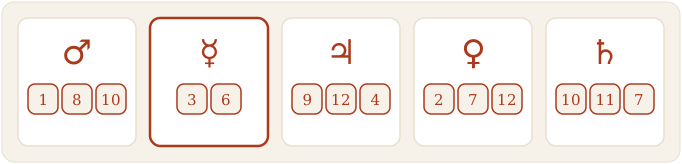
"Mahapurusha" means great person, and the five yogas carrying the name are described as "rare" on nearly every astrology page. What makes this article different: the rule is simple and binary enough to be measurable, and two independent engine builders have measured it. In tempora/vedicpupil's 4,000 sampled charts, 35.3 percent carried at least one Mahapurusha yoga; in desiutils.in's 40,000 sampled birth instants, about 34 percent. Both sources state themselves that these are shares of samples, not a measure of the human population; and both also state that the measurement is of the configuration, not the outcome. tempora's conclusion is direct: "rare" is a factual claim, and on the rule as classically stated it comes out false. This article opens the five yogas, their textual descriptions, both measurements, one elegant mathematical anomaly (Mercury's) and the conditions for reading results.
The rule and the five yogas
The rule comes from chapter 75 of the Brihat Parashara Hora Shastra (translation at jyotishvidya.com): if Mars, Mercury, Jupiter, Venus or Saturn, the five non-luminary planets, is in its own or its exaltation sign and simultaneously in an angle from the lagna, the first, fourth, seventh or tenth house, then Ruchaka, Bhadra, Hamsa, Malavya and Sasa yogas form respectively. The Sun and Moon take no part; the Saravali (in astrojyoti's translation) gives the same five, in a slightly different order. The names' meanings: Ruchaka, from ruchi, splendour; Bhadra, auspicious; Hamsa, the swan; Malavya, of the Malwa region; Sasa, the hare. The texts write the results of these yogas directly onto the body: the Ruchaka native has a long face, is exceedingly strong and valorous, with blue-black hair; the Bhadra native has a lion's splendour, a broad chest and an elephant's gait; the Hamsa native has a swan's voice, a fine nose and honey-tawny eyes; the Malavya native has moon-like lustre, beautiful lips and a slender waist; the Sasa native has small teeth and face on a body that is not small, and loves wandering forests and mountains. These must be read honestly: they are literal physical portraits, and the modern reader takes them as the symbolic language of planetary natures; both readings are kept separate in this article, and in neither reading are these measured claims.
The measured base rates: two engines, one conclusion
The first measurement is tempora.ltd's (the vedicpupil group), published 22 September 2026: 4,000 charts, dates drawn uniformly from 1960-2025, birth hours uniform across the day, Delhi latitude, Swiss Ephemeris, True Pushya Paksha ayanamsa. Results: at least one yoga in 35.3 percent; exactly one in 30.4 percent, exactly two in 5.0 percent, three or more not once in the sample. Per yoga: Sasa 10.07 (7.25 via own sign, 2.83 via exaltation), Malavya 9.60 (6.40/3.20), Ruchaka 7.95 (5.12/2.83), Hamsa 7.92 (5.35/2.58), Bhadra 4.70 (4.70/0.00). The second measurement is desiutils.in's: 40,000 sampled birth instants (1900-2099, an Indian-latitude grid, Lahiri ayanamsa), at least one yoga in about 34 percent; their calculator also gives an "honest why-not" for the yogas that are absent. Both sources state one limit: these are shares of sampled instants, not of people, because real birth dates and times are not uniformly distributed. Even so, the direction is unarguable: every third chart in these samples.
The Mercury anomaly: arithmetic that matches the measurement
The most elegant part of this measurement is Bhadra's count. Mercury is the only one of the five whose exaltation sign, Virgo, is also its own sign; the other four each have three qualifying signs (two own, one exaltation), Mercury has two. In the figure above, Mercury's card alone carries two numbers. And the direction of the measurement agrees: Bhadra at 4.70 percent against Sasa at 10.07, and Bhadra's via-exaltation column reads zero, because a Mercury in Virgo has already been counted as own sign. We checked this independently: assuming sign placement uniform and angle placement independent (an assumption, not reality; combustion and retrograde clustering skew the distribution), a three-sign planet gives 3/12 x 4/12 = 8.3 percent and Mercury gives 2/12 x 4/12 = 5.6 percent; at least one of the five comes to about 33 percent. The measured numbers (7.9-10.1, 4.7, 35.3) sit close to this frame, as tempora also notes; the Saturn and Venus measurements run slightly high, which shows the limit of the uniform assumption. So the main structural reason for Bhadra's relative scarcity is the lordship table, not a mystery, and for that reason it is the only Mahapurusha yoga that is genuinely relatively uncommon. One refinement: tempora calls this the "whole explanation", but our simple model only explains the direction of the gap, not the full measured ratio: the model would put Mercury near 5.6 and Saturn near 8.3, while the measurements came out 4.70 and 10.07, so the real gap is wider than the model's. We quote tempora's "whole explanation" phrasing within their own scope.
What one-in-three means: two surviving readings
After its measurement tempora leaves two consistent interpretations. First: the texts intended a stricter rule than the one in circulation, additional conditions on strength, aspect or avastha that the popular version dropped; then the measurement measures the popular rule, not the textual intent. Second: the yoga is common and the outcome it is supposed to mark is not; then the burden falls on the rest of the chart, not on the yoga. tempora states its own preference for the second, with a caveat: "we have measured how often the configuration appears and we have not measured what follows it; the frequency is settled, the effect is not." We quote both readings within their own scope. The practical consequence: a report writing "you carry a Mahapurusha yoga, you will be great" is presenting a common configuration as a seal of destiny; and the textual side that speaks of stricter conditions should say which conditions, from which text.
Five yogas, five portraits
One thing shows immediately on reading the textual descriptions: these portraits are not pure praise. In the chapter 75 translation, the Ruchaka native's qualities include "knowledge of mantras" and "valour" alongside "a leader of thieves"; that is, the author was describing a strong expression of Mars, not issuing a certificate of ideal citizenship. Ruchaka, the Mars yoga: strength, valour, a taste for battle, the capacity to command; the text extends this to ruling a region. Bhadra, the Mercury yoga: learning, eloquence, a lion's splendour and an elephant's gait; Mercury's intellect-led nature turns here into physical dignity. Hamsa, the Jupiter yoga: a swan's voice, a handsome form, a king of phlegmatic temperament, a promised hundred years; Jupiter's expansive nature gives the most "royal" portrait. Malavya, the Venus yoga: moon-like lustre, beauty, bodily fragrance, art and comfort; the very name comes from the Malwa region, a geographic memory of a culture of beauty. Sasa, the Saturn yoga: small teeth and face on a sturdy body, wisdom, a love of forests and mountains; Saturn's labouring nature molds here into solitude-preferring leadership. This diversity matters: the five yogas name the strong expression of five different natures, not five tickets to the same "success". And since in the texts the result domains are bound to planetary natures, on hearing "you have a Mahapurusha yoga" the first question must be "which planet".
A worked example: Gemini lagna, Mercury in Virgo
Take a hypothetical Gemini-lagna chart: Mercury in Virgo, in the fourth house. Virgo is both Mercury's own and its exaltation sign; the fourth house is an angle. On the rule sheet this is a clean Bhadra yoga, and in the language of tempora's table it will be counted in the "via own sign" column, not the exaltation one. Now the reading's staircase. Step one: Mercury here is also the lagna lord (Gemini lagna); the lagna lord in an angle in its own sign is itself a strength signal, so this is a "lagna-lord Bhadra", heavier than Bhadra in other lagnas. Step two: if the Sun is also close in Virgo, Mercury is combust; the configuration stands, the potency shrinks, and a good report will say so. Step three: if the birth time is off by even half an hour and the lagna is near a boundary, Mercury moves to the third or fifth house and the angle condition breaks; the desiutils birth-time confidence check measures exactly this. Step four: within the tradition the result timing ties to Mercury's dasha. So in one picture, a "yes" on the rule sheet and three reservations in the reading; both are true at once.
A historical hint about the name
The practice of reading the five yogas as a set is stable in the texts, but the historical background of the name "Mahapurusha" is interesting: the titles "shalakapurusha" and "mahapurusha" were already current in Mauryan-era Jain and Buddhist traditions, and texts like the Lalitavistara enumerate the thirty-two marks of a great person. The astrological set appears to connect to this cultural language of the "exceptional person", though a direct textual link is not established in the sources we consulted; this hint is our own, not a documented fact. The background is useful because it shows the weight of the word "mahapurusha": the name is a cultural honorific, and measuring the frequency of a configuration does not diminish the name's honour; what falls is only the literal claim of "rare".
One more layer absent from popular discussion: what the forming planet functionally is for that lagna. An own-or-exalted planet in an angle is the configuration's condition, but that planet's other lordships decide in what manner it is strong in that chart. A few examples from the standard lordship rules: for Aries lagna Saturn owns the tenth and eleventh, so a Sasa yoga of Saturn in Capricorn in the tenth is also a strong career-house lord, two signals in one direction. For Taurus lagna Jupiter owns the eighth and eleventh; there the Hamsa yoga's Jupiter carries eighth-house lordship with it, and the reading within the tradition is mixed. For Cancer lagna Mars owns the fifth and tenth, the yogakaraka; there a Ruchaka yoga is a yogakaraka's yoga, held especially powerful. For Libra lagna Saturn owns the fourth and fifth, again yogakaraka, and Sasa there is a yogakaraka yoga too. The same configuration changes meaning as the lagna changes. This layer comes from our own computation (the lordship rules are standard), and its direct use: after any Mahapurusha announcement, ask "for my lagna, what else is this planet?" Without that answer the name is only half the picture.
Testing strength: combustion and birth time
The desiutils scheme is familiar from our earlier articles: the own-or-exalted placement in an angle forms the yoga; combustion (closeness to the Sun) reduces strength; the word "cancelled" is never used. So a Bhadra yoga whose Mercury is combust keeps the configuration, with reduced potency. The second condition: the angle is counted from the lagna, and the lagna changes sign roughly every two hours, so a small birth-time error can push the planet out of the angle; this is why the desiutils calculator includes a birth-time confidence check. A third point from tempora's table: three or more Mahapurusha yogas together did not appear even once in 4,000 charts; the marketing language of "multiple Mahapurusha yogas" therefore claims a configuration invisible in the sample.
Common confusions
First confusion: these yogas are rare. The two measurements above: about a third of the samples. Second confusion: a formed yoga guarantees greatness. The measuring sources themselves deny it; the configuration was measured, not the outcome. Third confusion: the five are alike. No; the planets differ, the domains differ, and even the frequency differs by a factor of two (Sasa 10.07 versus Bhadra 4.70). Fourth confusion: the Sun and Moon also have Mahapurusha yogas. The rule covers five non-luminary planets; adding the luminaries is a popular extension. Fifth confusion: multiple Mahapurusha yogas are common. Two-yoga charts are 5 percent of the sample, three-yoga charts zero. Sixth confusion: a yoga requires a remedy or a gemstone. Within the tradition the answer is strength-testing and the dasha; purchase pressure is the warning sign.
Practical use
First, in testing a reading: on hearing "you have a Mahapurusha yoga", ask five questions: which planet, in its own sign or exaltation, in which angle, is the planet combust, and how far is your lagna from the boundary. Second, in testing language: when a report writes "rare", ask for the measurement; in the two consulted measurements the word does not hold. Third, in expectation: read the yoga as a strong expression of a planetary nature, not a certificate of destiny; read the texts' physical portraits as symbolic language, not measured claims. Fourth, in the name itself: "Mahapurusha" is a category name, not a promise of results; remember tempora's two surviving readings, a stricter rule or a common yoga with an uncommon outcome, and neither becomes "a guarantee of greatness for a third of all charts".
Sources and an honest note
The rule and the physical descriptions are from jyotishvidya.com's BPHS chapter 75 translation and astrojyoti's Saravali translation; Raman's yogas 19-23 from barbarapijan.com's three-hundred-combinations series (title level); the name meanings are our own word study. The 4,000-chart measurement, the per-yoga table, the Mercury-anomaly explanation and the two surviving readings are from tempora.ltd's published analysis; the 40,000-instant measurement, the combustion scheme, "never cancelled", the why-not readout and the birth-time confidence check are from desiutils.in; both measurements come from the sources' own samples and are quoted under their stated limits. Our 8.3/5.6/33 percent figures are simple uniform-distribution model estimates, not measurements. We have not opened the original Sanskrit of the texts ourselves. Everything tied to effects is presented as a claim of the tradition; no measured connection between any yoga and a life outcome is established. This article is educational.


