Pisces (Meena): The Two Fish of the Zodiac
Meena is the mutable water where the wheel completes itself: Jupiter’s second sign, where love becomes divine and analysis dissolves, and whose two fish swim opposite ways on one cord. From the classical verse to the modern sign profile, the art of compassion and the challenge of boundaries, with sources, and with an honest-limits note.
The water has been poured, and at the end of the wheel it gathers back into the sea. The twelfth sign, Meena, is thirty degrees of mutable water, the two fish of the zodiac, and the sign Satyori's Meena guide calls the principle of dissolution, transcendence and the return to source. This article audits that return in full: the sign's structure, the classical verse on a Pisces Moon, Jupiter's second house and the sign where Venus is raised and Mercury dissolves, the traditional tendencies in personality, career, relationships and health, and at the end an honest-limits note.
The sources are the usual four, each fetched for this article: Satyori's Meena rashi guide, a modern Jyotish reference last reviewed in May 2026; Wikipedia's Pisces article for the tropical frame and its Pisces constellation article for the mythology; the Brihat Jataka's seventeenth chapter as republished in English translation at VedicPupil, which we read directly; and Panchangtime's Vimshottari dasha methodology table. Where the sources hedge or disagree, the hedge stays standing.
The twelfth cell: the structure
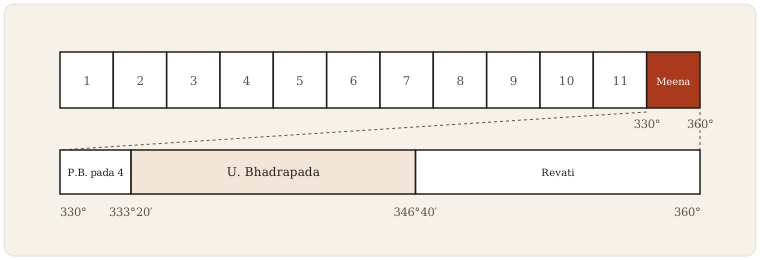
Meena is the twelfth and final sign of the zodiac, from 330 to 360 degrees. Its symbol is the two fish swimming in opposite directions, and the Satyori page reads the pair precisely: one fish swims toward the material world, the other toward liberation, and this duality defines the Meena experience. Its element is water, its character Dwiswabhava, mutable, and its ruler is Jupiter; the guide calls it the most fluid and boundary-less of all rashis, and sets its empathy against the fourth sign's: where Karka feels for its family, Meena feels for all beings. That universal empathy, the page says, is Meena's gift and its heaviest burden. In the Vedic mapping of the Kalapurusha, the cosmic person of time across whose body the twelve signs lie, Meena is the feet: the part that touches the earth last and carries the whole body's weight into rest, the end of the road the knees made possible and the ankles carried. The wheel that began with Mesha's head ends at Meena's feet.
Three nakshatra segments fall within Meena: the fourth pada of Purva Bhadrapada, all of Uttara Bhadrapada, and all of Revati. Each nakshatra spans 13 degrees 20 minutes of the zodiac, so Purva Bhadrapada's last quarter runs from 330 to 333 degrees 20 minutes, Uttara Bhadrapada from there to 346 degrees 40 minutes, and Revati closes the wheel from 346 degrees 40 minutes to 360; the arithmetic is ours from the standard nakshatra division. Two people both called Meena may therefore carry different nakshatras inside the same rashi, and in Jyotish the nakshatra carries its own weight. This collection carries a separate guide for each of the twenty-seven nakshatras, including Purva Bhadrapada, Uttara Bhadrapada and Revati; here it is enough that the rashi sets the frame and the nakshatra paints the finer shade within it.
The reference tables add the smaller certainties. Wikipedia calls Pisces a mutable sign spanning 330 to 360 degrees of celestial longitude, and notes that the March equinox point, the zero of the tropical zodiac, currently lies within the constellation's boundaries; its table records Jupiter as the traditional ruler and Neptune as the modern one. Satyori's quick-facts panel agrees on Jupiter, water, mutable and the degrees 330 to 360, and adds the dosha column to which we return in the health note below.
Meena and Pisces: two scales, one sky
They are two names for the zodiac's twelfth 30 degrees: Meena in the Vedic sidereal tradition and Pisces in the Western tropical one. The tropical zodiac is tied to the equinox point and the sidereal to the stars, and an ayanamsha gap of about 24 degrees separates them, the figure Satyori's own FAQ gives, so your Western sun sign and your Vedic rashi can differ. On dates, Wikipedia's Pisces page keeps the series' pattern of disagreeing with itself by a day: its summary table gives 18 February to 20 March for 2026, citing the US Naval Observatory's almanac, while its body text says the Sun transits tropical Pisces between about February 19 and March 20. We keep both readings standing, as we have throughout this series. Vedic Meena is computed from the panchang, not from these tropical dates.
The two fish: swallows, cords and the Syrian Goddess
The pair above this sign is older than its Greek telling. Wikipedia's Pisces constellation article records that Pisces originates from a composition of Babylonian constellations: Shinunutu, the great swallow, in current western Pisces, and Anunitum, the Lady of the Heaven, at the place of the northern fish; and in the first-millennium BC texts known as the Astronomical Diaries, part of the constellation was also called DU.NU.NU, the fish cord or ribbon. The Greek legend associates the pair with Aphrodite and her son Eros, who either shape-shifted into fishes to escape or were rescued by two fishes: in the version according to Hyginus, mother and son, while visiting Syria, fled the monster Typhon by leaping into the Euphrates and transforming into fishes, a passage that cites Diognetus Erythraeus; the Roman variant has Venus and Cupid carried away from the danger on the backs of two fishes, from Ovid's Fasti. Hyginus preserved a different origin tale in another work: an egg rolled into the Euphrates, some fishes nudged it to shore, doves sat on the egg until Aphrodite, thereafter called the Syrian Goddess, hatched out of it, and the fishes were rewarded by being placed in the skies; the Third Vatican Mythographer records the same story. The sign article adds a classical note: the symbol of the fish is derived from the ichthyocentaurs, the fish-tailed centaurs who aided Aphrodite when she was born from the sea. Every variant stands exactly where its source left it. Two fish, one cord: the image already holds the sign's whole tension, bound together and swimming apart.
The text's Meena Moon: Brihat Jataka
The Brihat Jataka's seventeenth chapter closes its Moon-sign cycle with the twelfth verse, 17.12, on the last sign, and we quote it from the English translation at VedicPupil, fetched and read directly for this article. Moon in Pisces: enjoys water, or water's products, and others' wealth, fond of his wife and clothes, or, as the translator's first bracket offers, home, vasa; with a well-proportioned handsome body, a high nose and a large head, on which the translator notes the reading is unclear, brihatkah; overcomes rivals, where the translator notes the text reads "sa patnan" and "sapatnan", rivals, is the reading taken; ruled by women, with pleasing eyes, enjoying radiance, treasure and wealth, and learned. Three translator's notes in a single verse, and we keep all three flying exactly as printed; this series has made a rule of letting the transmission show its seams. The site itself reduces the verse to a simple meaning: good looks, fond of wife and home, learned, overcomes rivals, comfortable. The same chapter holds its own hedge in verse 17.13, which says these twelve Moon-sign natures hold when no other planet or condition in the chart affects that sign; otherwise the marks change. The tradition said first that its portraits are not verdicts. The twelve Moon-sign verses are twenty-eight lines among the chapter's four hundred and nine; that says how old these figures are, and also how much else the book contains.
Jupiter's second house: where Venus is raised and Mercury dissolves
Jupiter rules Meena, its second lordship after Dhanu, and the dasha arithmetic continues: in the Vimshottari cycle of Panchangtime's methodology table Jupiter governs sixteen years, so the dasha of Meena's ruler arrives again in every life, the period the tradition reads as Guru-shaped years of faith, teaching and expansion. Meena also hosts the series' last exaltation pair. Venus is exalted here, at its deepest exaltation on 27 degrees, and Satyori's page explains the choice: Meena is the sign where love becomes divine, where artistic inspiration flows freely and where the soul transcends personal desire, so Venus, the planet of love, beauty and artistic expression, finds her highest expression here. This is Venus beyond romantic partnership, the page says: universal love, devotional art and beauty that serves spirit rather than ego. Mercury is debilitated here, at its deepest debilitation on 15 degrees: Mercury's analytical, categorizing mind dissolves in Meena's oceanic awareness; the debilitated Mercury may struggle with linear logic but often possesses remarkable intuitive intelligence, perceiving wholes that more analytical minds miss. Wikipedia's dignity table agrees on every row: Jupiter the traditional ruler, Neptune the modern, Mercury the detriment, Venus the exaltation, Mercury the fall. The sign that closes the wheel, then, is the sign where love is perfected and analysis is drowned: a fitting order for a water sign that ends the zodiac.
Meena in life: person, work, relationships, health
Satyori's personality portrait: Meena natives are often deeply compassionate, artistically gifted and spiritually sensitive, perceiving dimensions of experience that others miss; their imagination is vivid and their intuition, when trusted, remarkably accurate. The page's list of challenge is the sign's shadow: difficulty with practical boundaries, a tendency to absorb others' emotions, and a capacity to lose themselves in fantasy or escapism, whether through substances, excessive sleep or spiritual bypassing; learning to ground their sensitive nature, it says, is a lifelong practice. On career the page says Meena excels in fields that serve the collective: music, film, photography, healing arts, spiritual teaching and charity work, with an ability to channel the collective unconscious giving them an edge in creative fields, while they may struggle in highly competitive or metrics-driven environments. On relationships: Meena loves deeply and can merge completely with a partner, the page says, sometimes losing their own identity in the process; they need partners who appreciate their sensitivity and depth without taking advantage of their selflessness, and who can help them maintain healthy boundaries without crushing their romantic nature. Career and relationship readings in any system should be checked against the whole chart, the page itself hedges: the tenth lord, the dashas and the individual chart matter, and no one-dimensional zodiac prediction of a career or a marriage is complete.
On health the tradition is specific and we report it as the tradition's own attribution, not as medical fact. The Satyori page assigns Meena the feet, lymphatic system and immune function: foot problems, lymphatic congestion, immune irregularities and diagnoses that remain unclear or shift over time. It adds a characteristic note: Meena's health responds strongly to emotional and spiritual state; when spiritually aligned they are remarkably resilient, and when disconnected from meaning they become vulnerable to mysterious ailments, so the page advises regular sleep hygiene, emotional boundaries and avoiding escapist substances. The dosha column sets Meena with a Kapha affinity from the water element and Jupiter, with some Vata variability from its mutable nature, and advises light, warm, mildly spiced foods, regular movement against stagnation, dry massage and spiritual practices for balance. If you actually have foot, immune or lymphatic trouble, the reader this belongs to is a doctor, not a horoscope. And the standing caution of this whole collection applies here unchanged: if you are pregnant, ill, elderly or on medication, no regimen, fast or remedy the tradition mentions anywhere is for you without your doctor's explicit word, and no planetary period postpones a real symptom.
An honest note on limits
Everything above is the tradition speaking, assembled from a modern Jyotish guide, a classical chapter in translation, and reference tables, and this paragraph is us. Astrology's personality, career, relationship and health claims are not established findings, and neither the classical verse nor the modern page that cites it should decide your career, your marriage or your medical care. The honest way to use a sign portrait, if you use one, is the same practical test we have closed this whole series with: check the whole chart, as the tradition itself says to, hold the description lightly, and let it earn or lose your trust the way any description does, by whether it matches what you actually find when you look. With Meena the wheel closes, and the next article in this collection can only begin again where the series began, at the head, Mesha, which the tradition itself says is where every ending returns.
One more thing deserves its own sentence at the end of the wheel. The Brihat Jataka verse gave the Pisces Moon pleasing eyes, learning and victory over rivals; the modern guide gave the same natives escapism, blurred boundaries and dissolving identity. Both stand in this article, attributed and unreconciled, because both are what their sources say. If you are Meena, neither portrait is your ceiling; and if you are not, neither is your neighbour's floor. Signs describe tendencies in a system built to be read whole; lives are written in the whole, and the whole is yours.
Questions on this article
Are Meena and Pisces the same sign?
Two names for the zodiac’s twelfth 30 degrees: Meena in the Vedic sidereal system, Pisces in the Western tropical one. The two zodiacs differ by an ayanamsha of about 24 degrees, so your Western sun sign and your Vedic rashi can differ. Wikipedia’s own page gives 18 February to 20 March in its summary table but "about February 19 and March 20" in its body, and we keep both readings standing. Vedic Meena is computed from the panchang, not from tropical dates.
Why is Venus exalted in Meena, and why is Mercury debilitated?
Satyori’s page explains both directly. Venus is exalted at 27 degrees because Meena is where love becomes divine, artistic inspiration flows freely and the soul transcends personal desire; this is Venus as universal love, devotional art and beauty that serves spirit rather than ego. Mercury is debilitated at 15 degrees because the analytical, categorizing mind dissolves in Meena’s oceanic awareness; the debilitated Mercury may struggle with linear logic but often possesses remarkable intuitive intelligence.
Are all Meena natives the escapist dreamers of the stereotype?
Escapism is the tradition’s own listed shadow for this sign, through substances, excessive sleep or spiritual bypassing, but no tradition makes it uniform. The Brihat Jataka itself says these Moon-sign natures hold when no other planet or condition in the chart affects that sign, otherwise the marks change. Satyori adds that learning to ground a sensitive nature is a lifelong practice, and that the 10th lord, dashas and the whole chart matter; its own verse describes the Meena Moon as learned, handsome and overcoming rivals, which hardly sounds like a runaway.
Is any of this scientifically proven?
No. This article reports what the classical verse and a modern Jyotish guide say about Meena, with their hedges kept standing, and neither constitutes scientific evidence for personality, career or health claims. Use it as the tradition frames it, and check the whole chart before acting on any of it.


