Pitra Dosh: Chart Indicators, the Pitru Paksha Method, and the Balanced Truth
Not a curse but a karmic-debt concept: indicators, cancellations, and the simple system of remembrance.
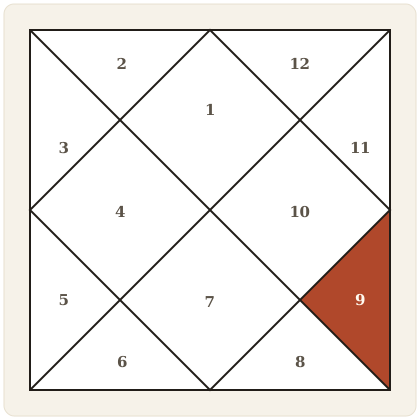
Pitra Dosh is the astrological concept that ties a birth chart to one's ancestors: tradition gives this name to the affliction of the Sun, the significator of father and forefathers, or of the ninth house of father and fortune, by Rahu, Ketu or Saturn. The first and most necessary clarification is this: it is not a curse from the ancestors. The sources that explain it call it an inheritance of unfulfilled duties or unresolved debts, not a curse. This article opens the complete arithmetic of the concept: the chart indicators, the cancellation conditions, what the tradition claims, the practical system of Pitru Paksha, the remedies, and a balanced view that protects against fear-selling.
The concept: the Sun, the ninth house, and the ancestors
In astrology the Sun is the significator of the father and, through him, of the ancestral line; the ninth house is the place of father, fortune and dharma. The tradition's reasoning: when these two centres are afflicted by malefic planets, the chart signals "pitri-rin", an ancestral debt, the weight of unfulfilled duties, unresolved family conflicts or unperformed last rites carried forward by the lineage. In the Hindu tradition honouring ancestors with tarpan offerings is the duty of the line, so the concept stands on that emotional ground. Let it be plain: ancestral or karmic debt is the tradition's belief, not an established or measurable causal link; read it as a belief everywhere in this article. It is also essential to understand that "dosha" here is not an accusation but an idea of inheritance: the ancestors are not at fault; the unfinished business is the subject.
Why the Sun: the arithmetic of signification
The key to the indicator list is signification. Every planet and every house in astrology "signifies" certain subjects. The Sun signifies the father and the ancestral line; the ninth house signifies father, fortune and dharma; the second house signifies the family line. This is why the concept's indicators revolve precisely around these centres, the Sun, the ninth house and its lord, and sometimes the second house. Rahu and Ketu signify eclipses, in which the Sun is "swallowed"; from this imagery the Sun-Rahu conjunction is also called an "eclipse yoga" and treated as the strongest indicator of ancestral debt. Knowing this chain of reasoning frees you from memorising the list: whatever centre is tied to father and forefathers, its affliction is the indicator.
Chart indicators: which placements are called Pitra Dosh
The principal indicators recorded in the sources are: the Sun-Rahu conjunction, especially in the first, fifth, ninth or tenth house, considered the strongest signal; Saturn conjunct, aspecting or exchanging with the Sun; Rahu in the ninth house; the ninth lord debilitated, combust or placed in the sixth, eighth or twelfth house; several malefics in the ninth house without a benefic aspect; and, in some traditions, the Sun and Moon both afflicted at once, since they signify father and mother respectively. One rule matters above all: no diagnosis stands on a single indicator; the whole chart's context is required. This is the same rule that later protects you from fear-selling.
Cancellation conditions: when the dosha is weak or void
Just as important: the tradition also enumerates cancellations. Jupiter's aspect on the ninth house or the Sun; benefics in the ninth house; the Sun in its own sign, Leo, or exalted in Aries; and a lifetime of regular shraddh and tarpan. Any of these is said to weaken or void the dosha. The practical meaning: hearing "there is a Sun-Rahu conjunction" and panicking is a half-reading; if the same chart carries Jupiter's aspect, the tradition itself reads it differently.
Three different things that share one name
The marketplace applies the label "Pitra Dosh" to three different things, and separating them is part of method literacy. First, the chart indication: an affliction of the Sun or ninth house in the birth chart; this is an astrological reading. Second, ritual neglect: shraddh and tarpan not being performed; this is a matter of conduct independent of any chart, and the tradition asks for it to be corrected before any diagnosis. Third, the family pattern: the experience of difficulties repeating across generations; that experience can be real, but reading its cause in a chart is an extra step not everyone takes. When someone says "there is Pitra Dosh", ask: in which sense? The three senses have different answers.
What the tradition claims
Those who accept the concept tie Pitra Dosh to these patterns: repeated career obstacles despite qualification and effort; last-minute reversals at the edge of success; difficulty having children; family, especially hereditary, health problems; financial strain running across generations; discord with father or elders; and delayed marriage. Read all of this as claims, not as proof. These experiences are common enough that almost every family will recognise them, and that is the chief methodological weakness of diagnoses of this kind.
Does it pass down the generations
Those who accept the concept say the karmic debt can run in the line: if a parent's chart shows the indicators, the children's charts may show some indicators too, though by no means necessarily; every chart is unique, and the presence, severity and expression differ from person to person. To this the tradition's rule attaches: regular shraddh and tarpan through one's lifetime are said to lighten the burden falling on coming generations. Read all of this as the tradition's claims. The simpler alternative reading is that circumstances, habits and behaviours genuinely do run in families, and the remembrance rites offer a frame for handling them consciously.
Pitru Paksha: the practical system of shraddh
The concept's practical centre is Pitru Paksha: the fifteen or sixteen days of the waning fortnight of Ashwin, usually September to October, when each tithi carries the shraddh of the ancestors who died on that tithi. The system is simple: every tithi is dedicated to those whose death anniversary it is; the final day, Sarva Pitru Amavasya, is for all whose tithi is unknown. Tarpan, an offering of water and sesame, is made facing south in the names of father, grandfather and great-grandfather; pind daan is performed at pilgrimage sites such as Gaya, Haridwar, Kashi or Prayag. The year's Amavasyas are also counted as days of ancestral remembrance. This system is independent of any chart diagnosis: with or without Pitra Dosh, shraddh is a general rite of remembrance.
How tarpan is done: the basic method
The basic method of tarpan is simple and possible at home. After the morning bath, facing south, black sesame is mixed into water and the water is released slowly from cupped palms or a copper vessel, while remembering the names and lineage of father, grandfather and great-grandfather. Amavasya and, within Pitru Paksha, the death tithi of one's own ancestor are the special days. Those who want the full procedure should follow the family priest or the recognised manual of their region; regional differences are natural. The summary: tarpan is an act of remembrance and regularity, not of expense.
The traditional remedies: remembrance, charity, planting
The tradition's remedies are of three kinds, and all are simple. First, acts of remembrance: shraddh and tarpan in Pitru Paksha; water offerings on Amavasya; recitation of the Pitru Gayatri or Pitru Sukta. Second, charity: food, clothing and dakshina to priests or the needy in the ancestors' names; feeding crows on Saturdays, which tradition regards as standing for the ancestors. Third, a living memorial: planting a peepal, banyan or neem tree and tending it steadily, a living legacy in the ancestors' names. For those who want a special shanti, the Narayan Nagbali at Trimbakeshwar and the pind daan at Gaya are famous; in that case use the temple or pilgrimage site's official arrangements. The sources stress one point: the fruit lies in regularity, not in a one-time puja.
When remedies are done: the calendar of the tradition
The tradition also orders the timing of remedies. The year's most important period is Pitru Paksha, when tarpan and pind daan are said to be especially fruitful; within it, the ancestor's own death tithi is the supreme day. The Amavasyas of the year are the second-rank days, especially Somvati Amavasya. For daily practice there is the custom of offering water to the Sun at sunrise, since the Sun is itself the father-significator. For special rites such as Narayan Nagbali, the tradition names particular tithis and places, and there the temple administration is the guide. One rule stands above all: a regular small act is considered better than one large one-time expense.
A worked example of the reading
Suppose a chart shows the Sun-Rahu conjunction in the fifth house. First question: does Jupiter aspect the Sun or the ninth house? If yes, the tradition itself calls this a cancellation. Second question: is the Sun in its own sign or exalted? If yes, the affliction is considered diminished. Third question: how are the ninth house and its lord? Writing "Pitra Dosh" on the basis of the Sun-Rahu conjunction alone skips all three questions, and that half-reading is what becomes a factory of fear. The order of a full reading is always the same: indicator, then cancellation, then context, and only then any conclusion.
The deeper message: seeing the pattern
The most useful reading of this concept goes beyond ritual. The sources that view it with balance say: the deeper meaning of Pitra Dosh is noticing family patterns, habits running down the generations, broken relationships, repeated mistakes, and repairing relationships with the living elders. If you see a family pattern repeating in your life, then alongside ritual, conscious action and, where needed, counselling are just as important in breaking it. In this reading, "dosha" is not the name of a fear but an invitation to adjustment.
How it differs from the other doshas
Keep the boundary with this series' other dosha articles clear. Kaal Sarp Dosh is the configuration of all seven planets hemmed on one side of the Rahu-Ketu axis, and it is a modern concept; Pitra Dosh is a reading of the affliction of the Sun and the ninth house, rooted in the older signification method. Manglik Dosh concerns the placement of Mars and belongs to marriage matching. Bundling all three into one "dosha" bag tied to one expensive "shanti" is the marketplace's method; in the tradition their definitions, indicators and observances are distinct. A writer or practitioner who cannot state the difference deserves extra scrutiny.
A note on the schools
The sources also differ in detail, and naming that is part of honest reading. Some schools confirm the dosha only when several indicators coincide; some also consult the navamsa chart for confirmation; some weigh the second house of family lineage more heavily than others. The remedy calendars differ by region as well: the tithi system of Pitru Paksha is shared, but the local customs of tarpan, the preferred pilgrimage site and the spoken formulas follow the family or regional tradition. None of this is a contradiction to resolve; it is the usual shape of a living tradition. The practical rule remains the one this series repeats: the list your own family tradition recognises is the one that governs your observance.
What this article does not say
Three limits must be recorded. This article does not say that any chart configuration must bring harm upon a family; there is no demonstrated basis for that. It also does not say the rites are pointless; remembrance, charity and planting carry their own cultural and social value, for which no prediction is needed. And it does not say every "Pitra Dosh" diagnosis should be accepted; the indicators are broad, the cancellations many, and any final conclusion belongs to the whole chart's context, taken with a qualified and disinterested scholar. Within these three limits the concept can be understood, respected and used with ease.
Common confusions
First confusion: Pitra Dosh is a curse from the ancestors. The sources clarify it is an idea of karmic debt, not a curse; the ancestors are not at fault, the unfinished duties are the subject. Second: a Sun-Rahu conjunction alone suffices. One indicator is inadequate; cancellations such as Jupiter's aspect or the Sun's own-sign placement change the reading entirely. Third: remedies happen only at pilgrimage sites. Tarpan, charity and planting happen from home; the pilgrimage puja is a special option, not a requirement. Fourth: only those "with the dosha" should perform shraddh. Shraddh and tarpan are general rites of remembrance, independent of diagnosis.
Practical use
Use this article in three ways. First, as method literacy: the indicator list and cancellation conditions let you test the completeness of any "Pitra Dosh" diagnosis yourself. Second, for planning observances: understand the Pitru Paksha tithi system and plan the shraddh of your ancestors by their death tithis; if the tithi is unknown, Sarva Pitru Amavasya serves. Third, as family reflection: adopt the concept's deeper reading, notice the patterns, repair the relationships; it depends on no claim and is always beneficial.
Sources and the honesty note
The chart indicators, cancellations, claims and remedies come from astronidan.com's Pitra Dosh article; the "not a curse but a karmic debt" clarification, the one-indicator-is-insufficient rule and the deeper family-pattern reading come from synksha.com's Pitra Dosh article; the Pitru Paksha tithi system was checked against drikpanchang.com's shraddh pages. Everything about effects is presented as the tradition's claim. This article is educational; it makes no claim about any person's chart or family.


