Pradosh Vrat: Vidhi, 2027 Dates, Puja Timings and Shani Pradosh
Shiva's fortnightly twilight: the exact 2027 Delhi computation, the sunset window and its vidhi, Soma, Bhauma and Shani Pradosh, both legends with sources, and an honest-limits note.
Twice a month, when the thirteenth tithi meets the twilight, Shiva's evening comes round. Pradosha, from pra, before, and dosha, darkness, is literally the first part of the night, and the pradosha vrata is the bimonthly fast kept in that twilight on both Trayodashis, the bright fortnight's and the dark one's. It is one of the most regular acts of devotion in the Shiva calendar: no season, no year-long wait, just the thirteenth tithi and the sunset. This guide walks the observance as the sources give it: what the word and the day are, the vidhi of the evening, the two definitions of the worship window that the sources genuinely differ on, the named Pradoshas of the week, the full New Delhi list for 2027, the Skanda Purana's cautionary tale of a king who broke his worship, Ujjain's legend of the pillar of light, and an honest-limits note at the end.
The backbone is two sources, both fetched directly for this article: Wikipedia's Pradosha article for the etymology, the legends, the temple observance and the named types, and drikpanchang's 2027 Pradosh dates page for New Delhi for every date, window and tithi span in this guide. Every timing is drikpanchang's computation for New Delhi 2027; other cities will differ, and the almanac itself insists on that difference. Where the sources disagree, including on how the worship window is defined, the disagreement is kept standing and named.
The word, and the two Trayodashis
The Sanskrit is a small lesson in itself: pradoṣa is a compound of pra, before, and doṣa, darkness, so the word means the twilight, the first part of the night, and the observance takes its name from the hour it keeps. Drikpanchang's list confirms what the definition promises: the vrat is observed on both Trayodashi tithis, the Shukla Paksha one and the Krishna Paksha one, in every lunar month, and the page notes that some people distinguish between the two pakshas' Pradosham. In South India, both sources agree, the same observance is Pradosham. The deity is Shiva, and the purpose drikpanchang states is to seek his blessings; the 2027 New Delhi calendar holds twenty-five such evenings, roughly one a fortnight, from 5 January to 25 December.
The window: two definitions, kept side by side
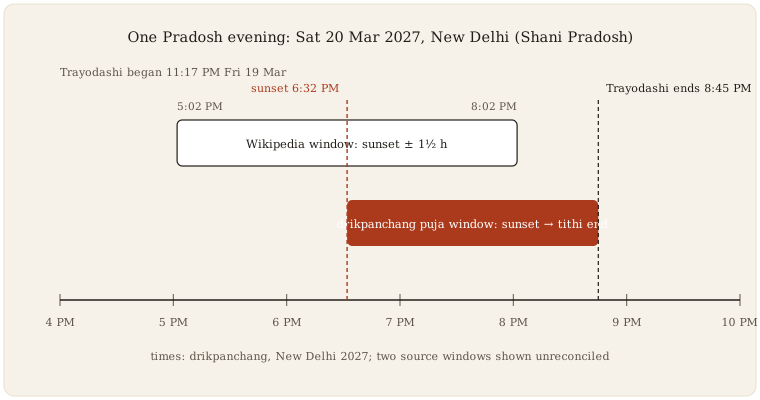
When exactly is the worship done? Here the sources genuinely differ, and the difference is instructive enough to leave standing. Wikipedia describes a three-hour window spanning one and a half hours before and one and a half hours after sunset, with the worship conducted in sandhya kala, the evening twilight. Drikpanchang defines it from the other edge: Pradosh Kaal starts after sunset, the fasting day is fixed when Trayodashi tithi falls during that kaal, and the auspicious puja time is the overlap between the tithi and the post-sunset period, the window the almanac prints for every Pradosham and says should be preferred for the Shiva puja. Worked on a real evening, the difference is visible: on Saturday, 20 March 2027, New Delhi's Shani Pradosh, the sun sets at 6:32 PM, Wikipedia's three-hour window runs 5:02 to 8:02 PM, and drikpanchang's printed window runs 6:32 to 8:45 PM, ending exactly when the Trayodashi tithi ends. The two windows overlap but do not match, and the diagram on this page draws both, each under its source's name.
That sunset anchor has the same consequence the almanac presses for every sunset-tied observance: the day is local. Fasting depends on when the sun sets where you are, drikpanchang says, so two cities in the same state can legitimately observe Pradosh on different days, and the observed day can even be Dwadashi, one day before Trayodashi, when the tithi's timing demands it. The page adds that most sources publish a single list for all cities because location-based lists are time-consuming to generate; that is the page's own claim, and we attribute it to the page. The astronomy underneath it is simply true.
The vidhi of the evening
The observance as Wikipedia records it is compact and physical. Practitioners bathe an hour before sunset and wear rudraksha and vibhuti, the sacred beads and the sacred ash. The vrata itself is fasting followed by a vigil. The worship is of Shiva with his household: the images of Shiva, Parvati, Ganesha, Kartikeya and Nandi are worshipped with an abhisheka, the ritual bath, with sandalwood paste, bael leaves, fragrance, deepas and naivedya, and after the formal worship and invocation, the story of pradosha is recited. In the Shiva temples of South India the evening takes procession form: Nandi, the bull-mount, is worshipped, and the festival idol of Shiva with Parvati seated on Nandi is taken around the temple complex. Drikpanchang adds the practitioner's note for the crowded fortnights: when Ekadashi and Pradosh fall on consecutive days, which happens often, the suggested course is a symbolic Ekadashi parana with only water, continuing the Pradosh without actually breaking the fast, and the page remarks that fasting two consecutive days, though it seems difficult, is quite normal in Hinduism. That suggestion is the almanac's, and we attribute it.
The named Pradoshas of the week
Every Trayodashi twilight is a Pradosha, but three weekdays carry a name of their own, and all three sources agree the names mark auspicious intensifications. Soma Pradosham is the Monday one, the day already sacred to Shiva in the Hindu week. Bhauma Pradosham is the Tuesday one. Shani Pradosham is the Saturday one, and it carries the richest regional legend, the Ujjain story told below. New Delhi's 2027 calendar is generous to the names: four Soma Pradoshas fall on 3 May, 17 May, 13 September and 27 September; five Shani Pradoshas fall on 20 March, 31 July, 14 August, 11 December and 25 December, so the first and last Pradoshas of the year after January are Saturday ones; and two Bhauma Pradoshas fall on 5 January, the year's opening Pradosha, and 12 October. Beyond the week, Wikipedia names one more: Maha Pradosha is the Pradosha observed before or on Maha Shivaratri, the great night of Shiva in the month of Magha.
2027, New Delhi: the year in twenty-five evenings
These are drikpanchang's 2027 Pradosh dates for New Delhi, printed with the puja windows the almanac says to prefer. January opens with Bhauma Pradosh on Tuesday the 5th, 5:38 to 8:21 PM, and Budha Pradosh on Wednesday the 20th, 5:50 to 8:31 PM. February's pair is Wednesday the 3rd, 6:02 to 8:39 PM, and Guru Pradosh on Thursday the 18th, 6:13 to 8:46 PM. March brings Shukra Pradosh on Friday the 5th, 6:23 to 8:51 PM, and the year's first Shani Pradosham on Saturday the 20th, 6:32 to 8:45 PM, the evening in the diagram. April's are both Sundays: Ravi Pradosh on the 4th, 6:40 to 8:58 PM, and again on the 18th, 6:48 to 9:01 PM.
May opens the Soma stretch: Monday the 3rd, 8:03 to 9:06 PM, the year's shortest printed window at about an hour because the Trayodashi ends early that evening, and Monday the 17th, 7:06 to 9:10 PM. June's pair is Wednesday the 2nd, 7:15 to 9:17 PM, and Wednesday the 16th, 7:21 to 9:21 PM. July holds Guru Pradosh on Thursday the 1st, 7:23 to 9:24 PM, the year's latest sunset windows, Thursday the 15th, 7:21 to 9:23 PM, and closes with a Shani Pradosham on Saturday the 31st, 7:13 to 9:19 PM. August gives Shani Pradosham on Saturday the 14th, 7:02 to 9:11 PM, and Ravi Pradosh on Sunday the 29th, 6:46 to 9:01 PM.
September's pair is Soma Pradosham on Monday the 13th, 6:29 to 8:48 PM, and again on Monday the 27th, 6:12 to 8:36 PM. October opens with Bhauma Pradosh on Tuesday the 12th, 5:55 to 8:24 PM, and Budha Pradosh on Wednesday the 27th, 5:40 to 8:14 PM. November's are Thursdays: Guru Pradosh on the 11th, 5:30 to 8:08 PM, and again on the 25th, 5:24 to 8:06 PM. December closes the year with two Shani Pradoshas: Saturday the 11th, 5:25 to 8:09 PM, and Saturday the 25th, 5:31 to 8:15 PM, the year's longest printed window at about two and three-quarter hours. The drift visible in those numbers, from the 5:38 PM window of January out to the 7:23 PM windows of July and back, is simply the year's sunset, because the almanac anchors the kaal to it.
The rhythm of the fortnight
Set beside the year's other Shiva observances, Pradosha is the most frequent by far. Maha Shivaratri comes once, in Magha; the monthly Shivaratri comes twelve times; Sawan's Mondays come four or five; but the Trayodashi twilight comes twenty-five times in a New Delhi year, and in most months twice. The observance therefore works less like a festival and more like a pulse: a small, repeatable evening of bath, ash and beads, fasting, abhisheka and story, tucked between sunset and night. The sources' picture of it matches that scale. Wikipedia's account is of practitioners at home with the household images, and of temple evenings in the South with Nandi's procession; drikpanchang's page is a working calendar of windows and tithis with practical notes about double fasts and drifting sunsets. Neither makes the evening heavy, and that is its character: the thirteenth tithi asks for an hour or two of twilight, twice a fortnight, all year.
Two calendrical details from the almanac are worth keeping because they shape real practice. First, the day-fixing rule: drikpanchang fixes the fasting day not by which civil day holds the most Trayodashi, but by which day's post-sunset Pradosh Kaal the tithi falls in. That is why an evening can sit on Dwadashi by the civil calendar and still be Pradosh. Second, the overlap itself: the printed puja window is the intersection of the tithi's span with the post-sunset kaal, so it can be as short as the 8:03 to 9:06 PM hour of 3 May 2027, when Trayodashi ended early in the evening, or as long as the two-and-three-quarter-hour window of 25 December 2027. The window is not a fixed two hours after sunset; it breathes with the tithi, and the year list above shows it breathing.
Pradosham in the South
Both sources note that in South India the observance goes by Pradosham, and Wikipedia gives the temple shape of it there: the evening is a temple event as much as a household one, with Nandi, the bull who faces every Shiva shrine, worshipped as part of the rite and the festival idol of Shiva and Parvati seated on Nandi taken in procession through the temple complex. The Skanda Purana legend travels with the observance too, and its geography is the Deccan, Vidarbha, which suggests how old and how far south the twilight vow's story runs. For the practitioner, the difference between the names is only a name: the thirteenth tithi, the sunset anchor and the Shiva worship are the same on both sides of the Vindhyas, and the almanac's New Delhi list serves the Pradosham-keeper as it serves the Pradosh-keeper, with the location caveat that the almanac itself repeats.
Keeping the observance, keeping the record
One closing note on how this guide was built, because the sources themselves raise the question. Every date, weekday and window above is drikpanchang's 2027 computation for New Delhi, and the weekday names, Soma, Bhauma, Shani, are the page's own labels, checked by us against the calendar arithmetic rather than copied on faith. Every legend and ritual detail is Wikipedia's retelling of the Puranic and regional material, attributed as such. Where the two stand apart, on the shape of the worship window most of all, the guide prints both versions and chooses neither, because a practice that has lasted this long on a twice-monthly rhythm has room for both a temple-defined twilight and an almanac-defined kaal. The reader who wants the last word on the ritual will find it where the sources themselves point: the family tradition, the temple, and the local priest.
The Skanda Purana's warning: the king who broke his worship
The Skanda Purana, as Wikipedia recounts it, makes the case for the observance by catastrophe. King Satyaratha of Vidarbha was a devout worshipper of Shiva. One Trayodashi evening his pradosha worship was interrupted: a courtier's execution was brought before him, he ordered it, and then dined without completing the ritual. The interrupted vow worked its consequence. He lost a battle, was slain, and his pregnant queen fled the fallen kingdom. She gave birth to a prince by a lake and was killed by a crocodile; the orphan boy was found and raised by a Brahmin woman named Uma, on alms. Years later the sage Shandilya, meeting the boy, revealed to him the karma behind his birth: his father's broken pradosha. The sage taught him the pradosha vrata itself, and the observance restored what the interruption had taken, wealth, grain, family and luck. The story is the Purana's, told as the Purana tells it, and its lesson is the one the tradition draws: the twilight vow is to be kept whole.
Ujjain's legend: the pillar of light on a Saturday
The regional legend Wikipedia records belongs to Ujjain and to the named Saturday observance. King Chandrasena's kingdom was attacked on a Saturday Trayodashi, a Shani Pradosha. As the invaders closed in, a boy named Shrikhar and a priest named Vridhi prayed by the Kshipra river for the city's deliverance. Shiva answered as he answers in such legends: he manifested as a pillar of light, defeated the invaders, and established himself in Ujjain as a svayambhu lingam, the self-manifested Mahakaleshwar, the jyotirlinga the city still worships. The story ties the Saturday Pradosha to one of the twelve great seats of Shiva, and explains, in the way legends explain, why the Ujjain evening of the thirteenth tithi carries a special weight.
Honest limits, and a few practical notes
This section is our own addition, not the sources'. The pradosha vrata is an observance of devotion, and the sources are devotional: the legends promise blessings, and we have recorded those promises as the tradition's words, never as outcomes we vouch for. No fast is a medical event with a guaranteed result, and the usual common-sense exclusions apply: anyone pregnant, ill, elderly, or on medication should take a doctor's advice before fasting, and the almanac's own pragmatic streak, the symbolic water-only parana for the hard double fasts, shows the tradition itself bending for the body. On dates, everything here is New Delhi 2027 as drikpanchang computed it; another city or another panchang may shift a day, and the almanac itself warns that single national lists miss that. Where the two sources define the worship window differently, we have printed both definitions rather than choosing one. And on the sources' own character: Wikipedia's article is thin and partly regional, and drikpanchang is a calendar service, not a scripture; for the ritual itself, the house tradition and the family priest remain the authority the sources themselves assume.
Questions on this article
What is Pradosh Vrat?
A bimonthly fast for Shiva kept on both Trayodashi tithis, bright and dark fortnight alike, with worship at twilight. The name means the first part of the night: pra, before, plus dosha, darkness. In South India the same observance is called Pradosham.
When should the Pradosh puja be done?
The two sources define the window differently and we keep both: Wikipedia describes a three-hour window one and a half hours either side of sunset; drikpanchang says Pradosh Kaal starts after sunset and prints the tithi-and-sunset overlap as the time to prefer for the Shiva puja. On 20 March 2027 in New Delhi those were 5:02 to 8:02 PM and 6:32 to 8:45 PM respectively.
Which Pradoshas are especially auspicious?
The sources name the weekday ones: Soma Pradosham on Monday, Bhauma Pradosham on Tuesday, and Shani Pradosham on Saturday, plus Maha Pradosha, the one before or on Maha Shivaratri in Magha. New Delhi's 2027 calendar holds four Soma, five Shani and two Bhauma Pradoshas.
Can Pradosh fall on different days in different cities?
Yes, and the almanac says so itself. The day is fixed by whether Trayodashi prevails during the post-sunset kaal, which depends on local sunset, so nearby cities can observe on different days and the observed day can even be Dwadashi. Drikpanchang adds that most published lists ignore this because location-wise lists take more work.