Rahu in Vedic astrology: ambition and illusion
Rahu is the shadow planet of ambition, foreign lands and the unconventional. Learn its real astronomy, the Rahu mahadasha, the truth about Kaal Sarp yoga, and simple remedies.
In Vedic astrology Rahu is the strangest of the nine planets: a planet without a body. It is no solid globe and no telescope can show it, yet its seat among the navagraha is firm. Rahu is in fact a point of astronomical arithmetic: one of the two places where the Moon's orbit crosses the Sun's path, the ecliptic. In the tradition Rahu is the karaka of craving, ambition, foreign lands, unconventional paths and technology; in short, of everything that crosses a boundary. This article explains Rahu on three levels: first its real astronomy, then its traditional meanings, and finally the truth about the frightening stories sold in its name.
The actual science first: what are Rahu and Ketu?
The Moon circles the earth on a tilted plane, and the plane on which the Sun appears to circle (the ecliptic) cuts it at two points, called the north and south lunar nodes. In the tradition the north node is Rahu and the south node is Ketu. Their importance is astronomical: solar and lunar eclipses occur only when a full moon or new moon falls near these very points, which is why the Puranas describe Rahu and Ketu as the ones who "swallow" the eclipsed light. This is evidence of the precision of ancient sky-watching. The node points do not stay fixed; they drift backward through the zodiac in about 18.6 years, which is why Rahu and Ketu are called "ever retrograde". In chart arithmetic Rahu and Ketu always stand exactly 180 degrees apart: two ends of one axis.
What is Rahu the karaka of?
In the classical texts and their commentaries Rahu is tied to these subjects:
- Ambition and craving: the thirst to achieve something big; a tendency to push past the boundary of contentment.
- The foreign: travel abroad, foreign people, foreign languages and cultures.
- Technology and novelty: machines, the internet, film and media, and everything outside the old framework.
- Illusion and maya: show, deception and pretence; and also the discernment that escapes them.
- The unconventional: every path that steps outside custom, from inter-caste marriage to brand-new professions.
- Large crowds: the masses, fame, politics and mass media.
Note that Rahu received no universally agreed day, colour or gemstone; different traditions treat it as Saturn-like. That itself is a sign that differences of opinion in Rahu's interpretation are natural.
The traditions disagree on exaltation
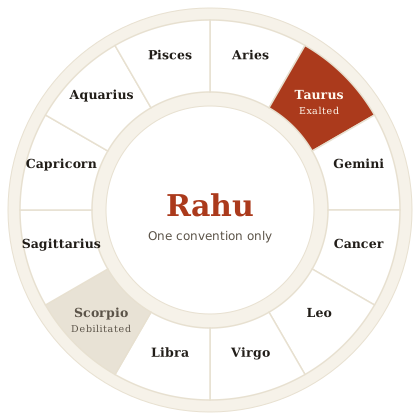
For the seven ordinary planets the exaltation and debilitation signs are nearly identical across texts, but on Rahu and Ketu the traditions split. The main views:
| Tradition | Rahu's exaltation | Rahu's debilitation |
|---|---|---|
| One current view | Taurus | Scorpio |
| Another current view | Gemini | Sagittarius |
| On an own sign | Some teachers count Aquarius as Rahu's own home; some call Rahu a "guest planet" with no own sign | |
We do not stamp any single opinion as final here, for an honest reason: Rahu is a point of arithmetic, not a physical body, so its "strength" cannot be tested by the same ancient method used for the ordinary planets. Different authors drew different conclusions from different experience. In practical reading the difference matters less than it appears, because Rahu's result is read mainly from its house, the condition of its sign-lord, its conjunctions and aspects, and the dasha.
Rahu through the twelve houses, in brief
- 1st: a wish to stand apart; a personality mixing magnetism and restlessness.
- 2nd: a thirst for wealth; impressive speech, unconventional family ties.
- 3rd: counted a good seat for Rahu; courage, media skill, a distinctness from siblings.
- 4th: a bent toward living away from home, or making a home abroad; a mind hungry for new things.
- 5th: unconventional education and creativity; talk of delay in children.
- 6th: a tendency to win in competition; counted among Rahu's excellent seats.
- 7th: talk of an unconventional or foreign partner; managing expectations in partnerships matters.
- 8th: hidden knowledge, research, and a tendency toward sudden rises and falls.
- 9th: building one's own philosophy; interest in foreign beliefs, talk of friction with teachers.
- 10th: ambition and the desire for fame in career; fields of public contact.
- 11th: large income and reach into large groups; counted a good seat for Rahu.
- 12th: talk of residence abroad; imagination and a bent toward liberation, with advice to watch spending.
Wherever Rahu sits, the tradition asks its first question: where is the "thirst" in this house's subjects running? Thirst with a direction is excellence; thirst without direction is restlessness. That is Rahu's core formula.
Rahu and Ketu: two ends of one axis
Reading Rahu without Ketu is reading only half. The two always stand exactly opposite, so in a chart they form an axis: where Rahu inflames thirst, Ketu brings detachment. The tradition's famous formula: Ketu is the door we came in through, Rahu the one we are running toward. So in prediction, Rahu's house tells "where the pull is" and Ketu's house "in which subject there is experience or indifference". The life-lesson is simple: Ketu's side is what we already know (hence the warning of laziness or smugness there), Rahu's side is what remains to be learned (hence both the stumbles and the lessons there). Balance lies between the two: clinging to old skill is as incomplete as losing the roots in a new race.
Rahu's auspicious and afflicted indications
Rahu's result is read through its "lord planet": if the lord of the sign Rahu occupies is strong and well placed, Rahu's fruits are said to grow well. In the traditional friendship list Rahu's friends are Venus and Saturn, its enemies the Sun, Moon and Mars, and Mercury and Jupiter are neutral. The traditional expression of an auspicious Rahu: foresight, the ability to read crowds, initiative in new things, and foreign doors opening. Of an afflicted Rahu: confusion, excess greed, entanglement in addictions, debt for show, and the company of people who talk in crooked lines. The traditional health mentions cover the skin and restlessness of the mind; remember these are traditional indications, and for any symptom the doctor is the first address.
The Rahu mahadasha: 18 years
In the Vimshottari system the Rahu mahadasha runs 18 years, the third longest after Venus (20) and Saturn (19). The tradition views this period as a season of rapid change, ambition and unfamiliar directions. Because Rahu has no settled own-sign base, the result of a Rahu dasha is held to depend more than any other on the sign-lord and the planets Rahu sits with. The lengths below use the schematic 360-day year: 7 × the sub-period lord's years ÷ 120. Calendar dates depend on the calculation settings. The interpretive labels are a symbolic reading, not a schedule of promised events:
| Sub-period | Length | Traditional character |
|---|---|---|
| Rahu-Rahu | 2 years 8 months 12 days | The rise of ambition; pressure to fix a direction |
| Rahu-Jupiter | 2 years 4 months 24 days | May wisdom give guidance; the Guru-Chandal test is also here |
| Rahu-Saturn | 2 years 10 months 6 days | The shrapit-style test; patience and the straight road |
| Rahu-Mercury | 2 years 6 months 18 days | Speed in technology, writing, trade; the intellect needs reins |
| Rahu-Ketu | 1 year 18 days | Both ends of the axis active; talk of major rises and falls |
| Rahu-Venus | 3 years | Growth in comforts and relationships; a test of temptation |
| Rahu-Sun | 10 months 24 days | A thirst for prestige; friction with authority, or advancement |
| Rahu-Moon | 1 year 6 months | Talk of the mind's restlessness; managing emotions |
| Rahu-Mars | 1 year 18 days | A storm of energy; advised caution with risky steps |
As with every dasha, the result is not fixed: Rahu-Venus is foreign success in one chart and a test of luxury in another. Context decides.
Kaal Sarp yoga: the biggest shop of fear
When all seven planets fall on one side of the Rahu-Ketu axis in a chart, the configuration is called Kaal Sarp yoga. More fear-trading has happened in this name than real astrology, so three honest points. First, the combination is common: by plain estimation a large share of charts fall under this definition, and if it were a curse, that share of society would visibly stall, which plainly does not happen. Second, the ancient root texts do not discuss this yoga with anything like its present-day dread; in its current popular outline it is considered a relatively new idea. Third, even the teachers who accept it made its effect depend on planetary strength, house and dasha, and prescribed paths of conduct for its pacification. The conclusion: if this combination appears in your chart, do not panic. And if someone sells an expensive ritual in its name, take a second opinion first. That is our standing advice.
Rahu and modern life
The fields the tradition assigns to Rahu are the fastest-growing of our age: technology and software, film and media, advertising, foreign trade, aviation, politics, and every profession that runs on the attention of crowds. That is why today's astrology students call Rahu "the planet of modernity". But its other face is just as current: screen addiction, the lure of shortcuts, the pressure to show off. In the tradition's language, Rahu-strength is the one that turns thirst into a goal, and Rahu-affliction the one that becomes a slave of thirst. In that sense Rahu's most modern remedy is this: write down the name of the thing you are chasing, and ask every year whether it is still the right direction.
The churning of the ocean: how Rahu came to be
In the Puranas Rahu's origin is tied to the churning of the ocean. At the amrita-drinking line, an asura named Swarbhanu disguised himself and sat among the gods; the Sun and the Moon recognised him, and Vishnu's Sudarshana severed his head from his body. Having already sipped the nectar, both parts became immortal: the head became Rahu, the body Ketu. As the story goes, Rahu and Ketu hold their grudge against the Sun and the Moon and "swallow" them from time to time: the mythical explanation of eclipses. The story's astrological symbol runs deep: Rahu is the head that tasted the nectar but has no stomach; in other words, the thirst that is never quenched. That is why the tradition calls Rahu the planet of "unfinished hunger" and prescribes the practice of contentment as its remedy.
The simple remedies
The tradition's remedies for Rahu's difficult influence:
- Charity: donating coconut, sesame, mustard, blankets and dark blue items, especially on Saturdays; feeding dogs is also tied to Rahu in the tradition.
- Mantra: chanting "Om Ram Rahave Namah"; the recitation of the Durga Saptashati is also linked to Rahu.
- Conduct: avoiding lies and deceit, not deciding under crowd pressure, and holding to one chosen goal; the tradition calls Rahu's remedy "reins on thirst".
- Gemstone: hessonite (gomed) is considered Rahu's stone; its astrological effects are not established, and buying one is not necessary.
Keep in mind that remedies are a support within the tradition, not a guaranteed fix. Big decisions about career, money or health belong first with qualified specialists.
Rahu in the panchang: rahu kaal
In the daily panchang, rahu kaal is the ninety-minute stretch of each day held to be inauspicious for new and auspicious beginnings. It falls at a different time on each weekday, since one of the day's eight parts is assigned to Rahu. Note that rahu kaal does not forbid auspicious work; the tradition treats it only as a signal to postpone fresh starts, while ongoing work continues. Eclipse periods are also tied to Rahu and Ketu, since eclipses occur at those very node points; the tradition counts practice and mantra-japa during an eclipse as especially fruitful.
An honest note
Astrology is a traditional system, not laboratory science. The meanings attached to Rahu rest on centuries of symbolism, and as shown above the traditions themselves do not agree on this planet's exaltation. Take decisions about career, money and health with qualified specialists; treat astrology as context, never the only basis. Sources consulted for this article: the node arithmetic and eclipse geometry from standard astronomical reference; the correspondence table of day, colour, gemstone and dasha years from satyori.com/reference/grahas/ (which also shows both views on Rahu's exaltation); and the Vimshottari dasha year-table at panchangtime.com/methodology/vimshottari-dasha. Our aim is to explain the tradition in plain words, not to sell fear, especially where fear is what is being sold.
Questions on this article
Is Rahu a real planet?
Rahu is not a physical body but the north lunar node, the intersection of the Moon's orbit and the ecliptic. Eclipses occur when a full or new moon falls near these points, which is why the tradition ties Rahu to eclipses.
In which sign is Rahu exalted?
The traditions disagree: one view says Taurus, another says Gemini. We present both; in practice the result is read from the house, the sign-lord and the dasha.
How long does the Rahu mahadasha last?
In the Vimshottari system the Rahu mahadasha lasts 18 years, the third longest after Venus and Saturn.
What is Kaal Sarp yoga, and should one fear it?
When all seven planets lie on one side of the Rahu-Ketu axis, it is called Kaal Sarp yoga. The combination is common, and the root texts do not discuss it with today's dread. There is no need to fear it; if someone sells an expensive ritual in its name, take a second opinion first.


