Rahu Kaal: The Window That Moves with the Sun, the Rule of Eight Parts, and the Clock-Time Misunderstanding
Rahu kaal is not a clock time but a moving eighth of the day: the sunrise-sunset weekday rule, a three-source check, our own worked example, and the real scope of the avoidance.
Rahu kaal is the best-known "bad time" in the daily panchang, and also the most misunderstood. The misunderstanding is that people take it for a fixed clock time, like 7:30 to 9:00 on Monday, when our sources say in one voice that it is not a clock time but a fraction of the day. Wikipedia's definition: Rahukala is an inauspicious period of the day, not considered favourable for starting any good work, and it lasts about an hour and a half each day between sunrise and sunset. panchangtime makes it plainer on its methodology page: Rahu Kalam does not depend on where Rahu is in the sky; it is a fixed day-division rule that splits the day into equal parts. This article examines that rule in full: the eighth-part method, the weekday table, why the clock time moves, three worked day examples, the status of the inauspiciousness and its limits, the myth layer behind the name, and how to read the information.
The rule: one eighth of the day
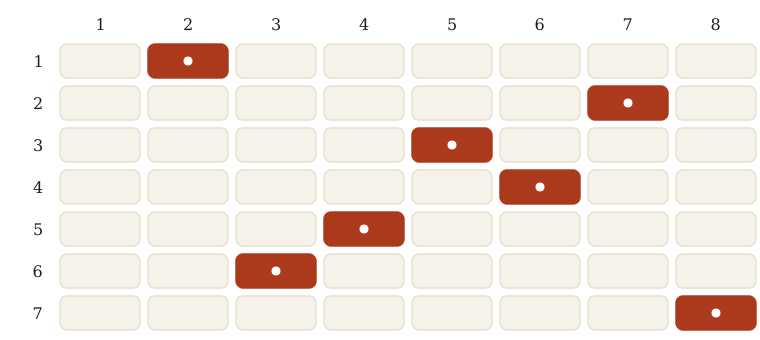
The method has three steps, in panchangtime's words. Step one: take the true day for your city and date, meaning local sunrise to local sunset. Step two: divide it into eight equal parts; each part is one eighth of daylight, so it is longer in summer and shorter in winter. Step three: the weekday decides which part is Rahu kaal. astrojyoti adds an important boundary rule: on no weekday does Rahu kaal fall in the first part of the day. And the order of which part belongs to which day is the same in both sources: Monday the second part, Tuesday the seventh, Wednesday the fifth, Thursday the sixth, Friday the fourth, Saturday the third, and Sunday the eighth. Wikipedia gives the same order. The rule is fully determinate: neither the date nor the month changes the order; only the clock time of the part changes, because the length of the day changes.
One honest note about the exemption of the first part: the rule is recorded in both sources, but no consulted source explains it; why the first eighth of the morning is always free of Rahu kaal is not in our pages. What is recorded is the rule itself, and its use for a reader: if any table shows Rahu kaal in the first part, it was not built from the rule our sources describe.
Why a fraction, not a clock time
Printed tables often list Rahu kaal with fixed clock times, and Wikipedia's page also gives its current list that way: Monday 7:30 to 9:00 in the morning, Tuesday 3:00 to 4:30 in the afternoon, and so on. But the page itself says this computation assumes a twelve-hour day, 6 a.m. to 6 p.m. The real rule, as both other sources stress, runs on the true length of the day, so Rahu kaal is never a fixed clock time: panchangtime writes that on a single long summer day the late-afternoon Rahu Kalam becomes shorter and earlier in winter, and that on a single date two cities have different times; astrojyoti advises computing it daily from the local sunrise and sunset printed in local newspapers. So a printed clock table is a convenience approximation: it sits correctly for that place, that season, that sunrise convention; change the place or the season and the rule, not the table, is what will work.
Wikipedia's current list, built on the 6-to-6 twelve-hour day, reads in full: Monday 7:30 to 9:00 a.m., the second part; Tuesday 3:00 to 4:30 p.m., the seventh part; Wednesday 12:00 noon to 1:30 p.m., the fifth part; Thursday 1:30 to 3:00 p.m., the sixth part; Friday 10:30 a.m. to 12:00 noon, the fourth part; Saturday 9:00 to 10:30 a.m., the third part; and Sunday 4:30 to 6:00 p.m., the eighth part. You can check this table's arithmetic yourself: a twelve-hour day, a 90-minute part, Monday's second part starting 90 minutes after sunrise, that is 6:00 plus 90 minutes, 7:30; every row repeats the same rule. This cross-check is ours, and it is also the method for testing any printed table against its local sunrise.
Three days, three parts: the astrojyoti table
This restlessness of the rule is visible at a glance in astrojyoti's three-example table. First example: sunrise 6 a.m., sunset 6 p.m., a twelve-hour day, an eighth of 90 minutes; on this day Rahu kaal is the famous time, Monday 7:30 to 9:00. Second example: sunrise 5:58 a.m., sunset 8:14 p.m., a fourteen-and-a-half-hour day, an eighth of 107 minutes; now Monday's Rahu kaal is 7:45 to 9:32. Third example: sunrise 6:36, sunset 6:10, an eleven-and-a-half-hour day, an eighth of 87 minutes; now Monday's Rahu kaal is 8:02 to 9:30. All three examples come from the same source table. Notice that three things changed: the length of the part, the start time, and the end time; what did not change is the part number, the second part, because that is bound to the weekday. This same table also proves the claim panchangtime makes in its questions section: Rahu kaal is not always 90 minutes; 90 minutes appears when the day is about twelve hours long.
A worked example, our own computation
Run the rule on an imaginary winter day. Suppose on some Friday sunrise is 7:10 a.m. and sunset 5:30 p.m.; the day's length is 10 hours 20 minutes, that is 620 minutes. The eighth part: 620 divided by 8, 77.5 minutes. Friday's Rahu kaal is the fourth part, so the start comes after three parts: 7:10 plus 232.5 minutes, that is 11:02:30; and the end 77.5 minutes later, exactly 12:20. So on that imaginary Friday Rahu kaal runs 11:02:30 to 12:20, 77.5 minutes long, not an hour and a half. This whole example, date, city and times, is our own computation repeating the rule of the sources above; it is not an actual day quoted from a panchang. For comparison, look back: in the same source table the summer long day made this part 107 minutes; the winter-summer difference alone is 29.5 minutes, and this is why a plan pinned to a fixed clock time misses as soon as the season turns.
The panchangtime Chennai example
A real-date source example is also on record. panchangtime shows on its methodology page the computation for Chennai, Monday 12 October 2026: sunrise 5:58 a.m., sunset 5:52 p.m., a day of 11 hours 53 minutes; the eighth part about 1 hour 29 minutes; Monday's second part, so Rahu kaal 7:28 to 8:57 a.m. The same page derives two more periods from the same eight parts: Yamaganda the fourth part, 10:26 to 11:55, and Gulika the sixth part, 1:25 to 2:54; that is, this eight-part method is a shared machine for three periods, not for Rahu kaal alone, and Yamaganda and Gulika are the subjects of our next articles. In this example too the part is 89 minutes, not 90, because the day was seven minutes short of twelve hours.
What is avoided, and what is not
The scope of the inauspiciousness is clear in our sources. Wikipedia: this period is strictly avoided when calculating muhurta, but regular activities already under way can be continued during it. panchangtime: the rule applies to starting new, auspicious or important work, such as signings, journeys, purchases, the opening of a ceremony; routine and ongoing activities are not affected; and some traditions even use Rahu Kalam for remedies related to Rahu, though general muhurta practice is to avoid it. In other words, this window concerns beginnings, not continuations; and its status is the same as recorded in our yoga and karana articles: this classification is the tradition's evaluation, not an astronomical event; Rahu kaal is made by the day-division rule, not by Rahu's position in the sky. panchangtime also states its computation policy openly: there the eighth part is computed from Swiss Ephemeris true positions with the Lahiri ayanamsa, and the rule is said to be taken from the standard muhurta literature, Kalaprakashika and Muhurta Chintamani; we have not opened those books ourselves, that is the page's own reference, recorded as an indirect citation.
In practice this avoidance is one pass in a daily trimming process. panchangtime explains that in its daily evaluation they subtract Dur Muhurtam and Varjyam along with Rahu Kalam, Yamaganda and Gulika, and an hour that is otherwise excellent is dropped if it falls inside Rahu Kalam. That sentence shows two things: first, Rahu kaal is not the only trimming, but one of several inauspicious windows; second, the system is prohibitive, meaning it tells you when not to act, while when to act is decided by the separate count of auspicious windows. Among these other windows, Varjyam is a different machine: according to astrojyoti, for each nakshatra a forbidden period of 4 ghatikas, that is 96 minutes, falls a fixed number of ghatikas after its beginning, and the source page lists those ghatika numbers for all twenty-seven nakshatras; Varjyam is nakshatra-based, Rahu kaal is day-based, the two machines are different, and a full examination of Varjyam is beyond this article's scope.
The myth layer behind Rahu
The story behind the name is also on record in the sources, as story. According to Wikipedia, Rahu is one of the navagrahas, a shadow planet and the king of meteors; in the Samudra Manthana story an asura named Svarbhanu drinks the nectar disguised as a deva, is caught, and is cut in two by Vishnu's Sudarshana Chakra; the two pieces became Rahu and Ketu. Rahu is considered a fierce planet that swallows the Sun, and the period believed to be under its influence is called inauspicious. This myth layer is an explanation of the name: the part of the day handed over to Rahu, Rahu's time. But it has nothing to do with the computation layer: nowhere in the eight-part method does Rahu's celestial position enter; this is why Rahu kaal does not change even when Rahu's actual transit position changes, only with sunrise-sunset and the weekday.
The name circulates in several spellings too: Rahukala, Rahukalam, Rahu kaal, and Rahu kalam in the pronunciation tradition common in South India; Wikipedia records both Rahukala and Rahukalam, and astrojyoti lists popular forms such as Rahukalam, Rahu kalam and Rahu kal as well. One more note on the astronomy layer: panchangtime calls Rahu the Moon's north node and one of two chhaya grahas; shadow planet here means that Rahu is not a solid body but the intersection point of the lunar path and the ecliptic, this is the traditional texts' figure, and modern astronomy likewise treats the node as a point.
How to read Rahu kaal: three questions
Reading Rahu-kaal information is a matter of three questions. First: what sunrise-sunset is this table built on? If it is a 6-to-6 convenience table, it is an approximation; the correct time comes from your own city's sunrise and sunset that day, dividing the day into eight. Second: which part is today? The weekday fixes the part, in the order in the table above; and on no day is the first part ever Rahu kaal, a check-rule that helps test a table's truth. Third: what must be avoided? New, auspicious or important beginnings; ongoing regular work is not, a limit on which both principal sources agree. After these three, remember one consistency: the same eight-part method also yields Yamaganda and Gulika, so on a page that prints Rahu kaal those two will be printed too in their own parts; all three tables come out of the same day-division.
One more practical check: on whichever panchang page or app you read Rahu kaal, look at its city setting. Since the rule runs on local sunrise and sunset, a page set to another city will show you a wrong time even if its rule is right; panchangtime gives exactly this reason for why two cities have different Rahu kaals on the same date. And finally a caution about assumptions: the static clock tables circulating on the internet, which never ask for city or date, are approximations built on the 6-to-6 convention; read them within their scope, not as a universal rule.
In sum, Rahu kaal is a moving window: growing and shrinking with the Sun, sliding with the city, but fixed to the weekday. The rule fits in one line: divide the day into eight and mark out the day's own part; the clock time comes out new every day; and the inauspiciousness is a tradition-assigned label applying to new beginnings inside that window. Remember the rule, do not lean on the clock table, and test any table with the first-part check.
Questions on this article
Does Rahu kaal fall at the same clock time every day?
No. Rahu kaal is a fraction of the day, not a clock time: the day from sunrise to sunset is divided into eight equal parts, and the weekday decides which part is Rahu kaal. Since sunrise and sunset shift with place and season, the clock time shifts with them, every day and in every city. Printed tables are a convenience approximation, not the rule.
Should ongoing work be stopped during Rahu kaal?
The tradition’s scope is new beginnings: auspicious starts, journeys, agreements or any fresh undertaking are moved out of that part. Work already in progress, the job or the studies continue as usual in the same reading; the sources present Rahu kaal as a rule about starting, not a stop sign for the day’s ordinary work.
Why does Rahu kaal depend on the city?
Because the rule rests on sunrise and sunset, and both shift with latitude, longitude and date. A Chennai Monday and a Delhi Monday keep the same ordinal part (the second), but their clock times differ. That is why the sound method is to compute from your own place’s sunrise and sunset, not to borrow another city’s printed table.
Does Rahu kaal track Rahu’s actual position in the sky?
No. panchangtime says plainly on its methodology page that Rahu Kalam does not depend on where Rahu is in the sky; it is a fixed day-division rule. Rahu itself is a shadow point, the Moon’s north node, and Rahu kaal is counted from the Sun’s day cycle, not from the node’s astronomical motion.


