Types of Raj Yoga: The Kendra-Trikona Grammar and Its Seven Forms
Saying "there is a Raj Yoga" is easy; the tradition's actual rule system, in which half the ascendants have their own yogakaraka planet and the cancellation conditions are explicit, with sources.
In the market language of astrology, "Raj Yoga" is the best-selling word: from chart reports to advertisements, it is handed out like a guarantee of power, position and wealth. The tradition's actual rule system is far more structural, and far stricter. Raj Yoga is not one combination but a whole category whose unit of grammar is "the connection of lords"; and the same tradition also writes explicit cancellation conditions, which the advertisements never quote. The astrosight.ai source article admits at the end: in a weak form a Raj Yoga turns up in most charts, but a strong, operative Raj Yoga belongs to a minority. This article opens that entire rule system: the kendra-trikona principle, the verses of the texts, the yogakaraka arithmetic, the seven types, and the conditions of cancellation.
The grammar: two groups, four connections
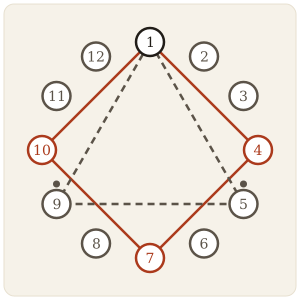
Of the chart's twelve houses, four are kendras (1, 4, 7, 10), the pillars of life: self, home, partner, career; and three are trikonas (1, 5, 9), the houses of dharma and fortune. The first house belongs to both groups, and that is why the lagna lord is the pivot of Raj Yoga analysis. The figure above shows both groups. The rule of Raj Yoga: a connection forms between the lords of these two groups. Per astrosight.ai, four doors of connection are admitted: conjunction (in one sign), exchange (each in the other's sign), mutual aspect, and one planet in the other's sign receiving its aspect. Note, this principle operates not between planets but between lordships: a Mars-Saturn conjunction is not by itself a Raj Yoga; it becomes one only when those planets rule a kendra and a trikona for that ascendant. This is what makes Raj Yoga ascendant-relative: the same conjunction is a Raj Yoga in one lagna, ordinary in another.
The textual root: Laghu Parashari and Uttara Kalamrita
Two direct textual sources for the principle are available at learning.astro-fusion.com with verse and translation. Laghu Parashari 2.14: "kendratrikonapatayah sambandhena parasparam, itarairaprasaktasced visesaphaladayakah", that is, when the lords of kendras and trikonas are mutually related and unassociated with inauspicious lords, they bestow extraordinary results. Note the condition "unassociated": even the pure Raj Yoga demands separation from other, inauspicious lords. And 2.15 goes further: if the lords are themselves blemished yet strong, the relationship alone makes them yogakarakas, meaning the condition is one of strength, not of spotlessness. Uttara Kalamrita 4.1 calls the conjunction "the bestower of supreme sovereignty", and 4.2 defines the yogakaraka: one planet ruling both a kendra and a trikona gives royal results by itself. We have taken these quotations from that very page; we have not opened the text editions ourselves.
The yogakaraka arithmetic: half the ascendants have their own planet
Uttara Kalamrita 4.3 lists three pairs: Saturn is the yogakaraka for Taurus and Libra, Mars for Cancer and Leo, Venus for Capricorn and Aquarius. We checked this with our own lordship count: for Libra ascendant, for example, Saturn rules both Capricorn (the fourth house, a kendra) and Aquarius (the fifth house, a trikona), so one planet represents both groups; the same logic holds for the other five lagnas, and for the remaining six (Aries, Gemini, Virgo, Scorpio, Sagittarius, Pisces) no single planet holds the dual lordship. The conclusion: six of the twelve ascendants, exactly half, have a single-planet yogakaraka. This arithmetic carries a graceful consequence: Saturn, called the "worst" planet in popular speech, is the finest yogakaraka for Taurus and Libra; a planet's benefic or malefic nature is not fixed but ascendant-relative. This lesson of "natural versus functional nature" is the first step of Raj Yoga reading.
The seven types: a practical taxonomy
The astrosight.ai article counts seven forms; we present them as claims. First, the classic kendra-trikona lord connection, the root rule above. Second, an exalted planet in a kendra: a planet in its exaltation sign seated in a kendra gives a Raj-Yoga-like result even without a lord connection. Third, exchange: a kendra and a trikona lord swapping signs; Uttara Kalamrita 4.4 calls this "supreme". Fourth, aspect-based: connection by aspect alone, without conjunction or exchange. Fifth, the conjunction of the fifth and ninth lords: the two trikona lords meeting also yields a Raj-Yoga-level result, sometimes called "Maha Bhagya Yoga". Sixth, the strength of the lagna lord: the lagna lord in own sign, exaltation or a kendra-trikona, free of malefic influence, gives a Raj-Yoga-like result alone. Seventh, the compound: several benefic connections forming a reinforcing network; per the source, historically powerful charts show not a single but multiple interlinked Raj Yogas.
The reversal Raj Yogas: Vipareeta and Neecha Bhanga
Two categories run on reversal. Vipareeta Raj Yoga: when the lord of the sixth, eighth or twelfth house sits in another dusthana, damage cancels damage and a rise follows; Uttara Kalamrita 4.5 is the verse on this, although in the astro-fusion translation the three components appear under the names "Hari, Shri and Pralaya", whereas modern reference lists (such as the table at vedicdream.com) call them Harsha (the sixth lord), Sarala (the eighth) and Vimala (the twelfth); we could not verify which reading belongs to which edition, so both namings are on record, and a fuller analysis comes in later articles of this cluster. Neecha Bhanga Raj Yoga: when the dispositor of a debilitated planet stands in a kendra from the lagna or the Moon, "the debility breaks and turns into Raja Yoga", Uttara Kalamrita 4.6; the tradition reads this as the structure of a rise after initial struggle. Both categories show one principle: in this tradition even a "bad" placement can reverse by structural rule.
The wider family of named yogas
Around the kendra-trikona root the tradition has built dozens of named yogas. The reference table at vedicdream.com lists the prominent ones, as claims: Lakshmi Yoga (the ninth lord strong in a kendra-trikona with the lagna lord strong), Saraswati Yoga (Mercury, Jupiter and Venus in a kendra-trikona or the second, with Jupiter strong), Chamara Yoga (the lagna lord exalted in a kendra with Jupiter's aspect), Akhanda Samrajya, Kahala, Bheri, Mridanga, Sreenatha; and Uttara Kalamrita 4.7 calls the Moon-Mars combination a yoga of wealth and commercial success, which the wealth-yoga article of this cluster takes up in detail. The purpose of this list of names is not memorisation but showing a pattern: nearly every named yoga is a specific instance of the same kendra-trikona grammar, usually with the extra condition "the lagna lord strong". The names bring nothing new; the conditions do.
Cancellation and strength: when a Raj Yoga does not run
Now the part the advertisements skip. Laghu Parashari 2.22: if the lords of the ninth and tenth also own the eighth and eleventh (as happens in some lagnas), the native does not obtain the yoga merely from their relationship, meaning even a top yoga like Dharma-Karmadhipati can be broken by a lordship blemish. The strength list (astrosight.ai): the yoga-forming planets in own, exalted or friendly signs; not combust; free of malefic aspect; the yoga seated in a kendra-trikona; the lagna and lagna lord themselves strong; and the Saravali rule that the dispositor of the yoga-forming planets must also be strong. The weakness list is its exact inverse, plus one subtlety: if the yogakaraka's dasha arrives in childhood or extreme old age, the tradition itself counts its material results as limited, meaning the right yoga at the wrong time is nearly useless.
Dasha timing: when the yoga fructifies
Laghu Parashari 2.18 says directly: the yoga generally fructifies in the dashas of the yogakaraka planets; and a graceful extension: even a benefic unconnected with them, if its dasha falls between the two yogakarakas' periods, gives yoga results. Verse 2.19 goes further: even malefic planets related to a yogakaraka deliver yoga-born results in their own sub-periods. From this comes a reading rule: a Raj Yoga report without the dasha sequence is incomplete. A yoga that does not arrive in the dashas of your productive years is counted by the tradition itself as delayed or weak; and this is why the experienced reader's first question after "there is a Raj Yoga" is "when".
The minority truth: how common a strong Raj Yoga is
Here is the honest point of the tradition analysis. With the generosity of the aspect rules, kendra and trikona lords manage to connect in one form or another quite often; astrosight.ai itself writes that "most charts contain at least a weak form of Raj Yoga". If the popular promises were true, most people would stand at summits of power and prestige. The source's next sentence is the correct scale: a strong, operative Raj Yoga, with the planets strong, unafflicted and the dasha apt, is present in a minority of charts. There is no measured figure for this proportion; we present no modelled figure either, because the generous definitions of "connection" defeat any simple model. But the direction is clear: the more conditioned the yoga, the rarer; and saying "you have a Raj Yoga" without the strength-cancellation-dasha checks is little more than announcing a common condition.
Two worked examples
First example, Libra lagna: list the lords: the lords of the kendras 1, 4, 7, 10 are Venus, Saturn, Mars, Mercury respectively; the lords of the trikonas 1, 5, 9 are Venus, Saturn, Mercury. Venus, ruling the first, represents both groups; Saturn alone rules both a kendra (4) and a trikona (5), the yogakaraka; Mercury here rules only a trikona (9). Now if the chart shows a Saturn-Mercury conjunction, that is a connection between the kendra-and-trikona lord (Saturn) and a trikona lord (Mercury): a Raj Yoga, and if Saturn sits in its own sign Capricorn or Aquarius, the tier rises. Second example, Aries lagna: the ninth lord is Jupiter, the tenth lord is Saturn; their conjunction or mutual aspect forms the Dharma-Karmadhipati Yoga, but check the 2.22 cancellation condition: here Saturn also rules the eleventh, so the lordship blemish is present, and per the source rule this yoga will be weaker than its pure form; that is precisely the subtlety that popular lists skip. Both examples show that "identifying the type" is only the first step; the second step is the cancellation test. A third, smaller conclusion follows too: half of Raj Yoga reading is making the list for your own lagna; the day you can name your ascendant's kendra and trikona lords from memory, testing most popular claims becomes a matter of seconds.
Common confusions
First confusion: Raj Yoga means becoming a king. The tradition today reads it as authority within a field: an institution, management, teaching, art, recognised leadership anywhere. Second: one yoga is enough. The sources show strong charts carrying several interlinked yogas; a single weak yoga's result is limited. Third: Saturn and Mars cannot make a Raj Yoga. Laghu Parashari 2.15 and 2.19 both say the opposite: a blemished but strong lord still becomes a yogakaraka, and a malefic related to a yogakaraka delivers yoga results in its sub-period. Fourth: with a Raj Yoga present, dasha is no worry. Verse 2.18 makes timing a condition of fructification. Fifth: "Raj Yoga is rare" is a selling argument. The weak form is common; the rare thing is the strong form, and that is decided by examination, not by the name.
Practical use
Use this article in three ways. First, for self-reading, with astrosight.ai's seven-step method: identify the lagna; list the kendra and trikona lords; any planet on both lists is a yogakaraka; then look for connection through the four doors; grade each connection's strength (sign dignity, combustion, malefic contact, dispositor); and finally match the dasha sequence. Second, for testing claims: on hearing "there is a Raj Yoga", ask three questions: which lords, by which connection, and were the cancellation conditions (especially lordship blemishes like 2.22) checked. Third, for expectation management: read Raj Yoga as a structure of potential, not as proof of destiny; remember the minority status of the strong form, and treat any "guaranteed Raj Yoga" offer as marketing.
Sources and the honesty note
The verses of Laghu Parashari chapter 2 (14-22) and Uttara Kalamrita chapter 4 (1-8), text and translation, are from the scripture pages at learning.astro-fusion.com; we have not opened the text editions ourselves, and these quotations are that source's. The seven-type taxonomy, the four connection doors, the strength and weakness lists, the ascendant-specific examples, the dasha reading, and the "weak in most, strong in a minority" admission are from astrosight.ai. The Harsha-Sarala-Vimala names and the other named yogas are from the reference table at vedicdream.com. The six-lagna yogakaraka count is our own lordship check, which agrees with Uttara Kalamrita 4.3. The naming divergence of the Vipareeta components (Hari-Shri-Pralaya versus Harsha-Sarala-Vimala) we could not verify; both forms are recorded. Everything about effects is presented as the tradition's claim; there is no established measured link between any yoga and life outcomes. This article is educational; it makes no claim about any person's position, power or future.


