Sagittarius (Dhanu): The Aim of the Zodiac
Dhanu is the mutable fire that travels: Jupiter’s sign, whose arrow aims at the stars and which cannot be pushed, only persuaded. From the classical verse to the modern sign profile, the art of freedom and the challenge of staying put, with sources, and with an honest-limits note.
From the depths, an arrow rises. The ninth sign, Dhanu, is thirty degrees of mutable fire, the archer of the zodiac, and the sign Satyori's Dhanu guide describes as the seeking of truth, wisdom and higher meaning, the centaur whose animal body is directed by philosophical vision, aiming its arrow at the stars. This article audits that aim in full: the sign's structure, the classical verse on a Sagittarius Moon, the ruler of increase and a telling pair of empty chairs in the exaltation table, the traditional tendencies in personality, career, relationships and health, and at the end an honest-limits note.
Everything below comes from sources fetched on 31 October 2026: Satyori's Dhanu rashi guide, the seventeenth chapter of the Brihat Jataka as published at VedicPupil, which we read directly in that page's English translation, Wikipedia's Sagittarius article for the tropical-sidereal gap and the archer's history, and Panchangtime's Vimshottari dasha guide for Jupiter's period. Where a claim belongs to one of them, we say so; where a note is ours, we mark it. Sign description is the tradition's framework; we give it as description, not diagnosis.
The ninth cell: the structure
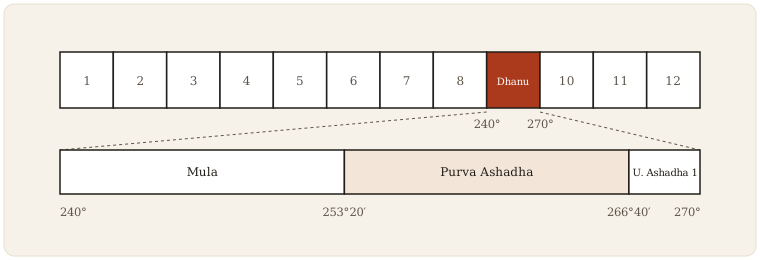
Dhanu is the ninth sign of the zodiac, from 240 to 270 degrees. Its symbol is the archer, the centaur, and the Satyori page reads the symbol precisely: the centaur, half human and half horse, represents the integration of instinct with higher intelligence. Its element is fire, its character Dwiswabhava, mutable, and its ruler is Jupiter; a mutable fire sign carries flame that travels, enthusiasm joined to adaptability, a nature at once passionate and philosophical. In the Vedic mapping of the Kalapurusha, the cosmic person of time across whose body the twelve signs lie, Dhanu is the thighs and the hips: the part that strides, the body's own equipment for the long road. The guide ties the sign to the ninth house of dharma, fortune, father and higher learning, and names its figures: the guru, the pilgrim and the natural philosopher.
Three nakshatra segments fall within Dhanu: all of Mula, all of Purva Ashadha, and the first pada of Uttara Ashadha. Each nakshatra spans 13 degrees 20 minutes of the zodiac, so Mula runs from 240 to 253 degrees 20 minutes, Purva Ashadha from there to 266 degrees 40 minutes, and Uttara Ashadha's first quarter to 270; the arithmetic is ours from the standard nakshatra division. So two people both called Dhanu may carry different nakshatras inside the same rashi, and the nakshatra has its own weight in a reading. This collection carries detailed introductions to all twenty-seven nakshatras, including Mula, Purva Ashadha and Uttara Ashadha; here it is enough that the rashi sets the frame and the nakshatra the finer shading within it.
One more boundary line matters. In Indian usage the word rashi usually means the Moon sign, the sign the Moon occupied at the birth moment. The classical chapter we quote below is titled exactly that, Chandrarashishila, the natures of the Moon signs. For Dhanu there is a fine tension in this: the mind's planet in the sign of the far target, the inner life aimed outward. A chart also holds the lagna, the sign rising on the horizon, and the Sun's sign; the three carry different significations. And Satyori adds in its own line that the condition of Jupiter in your chart strongly influences how Dhanu expresses in your life. A rashi is one axis, not the whole picture.
Dhanu and Sagittarius: two scales, one sky
In Western astrology Sagittarius is the same ninth sign: the archer, the fire element, the mutable quality, Jupiter as ruler; per Wikipedia's table, the Sun transits tropical Sagittarius from 22 November to 21 December in 2026, and approximately between 23 November and 21 December on average. But the tropical zodiac is tied to the equinox point, while the Vedic sidereal zodiac is tied to the stars. Satyori puts the ayanamsha gap between them at about 24 degrees. The practical result: a person whose Western sun sign is Sagittarius may have Dhanu as their Vedic rashi, or Vrischika; it is not the date that changes but the scale. This article speaks of the Vedic Dhanu, and for date boundaries rely on your own panchang or chart calculation.
The archer's story is a story of the unerring aim. Per Wikipedia, as an archer Sagittarius is said never to fail in hitting the mark, a depiction that alludes to the power of prophecy; hence the old claim that seers and prophets are born in this sign. The figure himself sits between kinds: shown as an archer he is classed human, as a centaur bestial, and the tradition shrugs at the difference, saying the classification carries no practical consequence for interpretation. Perhaps because the point is the aiming, not the archer. The series has by now met a ram who carried gold, a bull who guarded a heaven, twins who divided immortality, a crab who asked pardon, a lion set by Zeus, a maiden who left a corrupted age, scales weighed free of a scorpion's claws, and the scorpion itself; now the arrow leaves the animal half behind entirely and points past the zodiac altogether. The Satyori page reads the same figure from the inside: instinct integrated with higher intelligence, the horse's body directed by the human's sight.
The classical Sagittarius Moon: Brihat Jataka
Varahamihira's Brihat Jataka, a mid-first-millennium Jyotish text, devotes its seventeenth chapter to the natures of the Moon signs, and its line for Dhanu reads: with a long face and neck, having his father's wealth, generous, a poet, vigorous, a speaker, with thick teeth, ears, lips and nose, active in work, knowing crafts, with bent shoulders, poor nails, well-fleshed arms, bold, knowing dharma, hostile to relatives; he does not yield to force but is won over only by conciliation.
In plain terms: this is the generous antagonist, and the verse gives the sign of higher meaning a quarrelsome elbow. The list of gifts runs long, poet, speaker, craftsman, vigorous, generous, knowing dharma, and then the verse drops its counterweight: bandhu-dvit, hostile to relatives, the warm-hearted preacher at war with his own family. And the closing line is the sign's whole character in one stroke: force gets nowhere with him, but conciliation wins him entirely; you cannot push the archer, you can only persuade him. The fetched translation carries its own textual note on that line: the text reads vamsha, lineage, where vasham, control, is expected; as with the notes this series has kept visible in other signs, we keep the flag flying rather than smooth it. A small crack in the manuscript, left open, through which the verse's meaning still passes: his own people cannot make him yield, yet a soft word can.
The same chapter already holds the most useful hedge inside itself, the one we have quoted before in this series: verse 17.13, which says these twelve Moon-sign natures hold when no other planet or condition in the chart affects that sign; otherwise the marks change. The tradition said first that its portraits are not verdicts. The twelve Moon-sign verses are twenty-eight lines among the chapter's four hundred and nine; that says how old these figures are, and also how much else the book contains.
The ruler of increase, and two empty chairs
Dhanu's ruler is Jupiter, the great benefic, and the exaltation table here keeps two chairs empty: per Satyori's Dhanu guide, no planet is exalted in this sign, though Ketu is exalted in Dhanu per some traditions, and no planet is debilitated here, though Rahu is debilitated per some traditions. Both entries carry the hedge, and we keep both hedges standing exactly as the source wrote them; the nodal exaltations are one of the tradition's open disputes, and the page shows the dispute rather than settling it. What the table leaves open, the dasha table fills: per Panchangtime's Vimshottari guide, Jupiter's mahadasha runs 16 years, second only to Venus's 20 and beside Mercury's 17, set against the Sun's 6, the Moon's 10 and Mars's 7. The teacher's period is one of the longest; expansion, it seems, takes time.
Temperament, work and relationships: the tradition's map
The descriptive tradition seats Dhanu on the long road, and names the price of walking it. Satyori's traits: optimistic, honest sometimes to a fault, and genuinely enthusiastic about life's possibilities, with a natural moral compass and a deep sense of fairness that extends beyond personal relationships to philosophical principles. Their love of freedom can manifest as restlessness and an inability to commit to one path, place or person for long; the page names the growth edge plainly: depth sometimes requires staying put. And the calling cuts both ways: when it is authentic, these natives inspire genuine growth in others; when it becomes dogmatic, they preach rather than teach. In careers the descriptive tradition places them in education, law, publishing, philosophy, religious leadership, international business and travel-related fields; they make outstanding professors, lawyers, publishers and spiritual teachers, and struggle in careers that feel morally compromised or intellectually constraining. Satyori's own hedge stands here too: career outcomes depend on the tenth-house lord, planetary periods and overall chart strength.
In relationships this fire needs a fellow traveller. Satyori's account: Dhanu natives are warm, generous and fun-loving, but guard their independence fiercely; they need a partner who is also a companion for adventure, willing to grow, explore and discuss ideas at length. Their honesty, while admirable, can be tactless, blunt assessments delivered without sufficient emotional sensitivity, and they are most attracted to partners who have their own philosophy of life and do not need Dhanu to complete them. The classical verse had already drawn the same figure from the far side: generous and bold, yet hostile to relatives, and won only by conciliation. Warmth toward the horizon, the tradition says from both directions, and a temper reserved for home.
On health the descriptive tradition ties Dhanu to the hips, thighs, liver and sciatic nerve, with tendencies toward liver conditions especially from overindulgence, hip and thigh injuries and sciatic pain; Satyori adds that Jupiter's expansive nature can lead to excess in eating, drinking and living large, making moderation the sign's most important health practice. Its dosha note gives Dhanu a pitta-kapha dual affinity, pitta from the fire element and Jupiter's digestive heat, kapha from Jupiter's expansive, accumulating nature, a robust constitution with strong appetite and a tendency toward weight gain especially in the hips and thighs, and suggests disciplined eating, bitter and astringent foods that support the liver, and vigorous outdoor exercise. All of this is that source's Ayurvedic framing, given in its name; this article offers no medical advice, and for any symptom the doctor is the authority. If you are pregnant, ill, elderly or on medication, any regimen the tradition mentions is not for you without a doctor's word.
The honest limits
Sign description is the tradition's framework, not measured psychology. Everything above is what the texts and one modern guide say about Dhanu, recorded with their names and their dates; it is not what we measured in any person. The Brihat Jataka itself conditions every mark on the rest of the chart not disturbing the sign, and Satyori itself conditions career on the tenth lord and the dashas. A rashi is one thread of a chart and no thread of your worth. Do not measure anyone else by their sign, and do not pour yourself into one either; being Dhanu is not being only this.
Keep one practical test as well: if some description here does not fit you at all, that is no fault of yours and none of the tradition's; the text laid down beforehand that these portraits are general. And if a description does fit, do not make it your ceiling; the most important part of the archer's story is that aim is trained, an arrow goes where long practice sends it, by practice, not by sign.
Short answers
What is the difference between Dhanu and Sagittarius? A matter of scale: Vedic sidereal Dhanu is tied to the stars, tropical Sagittarius to the equinox, and a gap of about 24 degrees separates them; one birth date can therefore fall in different signs in the two systems. Is any planet exalted or debilitated in Dhanu? Satyori's table leaves both seats empty, adding that Ketu is exalted here per some traditions and Rahu debilitated per some traditions; we have kept both hedges exactly as the source wrote them. Are Sagittarius people really tactless? The tradition frames bluntness as honesty outrunning sensitivity, and the classical verse gives the same native generosity, poetry and knowledge of dharma; the text itself says the marks change with the rest of the chart. Is reading personality from a sign scientific? No; it is the tradition's descriptive framework, presented here as exactly that, with sources.
Questions on this article
What is the difference between Dhanu and Sagittarius?
They are two names for the zodiac’s ninth 30 degrees: Dhanu in the Vedic (sidereal) tradition and Sagittarius in the Western (tropical) one. The difference is that the tropical zodiac is tied to the equinox point and the sidereal to the stars; an ayanamsha gap of about 24 degrees separates them, so your Western sun sign and your Vedic rashi can differ. Per Wikipedia, the Sun transits tropical Sagittarius from 22 November to 21 December in 2026; Vedic Dhanu is computed from the panchang.
Is any planet exalted or debilitated in Dhanu?
Satyori’s table leaves both seats empty for this sign: no planet exalted and none debilitated, but the page adds that Ketu is exalted here per some traditions and Rahu debilitated per some traditions. We have kept both hedges exactly as the source wrote them: the tradition is not of one mind on the nodal exaltations.
Are Sagittarius people really tactless?
The tradition frames tactlessness as honesty outrunning sensitivity: per Satyori, blunt assessments can arrive without sufficient emotional sensitivity, and this is the sign’s test, not its identity. The Brihat Jataka’s Sagittarius-Moon verse calls the same native generous, a poet, vigorous and knowing dharma. And the text itself (17.13) says these marks change with the rest of the chart. Do not mould or measure any person by their sign.
Is reading personality from a sign scientifically established?
No, and this article makes no such claim. Sign description is the framework of the Jyotish tradition, carried through texts and practising astrologers over centuries; we present it as exactly that, with sources. Do not treat it as a substitute for psychology or medicine; as a way of reflecting on oneself it can be a cultural mirror, not a measuring instrument.


