Saturn in Vedic astrology: karma and sade sati
Saturn signifies work, discipline and delay. Learn the real arithmetic of sade sati, the traditional signs of a strong or weak Saturn, the Saturn mahadasha, and simple remedies.

In Vedic astrology Saturn, called Shani, is known as the giver of karmic results and the judge among planets: the one who delivers late but settles the account in full. It is the most distant of the planets known to the classical tradition, and famous for its rings. In the tradition, the mere name of Saturn makes people worry about sade sati, while Saturn's core meaning is not fear but discipline. From Saturn's placement the tradition reads the indications for effort, delay, responsibility, service and longevity. This article explains that tradition in plain words, and topics like sade sati with their actual arithmetic, without selling fear.
What is Saturn the karaka of?
In the classical texts Saturn signifies:
- Work and toil: effort, duty, discipline and its fruit; the formula of reaping what you sow.
- Delay and patience: matters ripening late; the tradition calls this the "delayed, not denied" tendency.
- Longevity: together with the eighth house, Saturn is the karaka of lifespan.
- Servants and the working class: employees, labourers, the service spirit; the elderly and the underprivileged in society.
- Detachment: a bent toward renunciation, solitude and austerity.
- Things that endure: iron, oil, mining, land, old objects; whatever has stood the test of time.
Hence the traditional saying that Saturn does not give sorrow, it gives maturity: the native who adopts discipline is said to make the most solid progress precisely in Saturn's periods.
Own sign, exaltation and debilitation
The traditional placements for Saturn:
| State | Sign | Traditional meaning |
|---|---|---|
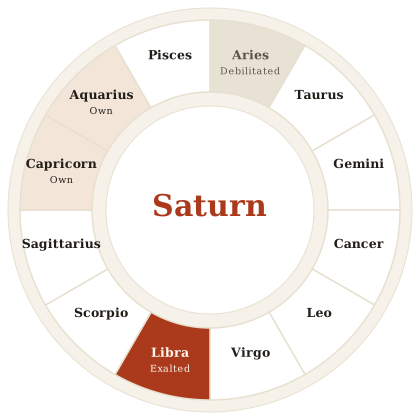
| Own sign | Capricorn and Aquarius | Saturn at home; discipline and structure form naturally |
| Exalted | Libra (deepest at 20 degrees) | Discipline inside justice and balance; held to be Saturn's finest placement |
| Moola-trikona | Aquarius 0-20 degrees | Exaltation-like, slightly milder |
| Debilitated | Aries (deepest at 20 degrees) | Discipline breaks in haste; the puzzle of impulse versus patience |
The symbolic reason is direct. Libra is the sign of the scales of justice, and Saturn is the planet of justice: together, discipline gets the direction of fairness. Aries is Mars's impulsive sign; there Saturn's slow, testing nature is suppressed, like asking a deliberate old horse to sprint. These placements, with their degrees, come from the classical dignity table whose source is given in the last section.
Sade sati: the actual arithmetic
Sade sati is the stretch of Saturn's transit through the twelfth, first and second signs counted from the birth Moon sign. The arithmetic is simple: Saturn stays about two and a half years in a sign, and three consecutive signs together make seven and a half years; hence the name. The cycle returns to every chart roughly every 29 to 30 years, so it visits an average life two or three times.
| Phase | Saturn's position from the Moon | Traditional theme |
|---|---|---|
| First (rising) | Twelfth sign | A tendency toward rising expense and duty; a season of preparation |
| Second (peak) | First sign (on the Moon) | Talk of mental pressure; a test of patience and self-care |
| Third (setting) | Second sign | A season of settling accounts in money and family; a gradual descent |
Now the part told less often. First, even within the tradition the result of sade sati changes with Saturn's condition, the sign-lord, the ashtakavarga points and the running dasha: in the same sade sati one person struggles while another settles into a job abroad. Second, when Saturn transits its own or a friendly sign, the hardship is counted as milder. Third, the tradition calls sade sati a "test of maturity": work that asks for two and a half years of care is not built in two and a half months of haste. Beware of fear-selling: selling expensive remedies in the name of sade sati is not astrology, it is business.
Dhaiya (kantaka Shani) and the Saturn return
Besides sade sati, two other transit combinations are current. When Saturn comes to the fourth or the eighth sign from the birth Moon, it is called dhaiya or kantaka Shani, a two-and-a-half-year period. The tradition treats it as a smaller test: restlessness of home and mind in the fourth position, talk of sudden changes in the eighth. The same rule applies here: the result changes with Saturn's strength and the rest of the chart.
A third cycle is rapidly gaining popularity among astrology readers: the Saturn return. Saturn's full round of the zodiac takes about twenty-nine and a half years, so when the transiting Saturn returns to the natal Saturn, the age is around 29 to 30. By the tradition's reading this is when a person sits the first full "examination of responsibility": career, marriage and direction tend to solidify at this age. The second Saturn return arrives around 59, called the season of turning experience into guidance. This cycle is astronomically exact, because Saturn's orbital period is indeed 29.45 years.
Saturn through the twelve houses, in brief
- 1st: a serious, responsible temperament; talk of slow but durable success.
- 2nd: money accumulates slowly; restraint in speech, duty toward family.
- 3rd: counted a good seat for Saturn; courage and skill through hard work.
- 4th: home and property are built by effort; the mind wants order.
- 5th: talk of delay in children or education; depth in research.
- 6th: victory over rivals through patience; a firm grip in service jobs; counted an excellent seat.
- 7th: talk of delayed marriage or an older, professional partner; Saturn is directionally strong here.
- 8th: the karaka of longevity in its own subject; talk of long life and deep research.
- 9th: practicality in belief; fortune built through effort.
- 10th: Saturn in its own element in the house of work; a slow climb to a high post.
- 11th: lasting income and senior friends; a good seat for Saturn.
- 12th: love of solitude, ties to service institutions; advice to restrain spending.
As always, a house result never runs alone: sign, aspects, conjunctions and dasha reshape the picture.
Signs of a strong and a weak Saturn
The tradition counts Saturn strong when it is in its own or exalted sign, in a kendra or trikona, joined or aspected by its friends Mercury and Venus, directionally strong in the seventh house, and free of combustion. On retrogression teachers differ - some count a retrograde Saturn stronger; the retrograde section below gives both views. The signs of a weak Saturn: debilitation in Aries, an enemy sign (Leo, Cancer, Scorpio), combustion by the Sun, and harsh conjunction or aspect from the Sun, Moon or Mars. The traditional expression of a strong Saturn: discipline, honesty, patience and the long view. Of a weak or afflicted Saturn: excess worry, low self-worth, extremes of procrastination or overwork, and mention of complaints tied to joints and bones. Remember that these health points are traditional indications, and for any symptom the doctor is the first address.
The Saturn mahadasha: 19 years
In the Vimshottari system the Saturn mahadasha runs 19 years, the second longest after Venus. The tradition calls it the "decade of karma": the foundations laid in this period are what the rest of life stands upon. The lengths below use the schematic 360-day year: 7 × the sub-period lord's years ÷ 120. Calendar dates depend on the calculation settings. The interpretive labels are a symbolic reading, not a schedule of promised events:
| Sub-period | Length | Traditional character |
|---|---|---|
| Saturn-Saturn | 3 years 3 days | Duty in full expression; a season of building structure |
| Saturn-Mercury | 2 years 8 months 9 days | Work through skill; learning and earning together |
| Saturn-Ketu | 1 year 1 month 9 days | A bent toward detachment; unnecessary loads fall away |
| Saturn-Venus | 3 years 2 months | The comfort of work done; technique in art, steadiness in ties |
| Saturn-Sun | 11 months 12 days | The clash of authority and duty; responsibilities toward the father |
| Saturn-Moon | 1 year 7 months | Talk of weight on the mind; care of the mother, lessons in patience |
| Saturn-Mars | 1 year 1 month 9 days | Energy versus obstruction; answer delays with strategy, not haste |
| Saturn-Rahu | 2 years 10 months 6 days | The tradition calls this a shrapit-style test; the straight road is the fastest |
| Saturn-Jupiter | 2 years 6 months 12 days | Discipline receives wisdom; success in teaching and management |
The same truth again: dasha results are not fixed. Saturn-Venus is marriage after hard work in one chart and the foundation of a creative career in another. Context decides.
Retrograde and combust Saturn
Saturn is retrograde for about four and a half months of the year. Astronomically this is the apparent motion seen from the earth. The tradition calls a retrograde Saturn "discipline turned inward": such natives test rules inside themselves first, and some teachers count a retrograde Saturn as stronger because it is then closer to the earth; both views are current. A combust Saturn, very close to the Sun, is judged harshly because Saturn and the Sun are counted mutual enemies: the father-son story and the enmity symbol meet here. In both states the result keeps changing with house, sign and dasha.
Shasha yoga, Vish yoga and Shrapit yoga
Among the five mahapurusha yogas, Shasha yoga forms when Saturn sits in a kendra house in its own or exalted sign; the tradition counts it a combination for organisational power, long-held office and leadership of many. On the other side, Saturn joined with the Moon is called Vish yoga, a tendency of pressure on the mind; the tradition itself lists cancellations, such as Jupiter's aspect or a strong Moon. Saturn with Rahu is called Shrapit yoga. The trade of selling fear in the name of all three yogas is common; keep the plain rule: no single yoga is a whole chart, and even for placements counted as afflicted, the tradition prescribes conduct, service and patience as the remedy-path.
Saturn and the fields of work
The fields the tradition assigns to Saturn: every kind of work tied to labour and organisation - agriculture, mining, iron and steel, oil, land and real estate, engineering, administration and bureaucracy, the justice system, and the process-work of large institutions. When Saturn ties to the tenth house or its lord, slow but durable advancement is discussed. This is a tendency-indicator, not an employment guarantee; qualification, experience and consistency hold their own place. In Saturn's own language, "success" simply means the thing still standing ten years later.
The stories and symbols of Shani Dev
In the Puranas Shani is held to be the son of the Sun, born of Chhaya, hence the name Chhayaputra. The story says that at his very birth his gaze brought an eclipse-like state upon the Sun; since then Saturn's "aspect" has been famous. His vehicle is the crow: the most ordinary, most patient and most hard-surviving of birds. The symbol runs deep: Saturn's teaching does not belong to palaces but to the people who rise every morning and work. Shani Jayanti falls on an amavasya, and the Saturday customs of oil, sesame and black cloth grew from this same story-world.
The simple remedies
The tradition's remedies for Saturn's difficult influence:
- Fasting and charity: a Saturday fast; donating mustard oil, black urad, sesame, iron objects and black cloth, especially to labourers and the elderly.
- Mantra: chanting "Om Sham Shanaishcharaya Namah"; Hanuman worship is also tied to Saturn, since the story says Shani gave Hanuman a word not to trouble him.
- Conduct: fairness with employees and elders, punctuality, keeping promises; the tradition files Saturn's remedies under "purification of conduct", not under tricks.
- Gemstone: the blue sapphire is considered Saturn's stone; its astrological effects are not established, and buying one is not necessary. The tradition itself strongly warns against casual wear of this stone, which is also worth hearing as a general caution about gemstone commerce.
Keep in mind that remedies are a support within the tradition, not a guaranteed fix. Decisions about work, debt, health or relationships belong first with qualified specialists.
Saturn's lesson for our times
In the age of instant results, Saturn's symbol is the great dissenter: it says real things take time. In the tradition's language, Saturn-strength means "the capacity to keep working daily when the fruit is late". Its modern form: tracking your effort instead of your luck, trusting process, and not measuring your pace against someone else's highlight reel. Read sade sati in the same spirit: the stretch of years in which life repairs its own foundations. For those who adopt discipline in that season, the tradition calls the end of sade sati "the silver lining".
An honest note
Astrology is a traditional system, not laboratory science. The meanings attached to Saturn rest on centuries of symbolism and remembered experience. Take decisions about health, money and career with qualified specialists; treat astrology as context, never the only basis. Sources consulted for the traditional placements and correspondences here: the dignity table of own sign, exaltation and debilitation with degrees, from the Saravali translation at saravali.github.io/astrology/dignities.html; the graha correspondence reference (day, direction, colour, gemstone, deity, dasha years) at satyori.com/reference/grahas/; and the Vimshottari dasha year-table at panchangtime.com/methodology/vimshottari-dasha. These present the classical Parashari framework; where traditions disagree, the text above says so. Our aim is to explain the tradition in plain words, not to sell fear.
Questions on this article
What is sade sati?
Sade sati is the period when the transiting Saturn moves through the twelfth, first and second signs from the birth Moon sign. Saturn stays about two and a half years per sign, so the three signs together make seven and a half years. Its result varies with the chart and dasha; it is viewed as a test of maturity, not a curse.
In which sign is Saturn exalted?
Saturn is exalted in Libra (deep exaltation at 20 degrees) and debilitated in Aries. Capricorn and Aquarius are its own signs.
How long does the Saturn mahadasha last?
In the Vimshottari system the Saturn mahadasha lasts 19 years, the second longest after Venus.
What are the remedies for a weak Saturn?
Traditional remedies include a Saturday fast, donating mustard oil and black urad, fairness with workers and elders, Hanuman worship, and chanting "Om Sham Shanaishcharaya Namah". Always show your full kundli before wearing a blue sapphire.