Saturn Transit 2027: The Aries Dip, a 139-Day Preview, and the Returning Pisces
Saturn usually stays years in one sign; 2027 has two changes: a 139-day Aries preview, then a return to Pisces, and the settled arrival in February 2028.
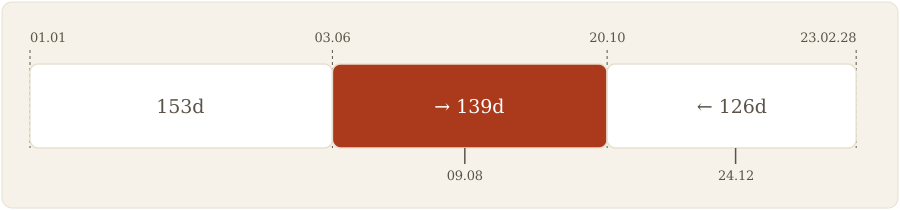
Saturn years are usually quiet: within a two-and-a-half-year sign stay, most years hold no ingress at all. 2027 has two. Saturn moves from Pisces into Aries on 3 June, turns retrograde at 3°38 of Aries on 9 August, returns to Pisces on 20 October, turns direct at 26°46 of Pisces on 24 December, and makes its settled entry into Aries on 23 February 2028. So 2027 is the first taste of Saturn in Aries; the settled arrival is early 2028. This article checks the dates against four sources, straightens the frame of debilitation-plus-retrogression, maps "window and pause" for Sade Sati and the dhaiyas, and ends with our own count: how many favourable days each Moon sign has in 2027.
The dates, checked against four sources
The base table on which the sources agree: entry into Pisces on 29 March 2025; the first entry into Aries on 3 June 2027; the retrograde return into Pisces on 20 October 2027; the settled Aries entry on 23 February 2028. The Aries stretch is 139 days (astromitra's count, matched by ours). The spread over the hours is wider than last time. On 3 June: astromitra 04:43 IST, cosmiqeai 05:28, drikpanchang 06:23; vedara's computation is 2027-06-02T23:59 UTC, which in our conversion becomes 05:29 IST. On 20 October: drikpanchang 06:05, vedara 01:43 UTC = 07:13 IST in our conversion, cosmiqeai 07:12, astromitra 08:13. Two things worth recording. First, the 3 June crossing is at 11:59 PM UTC on 2 June, so some tables will show 2 June (our dhaiya article's source janamkundlijyotish also says 2 June); the day difference is a time zone matter, not a computation disagreement. Second, nidarshanavedh itself writes that Saturn crosses a boundary very slowly, so the date is the reliable part and the clock time approximate; the three-and-a-half-hour spread is the shape of exactly that limit. And for context: Saturn was also combust from 21 March to 25 April 2027 (nidarshanavedh).
Why Saturn comes back: the mechanics
nidarshanavedh's account of the mechanics: Saturn circles the zodiac in about twenty-nine and a half years; the Earth overtakes it once a year, and for about four and a half months Saturn appears to drift backwards; Saturn itself does not reverse. When that drift begins soon after a sign change, the planet can be carried back over the border. The 2027 sequence is exactly this: having climbed only about three and a half degrees into Aries, Saturn turned retrograde on 9 August, and the backward motion carried it into Pisces on 20 October; then, after turning direct, it crossed the boundary again on 23 February 2028. The reader of the Jupiter article will recognise the pattern: in 2027 Jupiter also retreats retrograde from a dignity sign; for Saturn the dip is out of its debilitation sign. The arithmetic of both is one; the dignity position is inverted.
Debilitated, and mostly retrograde: the frame straightened
Aries is Saturn's debilitation sign, its weakest place in classical dignity; Pisces, ruled by Jupiter, is neutral for Saturn. But three structural lines stop this from being a plain "bad period". First, nidarshanavedh records that the tradition is divided on how much dignity matters in transit; that page does not choose a side, and neither do we. Second, the multiplication of Phaladeepika 26.31-32 (from cosmiqeai's compilation): in a favourable house a debilitated or enemy-sign planet gives nothing; in an unfavourable house the same planet turns sharper. Applied to 2027: for the Moon signs from which the Aries Saturn sits in the 11th, 6th or 3rd (Gemini, Scorpio, Aquarius), the textual logic calls that window not "fruitful despite debilitation" but "fruitless"; and where it is the 8th or 4th (Virgo, Capricorn), the caution sharpens. Third, cosmiqeai records that the texts hold a retrograde planet to gain cheshta bala, and this Aries stretch is retrograde for most of its 139 days (9 August to 20 October). All three lines are on record; drawing the conclusion is left to the reader's tradition.
Where this begins: the state of 2026
This article is written at the end of October 2026, so one line about the present too. In nidarshanavedh's table Saturn turned retrograde at 20°31 of Pisces on 27 July 2026 and turns direct at 13°42 on 11 December 2026; so as you read this, Saturn is in its retrograde stretch in Pisces, the same sign where it will spend most of 2027. The practical meaning: the "state" of 2027 is no new world but the same Pisces chapter running now; only the mid-year Aries dip is new. And for those whose charts form a named state from Pisces Saturn, a Sade Sati or a dhaiya, the experience of 2026 is itself the best preparation for 2027: the period is the same, with only a glimpse of a different room between June and October.
Window and pause: the Sade Sati and dhaiya map
The Aries stretch is a temporary window in Sade Sati and dhaiya terms, and nidarshanavedh's table maps it in exactly that language. Aries Moon: the rising phase is running, and the window previews the middle phase (Saturn over the Moon sign). Taurus: outside, with the window giving a first taste of the rising phase (the 12th). Aquarius: a two-and-a-half-month pause inside the setting phase (Saturn in the 3rd, favourable). Pisces: the middle phase is running, and the window previews the setting phase (the 2nd). Leo: Ashtama Shani is running, paused in the window (the 9th). Virgo: outside, with an Ashtama preview in the window (the 8th). Sagittarius: Kantaka Shani is running, paused in the window (the 5th). Capricorn: outside, with a Kantaka preview in the window (the 4th). The other four (Gemini, Cancer, Libra, Scorpio) are outside every named state. On 20 October every sign returns to its previous state; and on 23 February 2028 these same windows turn into settled changes. From this comes the practical meaning of "preview": the area of experience touched between June and October is the theme of 2028-30, within your own Moon-sign house.
Phaladeepika-26's Saturn rules
cosmiqeai's Phaladeepika-26 compilation holds three Saturn specifics, and we record first that we have not verified them against the original text. First, the twelve-house table: only the 3rd, 6th and 11th are "good" for Saturn; the 6th is even called "happiness all round, with nothing set against it", among the chapter's most favourable readings; and for the 1st and 8th the text adds a special caution over life, position and wealth. The compilation repeats one poetic line that we adopt: this is the text's caution, not a forecast for any one person. Second, vedha (26.5): the good results of the 3rd, 11th and 6th hold only if no other planet is then transiting the 12th, 5th and 9th from the Moon respectively; and one exception - if the Sun occupies those places, Saturn's results are not spoiled, because the text counts Saturn as the Sun's son. Third, the fruitful third (26.25): Saturn bears fruit in the last third of a sign; the Aries stretch (0 to three and a half degrees) sits entirely in the first third, so by the text's own logic this 139-day preview never enters the fruit-bearing band; this connection is ours, not the source's.
The houses from each Moon sign: the full table
The three houses of 2027 for every Moon sign, from the unanimous nidarshanavedh and cosmiqeai table; the order is: until 3 June (Pisces), 3 June-20 October (Aries), from 20 October (Pisces). Aries: 12, 1, 12. Taurus: 11, 12, 11. Gemini: 10, 11, 10. Cancer: 9, 10, 9. Leo: 8, 9, 8. Virgo: 7, 8, 7. Libra: 6, 7, 6. Scorpio: 5, 6, 5. Sagittarius: 4, 5, 4. Capricorn: 3, 4, 3. Aquarius: 2, 3, 2. Pisces: 1, 2, 1. The favourable list is 3, 6, 11; Sade Sati is 12, 1, 2; the dhaiyas are 4 and 8. The first and third periods share the same house, so the structure is sentence-like: the Aries stretch is the comma in between, and the main reading weight sits on the first period, because it is the larger part of the year.
Counting the favourable days: our own computation
We counted the favourable days for every Moon sign: the spans are 153, 139 and 73 days (1 January-2 June, 3 June-19 October, 20-31 December; inclusive counting of boundary days can shift this by one). The results: Taurus, Libra and Capricorn, 226 days (a favourable house in both Pisces stretches); Gemini, Scorpio and Aquarius, 139 days (only the Aries stretch); and the remaining six signs - Aries, Cancer, Leo, Virgo, Sagittarius, Pisces - zero favourable-house days. cosmiqeai's own summary (226 and 139) matches our count; our computation is independent. Compare with the Jupiter article: in 2027 Jupiter's minimum favourable days were 35; Saturn's are zero. That is the difference in the size of the two planets' favourable lists: five houses for Jupiter, three for Saturn. And the same limit: this count is of the house rule alone; vedha, dasha, ashtakavarga and the birth chart are not in it. For the zero-day signs, one line of nidarshanavedh is worth keeping: a demanding house means more responsibility, not misfortune, and many people find a Saturn period the most productive of their lives; that is the source's experiential statement, not a measured finding.
Common confusions
First confusion: from 3 June, debilitated Saturn, everything bad. Read the three-line frame above; and for six signs the Aries stretch is the year's only favourable window. Second: the 20 October return cancels Aries Saturn. No; it is the window closing, with the settled entry on 23 February 2028. Third: a retrograde Saturn is worse. The text-recorded cheshta bala says the opposite; and nidarshanavedh's restraint is also this, that a demanding house speaks the language of responsibility. Fourth: Sade Sati begins fully for an Aries Moon in 2027. An Aries Moon's Sade Sati is already running (Saturn in the 12th); June-October is a preview of the middle phase, not the full arrival. Fifth: combust Saturn changes nothing. The 21 March-25 April combustion is counted in the muhurt tradition. Sixth: the hour-level date fight matters. The sources themselves say: the date is reliable, the clock approximate.
One more small check, a number check: two ways to test any "Saturn 2027" page's table. First, the span sum: the Aries stretch should come to 139 days, and the three spans should add to 365; a table that shows Aries Saturn for a whole year, or for two and a half, has folded away the retrograde return. Second, the house palindrome: every Moon sign's first and third period must show the same house, because Saturn is in Pisces in both; where that equality breaks, either the table has an error or the count runs from some point other than the Moon. Both tests run without any panchang knowledge.
Practical use
First, write your three periods: your row from the table above, with the three dates. Second, use the window as a window: read the June-October experience of the Aries house as the preview of 2028-30, not as a verdict; the settled picture forms after February 2028. Third, use the pause: Aquarius, Leo and Sagittarius, whose named states hold a window-pause, can read it as a stretch for finishing old work; that frame is built from the sources' house themes, it is no promise. Fourth, restraint in the language of health: the 1st-8th house cautions in the Phaladeepika table are textual quotations; for any health question a doctor prevails - nidarshanavedh keeps exactly this disclaimer on its page. Fifth, expectation: read a Saturn transit as a period of structure and regularity; one line from the remedy tradition via cosmiqeai: Om Sham Shanaishcharaya Namah, on Saturday, with a donation of black sesame and iron; a part of the tradition, not a measured effect.
Three questions before any Saturn-2027 reading: first, does the reading treat 2027 as one state or as three; a sentence like "in 2027 Saturn is in Aries" loses the 226 days of the Pisces state. Second, is the debilitation talk bounded at the dignity scale or does it reach the house multiplication; Phaladeepika's framework is the second, and under it the Aries stretch's result comes out differently for every Moon sign. Third, does the reading carry the line of 23 February 2028; without it the October return will read as a cancellation, when the sources call it the closing of a window.
Sources and an honest note
Dates: vedara.me (the 2000-2050 Swiss-Ephemeris Lahiri dataset, UTC, CC BY 4.0; the IST conversion is ours), astromitra.com (the 139-day span, the 2.2-year Pisces stay), drikpanchang.com, cosmiqeai.com (times, retrograde boundaries, favourable-day summary); all four sources' hours are given above, disagreements included; the 2 June versus 3 June time zone explanation is ours. The mechanics, station degrees, combustion window, "the date is reliable, the clock approximate", the window-pause language, the house table, the recorded restraint on dignity's weight and the productivity statement are from nidarshanavedh.com (2 October 2026). Phaladeepika-26's house results, vedha 26.5 (with the Sun exception), fruitful third 26.25 and dignity multiplication 26.31-32 are from cosmiqeai.com's compilation, not verified against the original text. The favourable-day count, the note connecting the fruitful third to the Aries stretch, and the IST conversions are our own computation. Everything tied to transit results is presented as a claim of the tradition; no measured connection between a Saturn transit and a life event is established. This article is educational; on health matters a doctor's advice prevails.


