Scorpio (Vrischika): The Depths of the Zodiac
Vrischika is the fixed water that moves beneath a still surface: Mars’s sign where the war goes inward, and the depth from which both healing and destruction come. From the classical verse to the modern sign profile, a life between the scorpion and the eagle, with sources, and with an honest-limits note.
The marketplace taught agreement; now comes what agreement hides. The eighth sign, Vrischika, is thirty degrees of fixed water, the scorpion of the zodiac, and the sign Satyori's Vrischika guide calls the most intense rashi, capable of profound healing or profound destruction depending on the soul's development. This article audits that intensity in full: the sign's structure, the classical verse on a Scorpio Moon, a ruler whose battles here are internal, the traditional tendencies in personality, career, relationships and health, and at the end an honest-limits note.
Everything below comes from sources fetched on 31 October 2026: Satyori's Vrischika rashi guide, the seventeenth chapter of the Brihat Jataka as published at VedicPupil, which we read directly in that page's English translation, Wikipedia's Scorpio article for the tropical-sidereal gap and the scorpion's mythology, and Panchangtime's Vimshottari dasha guide for Mars's period. Where a claim belongs to one of them, we say so; where a note is ours, we mark it. Sign description is the tradition's framework; we give it as description, not diagnosis.
The eighth cell: the structure
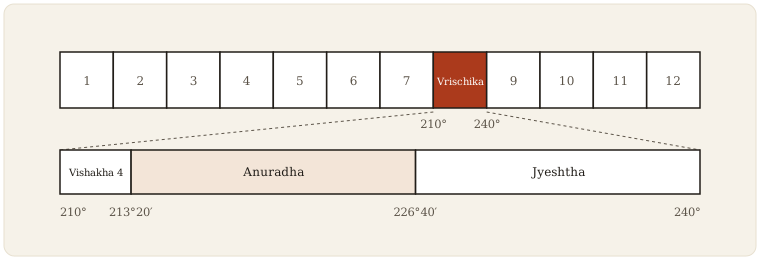
Vrischika is the eighth sign of the zodiac, from 210 to 240 degrees. Its symbol is the scorpion, and the Satyori page reads the symbol with both its edges: the scorpion represents the capacity to sting, including oneself, but the classical tradition also associates Vrischika with the eagle, the sign's potential for transcendence through transformation. Its element is water, its character Sthira, fixed, and its ruler is Mars; a fixed water sign is ice over a current, still surface, moving depth. In the Vedic mapping of the Kalapurusha, the cosmic person of time across whose body the twelve signs lie, Vrischika is the reproductive and eliminatory organs: the part that makes and the part that lets go, generation and expulsion in one seat. The same guide draws the contrast with Mars's other sign: where Mesha fights openly, Vrischika's battles are internal, psychological and often invisible to outsiders.
Three nakshatra segments fall within Vrischika: the fourth pada of Vishakha, all of Anuradha, and all of Jyeshtha. Each nakshatra spans 13 degrees 20 minutes of the zodiac, so Vishakha's last quarter runs from 210 to 213 degrees 20 minutes, Anuradha from there to 226 degrees 40 minutes, and Jyeshtha to 240; the arithmetic is ours from the standard nakshatra division. So two people both called Vrischika may carry different nakshatras inside the same rashi, and the nakshatra has its own weight in a reading. This collection carries detailed introductions to all twenty-seven nakshatras, including Vishakha, Anuradha and Jyeshtha; here it is enough that the rashi sets the frame and the nakshatra the finer shading within it.
One more boundary line matters. In Indian usage the word rashi usually means the Moon sign, the sign the Moon occupied at the birth moment. The classical chapter we quote below is titled exactly that, Chandrarashishila, the natures of the Moon signs. For Vrischika this meeting is itself the story: the mind's planet in the sign of what the mind would rather avoid. A chart also holds the lagna, the sign rising on the horizon, and the Sun's sign; the three carry different significations. And Satyori adds in its own line that the condition of Mars in your chart strongly influences how Vrischika expresses in your life. A rashi is one axis, not the whole picture.
Vrischika and Scorpio: two scales, one sky
In Western astrology Scorpio is the same eighth sign: the scorpion, the water element, the fixed quality, Mars as traditional ruler; per Wikipedia's table, the Sun transits tropical Scorpio from 23 October to 22 November in 2026, and between 23 October and 21 November on average. But the tropical zodiac is tied to the equinox point, while the Vedic sidereal zodiac is tied to the stars. Satyori puts the ayanamsha gap between them at about 24 degrees. The practical result: a person whose Western sun sign is Scorpio may have Vrischika as their Vedic rashi, or Tula; it is not the date that changes but the scale. This article speaks of the Vedic Vrischika, and for date boundaries rely on your own panchang or chart calculation.
The scorpion's story is a story of the small thing that kills the great. Per Wikipedia, Greek telling ties the constellation to the legend of Orion: a giant scorpion stung the mighty hunter to death, which is said to be why Orion sets as Scorpius rises in the sky, the two never sharing the heavens. Another Greek myth recounts how a scorpion caused the horses of the Sun to bolt when the inexperienced youth Phaethon drove them, the sting that nearly burned the world. Both tales give the scorpion the same power: not size but placement, the one strike that topples what towers over it. And Satyori's own page, as we noted, holds the tradition's other creature for this sign: the eagle, the same depths read upward. The scorpion stings; the eagle sees from above what the scorpion knows from below; the sign carries both, and which one flies is the work of a life.
The classical Scorpio Moon: Brihat Jataka
Varahamihira's Brihat Jataka, a mid-first-millennium Jyotish text, devotes its seventeenth chapter to the natures of the Moon signs, and its line for Vrischika reads: with broad eyes and chest, rounded shanks, thighs and knees, separated from father or elders and ailing in childhood; honoured by royal families, tawny, harsh in action, marked with the signs of a fish, a thunderbolt and a bird, hiding his faults: so is one born in Scorpio.
In plain terms: this is the courted outsider, and the verse builds him from separation. It opens with a body, broad-eyed and barrel-chested, and immediately wounds it: separated from father or elders, sickly in childhood. Then the reversal: honoured by royal families, the orphan welcomed at court. And then the mark the whole sign is known by, chhanna-papa, hiding his faults, the one who keeps his account closed. The strangest line is the most concrete: the native bears on his body the marks of a fish, a thunderbolt and a bird, jhasha, kulisha, khaga. The tradition reads such marks as signs on the skin; we simply note the company they keep, water, lightning and sky, the three storeys of this sign's house. And the bird, khaga, sits oddly well beside the eagle the later tradition gave Vrischika.
The same chapter already holds the most useful hedge inside itself, the one we have quoted before in this series: verse 17.13, which says these twelve Moon-sign natures hold when no other planet or condition in the chart affects that sign; otherwise the marks change. The tradition said first that its portraits are not verdicts. The twelve Moon-sign verses are twenty-eight lines among the chapter's four hundred and nine; that says how old these figures are, and also how much else the book contains.
The ruler whose war goes inward
Vrischika's ruler is Mars, the same Mars who rules Mesha, and the two signs split his warfare: per Satyori, where Mesha fights openly, Vrischika's battles are internal, psychological and often invisible to outsiders. The debilitation table carries the sign's central tension: the Moon is debilitated here at 3 degrees, and the guide gives the reason in full, the mind's desire for comfort and security is constantly challenged by this sign's intensity; Vrischika forces confrontation with what the Moon would rather avoid, death, loss, betrayal and the darker aspects of human nature. This placement creates emotional power but not emotional ease. And on exaltation the page shows the tradition mid-argument: no planet is exalted here, though Ketu is exalted in Vrischika per some traditions. We keep that hedge standing exactly as the source wrote it; the series has made a rule of letting sources disagree in public. Per Panchangtime's Vimshottari table, Mars's mahadasha runs 7 years, among the shortest, set against the Sun's 6, the Moon's 10, Mercury's 17, Jupiter's 16 and Venus's 20: a short, sharp period, like the strike itself.
Temperament, work and relationships: the tradition's map
The descriptive tradition seats Vrischika at the bottom of the well, and names what can be drawn up from there. Satyori's traits: intensely perceptive, psychologically astute and remarkably resilient; they see through pretense instinctively and have little patience for superficiality. Their emotional lives run deep, feeling everything intensely and revealing very little; trust is earned slowly and, once broken, rarely restored. And their capacity for personal transformation is unmatched: they can completely reinvent themselves through crisis in ways other signs cannot. In careers the descriptive tradition places them in research, psychology, surgery, investigation, intelligence work and any field requiring penetration into hidden layers; they make outstanding therapists, detectives, researchers and crisis managers, calm under extreme pressure, thriving in roles others find too intense, dark or emotionally demanding; the page adds that the occult sciences, tantra and transformational work are natural fits. Satyori's own hedge stands here too: career outcomes depend on the tenth-house lord, planetary periods and overall chart strength.
In relationships this water is all or nothing. Satyori's account: Vrischika natives either commit completely or maintain strict distance; their love is intense, possessive and deeply loyal once trust is established. Jealousy and control can become issues if the fear of betrayal goes unexamined, and superficial or unfaithful partners trigger the sign's most destructive tendencies; they need partners with emotional depth and honesty who will not be frightened by Vrischika's intensity. The classical verse had already given the pattern its first sketch: the childhood separation, and then the closed book, hiding his faults. What was never given freely, the tradition says from both directions, is guarded forever after.
On health the descriptive tradition ties Vrischika to the reproductive system, colon, bladder and eliminatory organs, with tendencies toward conditions of toxin accumulation, hormonal imbalances and chronic infections that resist easy treatment; Satyori adds that suppressed emotion can lead to conditions that fester below the surface before erupting, and recommends detoxification practices both physical and emotional. Its dosha note gives Vrischika a pitta-kapha dual affinity, pitta from Mars's heat and the sign's transformative intensity, kapha from the water element's depth and fixity, a powerful constitution with strong regenerative capacity but a tendency toward holding toxins physical and emotional, and suggests pungent and bitter foods that support elimination and physical practices that generate heat and release. All of this is that source's Ayurvedic framing, given in its name; this article offers no medical advice, and for any symptom the doctor is the authority. If you are pregnant, ill, elderly or on medication, any regimen the tradition mentions is not for you without a doctor's word.
The honest limits
Sign description is the tradition's framework, not measured psychology. Everything above is what the texts and one modern guide say about Vrischika, recorded with their names and their dates; it is not what we measured in any person. The Brihat Jataka itself conditions every mark on the rest of the chart not disturbing the sign, and Satyori itself conditions career on the tenth lord and the dashas. A rashi is one thread of a chart and no thread of your worth. Do not measure anyone else by their sign, and do not pour yourself into one either; being Vrischika is not being only this.
Keep one practical test as well: if some description here does not fit you at all, that is no fault of yours and none of the tradition's; the text laid down beforehand that these portraits are general. And if a description does fit, do not make it your ceiling; the tradition itself kept two creatures in this sign's sky, the scorpion and the eagle, and which one a life becomes is flown, not fated, by practice, not by sign.
Short answers
What is the difference between Vrischika and Scorpio? A matter of scale: Vedic sidereal Vrischika is tied to the stars, tropical Scorpio to the equinox, and a gap of about 24 degrees separates them; one birth date can therefore fall in different signs in the two systems. Is any planet exalted in Vrischika? Satyori's table records none, adding that Ketu is exalted here per some traditions; we have kept the hedge exactly as the source wrote it. Are Scorpio people really vengeful? The tradition frames the sign's memory as the price of its depth, and the classical verse gives the same native royal honour and a childhood wound; the text itself says the marks change with the rest of the chart. Is reading personality from a sign scientific? No; it is the tradition's descriptive framework, presented here as exactly that, with sources.
Questions on this article
What is the difference between Vrischika and Scorpio?
They are two names for the zodiac’s eighth 30 degrees: Vrischika in the Vedic (sidereal) tradition and Scorpio in the Western (tropical) one. The difference is that the tropical zodiac is tied to the equinox point and the sidereal to the stars; an ayanamsha gap of about 24 degrees separates them, so your Western sun sign and your Vedic rashi can differ. Per Wikipedia, the Sun transits tropical Scorpio from 23 October to 22 November in 2026; Vedic Vrischika is computed from the panchang.
Is any planet exalted in Vrischika?
Satyori’s table records no exalted planet in this sign, but the page adds that Ketu is exalted here per some traditions. We have kept that hedge exactly as the source wrote it: the tradition is not of one mind on this point. On debilitation the table is clear: the Moon is debilitated at 3 degrees, because the mind’s desire for comfort and security is constantly challenged by this sign’s intensity.
Are Scorpio people really vengeful?
The tradition frames this sign’s long memory as the price of its depth: per Satyori, trust is earned slowly and once broken rarely restored, and this is the sign’s test, not its identity. The Brihat Jataka’s Scorpio-Moon verse calls the same native honoured by royal families and marked by a childhood separation. And the text itself (17.13) says these marks change with the rest of the chart. Do not mould or measure any person by their sign.
Is reading personality from a sign scientifically established?
No, and this article makes no such claim. Sign description is the framework of the Jyotish tradition, carried through texts and practising astrologers over centuries; we present it as exactly that, with sources. Do not treat it as a substitute for psychology or medicine; as a way of reflecting on oneself it can be a cultural mirror, not a measuring instrument.


