The second house: wealth, family, speech
The second house is not just money: it holds wealth, family, speech and food. Learn how the tradition reads it.
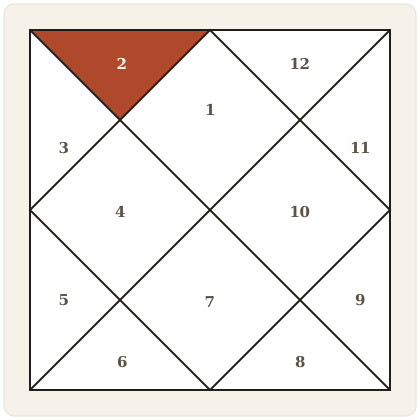
The second house of a Vedic chart is called Dhana Bhava, the wealth house, but reading it as merely "the money house" is half the picture. In the Parashara tradition four threads are woven under this roof: accumulated wealth, the family of origin, speech, and food - everything you take in and keep. This article opens each thread separately, explains the difference between second-house wealth and eleventh-house income, works out what it means for this to be the house of the voice, and gives the heavy word maraka its honest, fear-free meaning.
What the second house is
The sign after the lagna becomes the second house. The tradition calls it by two names, Dhana Bhava and Kutumb Bhava, and the two names announce its two largest subjects. Structurally it also falls in the maraka class, whose real meaning is explained in its own section below. To read the second house the tradition looks at three things together: the sign and planets in the house, the placement and condition of its lord, and the karaka planets - Jupiter for wealth, Mercury for speech.
The first thread: stored wealth
The wealth of the second house is accumulation: money in the bank, jewellery, possessions, and what comes down the family line. The tradition draws a fine distinction that is still useful: the second house is wealth that stays with you; regular income and gains belong to the eleventh house; and land and immovable property to the fourth. So "being well off" is three separate questions: how the earning runs (11th), how the saving holds (2nd), and how the assets stand (4th). A strong second house with a well-placed lord is linked in the tradition to the capacity to accumulate; an afflicted second house is discussed as money arriving but not staying. These are tendency-indicators: real wealth is built from income, spending discipline and decisions; the chart offers the tradition's lens, not a guarantee.
The second thread: family of origin
The second house is the family you were born into: the parents' home, the lineage, and the atmosphere of values in which childhood was spent. The family built after marriage is read from other houses (the fourth and seventh). From the second house the tradition reads the quality of ties with the birth family, the support that comes from the lineage, and family-held assets. When the second lord sits in a kendra or trikona, support from the family is discussed; in difficult placements, the talk is of heavier family responsibilities to carry.
The third thread: speech
The least discussed yet most everyday subject of the second house is speech: the style of talking, word choice, the effect of the voice. The face, mouth, throat and right eye are counted as this house's body territory, and Mercury is its karaka. The tradition speaks of a benefic in the second house as a sweet, effective voice, and reads an afflicted second house as harsh speech or the possibility of being caught by one's own words. Looked at with modern eyes the subject is remarkable: in work, in relationships, in society, speech is the one asset that earns daily and also binds relationships. So the second house is best understood not as the vault alone but as the house of what you hold and what issues from you, both.
The fourth thread: food and what goes in
Food is also a classical subject of the second house: taste in eating, food habits, even intoxicants are read from this house and its lord. The reasoning is direct: the mouth is this house's territory, and whatever passes in through the mouth is examined here. The same thread extends to what the mouth represents more broadly: taste, appetite, and the discipline of the senses at the table of daily life. With an afflicted second house the tradition advises attention to irregular eating - read this as a traditional pointer to watch habits, not a health ruling; for any symptom, the doctor is the first address. Keep in mind that the tradition frames these as habits to observe in yourself, not as diagnoses to accept. A further fine point rides on the same thread: since the right eye belongs to this house, charities such as funding eye care or spectacles are traditionally attached to the second house - giving is treated as the other end of the discipline of keeping; the one who learns to give learns to hold.
The karakas: Jupiter and Mercury
Every house carries fixed karaka planets, the natural significators of its affairs wherever they sit in the chart. The second house has two: Jupiter for accumulated wealth, and Mercury for speech and stored knowledge. The reading method triangulates the house's condition from three corners: the house itself, its lord, and the karaka. If the house is ordinary but Jupiter is strong, the wealth side is held to find support; if the house is fine but Mercury is afflicted, the speech side asks for separate attention. Drop any one of the three and the picture goes flat; this is the tradition's order of reading.
Dhana yogas: how the tradition frames accumulation
In the tradition, wealth combinations form mainly through relationships among the lords of four houses: the 2nd, 5th, 9th and 11th. The logic is simple: the second is accumulation, the fifth and ninth are the trikonas of past merit and fortune, and the eleventh is gains. When the lords of these houses connect by exchange, conjunction or aspect, a dhana yoga is named - for example, the second lord in the eleventh or the eleventh lord in the second. There is one more layer: any yoga ripens in its dasha. When the mahadasha or antardasha of the involved planets runs, the affairs are seen as activated. This mechanics is worth understanding because it shows what "there is a dhana yoga" means in the tradition: not "money will surely come" but "the doors of accumulation stand open, through time and effort".
The truth about maraka, without fear
A heavy word attaches to the second house: maraka. Its plain, calm meaning matters, because fear-sellers trade on it. The tradition counts the second and seventh houses as marakas, and the reason is entirely structural: the third and eighth houses are the stations of longevity; the second sits twelfth (the loss-house) from the third, and the seventh sits twelfth from the eighth. In the Vimshottari longevity framework, within the chart's predetermined longevity window, the dashas of these houses' lords are read as timing markers. That is a technical part of the longevity calculus and casts no shadow on the everyday meanings of wealth, family and speech. If anyone frightens you into buying remedies by saying "your chart has a maraka", remember that every chart has a second and a seventh house - by this arithmetic, every chart has a maraka. This is one of the oldest fear-selling tricks in the trade.
When planets sit in the second house
In the traditional shorthand: Jupiter in the second house speaks of accumulation and learned speech; Venus, of comfort-rich assets and a sweet voice; Mercury, of verbal skill and a head for accounts; the Moon, of mood-linked eating and fluctuating savings; the Sun, of pride-tied wealth and a high register; Mars, of direct, sometimes sharp speech and ups and downs in money; Saturn, of slow but lasting savings. Rahu here is discussed as unusual earning sources, Ketu as detachment from hoarding. These are tendencies: the sign, aspects and the lord's condition keep redrawing the final picture.
The second lord: where money ties in
Whichever house the second lord occupies, the tradition reads wealth and family affairs as tied to that place. A second lord in the tenth ties accumulation to work and profession; in the ninth, to fortune, higher learning or the dharma field; in the fourth, to property and home; in the twelfth, the advice is to watch the tilt toward spending. The reverse view is just as useful: the eleventh lord in the second speaks of income pouring straight into savings. This travel of the house-lord is the tradition's real reading: not "second house equals money" list-thinking, but a calculus of relationships.
Two practices: saving and speech
If one practical lesson is to be drawn from the second house, the tradition's view offers two practices. The first is the practice of keeping: the wealth house is the house of "staying", so its symbolic prescription is the art of setting aside before spending. The tradition, and modern financial sense alike, see regular small saving as the exercise that strengthens the second house. The second is the practice of speech: pausing a moment before speaking, reducing harsh words, reading or listening to something worthwhile daily - because speech's karaka is Mercury, and Mercury is shaped by practice. The interesting part is that the two practices feed each other: one whose speech is measured makes measured decisions too, and measured decisions are what accumulation is made of. This is the second house's inner thread: wealth and speech were placed in one house because both are built from the same source - restraint.
The second house at a glance
| Aspect | Traditional subject |
|---|---|
| Names | Dhana Bhava, Kutumb Bhava |
| Core subjects | Stored wealth, family of origin, speech, food |
| Body territory | Face, mouth, throat, right eye |
| Karakas | Wealth - Jupiter; speech - Mercury |
| Classification | Maraka (a technical role in the longevity calculus) |
| Related houses | Income - 11th; property - 4th; fortune - 9th |
| Dhana yoga parts | Relationships among the lords of 2, 5, 9, 11 |
Common misconceptions
First: "a good second house means guaranteed riches." The tradition has three or four centres of accumulation - income (11th), savings (2nd), assets (4th) - and the yogas ripen in their dashas; no single house decides alone. Second: "a malefic in the second house means poverty." Even Saturn here is linked to slow but durable saving; a malefic's meaning is a different style, not a loss. Third: "maraka means danger." As explained above, it is a technical role in the longevity arithmetic, not material for fright. Fourth: "speech is just temperament, what has a chart to do with it." The tradition counts speech as a central subject of the second house, and the view is practical too, because working on one's speech is the most direct "remedy" there is.
The second house in our times
In modern life all four threads of the second house are as alive as ever; only their forms have changed. Accumulation now lives in bank accounts, investments and digital assets; family has shifted from the joint household to small families and chosen bonds; speech has spread into meetings, presentations and written chat; and food habits have grown more irregular in the delivery era. The tradition's message is unchanged: what you store, whom you come from, what you speak and what you take in - attention to these four is wealth itself. The second house's most practical teaching is that accumulation comes from discipline before earning, and speech is the one asset that grows not by being spent but by being spent thoughtfully. Knowing your second house is useful not for predicting how much you will earn but for seeing which way your style of keeping tilts and where the work lies. That understanding is this house's most lasting fruit: it tells you where to soften your own ways of earning, keeping, speaking and consuming.
A worked distinction: income is not a balance
Imagine two fictional households earning the same amount. One has high fixed costs and no emergency savings; the other has lower costs but an irregular income. Calling both simply wealthy because their earnings match misses the question. The second-house versus eleventh-house distinction is useful as a vocabulary for asking separately about money received and money retained. It cannot tell which household will prosper. For that, examine actual records, debt terms, obligations and goals with appropriate financial help. A chart is not a substitute for those records.
An honest note
Astrology is a traditional system, not laboratory science. Take decisions about money, career or health with qualified professionals such as financial advisers and doctors; treat the chart as context, never the only basis. Sources actually consulted for this article: the second house's significations, karakas, the maraka classification and the components of dhana yogas from satyori.com/jyotish/articles/twelve-houses-overview/; planetary karaka assignments from satyori.com/reference/grahas/; and sign-lordship verified at saravali.github.io/astrology/dignities.html. Our aim is to explain the tradition in plain words, not to sell fear or promise wealth.
Questions on this article
What does the second house govern?
The tradition gives the second house four main subjects: stored wealth, the family of origin (kutumb), speech and food. Hence its two names, Dhana Bhava and Kutumb Bhava.
What is the difference between second-house and eleventh-house money?
The second house is accumulated wealth (savings, jewellery, inherited assets); the eleventh is regular income and gains; land and immovable property belong to the fourth.
What does maraka mean?
The second and seventh houses are technically called marakas in the longevity calculus because they sit twelfth from the longevity houses. It is only a role in that arithmetic; every chart has these houses, so there is nothing to fear.
How does a dhana yoga form?
In the tradition, dhana yogas form through relationships among the lords of the 2nd, 5th, 9th and 11th houses, by conjunction, aspect or exchange, and their results are held to ripen in the dashas of the planets involved.


