The seventh house: marriage, partnership
A guide to the seventh house as the traditional symbol of marriage, partnership and every one-on-one bond.
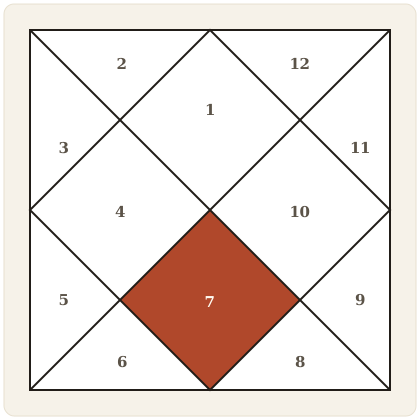
The seventh house of the chart is called Yuvati Bhava or Kalatra Bhava, the "spouse house". But its reach is far wider than marriage: this house covers every one-on-one relationship in which the interests of two sides become entangled with each other - marriage, business partnership, public dealings, the tie to the marketplace, residence abroad, and the intimate bond that forms between two people. Its body region is the pelvis, the lower back and the kidneys. The seventh is a kendra, one of the chart's four most powerful pillars, and by sitting exactly opposite the lagna it is the axis where "I" meets "the other". This article explains what the seventh house covers, how it is read, and where the tradition ends and the decisions of relationships begin.
The names and the mirror axis
"Kalatra" means spouse - the name fixed this house's identity, but its depth lies in its position: the seventh house sits exactly opposite the lagna. The first house is "self", the seventh is "other", and this first-seventh axis of the chart is the most important mirror in all of interpretation. The Parashari tradition discusses this house in its own dedicated chapter, and its method of reading gives a special place to the mutual relationship of the lagnesh and the seventh lord; in the tradition's view many of life's great events turn on exactly this equation of "I and the other". The karaka planet is Venus, the significator of spouse and harmonious partnership. The simple formula for understanding this axis is this: the seventh house tells how we join with others - and joining is the most practical subject of any chart.
Marriage and the life partner: the sensitive reading
The first subject of the seventh house is marriage and the life partner. The tradition discusses from this house the leaning toward marriage, the quality of the bond with a partner and the temperament of married life, and it is read by combining all three: the house, the seventh lord and the karaka Venus. Here the boundary must be kept fully plain: these are all tendency-indications - whether someone will marry, when, and how it will go is decided by no chart. The decision of marriage is made by two people, two families and long conversation; a relationship's quality is made of communication, respect and consent. Today marriage too has many shapes - love marriage, arranged marriage, marrying late, not marrying at all - and reading the tradition's symbols to declare one shape "correct" is not its purpose. The useful lesson of the seventh house is that a person recognises their own partnership style: do they join by leaning in or by keeping distance, does honour come first for them or togetherness. That self-knowledge improves every relationship.
Business partnership and public dealings
The second great subject of the seventh house is partnership - business partnership, joint ventures, and in general the tie to the market and the public. The logic is simple: wherever the interests of two sides are bound into one document, the seventh house is at work. The tradition discusses advancement through partnership under a strong seventh lord. Here too the same rule: the house describes a leaning; the decision of partnership is described by documents. Starting a business with someone rests on a written agreement, a background check and legal advice when needed - not on chart-matching. This layer of the seventh house is equally relevant for today's freelancer, startup co-founder and agency owner: every contract is a small partnership.
Residence abroad and distant dealings
A less-heard subject in the traditional list is residence abroad - a tendency-indication of settling far from the birthplace or joining with distant markets. Its logic too hides in the axis: the seventh house is the kendra farthest from the lagna, the milestone beyond the "self". In modern life this subject extends to the migrant workforce, businesses with foreign clients and international relationships. As in every subject, this too is a tendency-indicator - the real decision to move abroad is made by opportunity, visa, earnings and family circumstances. One modern subtlety is worth keeping in mind: today the "distant market" lives in every piece of work sold over the internet to a client in another country - the freelancer and the exporter dealing abroad from home are, in the tradition's language, extensions of this same seventh house. The essence of this subject, in other words, is not place but "joining with the distant other".
The fear-free meaning of maraka
Like the second house, the seventh is technically called a "maraka" in the longevity calculus, because it sits twelfth from the eighth house, the house of longevity. On this word keep two things firm. First: this is only a role in that arithmetic - every chart has a seventh house, so there is nothing to fear. Second: the tradition itself admits this subject's limit - at the very opening of the chapter on determining longevity it is acknowledged that fixing the length of a life is difficult even for the gods. Where the tradition's own author holds such humility, selling fear in the name of a house is an insult to that tradition. This side of the seventh house is worth reading because it teaches: understand technical terms from their arithmetic, not from their fright.
Kendra strength and the partnership line
The seventh house is a kendra - the first, fourth, seventh and tenth houses are the chart's four pillars - and a strong seventh lord is counted in the tradition as the sign of a marked partnership trajectory: a life that moves forward repeatedly by joining with others. Understand the opposite as well: a strained seventh lord is discussed as repeated learning in partnership - not as failure. And then the same rule again: all of this is tendency-thinking. The real assessment of anyone's marital or business success happens from their relationships and their work, not from a chart.
Where the seventh lord sits
In traditional shorthand: the seventh lord in the seventh itself speaks of the partnership theme standing firm; in the tenth, of marriage joining career, or of advancement through business partnership; in the first, of the partner's deep influence on life; and in the fourth, of a deep tie between home and partnership. The lord's dignity - own sign, exaltation, a friend's sign - strengthens or weakens these leanings, and at the end the condition of the karaka Venus is weighed alongside. All of these are symbolic readings: conclusions about anyone's marriage or partnership come not from them but from the facts of their relationships.
The lagnesh-seventh-lord dialogue
One formula recurs through the tradition's method of reading: the discussion-centre of many great life events is the mutual relationship of the lagnesh and the seventh lord. The logic is elegant - the lagnesh represents "I", the seventh lord "the other"; when these two planets stand in friendly signs, watch each other, or sit in each other's signs, the tradition discusses cooperation between "self" and "other"; when scattered or strained, more effort in the relationship field. This framework applies to all three - marriage, partnership and public life. While reading it, remember one thing: a planetary relationship is a map inside a chart, not of two real people's bond. The real "planetary relationship" between two people is their conversation, their promises and their capacity to keep them - and that is a bigger thing than any conjunction.
Planets in the seventh house
In traditional shorthand: Venus in the seventh house is counted favourable, with talk of a harmonious partnership. Jupiter here speaks of a partner with a guiding temperament and of expansion through marriage; the Moon of emotional attachment and popularity in public dealings; Mercury of a partnership that runs on conversation. The Sun with Mercury or Venus is discussed in connection with a self-respecting partner; Mars in the seventh as an energetic but occasionally abrasive partnership - the tradition also views it in the context of Kuja dosha, whose balanced meaning is treated in a separate article. Saturn here speaks of a partnership that comes late but lasts, or a bond with a partner full of responsibilities; Rahu of an unconventional or foreign partnership, Ketu of a certain detachment within partnership. All of these are tendency-indicators; the sign, the aspects and the lord's condition keep reshaping the final picture.
The question of time: when it activates
The seventh house's themes - events tied to marriage, decisions of partnership, the expansion of a public role - are seen coming forward when the mahadasha or antardasha of the seventh lord or of the karaka Venus runs. Venus's mahadasha lasts twenty years, the longest in the Vimshottari system, and the tradition reads it as a period of relationships, art and the means of comfort. The value of this discussion lies in understanding a leaning - not in fixing a wedding date. Marriage, partnership or moving abroad - the real time-setters of these are people, opportunity and preparation.
Common misconceptions
First: "a cruel planet in the seventh house means a ruined marriage." Never. The house, its lord and the karaka together give tendency-indications, and a relationship's fate is built from the conduct of two people. Second: "an empty seventh house means no marriage." Empty houses are normal; most houses in most charts are empty, and then the seventh lord, the aspects and Venus are read. Third: "the seventh house is only about husband and wife." This house covers every one-on-one partnership - business, contracts, public dealings, even rivalry. Fourth: "be frightened by the word maraka." As explained above, it is a technical role in the longevity arithmetic, and the tradition itself counts longevity determination as profoundly difficult.
The seventh house in our times
In modern life the seventh house is perhaps the most expanded house of all. The shapes of partnership have changed - live-in relationships, startup co-founders, remote contracts, international teams - but the core question is the same: how do "I" and "the other" meet? Dating apps have sped up introductions, but the tradition's lesson still stands: the quality of a bond is made not by the speed of meeting but by the quality of keeping. The same formula in business: contracts have gone digital, but trust is still built by humans. The modern benefit of knowing the seventh house is recognising our own partnership style - where we give too much, where too little - and becoming a little more conscious with each of our "others". That consciousness can begin from a chart, but its fruit ripens only in conversation and conduct.
A reading exercise: keep symbol and evidence apart
Take a hypothetical chart with Libra in the seventh house, so the seventh lord is Venus. Suppose Venus sits in the tenth house. The student first reads the framework: the house (the seventh, partnership), the lord (Venus, in the tenth, the career field), the karaka (Venus itself). The traditional reading: a deep tie between partnership and work - perhaps working together with the spouse, or meeting the partner through the field of work. Now the second step - this is a tendency-statement, not a map of anyone's marriage. That person may be unmarried and running a business alone; their spouse may be in a different field altogether. The real information will come from their relationships and their work. Record what matches, record what does not, and never invent a story to force a match. This exercise keeps the tradition a study, not a decree of fate.
At a glance: the seventh house's subjects
| Aspect | Traditional subject |
|---|---|
| Names | Yuvati Bhava, Kalatra Bhava |
| Main subjects | Spouse and marriage, business partnership, public dealings, the marketplace, residence abroad, intimate relations |
| Body region | Pelvis, lower back, kidneys |
| Karaka | Venus (spouse and harmonious partnership) |
| Classification | Kendra (1, 4, 7, 10); technically a maraka in the longevity arithmetic (12th from the 8th) |
| Axis | With the first house - "self" versus "other" |
| Related houses | Romance - the 5th; domestic happiness - the 4th; the longevity calculus - the 8th |
An honest note
Astrology is a traditional system, not laboratory science. Take decisions about marriage, partnership or any relationship with conversation, consent and, when needed, qualified professionals - counsellors, lawyers; treat the chart as context, never the only basis. In any relationship, safety and boundaries come first. Sources actually consulted for this article: the seventh house's significations, Venus's karaka role, the kendra classification and the maraka role (including the tradition's own remark on the difficulty of determining longevity) from satyori.com/jyotish/articles/twelve-houses-overview/; planetary karaka confirmations from satyori.com/reference/grahas/; and the Vimshottari dasha years from panchangtime.com/methodology/vimshottari-dasha. Our aim is to explain the tradition in plain words, not to sell fear or make promises.
Questions on this article
What does the seventh house signify?
The tradition places spouse and marriage, business partnership, public dealings, the marketplace and residence abroad here. These are symbolic meanings, not evidence about any person.
Which planet is the karaka of the seventh house?
Venus, as the significator of spouse and harmonious partnership.
Does an empty seventh house mean no marriage?
No. An empty house is normal - most houses in most charts are empty. Then the seventh lord's condition, the aspects and the karaka Venus are read; and in any condition the decision to marry rests with people, not with a chart.
Why is the seventh house called a maraka?
In the technical longevity calculus the seventh sits twelfth from the eighth (the longevity house), so the language of that computation calls it a maraka. It is only a role in that arithmetic; the tradition itself counts determining longevity as profoundly difficult, so there is nothing to fear.


