Shrapit Dosh: The Name That Says "Cursed", the Saturn-Rahu Conjunction, and the Maturity Clock
The heaviest-named dosha: the complete story of a modern label, in which the "curse" turns out to be a hard but learnable lesson.
Of all the names in the dosha literature, "Shrapit" is the heaviest: its literal meaning is "cursed". Hearing it, one imagines a seal of ancestral anger stamped on the chart. But the sources we studied for this article clarify two things in their opening paragraphs. First, this is the ordinary Saturn-Rahu conjunction, found in countless charts. Second, the name is a later label, not a direct diagnosis from the early texts; the tradition attached it to this conjunction afterwards. This article audits the name and the real structure beneath it: formation, house-wise reading, softening conditions, the clock of time and the remedies, every claim kept as a claim.
The name's etymology: where the curse imagery comes from
The paramarsh.app source article opens up the name's root. "Shrapit" derives from the Sanskrit "shrap", and in Puranic and Itihasic narratives a curse is usually the consequence of a specific transgression, not arbitrary punishment: a sage curses a king who violates dharma, or a wronged person's suffering becomes a binding consequence. And nearly every curse-story also carries a limit, a remedy or a release. Later Jyotish practice lifted precisely this narrative frame and placed it on the Saturn-Rahu conjunction. Notice that within this frame a curse does not mean "permanent damnation" but "a binding that has both a cause and an end". Nor is Saturn cruel in this imagery: in the tradition Saturn is the planet of kala, time, and of consequences, one who does not punish at whim but collects the account of actions already done; no serious reading of Shrapit Dosh proceeds without understanding Saturn as a teacher.
Formation and the rules of reading
The core rule is simple and agreed: Saturn and Rahu occupy the same house or sign, a straightforward conjunction. Some astrologers extend it to a close mutual aspect, or to Saturn sitting in a Rahu nakshatra, but the accepted signature is the conjunction itself. On degree closeness there is no classical cutoff; the practical rule is that a smaller angular separation reads as a denser configuration, and sharing one nakshatra intensifies it. Then come the three levels of reading: house, sign and reinforcing markers. The house says where in life the weight will be experienced. The sign says with what strength Saturn will carry that weight. And the reinforcing markers, the conjunction repeating in the Navamsha, a running Saturn or Rahu dasha, the pair falling in Saturn nakshatras (Pushya, Anuradha, Uttara Bhadrapada) or Rahu nakshatras (Ardra, Swati, Shatabhisha), or the absence of Jupiter's aspect, deepen the reading. So hearing "Shrapit is present" is only the beginning; the real reading starts after these three levels.
The house-wise reading: the house matters more than the label
The house-wise list from paramarsh.app shows how differently one label plays out in practice; we give that list, as its claims, in a table:
| House | Expression per the source |
|---|---|
| 1st (Lagna) | Shapes identity directly: a heavy, serious or burdened projection, struggle with self-image, feeling older than one's years from early on. |
| 5th | The field of intellect, children and devotion: traditional readings of delayed or complicated progeny, a restless devotional life. |
| 7th | Karmic weight in marriage and partnerships: significant delays in marriage, unconventional relationships, or partnerships that feel fated and challenging at once. |
| 8th | Hidden matters, sudden transformation, inheritance: the metaphor of concealed karmic burdens surfacing during seasons of change or crisis. |
| 9th | Father, guru, fortune and faith: a complicated relationship with belief or authority figures; this placement has a natural affinity with the Pitra Dosha pattern. |
| 10th | Career and public reputation: long plateaus, sudden setbacks, a professional path that feels made rather than chosen. |
| 12th | Losses, foreign lands and seclusion: financial drain, or a pull toward isolation that eventually opens a contemplative path. |
The sources also distinguish two house groups: the conjunction is said to feel sharper in the dusthanas (6, 8, 12), while in the upachayas (3, 6, 11) the same Rahu ambition can be put to work. Note that this table is a list of indications, not predictions about any person's life; and the second source, astroask.net, adds that this pairing touches timing more than talent: the job arriving a year late, the house purchase collapsing twice, the relationship stalled at the doorstep. The experiential theme is "a cluster of delays", not incapacity.
The strength of the sign: how much Saturn can carry
The sign hosting the conjunction decides with what capacity Saturn will handle Rahu's amplification. In Libra, Saturn's exaltation, the tradition says Saturn processes the weight with balance and fairness rather than grinding restriction. In Capricorn and Aquarius, Saturn's own signs, the same capacity holds: Saturn is strong enough to absorb the shadow. The contrasting example is Aries, Saturn's debilitation: there the conjunction is read more sharply, and Rahu's magnification can produce the feeling of circumstances that cannot be named and cannot be escaped by willpower alone. Rahu's sign-friendship is also weighed. The plain meaning of this level: the same "Shrapit Dosh" is a structured, slow discipline in a Libra-Saturn chart and a heavy pressure in an Aries-Saturn chart; one label, different experiences.
Softening conditions: softeners, not a formal cancellation
An important methodological subtlety: paramarsh.app says plainly that unlike Neecha Bhanga, this later label has no single, universally standardised cancellation formula; so these are better called "softeners" than "cancellation rules". Five are prominent. First, Jupiter's aspect: the most effective softener, because Jupiter brings wisdom, dharma and proportion; the aspect of a strong Jupiter is held to teach the person to manage the conjunction rather than fight it. Second, Saturn's dignity: Saturn in its own or exalted sign holds its karmic ground without being dragged into Rahu's amplification loop. Third, support from Venus or a strong Mercury: adding relationship skill, discernment and flexibility. Fourth, a strong lagna lord and a supported Moon: the person has a foundation for absorbing pressure. Fifth, an upachaya house: in 3, 6 or 11 the conjunction is held to reward sustained effort. The conclusion: accepting the diagnosis the moment the conjunction is seen is a mistake; run these five softening checks first.
The dasha window and the maturity clock
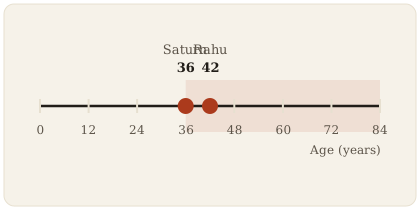
Two facts about time belong in every honest reading. First, the dasha window: the tradition's rule is that this conjunction is felt most sharply during the dashas and sub-periods of Saturn or Rahu. In charts where these dashas arrive in youth, the dosha opens early and sharply, but the middle years then move into lighter periods; in charts where they arrive late, early life may be easy and midlife heavy. Neither pattern is better or worse; the same karmic material is simply distributed across different life stages. Second, the maturity clock: the tradition matures Saturn around age 36 and Rahu around 42, and the studied source says most people describe life easing meaningfully from the late thirties. The figure above shows this clock. Its practical meaning: the conjunction behaves, by the sources' claims, not like a "lifelong curse" but like a long-arc lesson: the gifts arrive after the lessons, but they arrive.
The other side: grit and a talent for difficult systems
The studied sources record the other side too, as a claim: this very Saturn-Rahu conjunction is said to give grit, strategic patience and a talent for working with difficult or unconventional systems. astroask.net writes that this signature is frequently found in the charts of strong researchers, turnaround specialists and people who thrive in foreign lands. nakshtratak.com's conclusion carries the same spirit: people who keep going with discipline and service often achieve solid, lasting results, because the burden lifts once the lesson is accepted rather than resisted. Again, these are claims, not measurements; but at least this much is clear: selling this conjunction as "purely destructive" contradicts the sources' own balance.
Remedies: service is the currency, discipline the method
The tradition's remedies aim to balance both Saturn and Rahu, and the sources agree on one formula: not a one-time ritual but sustained practice over months and years. In mantra practice: the Shani beej mantra "Om Sham Shanaishcharaya Namah" on Saturdays, the Rahu beej mantra "Om Bhram Bhreem Bhroum Sah Rahave Namah", the Mahamrityunjaya mantra, and the Hanuman Chalisa; the Chalisa's popularity rests on the folk story that Hanuman freed Shani from Ravana's captivity, so Shani troubles Hanuman's devotees less. In charity: black sesame, mustard oil, iron items or blankets on Saturdays; feeding crows and people in need. And at the centre, service: serving the elderly, the poor, labourers and the disabled, since these are Saturn's significations; one source says plainly that service is the currency in which the debt of Saturn and Rahu is paid. Alongside, a firm warning: do not wear blue sapphire (Saturn) or hessonite (Rahu) without a study of the whole chart; astroask.net calls these the two easiest stones to get wrong, capable of amplifying the very thing being settled. And finally, the least-mentioned remedy: conscious engagement with the karmic pattern itself; Saturn rewards discipline and promise-keeping, and Rahu calms when shortcuts are abandoned.
The balanced view
This article's position is plain. Remove the word "Shrapit" and underneath lies an ordinary Saturn-Rahu conjunction whose meaning shifts with house, sign, aspect, dasha and time, and which the sources call an over-dramatised label. But dismissing the name as mere fear-selling is also incomplete: in the narrative frame a curse always arrives with a cause and a release, and the tradition's remedy set, service, discipline, remembrance, charity, is in itself a way of living that is wholesome independently of the chart. The most useful reading: treat this conjunction not as a punishment but as a long-arc lesson in discipline, whose examination is patience and whose result, by the sources' claim, arrives late but arrives to last.
Common confusions
First confusion: the name contains a curse, so life is cursed. The name is a later label and a metaphor; the sources call it over-dramatised, and both the softeners and the maturity clock describe it loosening with time. Second: the moment the conjunction is found, marriage, wealth or health is ruined. The sources say plainly that one afflicted pairing does not sink any of these subjects; they are governed by many factors at once. Third: one expensive ritual erases the dosha in a stroke. The tradition's own frame is sustained practice; Saturn is considered the opponent of one-time interventions. Fourth: a gemstone is the fastest remedy. Blue sapphire and hessonite are the riskiest options, reserved until after a full chart review; the safe remedies are service, charity, mantra and Saturday discipline, and they are free.
Practical use
Use this article in three ways. First, as method literacy: knowing the definition, the house-sign levels and the softening conditions, you can test any "Shrapit" diagnosis yourself and ask how many of the five softening checks apply. Second, as decision safety: before buying an expensive ritual or a gemstone on the strength of the name, remember that the sources' own remedies are free and sustained; gemstones are off-limits without a full review. Third, as perspective: if life is currently carrying a cluster of delays, the pattern of the maturity clock and the dasha window offers a frame for patience, and the service-and-discipline remedy set turns that patience into daily work; the frame is useful whether or not you accept astrology.
Sources and the honesty note
The name's etymology, the formation rules, the degree subtlety, the house-wise table, sign dignity, reinforcing markers, the methodological subtlety of "softeners, not cancellation", the dasha window and the mantra-charity-service remedies come from the Shrapit Dosha article at paramarsh.app; the point that the label is later rather than a single direct diagnosis from the early texts is also that source's, and we have not opened the root texts ourselves. The timing-over-talent reading, the dusthana-upachaya contrast, the maturity ages (Saturn 36, Rahu 42), the "over-dramatised label" remark and the gemstone warning come from the Shrapit Dosha article at astroask.net. The "service is the currency" conclusion is from nakshtratak.com, and the sustained-practice method from the jagannathhora.com article. Everything about effects is presented as the tradition's or the sources' claim; there is no established measured causal link between a chart configuration and a life outcome. This article is educational; it makes no claim about any person's chart or future.


