The sixth house: health, debt, conflict
A guide to the sixth house as the traditional symbol of daily obstacles, service and the capacity to cope.
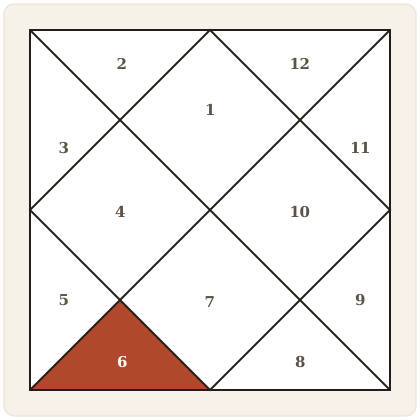
The sixth house of the chart is called Ari Bhava, the "enemy house", and in some sources also Roga Bhava, the "disease house". The names need not frighten: in the tradition this house covers all the subjects of daily life that must be dealt with as recurring work - competition and disputes, the health routine, debt, service work, and every obstacle that keeps coming back. Its body region is the lower abdomen and the digestive tract. The most distinctive thing about this house is its double classification: the sixth is both a dusthana and an upachaya - hard, but a hardness that improves with time and effort. This is the one house where the tradition usually counts cruel planets favourable. This article explains what the sixth house covers, how it is read, and where the tradition ends and medicine, law and arithmetic begin.
Two names, one thread
"Ari" means enemy and "roga" means illness - both are names of difficulty, but in the tradition their meaning is not "curse" but "work to be dealt with". The Parashari tradition discusses this house in its own dedicated chapter, and its list of significations runs: open enemies, daily conflict, lawsuits, disease, debt, the obligations of service work, and everything that must be overcome on a recurring daily basis. The karaka schema also places maternal uncles in this house. Notice that every item in the list is "daily": even disease enters here in the sense of the long-running, routine obstacle, not in the sense of some dreadful event. The sixth house is the corner of the chart that says some things in life are won not once but every day - and that is exactly this house's dignity.
The health theme: the most careful reading
The health theme of the sixth house demands the most balance in all of astrology, so let the boundary be stated first: no house of any chart is a diagnosis, a prognosis or a treatment. If there are symptoms, the first and final address is a qualified doctor; tests, vaccination and treatment are the territory of modern medicine. In the tradition the sixth house is read for the leaning of one's health routine - for example attention toward daily habits, or a tilt toward carelessness about fatigue. The karaka planets are Saturn (for disease and debt) and Mars (for conflict). The useful form of this reading is that a person identifies the weak link of their routine - sleep, food, exercise - and fixes it. That work happens with a clock and a doctor, not with a chart; the chart can only remind us that health too is a game won by those who win daily.
Debt: the tradition of borrowing and the arithmetic of it
The second great subject of the sixth house is debt. The tradition reads here the tendency around taking and repaying loans and the capacity to wrestle down a debt burden, and Saturn is named the karaka for this very theme. Here too the same formula: the house describes a leaning; the decision about a loan is described by arithmetic. Borrowing or not borrowing rests on the mathematics of interest rate, instalment, income and emergency fund - not on any planetary condition. The tradition's useful lesson is this: debt enters this house as a "thing to be dealt with" - a loan is no curse but an obligation that lifts with discipline. The person who respects the date of every instalment is, in the tradition's language, performing the finest practice of their sixth house.
Enemies, competition and disputes
The modern meaning of "ari" is not the imagining of enemies; its subjects are competition, disputes, friction and occasionally lawsuits. The tradition discusses a strong sixth house in the case of a person who holds up in competition and comes out by resolving disputes, and Mars is named the karaka of exactly this capacity for contest. Keep two boundaries plain: first, declaring someone a "chart enemy" over a disagreement is not this tradition's purpose - relationships mend through conversation. Second, the decision in lawsuits and legal disputes rests on the advice of legal specialists and on evidence - not on transits. In today's language the sixth house's conflict theme says this: competition is a permanent part of life, and the capacity to hold up in it can be built.
Service: the bright side of the sixth house
In the tradition the sixth house is also the house of service - daily labour, routine work and the work of lifting others' difficulties. A well-placed sixth lord is discussed in the case of people who work in the healing professions, the armed forces, or any field of daily contest with disease, disorder or difficulty. From this angle the sixth house is the chart's most hard-working house: its joy lies not in achievement but in resolving. In modern life it is that nurse, that doctor, that soldier, that sanitation worker, that social worker who lightens the load of other people's sixth houses. The tradition also calls service a remedy of the sixth house - and this is perhaps this house's most practical teaching: one way to deal with hardship is to reduce someone else's.
The maternal uncle and the daily support system
A small traditional subject of the sixth house in the karaka schema is the mother's brother - the maternal uncle. Notice the fit: the mother is seen from the fourth house, and her siblings follow in the next. The tradition discusses relationships tied to the maternal side from this house. From this small subject a larger formula can be drawn: the sixth house is also the house of "daily supports" - the relationships and arrangements that come to hand first in hard times. In modern life this circle extends to everyone who keeps our daily system running - household help, colleagues, the family doctor nearby, the friend who arrives first in need. In the tradition's view the quality of these supports is also part of the capacity to cope - and keeping them well is daily work too.
Both dusthana and upachaya: the double classification
The real key to the sixth house is its double classification. On one side it is a dusthana: the sixth, eighth and twelfth houses are counted as places of hardship. On the other side it is also an upachaya: the third, sixth, tenth and eleventh houses are counted as "growing" places, whose subjects improve with time and effort. The two together describe the sixth house's character: it is hard, but its hardness is cast into tested strength. This is why the tradition usually counts cruel planets here - Mars, Saturn, the Sun - as favourable: in an upachaya, harsh energy is seen turning into the capacity for contest. And this is why calling the sixth house simply "a bad house" and moving on is a half-understanding - this is the house that tells how hard times are dealt with.
Where the sixth lord sits
In traditional shorthand: the sixth lord in the sixth itself speaks of firmness in competition and the capacity to deal with illness and debt; in the tenth, of work in a field of service or competition; in the third, of courage joined to contest; and in the twelfth, of hardships slowly lifting or of service in a distant field. The lord's dignity - own sign, exaltation, a friend's sign - strengthens or weakens these leanings, and at the end the condition of the karakas, Mars for conflict and Saturn for disease and debt, is weighed alongside. All of these are symbolic readings: conclusions about anyone's health, debt or disputes come not from them but from the facts of a life.
Planets in the sixth house
In traditional shorthand: Mars in the sixth house is counted favourable, with talk of victory over competitors and technical discipline. Saturn here speaks of long patience and a service routine; the Sun of confidence in competition and disputes tied to authority. Mercury here is discussed as analytical work and precision with accounts; Jupiter as expansion in a field of service and the peaceful resolution of disputes; Venus as gentleness in the service professions and sometimes a caution about carelessness in food and drink. The Moon in the sixth speaks of a mind tied to routine; Rahu of competition in unconventional fields, Ketu of service done without display. All of these are tendency-indicators; the sign, the aspects and the lord's condition keep reshaping the final picture - and on the health theme the facts always come from tests and doctors.
The question of time: when it activates
The sixth house's themes - seasons of competition, the need for attention to the health routine, a period of debt repayment - are seen coming into discussion when the mahadasha or antardasha of the sixth lord or of the karakas runs. Mars's mahadasha lasts seven years and Saturn's nineteen. The value of this discussion lies in understanding a leaning toward preparedness - not in fixing the date of an illness or a dispute. The timing of a health check is set by the doctor, the instalment's date by the bank, and the date of a hearing by the court; the chart is the calendar of none of these.
Common misconceptions
First: "the sixth house is bad; fear it." The tradition itself counts it an upachaya - this house tells how hardship is dealt with, and cruel planets here are usually counted favourable. Second: "a planet in the sixth house means certain illness." Never. The state of health is learned from tests and doctors; the house, its lord and the karaka are tendency-indications. Third: "an empty sixth house means no obstacles in life." Empty houses are normal; then the sixth lord, the aspects and the karakas are read - and obstacles come and go in every life. Fourth: "debt is written in fate." A loan is a financial decision that lifts with arithmetic and discipline; calling it fate and leaving it alone is the worst possible conduct.
The sixth house in our times
Modern life is filled with the sixth house's subjects: gig work and competitive jobs, the routine of EMIs, the fatigue of seated work, and small disputes waiting to be resolved. Public-health science tells us that routine-driven illnesses - those tied to sleep, food and sitting - are among today's leading health burdens; that fact comes from research, not from charts, but it rhymes with the sixth house's traditional lesson: what arrives daily is mended only by daily attention. The modern benefit of knowing this house is recognising our own "daily resistance style" - one person deals by confrontation, another by postponement - and then resolving whatever the daily question is, dispute, instalment or routine, through small daily decisions. That old remedy of service works just as well today: doing work that lightens someone's hardship makes one's own hardship feel lighter - an experience open to any chart.
A reading exercise: keep symbol and evidence apart
Take a hypothetical chart with Capricorn in the sixth house, so the sixth lord is Saturn. Suppose Saturn sits in the tenth house. The student first reads the framework: the house (the sixth, service and competition), the lord (Saturn, in the tenth, the career field), the karakas (Mars for conflict, Saturn for disease and debt). The traditional reading: a leaning toward work in a field of service or competition. Now the second step - this is a tendency-statement, not a verdict on profession or health. That person may be a doctor, may be an athlete, may be a bank officer handling loan recovery - or none of these. The real information will come from their education, their job and their health record. Record what matches, record what does not. This exercise keeps the tradition a study, not a trade in fear.
At a glance: the sixth house's subjects
| Aspect | Traditional subject |
|---|---|
| Names | Ari Bhava, Roga Bhava |
| Main subjects | Competition and disputes, the health routine, debt, service work, daily obstacles, the maternal uncle |
| Body region | Lower abdomen, digestive tract |
| Karakas | Mars (conflict); Saturn (disease and debt) |
| Classification | Both dusthana (6, 8, 12) and upachaya (3, 6, 10, 11) - a hardness that improves with effort |
| Special trait | Cruel planets here are usually counted favourable |
| Related houses | Courage - the 3rd; career - the 10th; gains - the 11th |
An honest note
Astrology is a traditional system, not laboratory science. Take decisions about health, debt or any dispute with qualified professionals - doctors, financial advisers, lawyers; treat the chart as context, never the only basis. If symptoms appear, the first address is always a doctor. Sources actually consulted for this article: the sixth house's significations, the Mars and Saturn karaka roles, the double dusthana-upachaya classification and the service signature from satyori.com/jyotish/articles/twelve-houses-overview/; planetary karaka confirmations from satyori.com/reference/grahas/; and the Vimshottari dasha years from panchangtime.com/methodology/vimshottari-dasha. Our aim is to explain the tradition in plain words, not to sell fear or make promises.
Questions on this article
What does the sixth house signify?
The tradition places competition and disputes, the health routine, debt, service work and daily obstacles here. These are symbolic meanings, not evidence about any person.
Is the sixth house a bad house?
The tradition counts it both a dusthana and an upachaya - hard, but a hardness that improves with time and effort. Cruel planets here are usually counted favourable, and it is also the house of service and the capacity to cope.
Can illness be known from the sixth house?
No. No house of any chart is a diagnosis or a prognosis. The house, its lord and the karaka give tendency-indications; for any symptom, tests and treatment belong with a qualified doctor, first and last.
Which planets are the karakas of the sixth house?
Mars for conflict and competition; Saturn for disease and debt.


