The Sun in Vedic astrology: karaka of soul, father and confidence
The Sun is the karaka of soul, father, authority and self-confidence. Learn the traditional signs of a strong or weak Sun in a kundli and the simple remedies.
In Vedic astrology the Sun is the king of the nine grahas. It is the only one that shines with its own light; every other body reflects it. That is why the Sun in a kundli stands for the atman, the inner self: who you are when nobody is watching. This article explains what the Sun signifies in the tradition, what a strong or weak Sun is said to look like, and the simple remedies the parampara suggests.
What is the Sun karaka of?
A karaka is a significator, the planet that stands for a subject. Classical texts assign the Sun these portfolios:
- Soul and self-confidence: how you see yourself; your inner dignity.
- Father: the relationship with the father and indications about his situation.
- Authority and government: government jobs, position, prestige, leadership.
- Health and vitality: physical stamina, immunity, the eyes (especially the right eye in a male chart), the heart and bones.
- Honour: social respect and reputation.
So whenever a question touches career, government work, the father or self-worth, the astrologer reads the Sun first.
The Sun's signs: own, exalted, debilitated
Every graha has an own sign, an exaltation sign and a debilitation sign. For the Sun:
| State | Sign | Traditional meaning |
|---|---|---|
| Own sign | Leo | The Sun is comfortable and delivers naturally |
| Exalted | Aries (deepest at 10 degrees) | The strongest placement; leadership and confidence run high |
| Debilitated | Libra (deepest at 10 degrees) | The Sun is at its weakest; self-belief and authority fluctuate |
| Moola trikona | Leo 0-20 degrees | A zone of special strength |
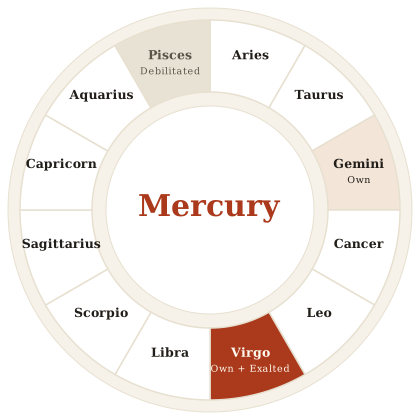
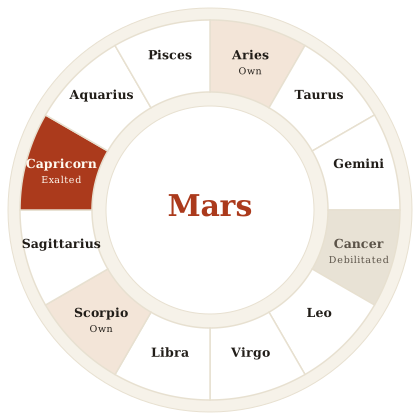
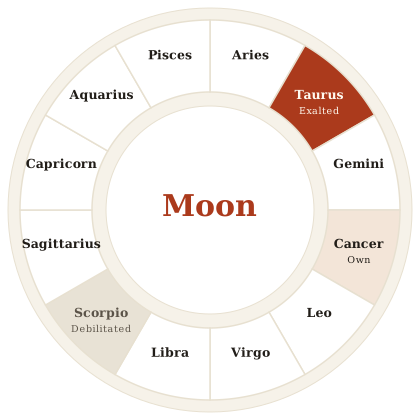
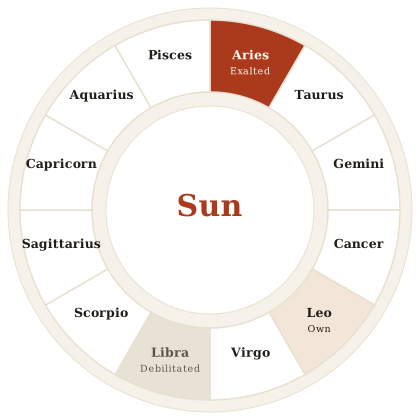
A debilitated Sun is not a curse. People with the Sun in Libra often learn to lead by putting others first and do well in partnerships and service. There are also neecha-bhanga (cancellation) combinations that lift the debilitation substantially. Never judge from the sign alone: degree, house, aspects and conjunctions complete the picture.
Friends, enemies and neutrals
Inter-planetary friendship shapes results too. The classical list for the Sun:
- Friends: Moon, Mars, Jupiter
- Enemies: Venus, Saturn
- Neutral: Mercury
A Sun-Saturn conjunction or mutual aspect is read like a father-son clash, since the two are natural enemies. The tradition describes early distance from the father or friction with authority. This is not fate: many such natives become stronger by standing on their own feet.
Signs of a strong Sun
The tradition considers the Sun strong when it is:
- in its own sign (Leo) or exalted (Aries),
- placed in a kendra (1, 4, 7, 10) or trikona (1, 5, 9) house,
- aspected or joined by friendly planets and free of malefic pressure,
- placed in the 10th house (digbala, directional strength),
- in a day birth (divabala, the day-strength division).
- combustion is no concern here: the Sun is never combust; that check belongs to the other planets.
A strong Sun shows up as self-belief, leadership and dignity. Such people accept responsibility and often rise in administration, politics, medicine or management. Too much force can tip into pride, so balance matters.
Signs of a weak Sun
The Sun is considered weak when debilitated, in an enemy sign, afflicted by Saturn or the nodes, or unsupported in the 6th, 8th or 12th house. The traditional indicators include:
- low or fluctuating self-confidence,
- distance, disagreement or health worries around the father,
- delays and friction in government-related work,
- a tendency toward eye, heart or bone complaints,
- struggling for recognition, or clashing with superiors.
These are general indications. Ten other factors in the chart modify every one of them, and no single weak planet decides a life.
Sun mahadasha and transits
In the Vimshottari system the Sun mahadasha runs for 6 years. It is read as a period when self-development, career responsibility, and matters of father or government move to the foreground. A strong Sun's dasha is said to bring position and honour; a weak or afflicted Sun's dasha is when the tradition advises watching ego clashes, friction with superiors and the father's health.
In transit the Sun changes sign every month, and this movement creates the solar months and sankrantis. Festivals like Makar Sankranti and Mesha Sankranti are anchored to the Sun's sign change.
Traditional remedies
The parampara suggests simple, harmless remedies to strengthen the Sun:
- Arghya: offering water to the rising Sun from a copper vessel.
- Mantra: "Om Ghrinih Suryaya Namah" or the Aditya Hridaya Stotra.
- Vrat: a Sunday fast; donating jaggery and wheat.
- Conduct: respecting the father and elders; keeping one's word. The tradition calls conduct the greatest remedy of all.
Ruby (manik) is the Sun's gemstone, but a gemstone can backfire if the Sun rules difficult houses in your chart. Never wear one without showing the full kundli to a competent astrologer.
The Sun through the twelve houses, briefly
The house the Sun occupies is where the soul's energy concentrates, says the tradition. The short classical readings:
- 1st house: a commanding presence and self-respect; sometimes tipping toward pride.
- 2nd house: direct, blunt speech; earnings linked to government; notes about eyes or teeth.
- 3rd house: courage, influence among siblings, a bent for media and writing.
- 4th house: friction with the mother or worry about her health; a need to hold authority at home.
- 5th house: intelligence, pride in children; classical texts discuss delay in childbirth.
- 6th house: victory over rivals, success in competition; digestion-related complaints mentioned.
- 7th house: a self-respecting spouse; possible ego clashes in marriage.
- 8th house: sudden ups and downs; disputes over inheritance discussed in texts.
- 9th house: fortune, dharma and the father's blessing; gains through travel.
- 10th house: the Sun at digbala; career heights and administrative ability.
- 11th house: good income sources; gains through elders and seniors.
- 12th house: foreign residence, a bent for working in solitude; advice to watch expenses.
These are starting formulas only; sign, aspects and house lords keep modifying them.
Career and the Sun
The Sun rules administration, government, leadership and prestige. The tradition links a strong Sun to the civil services, politics, management, medicine (especially heart and eye fields), the energy sector and public enterprises. When the Sun ties into the tenth house, positions of responsibility are said to arrive early. Treat this as an indicator of inclination, never a guarantee: examinations and hard work remain non-negotiable.
The traditional view on health
Ayurvedic astrology associates the Sun with pitta, bone strength, the heart and eyesight. An afflicted Sun is said to indicate a tendency toward weak vision, bone aches and fatigue. These are indicators, not diagnoses. For any symptom, a qualified doctor is the real step; remedies never replace treatment.
Classical correspondences
| Subject | Sun |
|---|---|
| Day | Sunday |
| Direction | East |
| Colour | Copper-red, saffron |
| Metal | Copper, gold |
| Gemstone | Ruby (wear only on expert advice) |
| Deity | Surya Narayan; Arka, Bhaskar and Divakar are common names |
| Dasha length | 6 years (Vimshottari) |
| Element | Fire |
Puranic background
The Puranas call the Sun the eye of the world. The Ramayana tradition tells of the sage Agastya teaching the Aditya Hridaya Stotra to Shri Ram on the battlefield, whose recitation restored his courage. The Sunday fast and the morning water offering grew from the same stream of gratitude, and the surya namaskar of the yoga tradition belongs to that long family.
How to check the Sun in your own chart
Our free kundli tool builds your chart from your birth date, time and city. In it, the Sun is marked "Su". Look at which sign and house it sits in, which planets join it, and whether Saturn, Rahu or Ketu aspect it. Then compare with the strong-weak indicators above. For a deeper reading, showing the full chart to an experienced astrologer remains the right step.
The Sun through the twelve signs: quick reference
The table below summarises the Sun's classical temperament in each sign. Treat it as a starting point; house and aspects give it shape.
| Sign | Traditional temperament |
|---|---|
| Aries (exalted) | Aggressive leadership, quick decisions, a pioneer's drive |
| Taurus | Steady authority; self-worth tied to wealth and stability |
| Gemini | Intellectual identity; confidence in writing and speech |
| Cancer | Identity woven into feelings; leadership for the family |
| Leo (own sign) | Natural regal confidence, generosity, love of the stage |
| Virgo | An analytical ego; identity through service and precision |
| Libra (debilitated) | Identity through others; hesitation in decisions; strength in partnership |
| Scorpio | Deep, intense nature; private power and capacity for transformation |
| Sagittarius | A philosophical ego; identity tied to dharma, teaching and travel |
| Capricorn | Practical ambition, step-by-step rise; struggle under Saturn's sign |
| Aquarius | Identity tied to social good, unconventional thinking; a restrained ego in Saturn's sign |
| Pisces | A gentle, imaginative ego; contentment through service and sacrifice |
Sun with Rahu or Ketu: the eclipse combination
When the Sun sits with Rahu or Ketu, the tradition calls it a "grasta" or eclipsed Sun. Indications include friction with the father, sudden rises and dips in reputation, and phases of self-doubt. Remember that countless births every month carry this combination, and most such people live ordinary, meaningful lives. The difference is one of homework: these natives learn to build identity from their own actions, not from others' approval.
The Sun in relationships
The Sun signifies the father, the husband (in the classical reading of a woman's chart) and elders. Families of a strong Sun decide clearly, though a chill of "I alone am right" can creep in. For a weak Sun the tradition describes an absent father or concern for his health. In either case, relationships are nourished by respect and conversation; planets show the temperament, our conduct builds the bond.
A few common myths
- "A debilitated Sun ruins life." Wrong. It teaches humble leadership; many successful artists, lawyers and social workers carry it.
- "Wearing a ruby instantly strengthens the Sun." Gemstones do not change fate, and the wrong one can cause discomfort.
- "Sun dasha guarantees a government job." A dasha opens the door of opportunity; preparation and merit walk through it.
Sub-periods within the Sun mahadasha
The six-year Sun mahadasha divides into nine antardashas. Their classical character, in brief:
| Sub-period | Length | Traditional character |
|---|---|---|
| Sun-Sun | 3 months 18 days | Rising confidence, new responsibility |
| Sun-Moon | 6 months | Mental peace; auspicious matters around mother and home |
| Sun-Mars | 4 months 6 days | Energy and initiative; advice to avoid disputes |
| Sun-Rahu | 10 months 24 days | A volatile phase; guard the reputation |
| Sun-Jupiter | 9 months 18 days | An auspicious stretch of guidance and progress |
| Sun-Saturn | 11 months 12 days | Hard work and delays; patience with superiors |
| Sun-Mercury | 10 months 6 days | Intellectual work, gains through writing and trade |
| Sun-Ketu | 4 months 6 days | Solitude and introspection; a spiritual pull |
| Sun-Venus | 12 months | Growing comforts, sweetness in relationships |
The lengths follow the Vimshottari proportions. Actual results depend on the placement of both planets in the chart.
The Sun in daily routine
The tradition also reads the Sun as the planet of discipline. People who feel lazy, unstructured or low on confidence are given three simple practices: rise at a fixed time, take a few minutes of morning sunlight, and finish the day's hardest task first. These habits help whether you read them as astrology or as modern health advice. In that sense a Sun remedy is not only a mantra; it is an ordered way of living.
The Sun, the seasons and the ayanas
The Indian panchang is both solar and lunar. The Sun's passage through the signs makes the twelve solar months and fixes the sankrantis such as Makar Sankranti on 14 January. The six months from Makar Sankranti to Karka Sankranti are Uttarayana, when the days grow longer; the six that follow are Dakshinayana. The tradition treats Uttarayana as the day of the gods and favours it for auspicious undertakings. This cycle, tied to the tilt of the earth's axis, is exactly what astronomy describes as the changing seasons: here tradition and sky-math say the same thing in two languages. That is why calling the Sun the spine of the panchang is no exaggeration: the tithi comes from the Moon, the month from the Sun, and the rhythm of days from the two together.
An honest note
Astrology is a traditional system, not laboratory science. The meanings attached to the Sun come from centuries of symbolism and observation. See a doctor for anything medical; treat astrology as context for career decisions, alongside your skills and effort, never as the only basis. Sources consulted for the traditional placements and correspondences here: the dignity table of own sign, exaltation and debilitation with degrees, from the Saravali translation at saravali.github.io/astrology/dignities.html; the graha correspondence reference (day, direction, colour, gemstone, deity, dasha years) at satyori.com/reference/grahas/, and the Vimshottari dasha year-table at panchangtime.com/methodology/vimshottari-dasha. These present the classical Parashari framework; where traditions disagree, the text above says so. Our aim is to explain the tradition in plain words, not to sell fear.
Questions on this article
In which sign is the Sun exalted?
The Sun is exalted in Aries (deep exaltation at 10 degrees) and debilitated in Libra. Leo is its own sign.
What are the remedies for a weak Sun?
Traditional remedies include offering water to the Sun at sunrise, reciting the Aditya Hridaya Stotra, keeping a Sunday fast, and donating jaggery and wheat. Consult a qualified astrologer with your full kundli before wearing any gemstone.
How long does the Sun mahadasha last?
In the Vimshottari system the Sun mahadasha lasts 6 years.


