Taurus (Vrishabha): The Steady Ground of the Zodiac
Vrishabha is the ground that holds the spark of Mesha: Venus’s fixed earth, patience that refuses to be rushed, and the Moon’s garden. From the classical verse to the modern sign profile, the art of sustaining and the refusal to move, with sources, and with an honest-limits note.
Where the spark of Mesha lands, something must hold it. The second sign of the zodiac, Vrishabha, is that holding: thirty degrees of fixed earth, the bull that does not charge but stands its ground, and the sign Satyori’s Vrishabha guide compresses into one line, that where Mesha initiates, Vrishabha stabilizes. This article audits that steadiness in full: the sign’s structure, the classical verse on a Taurus Moon, the ruling planet and a famous exaltation, the traditional tendencies in personality, career, relationships and health, and at the end an honest-limits note.
Everything below comes from sources fetched on 31 October 2026: Satyori’s Vrishabha rashi guide, the seventeenth chapter of the Brihat Jataka available at VedicPupil (which we read directly, in that page’s English translation), Wikipedia’s Taurus article for the tropical-sidereal difference and a remarkable piece of history, and PanchangTime’s Vimshottari dasha guide for Venus’s period. Where a tendency belongs to a source, the source is named; where a note is ours, it is marked. Sign description is the tradition’s framework; we give it as description, not as diagnosis.
The second cell: the structure
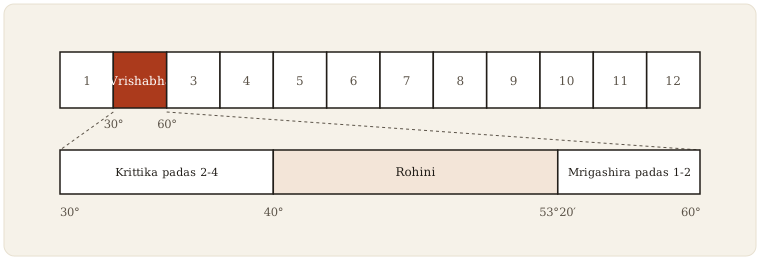
Per Satyori, Vrishabha is the second sign of the zodiac, spanning 30 to 60 degrees. Its symbol is the bull, which does not charge recklessly like the ram but stands with quiet, immovable strength. Its element is earth, its character sthira, fixed, the sustaining kind, and it is classed in the feminine group. The ruling planet is Venus. In the Vedic tradition of the Kalapurusha, the cosmic person of time across whose body the twelve signs are laid, Vrishabha is the throat and face: the part that receives nourishment and gives voice, which is why taste, speech and song keep returning in this sign’s portrait. Being a fixed earth sign means this is the earth that stays put: the capacity to receive, to hold and to keep what life offers. Satyori frames it as the principle of sustenance; being the second sign is not a step down from the first, it is what makes the first sign’s beginning last.
Vrishabha holds three nakshatra segments: the second, third and fourth padas of Krittika, all of Rohini, and the first two padas of Mrigashira. Each nakshatra in the zodiac spans 13 degrees 20 minutes, so Krittika’s remainder runs from 30 to 40, Rohini from there to 53:20, and Mrigashira’s first half from 53:20 to 60; this follows the standard nakshatra division. Two Vrishabha natives can therefore belong to different nakshatras within the same sign, and in Jyotish the nakshatra carries its own weight. This site carries a separate guide for each of the twenty-seven nakshatras, including Krittika, Rohini and Mrigashira; here it is enough that the sign sets the frame and the nakshatra paints the finer shade within it.
One more boundary line matters: in Indian usage ‘rashi’ usually means the Moon sign, the sign the Moon occupied at the moment of birth. The classical chapter we quote below is titled exactly that, Chandra-rashi-sheel, the characters of the Moon signs. A chart also has a lagna, the sign on the rising horizon, and a Sun sign; the three signify different things. And Satyori adds in one line that the condition of Venus in the chart strongly influences how Vrishabha expresses in a life. The sign, in other words, is one axis, not the whole picture.
Vrishabha and Taurus: two scales, one sky
In Western astrology Taurus is the same second sign: the bull, the earth element, the fixed quality, Venus as ruler, and Scorpio opposite; per Wikipedia, in the tropical system the Sun transits it roughly from 21 April to 21 May. But the tropical zodiac is bound to the equinox point, while the Vedic sidereal zodiac is bound to the stars. Satyori states the gap between them as an ayanamsha of about 24 degrees. The practical result: a person whose Western sun sign is Taurus may have Vrishabha as the Vedic rashi, or may have Mesha; it is not the date that changes but the scale. This article speaks of Vedic Vrishabha, and for date boundaries rely on your own panchang or chart calculation. Wikipedia also notes that the sign of Taurus does not entirely align with the constellation of Taurus; a sign is a thirty-degree measure, not a star picture.
One historical detail from that page deserves its own paragraph. Per Wikipedia, Taurus was the first sign of the zodiac established among the Mesopotamians, who called it the Great Bull of Heaven, because in the Early Bronze Age, roughly 4000 to 1700 BC, the Sun rose through this constellation at the vernal equinox. That is, the bull once stood where the ram stands now; the slow precession of the equinoxes moved the starting line, and Aries took the gate. For a sign whose whole character is staying put, there is something fitting in the fact that even its first place did not stay put.
What the classical text says: the Brihat Jataka’s Taurus Moon
Varahamihira’s Brihat Jataka is among the root texts of Jyotish, and we read its seventeenth chapter, Chandra-rashi-sheel, directly on VedicPupil’s page, in that page’s own English translation of the Sanskrit. The chapter gives each sign’s result when the Moon stands in it. The Taurus verse, 17.2, in that translation: handsome, with a playful gait, broad thighs and face, with marks on the back, face and sides, generous, bearing hardship, a master, with a raised hump-like shoulder, having daughters, phlegmatic; parted from his former kin, wealth and children, or, as the page’s alternative reading gives it, without kin, wealth and children in early life; fortunate, forgiving, with strong digestion, fond of women, with steady friends, happy in the middle and last parts of life. This portrait is of fourteen centuries ago, and it carries its own time’s way of speaking; we have recorded it as it stands.
The verse’s arc is worth pausing on, because it is unlike the other signs’ verses. The page’s own simple meaning reads: handsome, generous, patient, steady friends; early losses may come, and happiness grows in middle and later life. Loss first, settling later: the classical portrait of the fixed earth sign is itself fixed around the idea that what Vrishabha builds, it builds slowly and late. Generosity and strong digestion sit in the same verse as marks on the skin and a playful gait; the classical style mixes body, temper and fortune without sorting them, and we have kept them unsorted.
The seventeenth chapter’s thirteenth verse sets the condition that applies to every sign: the stated qualities come fully only when the Moon is strong and the sign’s lord is strong; otherwise the indications require further consideration. In plain words, the text itself says a sign reading is a general sketch, not a verdict on any one birth chart. The tradition’s own caution remains as precise today.
One more detail from the page gives context: the Brihat Jataka is a work of 409 verses in 28 chapters, and the seventeenth chapter gives the Moon-sign results for all twelve signs, one verse each; the English we read is VedicPupil’s own translation. It is useful to know how compressed the classical description is: more than twenty traits in a single verse, without commentary. A modern sign guide, such as Satyori’s, unfolds those same seeds into the context of present-day life; the two are best read with one eye, the seed from the text, the growth from today’s commentary.
The ruling planet: Venus, and the Moon’s garden
Venus is Vrishabha’s lord, and per Satyori the sign embodies what Venus stands for here: the capacity to receive, hold and enjoy what life offers; material security, sensory pleasure, enduring values. If Mesha’s Mars is the engine that starts the journey, Vrishabha’s Venus is the ground that makes the journey worth taking. The modern sign profile on the same page fills in the colours: a refined aesthetic sense, and genuine appreciation for beauty, music, good food and physical comfort. Venus has its place in the timing tradition too. Per PanchangTime’s Vimshottari dasha guide, the Venus mahadasha runs 20 years within the 120-year Vimshottari cycle, the longest planetary period in that cycle; when a Vrishabha native’s Venus period runs, the sign’s own ground sits underfoot for a long stretch. This too is description, not prediction.
Vrishabha also carries the tradition’s most famous exaltation. The Moon is exalted here, and both our sources fix the exact degree: 3 degrees. Satyori’s explanation is one of the fine passages of sign astrology: the Moon finds exaltation in Vrishabha because this sign provides the emotional stability and material comfort the Moon needs to feel secure; the lush, fertile nature of Venus-ruled earth gives the Moon a garden in which to flourish, making this placement, in that page’s words, one of the most contented in all of Jyotish. On the debilitation side there is a real source difference, which we leave unresolved as the sources stand: Satyori’s quick facts record no debilitated planet for Vrishabha, and note in brackets that Ketu is debilitated here per some traditions. We record both readings; we do not silently reconcile them.
Personality, career, relationships: the traditional tendencies
The traditional personality description, per Satyori’s Vrishabha profile: grounded, sensual, and deeply loyal once committed; valuing consistency, remarkably patient in pursuit of long-term goals. The fixed nature’s other face is stubbornness: once the mind is made up, that page says, persuasion is nearly impossible. The classical verse’s ‘bearing hardship’ and ‘forgiving’ become, here, the same coin: the bull endures, and the bull remembers what it has decided. Notice how the classical seed and the modern profile track each other across fourteen centuries: generosity, patience and steady friends run through both, and so does the hint of appetite, in the verse’s ‘strong digestion’ and the profile’s love of good food.
For career, Satyori’s list is long and characteristically tangible: finance, agriculture, luxury goods, the arts, music, food and real estate; artisans, chefs, bankers and investment managers. The reasoning matters more than the list: Vrishabha builds wealth steadily rather than through speculation, preferring reliable income streams to high-risk ventures, and needs work environments that feel physically comfortable and aesthetically pleasing. The same page adds the tradition’s own hedge, that career outcomes depend on the tenth-house lord, planetary periods and overall chart strength; a sign preference is not an employment forecast.
In relationships, per the same profile, Vrishabha natives are among the most devoted and physically affectionate partners in the zodiac, expressing love through acts of service, touch and a beautiful shared environment. Loyalty is named non-negotiable: betrayal is the one thing they cannot forgive. The classical ‘steady friends’ becomes, here, a partnership’s real foundation. The profile adds a balance too: possessiveness can become an issue, and it offers a generous reading, that Vrishabha’s desire for closeness comes from genuine depth of feeling, not insecurity. We give that reading in the source’s name; whether it fits any one person is that person’s own testimony.
Health: the traditional reading
Per Satyori, Vrishabha’s vulnerable areas are the throat, thyroid, neck and lower jaw, and its tendencies run toward kapha-type conditions: weight gain, sluggish metabolism and congestion; the page adds that the love of rich food and comfort can exacerbate these if unchecked, and suggests regular movement and avoiding excessive sweet and heavy foods. Its dosha note ties the sign to kapha affinity through the earth element and Venus rulership, with a tendency toward accumulation in both body and possessions. All of this is that source’s Ayurvedic framing, which we have given in its name; this article offers no medical advice, and for any symptom the doctor is the authority. If you are pregnant, ill, elderly or on medication, any fasting or lightening practice the tradition mentions is not for you without a doctor’s word.
The honest limits
Sign description is the tradition’s framework, not measured psychology. Everything above is what the texts and one modern guide say about Vrishabha, recorded with their names and their dates; it is not what we measured in any person. The Brihat Jataka itself conditions every result on the strength of the Moon and the sign lord; Satyori itself conditions career on the rest of the chart. A rashi is one thread of a chart and no thread of your worth. Do not measure anyone else by their sign, and do not pour yourself into one either; being Vrishabha is not being only this.
Keep one practical test as well: if some description in this article does not fit you at all, that is no fault of yours and none of the tradition’s; the text laid down beforehand that these portraits are general. And if a description does fit, do not make it your ceiling; the most important part of the bull’s story is that steadiness is a skill as much as a temperament, and skills are learned by practice, not assigned by signs.
Questions on this article
What is the difference between Vrishabha and Taurus?
They are two names for the zodiac’s second 30 degrees: Vrishabha in the Vedic (sidereal) tradition and Taurus in the Western (tropical) one. The difference is that the tropical zodiac is tied to the equinox point and the sidereal to the stars; an ayanamsha gap of about 24 degrees separates them, so your Western sun sign and your Vedic rashi can differ. Per Wikipedia, the Sun transits tropical Taurus roughly 21 April to 21 May; Vedic Vrishabha is computed from the panchang.
Why is the Moon exalted in Vrishabha?
Both our sources fix the exact degree: 3 degrees. Per Satyori the reasoning is that Vrishabha provides the emotional stability and material comfort the Moon needs to feel secure; fertile Venus-ruled earth gives the Moon a garden in which to flourish, so this is counted among the most contented placements in Jyotish. This is the tradition’s internal logic, not a physical measurement. On debilitation the sources differ: Satyori lists none, while some traditions place Ketu debilitated here.
Are Taurus people really stubborn?
The tradition’s description is that Vrishabha natives hold uncommon patience, and the other face of that same fixity is stubbornness; Satyori writes that once the mind is made up, persuasion is nearly impossible. The Brihat Jataka’s Taurus-Moon verse also keeps hardship-bearing and steady friends together. But this is astrology’s own language, not a psychological diagnosis; the text itself says the qualities hold fully only when both the Moon and the sign lord are strong. Do not mould or measure any person by their sign.
Is reading personality from a sign scientifically established?
No, and this article makes no such claim. Sign description is the framework of the Jyotish tradition, carried through texts and practising astrologers over centuries; we present it as exactly that, with sources. Do not treat it as a substitute for psychology or medicine; as a way of reflecting on oneself it can be a cultural mirror, not a measuring instrument.