The tenth house: action, career, status
A guide to the tenth house as the traditional symbol of action, field of work and public standing.
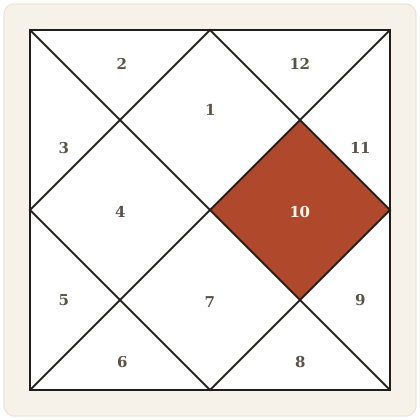
The tenth house sits at the very top of the chart. Because of that position it is sometimes called the midheaven of the Vedic chart, and the tradition counts it among the most-watched houses of all. But a common mistake begins right here: people read the tenth house as "the house of job." The Sanskrit name is Karma Bhava, the house of action, not the house of employment. Karma means deed - the work you do in the world and the footprint it leaves on others. A job is one possible form of that, not the whole meaning. In this article we read the tenth house with that difference intact: career, status, government and authority are its subjects, but we will look at how the tradition actually derives meaning and where interpretation must stop.
Why the tenth house gets watched first
Among the four kendras, the angular pillars of the chart, the tenth sits at the chart's crown. The tradition treats the lagna as the chart's root, but the tenth house as the tree that rises from that root into public view. The question it answers is direct: what does this person do in the world, and what does the visible outcome of that doing look like? That is why most traditional practitioners, on opening a chart, look at the lagna, the tenth house, its lord and any planets occupying it before anything else. One caution matters here: being the most-watched house speaks to the depth of interpretation, not to any guaranteed outcome. The tenth house is a tendency-indicator; it does not tell you which profession a person will enter or how high they will rise.
Karma Bhava in the Parashari texts
In the Brihat Parashara Hora Shastra, chapters 12 through 23 treat the twelve houses one by one, and the tenth house's subject arrives in chapter 21. There, kingdom, royal honour, rank, prestige and action are listed among its significations. In modern language we would call these career, public standing, relationship to government, and authority. One feature of that list is striking: the text says "karma" and "prestige," not "job." Salaried employment as we know it was not the common arrangement in the society those texts came from; most people's work was tied to lineage, land, craft or service. So mapping Karma Bhava directly onto the modern civil service or a corporate job narrows the text's intent. Its aim is broader: the work that shows publicly and builds one's place in society.
The subjects: profession, status, government, authority
It helps to group the tenth house's traditional subjects into four clusters. The first is the field of work: which domain you act in, what kind of action becomes your identity. The second is status: how society sees your work, what your public name is. The third is government and authority: your dealings with the state, officials and institutions. The fourth is command: how much decision-making room you hold within your field. Seen together, these show that the tenth house is not the house of income; income belongs to the eleventh house of gains, and stored wealth to the second. The tenth is the process by which income and standing are generated. The difference is practical: people often tie an income problem to the tenth house, when the tradition places income in a different house altogether.
Who acts: lagna versus the tenth house
A basic rule of house interpretation applies here with full force: no house is read alone. The question "what does this person do" is answered by the meeting of lagna and tenth house. The lagna gives the body, temperament and personality that performs the action; the tenth house gives the field in which the action lands. A strong lagna lord together with a strong tenth lord is taken as an indication of strong capacity for work; if one of them is weak, the shape of the reading changes. For example, if the tenth lord sits in the seventh house, the tradition says the field of work joins with partnership; if it sits in the ninth, with teaching, dharma or distant places. These are tendency-indications, and here too the tradition contains no clause of guarantee.
Four karakas: four styles of work
Most houses have one chief karaka, but for the tenth house the tradition counts four - and that number is itself a teaching. Surya is the karaka of status and leadership: work with authority and visibility. Budha is the karaka of commerce and skilled craft: work of the intellect, calculation, writing and trade-skill. Guru is the karaka of the wisdom-based profession: teaching, counsel, law, scripture. Shani is the karaka of service-oriented public work: organised labour, administration, long-haul effort. That there are four karakas means the tradition admitted from the start that "work" is not one thing. A physician, a trader, a teacher and a labourer all perform karma, but the shape of their karma differs. Which karaka is strong in the chart, which planet occupies the tenth house, and whose sign the tenth house holds - these build a symbolic picture of the style of work, never the name of a specific job.
Kendra and upachaya: a double strength
Structurally, the tenth house belongs to two lists at once. It is a kendra, an angular pillar that directs the chart's energy. And it is an upachaya: houses three, six, ten and eleven are called upachaya, "growing," because their results are held to increase with time. From this comes a striking traditional view about natural malefics in the tenth house. Being in a kendra makes them strong; being in an upachaya means their hard nature matures, over time, into the capacity to win through challenge. If Mars or Saturn occupies the tenth house, the tradition reads it as "career success forged through struggle." This is a tendency-description; drawing from it the conclusion that a malefic in the tenth guarantees success would go beyond what the texts say.
The knees: the body's pointer
Each of the twelve houses is linked to a part of the body, and the tenth house's part is the knees. Symbolically the match is elegant: the knee is the joint that both bends and lifts, and the tenth house is likewise the house of bending - service - and rising - status. In traditional medical astrology, affliction to the tenth house and its lord was tied to knee complaints. A clear warning is needed here: this is a symbolic correspondence, not a medical diagnosis. Knee pain or any health problem belongs with a physician, not with a birth chart. Using astrology as a substitute for medicine in health decisions is neither the tradition's intent nor responsible behaviour.
The dashamsha: a finer map of the field
When the question of work runs deep, the tradition moves beyond the rashi chart to the divisional charts. For the tenth house's subject, the special division is the dashamsha, called the D-10. In the dashamsha each sign is cut into ten parts, and this divisional chart is examined for fine analysis of career, profession and public standing. The traditional method is that the rashi chart's tenth house gives the base direction, and the dashamsha clarifies the details within that direction. A practical lesson follows: if a practitioner looks only at the birth chart's tenth house and declares a specific profession, they are doing half of their own tradition's method. And note: the dashamsha too is an instrument of symbolic analysis; it does not print out a job title either.
Changing jobs or choosing a career: the limits
In modern life the most common questions tied to the tenth house are these: which career should I choose, when should I change jobs, business or service? The tenth-house tradition can offer a framework for reflection here: toward which style of work is there a symbolic leaning, is partnership or independent work more fitting, is the field service or leadership? But keep three things clear. First, no house or planet chooses your profession for you; the choice belongs to your interest, training and circumstance. Second, financial decisions like quitting a job, taken on the basis of a transit or dasha alone, carry real risk; salary, contract and actual market information should ground the decision. Third, the variety of modern professions far exceeds what the texts' era knew; a software engineer or designer has no direct classical karaka, so the karakas' style-logic has to be applied with flexibility.
The tenth lord: where the work travels
The central formula of house interpretation is that the house lord carries its house's affairs to wherever it sits. Whichever house the tenth lord occupies, the tradition takes the field of work to be tied to that house's subjects. The tenth lord in the third stamps the work with writing, skill or self-effort; in the fifth, with teaching, creativity or advisory work; in the ninth, with dharma, higher learning or distant places; in the eleventh, with large networks and organisations. This formula keeps interpretation alive, because the tenth house's sign differs for all twelve ascendants and its lord can sit anywhere in the chart. Still, it is a structural indication; many factors act together in any life, and the chart is a map of tendencies, not a written order of the future.
Dasha and transit: when the tenth house activates
When do the tenth house's subjects come forward? The traditional answer lies in dasha and transit. During the dasha or sub-period of the tenth lord, or of a planet occupying the tenth house, matters of the work-field are held to move to the front row. Likewise, when slow planets like Saturn or Jupiter transit over the tenth house, the tradition reads a period of pressure or expansion in the career domain. Restraint is needed here: "a subject activating in its dasha" means that events or decisions in that area tend to surface, not that a specific event must occur. Many people postpone career decisions in the name of waiting for a dasha; yet the tradition itself places effort above fate, and abandoning sound work while waiting for the right period runs against that principle.
Common confusion: tenth house means government job?
A major confusion runs like this: the tenth house contains government among its subjects, so a strong tenth house signals a government job. That is a narrowing of meaning. The texts list kingdom and prestige because, in their time, the largest form of public authority was the state. Today public authority takes many forms: a famous artist, a major entrepreneur, an elected representative, an influential writer all hold public authority. A second confusion is that an empty tenth house means a weak career. An empty house is normal in the tradition; the reading proceeds through the house's sign, its lord's condition and the aspects it receives. A third confusion is that the tenth house belongs to men; that is a modern social prejudice, not textual method, since house-method applies identically to every ascendant chart.
Practical use: a vocabulary for thinking about work
The wisest modern use of the tenth house is not prediction but reflection. When you think about your work, the tenth house's questions are useful: how much of my identity is my work? Do I want authority or autonomy? Is my work service, craft, knowledge or leadership? The four-karaka division gives these questions a concrete language. If your work energises you, the tenth-house tradition invites you to see it joined to dharma; if it does not, the tradition does not tell you to simply wait for a dasha to change. Use the chart as a mirror for self-examination, not as a place to park responsibility. That balanced use is the method of this article series.
A note on sources and honesty
The facts used in this article come from sources actually opened and read: for the twelve houses' overview, satyori.com's article "The Twelve Bhavas (Houses) in Jyotish," which lists BPHS chapter references, karakas, body parts and structural groupings. Where a text is named, such as chapter 21 of the Brihat Parashara Hora Shastra, that rests on the reference in that secondary source; we have not consulted the original Sanskrit text directly and do not present it otherwise. Where traditions differ, as on karakas and the upachaya classification, we have stated the disagreement rather than declaring one view final. This article is educational; it offers no guarantee about any person's career, employment or future, and decisions about profession, jobs or investment should not be taken on its basis alone.
Questions on this article
What does the tenth house signify?
The tradition places action, profession, public status, government and authority here. It is the house of karma, not merely of a job; these are symbolic meanings, not evidence about any person.
Which planets are karakas of the tenth house?
Four: the Sun for status and leadership, Mercury for commerce and skill, Jupiter for the wisdom-based profession, Saturn for service-oriented public work. Four karakas show that "work" is not one thing.
Is a malefic in the tenth house bad?
The tradition reads it the other way: the tenth is both kendra and upachaya, so malefics like Mars or Saturn here ripen over time into "career success forged through struggle." That is a tendency-description, not a guarantee.
Does the tenth house decide your profession?
No. The house, its lord, the karakas and the dashamsha give a symbolic picture of the style of work; the choice belongs to your interest, training and circumstance. Take decisions like changing jobs on real financial information, not on dasha and transit alone.