The third house: siblings, courage, skill
A guide to the third house as a traditional symbol of initiative, younger siblings, communication and practice.
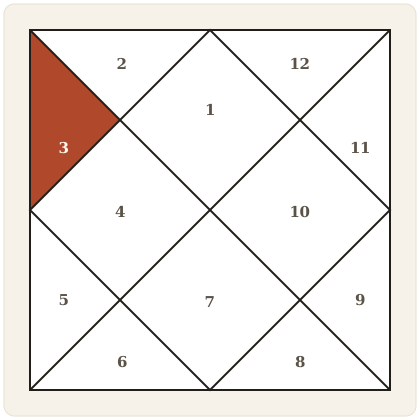
The third house of a Vedic chart is called Sahaja Bhava, the house of those "born together" with you. Under its roof sit younger siblings, courage (parakrama), short journeys, skill of hand, and everyday communication, written and spoken. The tradition also counts it as an upachaya, a growing house: its affairs ripen with time and effort rather than arriving finished at birth. This article explains why the third house is called the house of initiative, how sibling ties are read from it, and what its upachaya status really means in practice.
What the third house is
The third sign from the lagna becomes the third house. Its classical names announce its nature: Sahaja Bhava, the house of those born alongside, and Parakrama Bhava, the house of valour and initiative. Its body territory is the hands and arms, the shoulders and the lower neck: the physical seat of both skill and courage. Its karaka is Mars, for two reasons: Mars is the warrior planet, the embodiment of parakrama, and Mars is the natural significator of younger siblings in the karaka scheme. Reading the third house, the tradition keeps three things together: the house, its lord, and Mars.
Parakrama: the capacity to initiate
The deepest subject of the third house is not courage but initiative: the capacity to begin something with your own hands. The tradition reads here how often, and with how much firmness, a person steps forward on their own, without being pushed by circumstance or carried by the help of others. Taking up a project at work, standing forward in a crisis, learning a craft and standing on your own feet: this is all third-house language. That is why the tradition does not consider malefics here, Mars or Saturn, as harmful: since this is an upachaya house, its hardships are seen as tempering into tested courage. A strong third house is discussed in the person who does not wait for circumstances. The Sanskrit word itself says it: parakrama is valour turned outward, toward action; this is the valour of stepping onto the field, not of sitting with the thought.
Siblings and the meaning of sahaja
Sahaja literally means "born together", and the house's first subject is younger siblings (elder siblings are read from the eleventh house). The tradition reads from the third house the quality of ties with younger siblings, the support that flows between them, and indications about their well-being. A well-placed third lord speaks of support from siblings; affliction speaks of relationships that ask for effort. In the modern frame the house's field extends to all "like-born" ties, the contemporaries around you: colleagues, neighbours, fellow craftspeople.
Communication, writing and skill of hand
The third house is the house of small-scale communication: daily conversation, writing, messages, and in the modern extension, blogs, social media and short video. The depth of speech comes from the second house and the grip of intellect from the fifth, but the readiness and agility of saying and writing is counted as the third house's gift. With it goes skill of hand: writing, drawing, playing an instrument, craft. Mercury in the third house is discussed with writing and communication ability; Mars, with technical skill and sport. This house shows how, and with how much skill, a person carries their word into the world. In an age when a short message can travel further than a speech once did, the tradition's attention to this house reads as remarkably current: the third house is, in the old language, the house of the broadcaster within.
Upachaya: what grows with time
The 3rd, 6th, 10th and 11th houses are the upachayas, the growing stations. Their affairs are not ripe at birth; they grow with effort. For the third house this means: courage and skill are not inborn, they are built. This is why the tradition counts malefics in the third house as favourable: Mars or Saturn here speak of courage that ripens after testing, while benefics here speak of readiness that arrives easily. A practical lesson follows from the same thread: whatever the third house looks like, its subjects improve with practice. This is the most effort-friendly station inside astrology.
Short journeys and the neighbourhood
Among the third house's classical subjects are short journeys: the day trip, the cross-town errand, travel to a nearby shrine or relative. (Long journeys and foreign lands belong to the ninth and twelfth.) The distinction matters in practice: this house is about the movement of routine, not the movement that changes a life. The older texts even describe from this house the "journey taken on purpose", travel for work, distinct from travel for leisure. The reasoning is natural: the third is the house of moving hands and feet and moving about the neighbourhood. The tradition also reads here how connected a person stays to their immediate surroundings: the lane, the locality, nearby relations. In the modern lens, the daily commute and movement within the city ride the same thread.
Where the third lord sits
Whichever house the third lord occupies, the tradition reads the affairs of initiative and communication as tied to that place. The lord in the tenth speaks of initiative and skill flowing into the career; in the fifth, of courage joining creativity and learning; in the seventh, of initiative in partnership; in the twelfth, of effort spent on distant fields or behind the curtain. The lord's dignity, own sign, exaltation, a friend's sign, scales this strength. And then the condition of Mars: if the karaka of the house is strong, the house is held to find compensating support.
Planets in the third house
In the traditional shorthand: Mars in the third house is counted as highly favourable, speaking of firm courage and technical grip. Saturn here speaks of slow but unbreakable effort; the Sun, of initiative taken with self-confidence; Mercury, of alertness in writing and communication; Jupiter, of courage driven by ideas; Venus, of artistic skill and pleasant communication; the Moon, of mood-linked short travels and writing in changing moods. Rahu in the third is discussed as unconventional daring and media use; Ketu, as effort done in silence. These are tendency-indicators: sign, aspects and the lord's condition finish the picture.
The traditional reading of valour
In the tradition, parakrama is not merely the capacity to fight; its range is wider: nerve in difficulty, the strength to decide, and confidence in one's own skill. From this the third house ties into the work sphere: the tenth house tells what you do, the third tells with how much force you do it. For people whose work joins daily struggle, athletes, security forces, artisans, founders, the role of the third house in the chart is read with special attention. This is a remark about tendencies, not a guarantee of profession: skill, training and opportunity keep their own place.
The house of skill: the astrology of practice
Calling the third house "the house of the hands" is no ornament. Whatever art flows out of the fingers, writing, drawing, music, sewing, carpentry, typing itself, is counted here in the tradition. This carries a fine implication: this is the house of sadhana more than of talent. Those who find their third house "weak" and lose heart have their answer in the upachaya thread itself: what works here is not the strength of the start but the strength of continuity. Half an hour of daily practice, improvement visible in weeks: this is the third house's pace. The tradition speaks of the person whose skill "came through testing", and the fruit of an upachaya house is held to grow in the second half of life. So a late-blooming talent in the third house is no blemish: the timetable is simply different. That is why the tradition refuses to count even a weak-looking third house in youth as a cause for despair: upachaya means the assessment here is to be dated, not done today but over a ten-year span.
The third house and timing
The static chart shows potential; the dasha shows when each potential ripens. In the tradition the third house's affairs, matters of siblings, the display of skill, decisions taken on initiative, come forward when the mahadasha or antardasha of the third lord or of the karaka Mars runs. The Mars mahadasha lasts seven years, and the tradition reads it as an active season for the subjects of initiative. In transit as well, when the slow planets pass through the third house, Saturn's transit through the third is counted as favourable, for instance, the talk is of effort bearing visible fruit in these subjects. This timing layer matters because house-reading without dasha stays a frozen picture; time is what sets it moving.
Sibling ties: the tradition's doors of repair
If the third house shows affliction, the tradition's first door of repair is conduct, not ritual: regular contact with younger siblings or like-born peers, stepping forward to help in their work, and restraint in speech. Mars is this house's karaka, and Mars's classical discipline is to spend energy in building: some work together, some sport, some project. The third house is said to improve not by "sitting together" but by "doing together". The same lesson applies to the colleague relationships of today's workplaces, where shared effort repairs what conversation alone cannot.
The third house at a glance
| Aspect | Traditional subject |
|---|---|
| Names | Sahaja Bhava, Parakrama Bhava |
| Core subjects | Younger siblings, courage, communication, skill of hand |
| Body territory | Hands and arms, shoulders, lower neck |
| Karaka | Mars |
| Classification | Upachaya: a house that grows with time and effort |
| Travel | Short, nearby journeys |
| Related houses | Elder siblings - 11th; long journeys - 9th; depth of speech - 2nd |
Common misconceptions
First: "Mars or Saturn in the third means enmity with siblings." Malefics in an upachaya house are counted as favourable; the state of relationships is decided by the house-lord, the aspects and the karaka, not by one planet alone. Second: "courage means quarrelsomeness." Parakrama means initiative and steadiness; a quarrelsome temper is a sign of unbalanced energy. Third: "an empty third house means cowardice." Empty houses are normal; then the lord, the aspects and Mars's condition are read. An empty third house simply means the story of courage here is told by the lord and karaka rather than by a resident planet. Fourth: "this is a minor house, it matters less." Upachaya houses are the ones that grow most over time; their weight is often seen increasing in the second half of life.
The third house in our times
In the digital age the third house has arguably become the most active house of all. Communication is this house's subject, and today every hand holds a device of communication. Learning a skill, saying your piece, starting your own work: the video creator, the writer, the freelancer, the small founder, all run on third-house energy. The tradition's teaching is unchanged: parakrama means beginning without waiting, and skill means daily practice for the hands. The most practical understanding of the third house is that it changes less by fate and more by practice, which is why work on its subjects shows results the most directly and the soonest. Knowing your third house comes down to this: recognise your own style of initiative, then take one small step in that direction daily; that is the discipline of parakrama. And when in doubt whether to step forward or not, the third house's tradition answers simply: take the small step and see, because this house speaks not through waiting but through doing.
A reading exercise: separate symbol from evidence
Consider an invented chart with Gemini as the third house. Mercury is therefore its lord. A learner can first identify Mercury in the chart, then note its sign and house, and only then read the traditional associations. That is a structural exercise, not permission to conclude that the person writes well, has a particular sibling relationship or should take a media job. Test those questions against the person's actual experience and consent. Someone may have no younger sibling, may not enjoy writing, or may have developed a skill through training that a keyword list overlooks. Record the mismatch instead of inventing an explanation that makes every possible outcome fit.
An honest note
Astrology is a traditional system, not laboratory science. Take decisions about career, relationships or health with qualified professionals; treat the chart as context, never the only basis. Sources actually consulted for this article: the third house's significations, the Mars karaka and the upachaya classification from satyori.com/jyotish/articles/twelve-houses-overview/; planetary karaka assignments confirmed at satyori.com/reference/grahas/; and sign-lordship verified at saravali.github.io/astrology/dignities.html. Our aim is to explain the tradition in plain words, not to sell fear or make promises.
Questions on this article
What does the third house signify?
Traditional subjects include younger siblings, initiative, short journeys, communication and manual skills. These are symbolic associations, not evidence about a person.
What does upachaya mean?
The 3rd, 6th, 10th and 11th are called growing houses. The tradition associates them with development through time and effort, without guaranteeing results.
Is an empty third house bad?
Empty houses are normal. Traditional reading then considers the lord, aspects and Mars as karaka. Do not use an empty house to judge courage or relationships.


