The twelfth house: expenditure, foreign lands, liberation
A guide to the twelfth house as the traditional symbol of spending, dissolution and liberation.
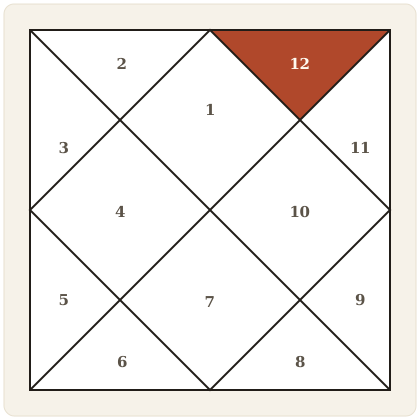
The twelfth house is the last house of the chart, and more fear has been spread about it than about any other. "Your twelfth house is bad" - this one line has been used on countless people to threaten them with hospital, debt and disgrace. The truth is more interesting. Vyaya Bhava means "the house of expenditure": spending, depletion, dissolution. And the same tradition calls this house the house of moksha - liberation itself. How can one house be both debt and liberation? That question sits at the centre of this article, and the tradition itself supplies the answer: the reading of the twelfth house depends on the life-aim around which the chart is organised. In a chart oriented toward worldly achievement, a heavy twelfth is read as expenditure outpacing gain; in a spiritually-oriented chart, an active twelfth is a positive signature.
Vyaya Bhava: the house of spending or of liberation?
The Sanskrit "vyaya" means to be spent, to wane, to pass away. That is why the twelfth house is called Vyaya Bhava: it is the place where things are let go. But letting go comes in two kinds. One is unwilling depletion: money draining without purpose, energy scattering, states like hospitalisation or confinement. The other is chosen release: charity, spiritual practice, solitude, and in the tradition the highest form of all - moksha, the final dissolution of the ego-self. Both are two forms of one act: something is leaving. The difference lies in who sets the direction of the leaving - circumstance or you. This is why the texts call this house a dusthana and also part of the moksha trikona. The house is one; its colour changes in the mirror of the life-aim.
Vyaya Bhava in the Parashari text
In the Brihat Parashara Hora Shastra the sequential treatment of the twelve houses begins in chapter 12 and ends in chapter 23, and that final chapter belongs to Vyaya Bhava. There, expenditure, fall, residence abroad, the bed and its associated subjects are listed, and the tradition placed moksha in the same list. To a modern reader the list can sound alarming: expense, hospital, confinement, hidden enemies. But the list must be read in its own time. In that era foreign travel took months with no certain return; hospitals were not treatment centres as we know them; and "the bed," meaning sleep and dreams, describes night-life rather than any punishment. The text lists a house's subjects; stamping those subjects onto a person as events that will happen is not textual method but the selling of fear.
Spending and giving: the two forms of expenditure
The most useful practical reading of the twelfth house lies in the two forms of spending. The first form is uncontrolled expenditure: spending without plan that eats the gains. The second form is chosen expenditure: charity, investment, travel, spending on practice - everything in which you knowingly release something in order to gain something else. The tradition calls charity the noblest use of the twelfth house, because charity is willing release - the same act that, when uncontrolled, is called loss. A practical principle follows: the traditional remedy for twelfth-house anxiety is not fear but making spending conscious. Making a budget, regularity in giving, reviewing unnecessary expense - these are, in modern language, what the tradition calls "giving direction to vyaya." Let it stay clear though: your chart's twelfth house does not keep your accounts; your bank statements do.
Foreign lands and distant travel
Among Vyaya Bhava's subjects, residence abroad and travel to distant lands is prominent. The reasoning is traditional: the twelfth house is the house "farthest" from the birth place - the last from the lagna - and so it joins with distant places. In modern life this subject has grown more relevant: working abroad, emigration, international travel are all tied to the twelfth house. Two cautions are necessary here. First, people hoping to go abroad are told things like "a planet in the twelfth house means foreign residence is certain"; in the tradition this is a tendency-indication, not a ticket guarantee, and visas, qualifications and opportunities are the real determinants. Second, reading foreign residence as negative is an old confusion; today it is often a path of achievement, and its place in the text's list is "going far," not "being ruined."
Sleep and dreams: the private side
Among the twelfth house's subjects is the bed: the bed, sleep and the dream-state. After the public life of the day, the twelfth house is the house of the night's private life - the region where a person is alone, rests, and looks inward. The tradition of dream-lore is tied to this same house: the texts enumerate auspicious and inauspicious dream signs, but modern science understands dreams as a normal process of the brain, and our method is to take that as the evidence. The same rule holds for sleep problems: the answer to insomnia or poor sleep lies in medicine and sleep hygiene, not in a chart. This side of the twelfth house is valuable in interpretation because it treats rest, solitude and the inner life as legitimate parts of life - not outer achievement alone.
Hospital and solitude: the subjects of confinement
The twelfth house's textual list includes hospital, prison and secluded residence - states in which a person is separated from ordinary life. The balanced way to read this list is that their common element is "separation," not punishment. A hospital is a place of treatment; solitude can be conscious practice; and in modern life this side of the twelfth house can join with retreats, meditation camps and work done in seclusion. In the tradition, a strong twelfth house in the chart of a yogi or renunciate was taken as an indication of capacity for practice - the same house that, in another context, signifies hospital. The same principle is confirmed again: a house's subjects are fixed, but their evaluation happens through the mirror of the life-aim. And as this series has repeated: no house can "stamp" a hospital or prison event onto any person.
Hidden enemies: a fear-free reading
"Hidden enemies" is the twelfth-house subject most attached to the fear trade: lines like "your hidden enemies are conspiring against you" are tools for selling fear. In the tradition this subject's meaning is more restrained: adversities that do not show themselves - one's own unnoticed habits, unknown spending patterns, circumstances behind the curtain. Several commentators have tied "hidden enemies" to the unconscious tendencies of the mind: those that will not let us accept a loss even after losing. Under this reading the subject becomes useful: the student of the twelfth house audits their invisible leaks - of money, of energy, of attention. In any case, declaring some specific person your "hidden enemy" is not astrology but the distribution of suspicion, and this series's method rejects it.
The moksha trikona: four, eight, twelve
Among the trikonas of the four purusharthas, the moksha trikona is the fourth, eighth and twelfth houses. In the earlier articles of this series we read the fourth house as inner peace and the eighth as transformation; the twelfth house completes this trikona: dissolution, the melting of the ego, and in the tradition final liberation. This structure shows that the texts did not treat the twelfth house as the house of loss alone; they took it as the summit of a spiritual arc. In the fourth house the mind grows quiet, in the eighth it passes through transformation, in the twelfth it lets go of its boundaries. For this reason some sources count it with the moksha trikona even while it is a dusthana. The Western twelfth house shares loss and hidden subjects, but the explicit moksha frame is distinctive to the Vedic tradition.
A dusthana, but not the last word
The twelfth house is counted with the sixth and eighth among the three dusthanas - the group of difficult houses. But this series's method has been to understand a dusthana, not fear it. In the sixth house we saw that the house of disease, enemies and debt is also called an upachaya; in the eighth we read depth and transformation; in the twelfth, dissolution and moksha. A pattern runs through all three dusthanas: these houses mark the places where life does not flow easily, yet those same places are the deepest fields of maturity. For the twelfth house this means: learning to spend, enduring aloneness, and knowing how to let go - these are hard capacities, and the tradition counts them as steps of growth. Being a dusthana is not the house's defect; reading it only through fear is the reader's defect.
The karakas: Saturn, Ketu, and in some views Venus
Vyaya Bhava has two chief karakas. Saturn is the karaka of loss and renunciation: slowness, limit and dispassion are his nature, and the match with the twelfth house's subject of "letting go" is natural. Ketu is the universal karaka of moksha: as the symbol of dissolution and detachment, wherever Ketu goes, material attachment is held to loosen, and in the spiritual reading of the twelfth house his place is central. Some sources give Venus a role in the subject of bed-pleasures - we record this disagreement here, without declaring any one view final. In karaka interpretation the same triangle applies: house, house lord and karaka together build the picture of tendencies, and no single indication alone is the guarantee of any conclusion.
The feet: the body's pointer
In the kalapurusha chart the twelfth house joins with the body's final parts - the feet and soles. Symbolically the match is orderly: the feet carry us far away, and the twelfth is the house of distant lands; the feet are the body's lowest part, and the twelfth house is the chart's last, the place of dissolution. Traditional medical astrology tied affliction of this house to problems of the feet. This series's standing warning applies here as well: this is a symbolic correspondence, not a medical diagnosis. Pain in the feet or any health problem is answered by consulting a physician; astrology is no substitute for medicine in health decisions.
The twelfth lord: which direction the spending goes
The house-lord formula refines the twelfth house's reading: whichever house the twelfth lord occupies, the tradition ties the expenditure to that direction. The lord in the second house points to spending on family or speech; in the fourth, on home and vehicles; in the sixth, on settling disease or debt; in the ninth, on pilgrimage and religious works; in the tenth, on expanding the field of work. From this same formula emerges an elegant traditional view: if the twelfth lord is strong and well-placed, even expenditure flows into fruitful directions - spending becomes investment. And if the lord is afflicted, the tradition reads a tendency toward unnecessary leakage. All of these are tendency-indications; a person's actual spending is made by their decisions, and a budget statement is a far more accurate document than any chart.
Common confusions
First confusion: an active twelfth house means certain ruin. The tradition's view is more subtle to the point of opposite: an active twelfth can also be a time of practice, foreign residence and release; the evaluation proceeds from the life-aim. Second confusion: no planet in the twelfth house means the path of moksha is closed. An empty house is normal; the reading proceeds through sign, lord and aspects, and a subject like moksha is bound less to a chart-claim than to practice. Third confusion: the remedy for the twelfth house is expensive ritual. The tradition's own primary remedy is charity and restraint - the art of spending, not spending out of fear. Fourth confusion: you must show your chart to escape hidden enemies. A suspicion-based life is not the chart's counsel; auditing your own spending and habits is more useful.
Practical use: a balanced view of spending and release
The balanced use of the twelfth house lies in three questions. First: which direction does my spending go, and did I choose that direction? Vyaya Bhava's tradition teaches making spending conscious - budget, charity, reviewing leaks. Second: do I accept solitude and rest as parts of life, or do I run from them? As the house of the bed and of solitude, the twelfth reminds us of the inner life's legitimacy. Third: what am I avoiding letting go of? As the house of dissolution, it invites reflection on the capacity for release. Do not make the chart a prediction-letter of losses; make it a framework for reflecting on spending, solitude and letting go. That has been this series's method - from the first house to the last.
A note on sources and honesty
The facts in this article come from sources actually opened and read: for the overview of the twelve houses, satyori.com's article "The Twelve Bhavas (Houses) in Jyotish," which gives the BPHS chapter references, karakas, body-part divisions, the dusthana classification, the moksha trikona and the dual reading based on the life-aim. Where a text is named, such as chapter 23 of the Brihat Parashara Hora Shastra, that rests on the reference in that secondary source; we have not consulted the original Sanskrit text directly and do not present it otherwise. Where traditions differ, as in Venus's role in bed-pleasures or the Western-versus-Vedic reading, we have recorded the disagreement. This article is educational; it offers no guarantee about any person's expenses, health, foreign travel or future, and financial or medical decisions should not be taken on its basis.
Questions on this article
What does the twelfth house signify?
The tradition places expenditure, loss, foreign residence, sleep and dreams, solitude, charity and moksha here. These are symbolic meanings, not evidence about any person or announcements of events.
Is the twelfth house bad?
It is a dusthana but also part of the moksha trikona. The tradition holds that its evaluation proceeds from the life-aim: a sign of heavy spending in a worldly reading, of practice and liberation in a spiritual one. One house; the life-aim sets the direction.
Which planets are karakas of the twelfth house?
Saturn is the karaka of loss and renunciation; Ketu is the universal karaka of moksha. Some sources give Venus a role in bed-pleasures - this disagreement is recorded in the article without declaring any view final.
Does a planet in the twelfth house guarantee going abroad?
No. Foreign residence is a tendency-indication of the twelfth house, not a ticket guarantee. Visas, qualifications and opportunities are the real determinants, and going abroad today is often a path of achievement, not a loss.


