Vara: The Week the Sky Did Not Make, the Reason for Seven, the Machine of the Sequence, and the Layers of the Names
The panchang's only human-made limb: the reason for seven, the planetary-hours machine behind the Sun-Moon-Mars order, the changing god layers, the Indian vasara names, and one open question even our sources will not settle.
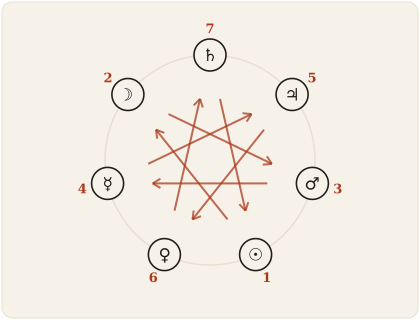
Of the panchang's five limbs, the vara is the only one the sky did not make. Lowell Observatory's article opens on exactly this: the year, the month and the day come from astronomical events, the Earth orbiting the Sun, the Moon circling the Earth, the Earth spinning on its axis; but the week is not a naturally occurring phenomenon, it is a human invention. Then why is it seven days long, not five or ten; and why does Monday have to be followed by Tuesday? This article walks that order: the reason for seven, the seven classical planets, the machine of the sequence, the layers of the names, the Indian desk, and the question our sources leave open, which way this system travelled.
Why seven: an approximation of the Moon's count
The explanation in timeanddate's history article: the Moon takes about 29.5 days to run through all its phases, and for everyday life that is a long and impractical span; the Babylonian society of Mesopotamia rounded the Moon cycle down to 28 days and divided it into four periods of 7 days each, adding leap days to stay in step with the phases over the long run. The same article adds another line: this 7-day structure is also believed to have informed several popular creation accounts, such as the seven-day creation of the Book of Genesis. Lowell adds a leveling note: several theories explain the week's origin, and multiple cultures may have conceived the idea independently, for varying reasons. So there is no single proven history of "the beginning of the week" in our sources; what exists is the most widely told explanation, and we present it under its own source's name.
The seven classical planets: the shining wanderers
The second reason for seven twinkles in the sky. Per Lowell, ancient observers saw, besides the Sun and the Moon, five other bright bodies that wandered among the fixed stars; in Greek these were called planetes, wanderers, which gives us the word planet. Together they make the seven classical planets: the Sun, the Moon, Mars, Mercury, Jupiter, Venus and Saturn; in the Earth-centred worldview of that age the Sun and Moon counted as planets too, and the planets beyond Saturn had not yet been discovered. Per timeanddate, the Babylonians developed around 500 BCE a kind of horoscope in which each day of the week was assigned to one of these seven bodies; and the same article honestly records a discrepancy: some historical sources claim the day-planet link was introduced later by the ancient Greeks. Both lines are on record; this is our first open question.
The machine of the sequence: the distance ladder and the planetary hours
Now the centre of this article: why is the order of days so strange, Sun, Moon, Mars, Mercury, Jupiter, Venus, Saturn? timeanddate's explanation has two stages. Stage one: Roman sky-watchers observed the speeds at which the classical planets crossed the sky and concluded that the fastest mover must be nearest the Earth, the slowest farthest; this produced the Chaldean order, by assumed distance from Earth: Saturn, Jupiter, Mars, Sun, Venus, Mercury, Moon. Stage two: the planetary hours. In the ancient belief, each hour of the day was governed by one of the planetary deities, and the hours ran in that same Chaldean order; whichever planet's hour was the day's first hour became that day's namer. Now look at the arithmetic: run 24 hours through a cycle of 7, and each next day begins three positions ahead in the order. timeanddate applies the pattern to all 168 hours of the week and out comes: the first day the Moon, then Mars, Mercury, Jupiter, Venus, Saturn, and the seventh day the Sun; exactly the order of today's week. In our words, one pass of their mechanism: Sunday's first hour is the Sun's; counting 24 hours ahead, the twenty-fifth hour, the next day's first, falls to the Moon, Monday; and the same three-step leap repeats every day. That whole frame is that article's presentation; we re-ran the sequence arithmetic by its own rule.
Walk the full cycle once slowly, reading the Chaldean list as Sa, Ju, Ma, Su, Ve, Me, Mo: Sunday's first hour is the Sun's; 24 hours later the twenty-fifth hour is the Moon's, Monday; from there 24 hours ahead the first hour is Mars's, Tuesday; then Mercury, Wednesday; then Jupiter, Thursday; then Venus, Friday; then Saturn, Saturday; and 24 hours on from Saturday it is the Sun again, Sunday. In seven days the cycle closes back where it started, and that is why this order has stood unshaken for centuries: it is a cycle of counting, not of events; there is no astronomical reason that could stop it. One remark more: this machine does not measure physical distance; the Chaldean ladder does not match the true distances we know today, it was the era's assumption. But for the week that assumption was enough: a ladder was built, the hours ran, and from an imagined distance-order came a very real social cycle that runs the whole world today.
The layers of the names: gods changed, planets stayed
The history of weekday names is a history of changing god-layers over an unchanged planet base. Per timeanddate, historians generally agree that it was the Romans who, from around the first century BCE, adapted the Babylonian system to their world view: each day named for a Roman god, each god tied to a classical planet; Saturday was dies Saturni, the day of Saturn. Lowell shows the language layer: in Latin-based languages the Roman names live on, Spanish Lunes (Moon), Martes (Mars), Jueves (Jupiter); in English and the Germanic languages four days were swapped to Norse gods, Tuesday from the war-god Tiw, the counterpart of Mars, Wednesday from the chief god Woden, the counterpart of Mercury, Thursday from Thor, the counterpart of Jupiter, Friday from the goddess Freya, the counterpart of Venus; and Saturday is the one that kept its Roman planet-name, Saturn. Lowell also records an opposite pattern: Russian speaks not of planet-gods but of ordinals, Monday the "do-nothing" day, Tuesday the "second," Wednesday the "middle," Thursday the "fourth," Friday the "fifth," Saturday the "sabbath," Sunday the "resurrection." That is: on one week-frame, cultures lay different name-layers.
The Indian desk: the names of the vasara
In Hindu astrology the same concept runs under the name vasara or vara, and Wikipedia's table shows the same planet-day mapping: Ravivar the Sun (Ravi, Aditya, Bhanu), Somvar the Moon (Soma, Indu), Mangalvar Mars (Bhauma), Budhvar Mercury (Saumya), Guruvar Jupiter (Brihaspati), Shukravar Venus (Bhrigu), Shanivar Saturn (Sthira). The same page records the Sanskrit alternates: Bhanuvasara, Induvasara, Bhaumavasara, Saumyavasara, Guruvasara, Bhriguvasara, Sthiravasara. The etymology notes belong to the same source: Shukra is regarded as a son of Bhrigu, hence Bhriguvasara; Guru here is a title of Brihaspati; and Budha is regarded as a son of Soma, the Moon, which is why Wednesday also ties to the lunar family name Saumya. Worth noticing: the planet-day mapping is the same on the Indian and the Roman desks, Sunday and Ravivar both the Sun's, so translation never scrambles it; only the languages' names change. The same table's Indian language rows show this uniformity: Gujarati Ravivar-Somvar, Tamil Nyayiru (Sun) and Tingal (Moon), Malayalam Nhayar and Tingal, Telugu Adivaram-Somavaram, Nepali Aaitabar-Sombar; in Tamil and Malayalam Thursday is Vyazham/Vyazhan, from a regional name of Jupiter, and Friday Velli, a Dravidian form of Venus. Ten languages, one sequence; that uniformity is itself a sign that one shared planet frame runs beneath the names.
What the week does not ask
The week's strangest virtue is its indifference: it does not ask the length of the month, the year, the tithi, or the festival. Whether the month has 31 days or 28, Monday returns on its seventh day. In timeanddate's Babylonian account the frame originally ran with extra days to stay in step with the Moon's phases; the modern civil week has cut free of that mooring entirely, a pure seven-day cycle. In panchang terms the meaning is: the vara and the other four angas are independent clocks; a day's full reading forms only when all five are read together, the vara on its seven-day clock, the tithi on its 12-degree clock, the nakshatra on its own arc. One more practical distinction: the civil day changes at midnight, while the panchang clock of our tithi and fasting articles runs from local sunrise; for a "Saturday fast" the vara is counted from sunrise in the panchang tradition, which is exactly why vrat rules are checked from the panchang.
The open question: which way the system travelled
Now the part where our sources themselves hesitate, and we record the hesitation as it stands. Wikipedia writes that knowledge of Greek astrology existed in India from about the 2nd century BC, and that references to the vasara occur somewhat later, in the Gupta period, in the Yajnavalkya Smriti, dated roughly the 3rd to 5th century AD; and it adds that this is roughly the same period as, or before, the system's introduction in the Roman Empire. Both sentences carry the page's own editorial "citation needed" markers. timeanddate's own discrepancy is already on record: the day-planet link Babylonian or later Greek, both claims exist in the sources. Taking the three together, this much is settled within the consulted sources: the system is ancient, the seven-planet base is shared, and in India it appears in Gupta-era texts; but the direction question, who took it from whom, is unresolved in the sources we opened, and the very lines that assert it carry citation markers. We do not certify any direction.
The vara in panchang practice
Our tithi article already opened this contrast: the tithi is a pure sky-measure that changes its length every month; the vara is a fixed seven-day cycle, free of eclipse arithmetic. It is precisely this steadiness that makes the vara one of practice's heaviest layers. The vrat layer: the seven-day table of our weekday-fasting article runs on this very cycle, Monday Shiva, Tuesday Hanuman, Friday Lakshmi or Santoshi Mata, Saturday Shani; all its methods bind to the vara calendar, not the tithi calendar. The muhurta layer: the vara holds its place in day selection, and that layer opens in this cluster's how-to-choose-muhurat article. And one modern remark: today this order is one across the whole world, and every language speaks the same planetary sequence; a page that writes "auspicious" or "inauspicious" fruits for weekdays is writing the tradition's encouragement language, and in none of the sources we consulted is there measured evidence for any weekday fruit.
Three questions for any weekday-significance page
First, which layer is speaking: sky-history (the week is human-made), language-history (the Norse god swap), or the astrological tradition (day-deities and vrats)? All three can be true; the trouble starts when one layer is made the proof of another. Second, does the page give the reason for the order, or only repeat the list? The real explanation is the planetary-hours machine: the distance ladder and the 24-hours-three-steps rule; a page that does not show this has given a list, not an answer. Third, do the origin claims carry citation markers? In our principal source the direction lines carry their own "citation needed" flags; if a page tells the Babylon-to-India or Greece-to-India journey as settled, ask it for its sources.
Source note: this article has three sources, all opened in full. timeanddate (timeanddate.com/calendar/days/7-days-week.html): the Babylonian 28-days-four-periods explanation and the Genesis link, the ~500 BCE Babylonian day-planet system (with the "some sources credit the later Greeks" discrepancy), the Roman god-naming (from the 1st century BCE, the dies Saturni example), the speed-to-distance assumption of the Chaldean order, and the 168-hour planetary-hours machine from which today's weekday order falls out. Lowell Observatory (lowell.edu/view-from-mars-hill-the-planets-and-their-ties-to-the-days-of-the-week/, 2021): the week as human invention (year-month-day astronomical), the possibility of independent origins, planetes = wanderers, the seven classical planets, the Norse god substitution in English names (Tiw, Woden, Thor, Freya) and Saturday's keeping of Saturn, the Spanish Latin names, and the Russian ordinal names. Wikipedia's Names of the days of the week page: the vasara/vara term, the seven planet-day names and the Sanskrit alternates table (Bhanuvasara through Sthiravasara), the Shukra-son-of-Bhrigu, Guru-as-Brihaspati-title and Budha-son-of-Soma etymologies, the Hindi week names, the Indian language rows, and the direction-question lines (knowledge of Greek astrology from the 2nd century BC; vasara references in the Gupta-period Yajnavalkya Smriti), which carry that page's own "citation needed" markers; we did not open the Yajnavalkya Smriti itself, and that context is an indirect quotation. In none of the consulted sources did we find measured evidence for any fruit of any weekday; the day-deity and vrat associations are the tradition's presentations.


