Bedroom Vastu: Separate Directions, Sleep Advice and Safety
A room zone, a bed location and a sleeping direction are three different questions. Cultural preferences do not replace safe access or medical care.
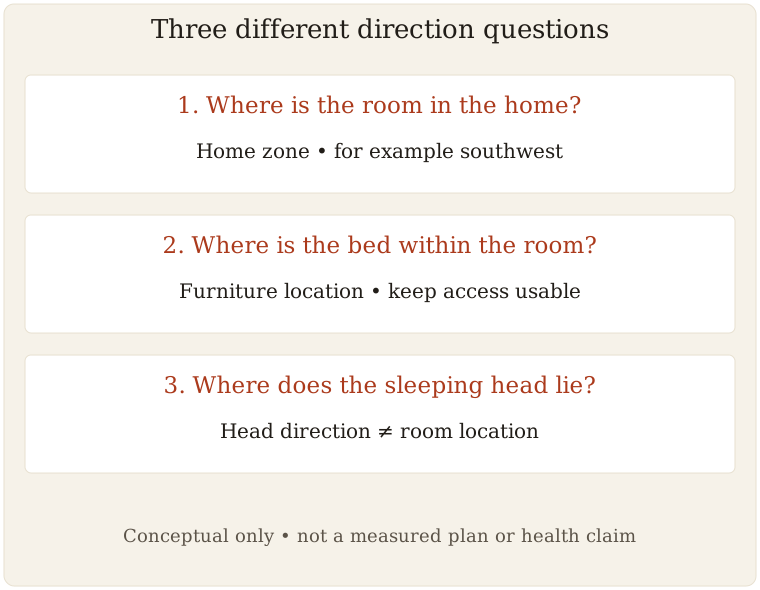
Bedroom Vastu is easiest to understand when three different directions are kept apart: the bedroom's position within the home, the bed's position within that room, and the direction in which the sleeper's head lies. They are not interchangeable. A southwest bedroom can contain a bed pointing several ways, and moving a pillow does not move the room into another part of the building. This guide compares consulted modern Vastu advice, records disagreements, and puts practical sleep and child safety guidance beside it without pretending that the two have the same evidence basis.
Begin with a sketch, not a diagnosis
Draw the existing room, including the door swing, windows, fixed cupboards, sockets and the bed. Mark directions separately from the page edges. A listing's phrase east-facing flat may describe its entrance rather than the bedroom or the headboard. Before applying any directional rule, find out which object the direction refers to. If you cannot establish the reference, keep that uncertainty rather than rotating the whole plan to fit a desired answer.
Our diagram is a schematic distinction between the three levels, not a measured floor plan for your home. It labels a southwest room zone, a bed within a room and a head direction as separate ideas. It provides no prescribed clearance, structural advice or prediction of sleep quality. Actual furniture dimensions, opening doors and people's access needs belong to the real plan, not to a symbolic compass label.
What the consulted sources say about room location
Architectural Digest India's advice page presents southwest as the preferred bedroom area and discourages northeast and southeast. Coohom's bedroom guide likewise names southwest for the primary bedroom, with south and west as alternatives. These are their Vastu recommendations. Their language about prosperity, stability or household authority should not be mistaken for a measured assessment of what will happen to the occupants.
An existing flat may offer no southwest sleeping room. That fact alone does not diagnose a health problem or a relationship conflict. First ask whether the available room is usable, private enough, comfortable and safe for its occupant. Cultural preferences can inform a choice between otherwise suitable rooms; they should not make an accessible room unavailable to someone who needs it.
Head direction: the sources do not give one answer
The Architectural Digest page says to place the bed in the southwest corner with the head facing west. Coohom rates south as best, east as good, west as neutral and north as a direction to avoid within its Vastu scheme. Naksham's commercial explainer also prefers south or east. We preserve the west-versus-south recommendation difference instead of writing that all consulted sources unanimously prescribe one direction.
Here head direction means where the head lies when sleeping, not the direction the eyes face while standing at the bedroom door. A headboard against the south wall normally places the head at the south end of the bed in a simple aligned layout. Write head at south rather than the ambiguous phrase south-facing bed. The distinction helps prevent a perfectly understandable preference from being implemented backwards.
A wall rule can conflict with a head rule
Naksham's table says the head should point south or east, while its wall-contact row allows the headboard against the south or west wall. In an ordinary bed perpendicular to that wall, a west-wall headboard puts the head west, not east. The page's two formulations are not identical. We do not silently change west to east or invent a special angled arrangement to make them match.
When asking a consultant or designer for a layout, request an arrow from feet toward head and a written direction at the headboard. If the drawing and text disagree, settle that before moving furniture. A named rule with an unresolved internal difference is not a reason to blame yourself for arranging the room incorrectly. The source may need clarification.
Magnetic language is not clinical proof
Coohom and Naksham explain their south-head preference using claims about the Earth's field and the body. Naksham goes further, describing a measurable energetic sleep effect. Those are source claims; this article has not independently validated their mechanism or shown a clinical benefit from rotating a bed. Scientific-sounding words do not turn an asserted explanation into a demonstrated treatment. We do not repeat the body-as-compass analogy as established physiology.
The distinction is especially important when a reader has insomnia, chronic fatigue or other symptoms. A room arrangement may be a personal comfort preference, but a compass direction cannot diagnose the cause of symptoms. Do not stop prescribed treatment, buy a remedy or delay seeking medical advice because a bedroom has been labelled directionally wrong. The health guidance later in this article has a separate source and purpose.
Classical references need actual consultation
Naksham attributes bedroom prescriptions to named Sanskrit works and specific chapters, and describes its southwest rule as universal across classical texts. For this article we fetched the modern page, not those editions. We therefore cannot present its quotations as our own reading of Charaka Samhita, Manasara, Mayamata, Vishwakarma Prakash or Brihat Samhita, nor verify its universal claim from that page alone.
A book title and chapter number can be a useful research lead. They do not prove the passage's wording, translation, context or agreement with every other edition. Keep the attribution attached: this website says the text states a rule. If an expensive redesign depends on the claim, direct examination of the passage and a competent review of the real building would be more responsible than copying a confident summary.
Mirrors: distinguish a belief from a practical annoyance
The three consulted Vastu pages discourage a mirror reflecting the bed. Coohom suggests an internal wardrobe mirror or a cover when moving it is impractical. These can be discussed as preferences. We do not adopt claims that a reflection drains personal energy, causes illness or produces marital conflict. A person who finds reflected light or movement distracting may prefer another position without needing such a causal story.
Before moving a large mirror, consider its mounting and the route used to carry it. A symbolic concern does not make unsafe handling sensible. In a rented room, a removable, appropriate solution may be preferable to drilling without permission. Do not put a loose covering over equipment that needs ventilation merely because a dark screen is being described as a mirror. A room should remain usable and safe after an adjustment.
The wardrobe advice has a source-level inconsistency
Coohom's practical example suggests adding a wardrobe or bookshelf on the north wall after moving the bed. Its later wardrobe section prefers southwest and discourages northeast clutter. Naksham, separately, says never against the north wall where it blocks light and open flow. These statements do not form one universal wardrobe instruction. The exact room and the specific page's wording matter, and we keep the tension visible.
Furniture location should also be checked against real use: can drawers open, can someone reach clothes, does the door work, and is the route out clear? Those are our practical planning questions, not a newly discovered Vastu verse. A cupboard is not a cure for a room's compass location. Do not add heavy furniture merely to fulfil a symbolic weight rule if it makes the space less usable.
Colours are choices, not remedies with guaranteed effects
Architectural Digest recommends neutral or earthy bedroom shades. Coohom varies its palette by room type. Naksham lists blue, pink, lavender, cream and soft green, while warning against some other colours with claimed sleep effects. These are attributed recommendations and marketing interpretations, not prescriptions for treating a sleep disorder. We do not turn a shade name into a guaranteed effect on heart rate, fertility or a relationship.
For an existing room, it may be enough to use bedding or a small decorative change if the occupant enjoys it. Repainting every surface is not required by this article. Consider whether both people using the room like the result and whether the change introduces cost, disruption or maintenance they do not want. A bedroom can feel personally restful without matching a website's complete palette.
Water and candles: do not assemble a remedy list
Naksham warns against water bodies in bedrooms, yet later proposes a water bowl among cooling remedies for a southeast bedroom. The scope may be intended to differ, but the consulted explanation does not resolve it. We record the internal tension rather than recommend the bowl. The same site promotes its own ritual candle, so its product recommendation also has a commercial context.
This guide recommends no flame, fragrance, water feature or paid Vastu product. A reader need not buy something to make a bedroom acceptable. Personal worship or decoration is a separate choice, not evidence of a medical result. Where someone wants a devotional object, discuss the actual object and its safe use rather than treating a sales page's energy claim as a requirement for the whole household.
What clinical sleep guidance actually recommends
NHLBI's healthy-sleep guidance recommends making time to sleep, keeping a regular schedule and keeping the bedroom quiet, cool and dark, with a dim night light if needed. It also discusses quiet time before bed and limiting bright artificial light. Mayo Clinic's sleep tips similarly recommend a restful environment and limiting prolonged use of light-emitting screens before bedtime.
These recommendations concern conditions and habits people can observe. They are not proof for the Vastu direction claims placed beside them in this article. If closing a curtain reduces unwanted light, describe that practical change as reducing light; do not claim it has verified a directional energy system. Keeping the explanations separate allows a reader to respect a tradition without confusing it with clinical advice.
Even health guidance can differ in scope
The NHLBI page advises adults with nighttime sleep difficulty to limit naps or take them earlier and gives a twenty-minute limit. Mayo's broader adult tips allow up to an hour and advise avoiding late naps, while noting that night workers may need a late-day nap before work. We do not merge those into one invented universal number. The person's schedule and the guidance's context matter.
This is the same careful reading habit used for Vastu sources, though the evidence categories differ. A general article is not a personalised sleep plan. If you work shifts, care for a baby or have a medical condition, discuss continuing difficulty with a clinician rather than force your life into an ideal room-and-schedule diagram. Practical limits deserve recognition, not guilt.
Child safety outranks a preferred bed direction
The US Consumer Product Safety Commission's window-cord guidance warns that children can become entangled in window-covering cords even when an adult is nearby. It identifies cordless coverings as the way to eliminate that cord strangulation hazard and recommends moving cribs, beds, furniture and toys away from windows and cords. Its advice concerns a physical hazard, not symbolic room energy.
Therefore do not move a child's bed next to a cord merely to obtain a preferred compass direction. The CPSC also notes that interim cord adjustments reduce rather than eliminate the hazard. We do not present a tied-up cord as equivalent to a cordless covering. The agency is US-based; product rules and support contacts on its page are not automatically Indian local requirements or services. The hazard explanation remains relevant when checking a room.
A rental or small room is not a failed home
A tenant may be unable to choose the room, move a fixed wardrobe or alter a window. Start with changes that are permitted and genuinely useful. Keep the existing plan if rotating a bed blocks access or makes daily care harder. A family member using a mobility aid may need a different arrangement from a generic plan. We prescribe no minimum clearance here because a safe layout depends on the person and actual space.
Make one low-disruption change at a time if the occupant wants it, and note whether it improves their comfort. That observation can guide a personal choice without proving a universal Vastu mechanism. Do not attribute every good night to a direction or every bad night to a mirror. Work, illness, noise and stress can vary at the same time.
When to stop rearranging and seek help
Mayo Clinic advises contacting a health-care provider if trouble sleeping is frequent. NHLBI also recommends speaking with a doctor when daytime sleep or adapting to shift work remains difficult. This article is not a diagnostic checklist. Continuing symptoms deserve attention rather than repeated purchases, room changes or blame. A household disagreement also needs conversation, not a claim that one person's furniture preference caused the conflict.
A careful bedroom plan can say: these are our cultural preferences, these are the source disagreements, these are the practical constraints and these are the safety priorities. That is enough. The room does not need a promise of wealth, perfect sleep or permanent harmony to be worth improving. Keep choices voluntary, claims attributed and real people more important than a compass rule.


