Kitchen Vastu: Read the Compass, Keep the Safety Check
Separate room location, stove position and the cook’s direction; preserve source disagreements and keep fire safety and cooking-air guidance distinct.
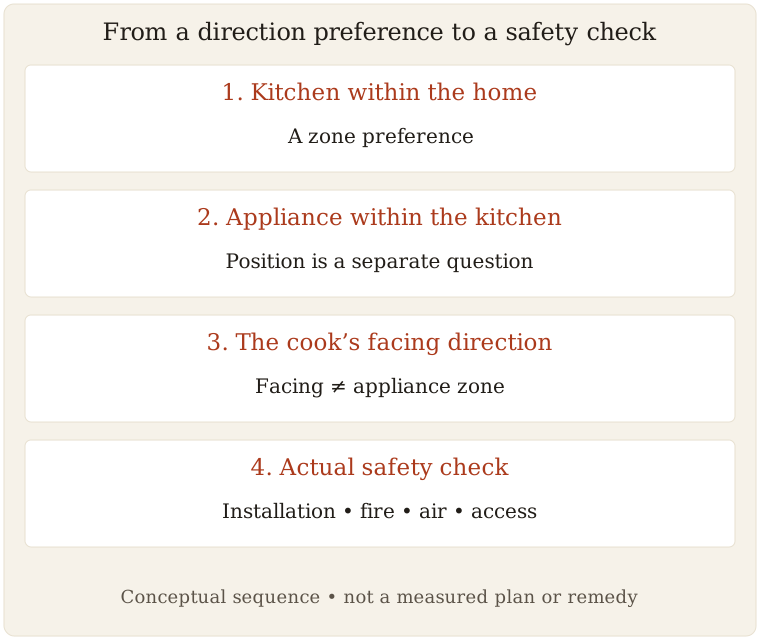
Kitchen Vastu starts with two different maps
A kitchen can be in the southeast part of a home while its stove stands somewhere else within that room. The person cooking can face a third direction. These are three separate questions, not interchangeable descriptions of one arrangement. A listing that calls a flat east-facing does not establish any of them. Start with the actual home and the actual kitchen before applying a directional preference.
This guide compares three consulted Architectural Digest India articles, records where their advice differs, and separates their Vastu claims from practical fire and indoor-air guidance. It does not promise prosperity, diagnose family conflict or prescribe a renovation. The purpose is to help a reader understand what the sources say without treating a symbolic preference as permission to ignore an appliance manual, a safe installation or the people using the room.
What southeast means in the consulted advice
The sink-and-stove article names southeast as the preferred kitchen location within the home and northwest as an alternative. It separately gives those same preferred and alternative zones for the stove within the kitchen. The association with Agni belongs to the article's Vastu explanation. It is not an engineering test of heat, air movement or fire risk.
The six-tips article quoting Ashna Ddhannak also prefers a southeast kitchen and accepts northwest. Its further statement that kitchens in certain other directions will ruin relationships is an attributed claim, not a conclusion we adopt. A family argument does not establish a compass-related cause. A usable existing kitchen need not be treated as a threat merely because its location differs from a consulted preference.
The cook's direction is not the stove's zone
Ddhannak's advice places fire-related appliances in the southeast part of the kitchen and asks that the cook face east. The expert Q&A by Aarushi Sadhotra Manhas likewise asks for a southeast hob and an east-facing cook, where the interior allows. Locating an object in a corner and facing a direction while using it describe different features of a plan.
Our original diagram keeps these levels apart and then adds a safety check. It is a decision diagram, not a floor plan, a working triangle or a measured installation drawing. It supplies no appliance clearance, pipe route or building approval. If a sketch is needed, label the room boundary, north reference, stove position and the cook's facing arrow separately. Do not rotate an imaginary map until it produces the answer someone expected.
The refrigerator advice genuinely differs
The six-tips article places the refrigerator in the southwest. The expert Q&A places the refrigerator, microwave and toaster in the northwest. These are different recommendations within the same publication, from different advice pages. We preserve that difference instead of presenting one universal appliance chart. Their claims about obstacles, peace or prosperity remain their interpretations rather than demonstrated effects of refrigerator placement.
The disagreement also matters when comparing the microwave recommendations: the six-tips article groups it among fire objects for the southeast, whereas the Q&A assigns it to the northwest. A reader cannot follow both literally in one fixed arrangement without a further explanation. This guide has not consulted an original classical edition that settles the dispute. Ask which named method a consultant is applying and keep their answer attached to that method, rather than rewriting a discrepancy out of sight.
Sink placement has more than one formulation
The sink-and-stove article prefers north or northeast for the sink. The six-tips article similarly names north or northeast for washbasins, water pipes and drainage. The expert Q&A gives eastern or northern walls for the dishwasher, purifier and sink. A wall reference is not automatically the same as an entire room zone, and east is not simply another spelling of northeast.
Record the source's actual reference before moving a fixture. Plumbing has an existing route, maintenance access and consequences for leaks. This article does not supply a drainage gradient, waterproofing design or professional inspection. Where a sink already works safely, a directional preference is not by itself a reason to break a counter. A landlord, qualified installer and the appliance instructions may need to be involved before any real alteration; a decorative diagram cannot replace that work.
A distance claim is not a safety clearance
The sink-and-stove article recommends at least four to five feet between the fixtures to avoid what it calls energetic conflict. We report that range as its Vastu advice, not as a verified fire, electrical or plumbing clearance. The six-tips article uses a different formulation: sink and cooking range should not share a platform or stand parallel. Those sentences are not one interchangeable dimensional rule.
A reader should not infer that every installation just beyond a quoted distance is safe, or that every smaller kitchen is unsafe. Actual requirements depend on the equipment and applicable installation rules, which this general article has not checked for a particular home. Do not change a gas connection, socket or water line to satisfy a number copied from an interior feature. Use the manufacturer's requirements and a qualified professional for the real installation, and keep symbolic preferences within those constraints.
A partition or colour is not a universal remedy
The sink-and-stove article proposes a small partition or different colours when separation is difficult. That is its suggested symbolic adjustment, not a tested way to prevent household conflict. A partition changes a real kitchen as well as its appearance: it can occupy preparation space or interrupt how someone sees and reaches a pan. Whether an actual object is suitable needs a check of the actual room.
We do not recommend putting an improvised board, plant, curtain or decorative screen beside a burner. A colour choice cannot make an unsafe installation safe. Nor does a useful strip of counter need to be filled with a purchased remedy. If a household wants a symbolic distinction, discuss the preference without accepting a promise about wealth or health. The safest acceptable outcome may be leaving an already workable arrangement unchanged rather than adding something solely to complete a ritualised layout.
Read colour advice at its stated scale
The sink-and-stove article suggests earthy tones including brown, beige and green, and also mentions yellow and orange. The six-tips article includes yellow, rose, chocolate brown, green, orange and red for walls while discouraging black. The Q&A prefers pale counters, rejects green and dark brown for the countertop, and suggests a mostly white southeast kitchen with red kept minimal.
Some of this difference concerns surfaces: a wall palette and a countertop restriction do not necessarily contradict each other. But the sources still do not provide a single universal colour prescription. Keep both the surface and the speaker visible. A green wall should not be treated as the same claim as a green counter. We do not adopt the claimed health or motivational effects as clinical facts. Choose finishes for the household's preferences and the real use of the room, not fear of a shade.
Ventilation is more than a compass label
The six-tips article prefers east for windows or exhaust outlets. That preference does not tell us whether an existing hood actually vents outdoors or merely moves air within the room. The US Environmental Protection Agency's cooking-air guidance distinguishes a hood that vents outside from situations without one. That is a practical equipment distinction, not a Vastu classification.
For an outdoor-venting hood, EPA recommends using it whenever cooking, leaving it on for ten to twenty minutes afterward, using back burners when possible to capture more emissions, and routinely cleaning surfaces, appliances and the grease filter. These are attributed general recommendations, not measurements of your kitchen's air. They do not establish that a preferred eastern outlet alone provides adequate ventilation. Follow equipment instructions and obtain professional advice when the arrangement or its operation is uncertain.
Keep the conditions attached to fresh-air advice
Where there is no outdoor-venting hood, or to supplement it, EPA suggests opening doors and windows only when outdoor air quality and weather permit and doing so is safe. It also discusses exhausting indoor air outdoors, an appropriately sized air cleaner that does not produce ozone, and suitable heating or cooling system filtration. Its filter advice is conditional on what the system can accommodate.
The conditions are part of the guidance. Do not reduce the paragraph to an unconditional instruction to open every window or buy a particular purifier. This article has not measured pollutants, inspected a duct or selected equipment for a home. A larger purchase or altered exhaust route needs its own assessment. Air movement and maintenance deserve attention because the kitchen is used for cooking, without turning those ordinary practical concerns into proof of a directional energy mechanism.
The first fire-safety rule is attention
The US Fire Administration's cooking guidance asks people to stay by the pan and turn the burner off if they leave the kitchen. It also says to watch cooking and turn the burner off if smoke appears or grease starts to boil. This is about an active cooking process. No favourable corner, auspicious colour or symbolic separation substitutes for attending to heat.
Its advice to turn pot handles toward the back helps avoid someone bumping or pulling them over. Its page also asks that things that can catch fire be kept away from the stovetop. These are useful safety considerations while discussing any arrangement, including a culturally preferred one. The agency is US-based: its statistics describe that setting, not an Indian household fire rate. We do not transplant its numbers into a claim about the reader's country or their particular kitchen.
Safety advice is not a complete emergency course
USFA also recommends keeping a pan lid or baking sheet nearby and using it to cover a pan that catches fire. That short source passage is not a complete emergency-response protocol, and this article is not fire training. Do not treat a Vastu article as the place to improvise a response to an active emergency. Use appropriate local emergency help when needed rather than continuing a layout discussion.
The same boundary applies to installation. The consulted Q&A gives a directional statement about cylinders, but this article does not adopt it as LPG installation guidance. We have not verified a particular cylinder position, hose, regulator or local supplier requirement. Do not move or stack fuel containers because of a compass chart. Ask the authorised supplier or qualified installer to assess the real setup. Decorative preferences must never become an instruction to alter safety-sensitive equipment without that check.
Begin with the kitchen people actually use
Before considering a change, walk through a normal meal preparation in the existing room. Where do ingredients go, where is washing done, and can the person cooking reach what they need? Does a door open into the space someone must use? These are our planning questions, not newly discovered Vastu verses. Their answers belong to the actual household rather than a generic illustration.
Accessibility, shared routines and the user's comfort can alter what counts as a workable arrangement. A plan that looks orderly in a small diagram may still be awkward for a person using a mobility aid or cooking with another family member. No minimum aisle width is prescribed here because we have not inspected the room or the person's needs. Preserve a safe existing route rather than making daily life harder solely to satisfy an unverified symbolic promise.
A rented kitchen is not a failed home
Tenants may not be allowed to move a sink, make a duct opening or alter fixed cabinetry. Owners may also have practical limits set by the building and their budget. Those limits do not establish that the household will lose peace or prosperity. Keep a cultural preference voluntary and proportionate. No family member should have to accept blame for a room they cannot reasonably change.
Start with permitted, low-disruption improvements the people using the room actually want. A maintenance problem can be reported; an unwanted decoration can be removed; a cooking routine can be discussed. Those actions do not need an energy claim to be worthwhile. When a structural change is proposed, separate the stated preference, the practical design, the permission and the cost. Agreement about liking a direction is not agreement to spend money, alter a rental or accept an unsafe installation.
Keep sources, claims and decisions separate
All three Vastu pages consulted here are modern advice articles. They are evidence of what their authors or quoted advisers say, not our independent reading of an ancient construction text. We have not fetched a classical edition for this article. Calling a recommendation traditional does not establish its exact original wording, translation, scope or agreement across schools. Attribution is more honest than an invented universal rule.
A useful kitchen note can therefore contain four lines: the household's cultural preference; the places where consulted sources disagree; the actual installation and safety limits; and the change, if any, that everyone wants. Keep fire and air guidance separate from prosperity claims. The room does not need a promise to become worth caring for. A thoughtful choice leaves people able to cook, maintain their equipment and respect a tradition without treating a compass bearing as a verdict on their home.


