Main Entrance Vastu: Direction, Door Position and the Way Out
Compare entrance traditions without turning a direction into a verdict. Keep source disagreements, privacy, fall prevention and escape planning distinct.
A doorway is not a verdict on a household
A main entrance is a place people use with shopping bags, visitors, keys, mobility aids and sometimes an urgent need to leave. Vastu gives it symbolic importance, but its direction alone should not become a judgment about the people living behind it. A south-facing flat does not establish that its occupants will lose money, and a northeast-facing door does not establish that they will be healthy or happy. The consulted sources themselves do not give one uniform account.
This article compares two Architectural Digest India features and a commercial AppliedVastu explainer, keeping their claims attached to their sources. It also reads fire-escape and fall-prevention guidance separately. We have not surveyed your building, measured its door, checked local code or consulted an original classical edition. The aim is informed choice, not a remote diagnosis, a demolition order or an invitation to buy a cure for a direction.
First name the entrance you mean
The gate to a plot, the entrance to an apartment building and the door to an individual flat are different physical boundaries. A photograph of one does not automatically describe the others. Before discussing a preference, write which boundary is under consideration and who can alter it. A shared corridor or building door may be outside a resident's control even when the flat itself is owned.
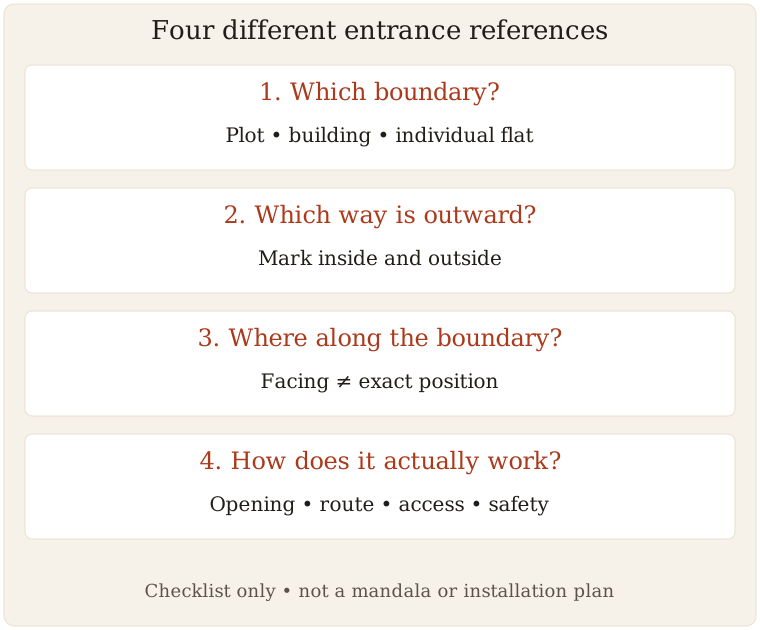
Our diagram separates the boundary, its outward-facing direction, the door's position along that boundary and its actual operation. It is an editorial checklist, not a Vastu mandala or measured floor plan. No favourable segment, hinge design, exit width or accessible threshold is prescribed. If a professional needs a drawing, label those real features separately rather than transferring a general property listing's compass word to every entrance on the route.
Outward facing needs an explicit reference
The Architectural Digest home-tips feature describes its preferred door orientation through the direction a person faces when stepping out: north, east or northeast. That stated outward reference is useful. Someone standing outside and looking into the home faces the opposite way, so a direction given without a viewpoint can be implemented backwards even when everyone is trying to help.
Record the reference on the sketch: outside, inside and the direction of the outward arrow. This article supplies no compass reading for a particular property. It also does not assume that the top edge of a floor plan is north. A directional label is only meaningful when the underlying reference is known. Where the reference remains unclear, keep that uncertainty visible instead of confidently assigning a new doorway category to the home.
A preferred direction is not a consensus result
The home-tips feature prefers north, east or northeast. The entrance feature quoting Neeta Sinha describes traditional practitioners as favouring northeast, but Sinha then rejects predicting a place's fate from direction alone. She recounts favourable south entrances and unfavourable northeast ones, and places emphasis on the home's overall ambience. These are her observations, not a controlled study that independently proves a Vastu mechanism.
The distinction matters: the first article's short preferred-direction list is not the same instruction as the second expert's broader acceptance. We preserve both. We have not independently checked the hotel examples used in Sinha's explanation, so they are not repeated here as verified case studies. A reader can respect a tradition while noticing that consulted advisers frame the same question differently, without treating a disagreement as a personal failure.
Direction and position along a wall differ
The AppliedVastu entrance explainer uses a more segmented system. It describes thirty-two perimeter fields, with eight for each of four directions, and says a scaled drawing and geographical direction are needed. Its interpretation is therefore not simply a list of four equally acceptable wall names. A broad facing direction and a position along a wall are distinct within that source's account.
We are reporting the method as that commercial website presents it, not verifying a measured energy field or an effect on residents. We have not inspected a scaled drawing for your home, nor read the classical edition to which the page refers. Do not take the phrase thirty-two fields as evidence that a phone photograph is enough to identify an exact favourable segment. The method's asserted outcomes remain claims, not a substitute for a building assessment.
Do not smooth over the explainer's own tensions
AppliedVastu's main discussion criticises blanket rejection of south or west entrances and assigns different results to individual fields. Its later FAQ returns to north, east or northeast as a general answer, then gives a south-centre exception with wording that becomes difficult to reconcile. The page's broader method and its simplified answers are not one clear universal instruction. We keep that source-level tension visible rather than silently rewriting the FAQ.
The same page warns against a particular northeast field while also praising northeast in a general FAQ. That contrast is a reason to ask what exact boundary, scale and method a consultant means, not a reason to panic about an existing door. A general reader should not be made responsible for resolving a commercial page's ambiguous phrasing. Where the source is unclear, the honest answer is that further explanation is needed before it can guide a real change.
Reject claims that stigmatise residents
AppliedVastu attaches severe predictions and character judgments to some entrance fields, including illness, loss and negative descriptions of residents' relationships or behaviour. This article does not adopt those judgments. A doorway cannot be used here to diagnose disease, establish dishonesty or make a person's marriage choice a defect. Such claims can create blame without supplying evidence about the actual person or household.
A cultural preference should stay voluntary and should not become a way to pressure a family member, reject a tenant or explain away a health concern. If someone is unwell, a door label is not a medical assessment. If a family is struggling, ask about the actual problem rather than assigning moral responsibility to a wall. No paid correction is recommended in this article, and no threatening source sentence is converted into a forecast for the reader.
A percentage is not a measured share of wellbeing
Sinha's entrance feature attributes fifty percent of the home's energetic resonance to the entrance; its introductory summary phrases the claim in terms of abundance. Those are the page's claims and formulations, not measured shares we can use to calculate a family's future. We have not independently established a definition, measurement method or evidence behind that percentage. The precision of a number does not make its subject measurable by itself.
For that reason our diagram does not show half a household's happiness flowing through a door. We do not translate the figure into a budget, a success probability or a reason to prioritise an entrance over urgent repairs elsewhere. Practical attention can still be worthwhile: an opening that works reliably and a route people can use are observable matters. They do not require us to accept an unverified energetic percentage before caring for the doorway.
Clockwise is not a complete hinge specification
The home-tips article and AppliedVastu both recommend clockwise opening. But a real door needs a viewpoint, hinge location, opening direction and a clear swing area to be understood. This article does not infer all of those features from that one word. It supplies no universal instruction to reverse a door, remove a closer or change an outward-opening assembly into an inward-opening one.
An existing door may also be part of a building's fire or security arrangement. A symbolic preference is not permission to alter that assembly. If a physical change is proposed, have the responsible building manager and qualified professional assess the actual door and applicable requirements. Keep cultural intent separate from technical approval and the resident's permission. A diagram that omits hinges is more honest here than an attractive swing arc that could be mistaken for installation advice.
A larger wooden door is not automatically suitable
The consulted home-tips feature and AppliedVastu favour a main door larger than the home's other doors and prefer wood. Those are attributed Vastu preferences, not our verified product specification. We have not assessed the frame, the building's requirements, weather exposure, accessibility or any fire-resistance certification for a replacement. The appearance of a material does not establish what a complete installed door can do.
Do not replace a serviceable entrance simply because a general article praises wood or height. A tenant may not have permission, and an owner may still need building approval. Any replacement has its own cost and technical decisions. This guide recommends no purchase and commits no budget. If the household wants a different appearance, first establish what may safely and lawfully change rather than assuming that an ornamental preference settles the entire door design.
Nameplates help with identification, but disclosure is a choice
Sinha recommends a conspicuous full name and flat number. The other Vastu sources also favour nameplates. That is their advice, not a requirement from this article to publish a person's full identity. A household may have privacy, tenancy or building rules that affect what it wants displayed. Decide with the people concerned, especially in a shared home, rather than copying private details onto a decoration without their agreement.
The National Fire Protection Association's escape-planning guidance separately asks that the street number be visible to responding emergency personnel. Identifying a location and displaying every resident's full name are not identical needs. NFPA is a US-based source, and its code references are not presented here as the law for an Indian flat. The practical point is to consider clear identification while keeping personal disclosure and local requirements distinct.
Decoration must leave the route usable
The AD features mention torans, rangoli, plants and other welcoming decorations; AppliedVastu also discusses entrance images. These can be matters of personal or religious taste. Their claimed luck or energy effects are not verified by this article. Nor is decoration compulsory for every home. A person who wants a plain, quiet doorway has not failed a test of hospitality or devotion.
Before adding a pot, hanging item or floor decoration, consider the actual route and the door's operation. NFPA asks people to keep escape routes clear and check that doors and windows can open easily. Our practical planning question is whether a decoration makes that harder for anyone who uses the entrance. Do not use a symbolic arrangement to justify an obstruction. A communal corridor also belongs to other residents' daily access, not merely one household's preferred visual scheme.
The red-mat advice conflicts with fall-prevention priorities
Sinha recommends a large red doormat and attributes energy-transforming effects to it. The US National Institute on Aging's fall-prevention guidance instead cautions against throw rugs and small area rugs, asks that carpets be fixed firmly, and says walking areas should stay tidy. These sources address different aims and use different language; a symbolic colour claim cannot settle whether a particular mat is safe.
We therefore do not recommend buying a larger mat as a remedy. Assess the actual surface, its movement and the needs of the person crossing it, with suitable professional advice when needed. No mat in our diagram is certified as safe. A mobility aid, an uneven threshold or a person carrying bags can make a generic decorative example unsuitable. Put the person's ability to enter and leave ahead of a claim about what a red surface will do to their energy.
Lighting and maintenance have their own practical purpose
The Vastu sources favour a clean, well-lit entrance and a door without noisy or damaged operation. NIA's guidance separately recommends good lighting, clear walking paths, sound front steps and porch lighting when returning after dark. Its advice concerns reducing fall risk, not proving that a compass direction creates wellbeing. Keep the explanations separate even when both lead someone to notice the same poorly lit step.
The NIA page discusses older adults and a US setting; its service contacts and emergency number are not automatically local resources for an Indian reader. This article adopts no country-specific phone number. We also do not repeat the entrance feature's suggestion to burn oils or incense as a required improvement. Light does not need to come from a flame, and a welcoming doorway does not require fragrance. Discuss maintenance safely rather than turning a ritual detail into a household obligation.
Plan for the people who may need help
NFPA asks households to inspect escape routes, plan together and arrange assistance for infants, older people or anyone with mobility limitations, including a backup helper. It also discusses emergency-release devices where security bars exist. These are planning topics for the actual household and building, not a direction-based promise. A route is not useful merely because a fit adult can use it in daylight with empty hands.
The same guidance notes that high-rise or apartment residents may face different emergency strategies, including defending in place. This short Vastu article is not a complete emergency plan and does not choose a strategy for a particular building. Follow the building's verified arrangements and appropriate local fire-safety advice. Do not remove security equipment or modify a fire door based on a general paragraph. Resolve the real installation with responsible professionals while preserving the ability of everyone concerned to get appropriate help.
Make one proportionate decision, not a fearful renovation
For an existing home, write four separate notes: which entrance is meant; what the directional source actually says; what practical problem exists; and what change the household wants and is allowed to make. If there is no practical problem and no shared wish to change the door, leaving it alone is a valid outcome. A rented or south-facing home does not need a fear-based purchase to become worthy of care.
All three Vastu sources are modern pages we actually read. They are not our independent reading of an ancient text. The disagreement about direction, the segmented method's ambiguity and the limits of percentage claims remain visible. Keep preferences voluntary, identity disclosure deliberate and safety grounded in the real building. An entrance should welcome the people who use it without making them carry a prediction about their health, morality or financial future every time they turn the key.