Office Vastu: A Direction Preference Is Not a Workstation Assessment
Compare conflicting office-facing advice with practical checks for posture, glare, access and breaks. No promises of profit or compulsory purchases.
Start with the work, not a promise of wealth
An office has to support actual work: reading, calls, writing, meetings, private conversations and the movements of people who share it. Vastu can offer a cultural way to think about that space. It cannot, on the evidence consulted here, guarantee a promotion, a profitable quarter or a healthy workforce. A desk facing an unfavoured direction is not evidence that its user is careless or destined to fail. A good arrangement should remain usable when a colleague has different beliefs, a disability or different visual needs.
This guide compares four modern Architectural Digest India articles with Oregon OSHA's computer-workstation checklist and the UK Health and Safety Executive's guidance on work routines. These are different kinds of sources. The design features report Vastu recommendations; the official guidance supplies practical questions about posture, screens and breaks. We have not consulted a classical Sanskrit office chapter, surveyed your building or established the law that applies to your employer. Our priority order and the diagram are an editorial synthesis, not a recovered ancient plan.
Three directions that are easily confused
First ask where the work area lies within the home or office. That is a location question: a southwest room can contain desks facing several directions. Next ask where a desk sits within that room. A desk near the west wall need not face west. Finally ask which direction the seated person looks while doing the main task. The user's facing direction is not automatically the direction in which a drawer opens, the computer's back points or the office entrance faces.
Record those distinctions before discussing changes. Draw a simple outline, mark doors and windows, and label the place from which you are describing the direction. If the building's orientation has not been established, say so rather than turning a rough impression into an exact compass measurement. A Vastu consultation that uses room zones cannot be reproduced from a photograph of a laptop. Nor should a general article quietly assign a measured grid to an irregular rental or a shared floor.
The sources do not give one facing rule
The article attributed to Ashna Ddhannak recommends a home office in the west or southwest portion of the house. Its desk instruction then says the desk should be in the southwest while the worker's position should be in the northeast direction. That wording does not clearly distinguish facing from location in every clause. We retain the ambiguity rather than manufacturing a precise arrow. The same feature links these arrangements to better business decisions and concentration, but does not provide a controlled test of those outcomes.
Ariane Shah's study-table feature also recommends west or southwest for the home office, yet explicitly says the home-office desk must face southwest. Neeta Sinha's work-from-home feature instead recommends facing east, north or northeast. Her corporate-office feature recommends east or north, with a distinction between trading and professional or service work. These are material differences, not interchangeable spellings of one instruction. The sources do not establish a common rule that resolves them. Choose a tradition consciously if it matters to you, and do not present the chosen preference as unanimous evidence.
Read dates and authority with care
The fetched study-table page displays 29 May 2025 although its search metadata supplied another date. The work-from-home page displays 7 April 2023 while its search metadata also differed. We use the text actually read rather than assuming that a search label fixes a page's publication history. Those differences are a reminder to keep a source's wording and visible context attached to any recommendation copied from it.
These articles are contemporary design journalism, including advice from named practitioners. Their statements about Vastu history, cosmic energy or magnetic fields do not become scientific demonstrations because they appear beside attractive interiors. In particular, the corporate-office feature's explanation connecting east or north seating to the earth's magnetic field is an attributed explanation, not a finding verified here. We have not checked a primary study that shows a compass-facing desk increases productivity. That limited statement describes this research, not an exhaustive claim about every study ever published.
Use the diagram as a decision order
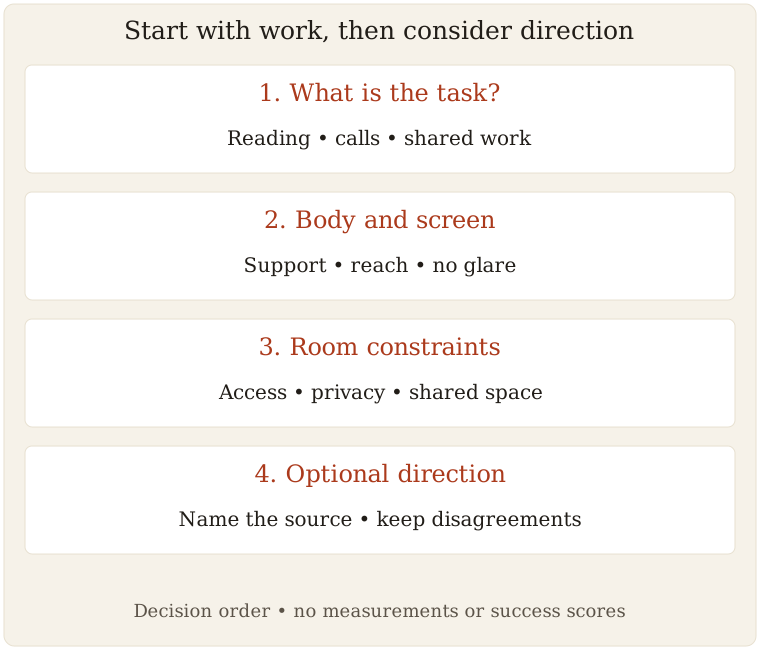
Our original diagram starts with the task, moves to the body and screen, then asks about the room, and only then introduces an optional direction preference. It is not a floor plan, compass wheel or ergonomic measurement chart. There are no lucky sectors, required desk angles or numerical success scores in it. Each stage can send you back to revise an earlier assumption when the actual worker tries the space.
For example, a desk might satisfy a chosen east-facing preference but force the user to twist toward a monitor on a side shelf. Correcting the screen position is more important than defending the arrow. Another desk might face north but block a shared route when its chair is pulled out. That is not a successful layout. Keep the preference only when the work, access and bodily requirements still make sense. No paid remedy is needed to acknowledge a constraint that cannot be changed.
Fit the chair to the person, not a symbol
Several design features recommend a strong, spacious chair with support for the head. Oregon OSHA's checklist asks a different set of functional questions: does the backrest support the lower back, does the seat fit the person, is there clearance behind the knees, and do any armrests support the forearms without restricting movement? A tall chair is not automatically a well-fitting chair, and a headrest does not substitute for usable lumbar support or the ability to approach the keyboard.
The same checklist asks whether feet rest on the floor or a stable footrest, shoulders are relaxed, elbows remain close to the body and wrists stay straight. Use these as assessment questions rather than forcing everyone into one rigid pose. Try the setup with the person who will use it, including any assistive equipment. An employer's workstation assessment or a qualified clinician may be needed for individual difficulties. Persistent pain should not be blamed on a direction, a blue wall or a missing crystal.
Make the screen readable without twisting
Oregon OSHA asks whether the monitor is directly in front of the user, whether its distance permits reading without leaning forward or backward, and whether the top is at or below eye level. It separately asks whether people using bifocal or trifocal lenses can read without bending their necks. That qualification matters: a generic screen-height slogan should not override the person's actual vision and posture. The checklist does not prescribe one universal monitor distance for every person and task.
Check glare from windows and other lights in the position where work really happens. A sunny photograph does not show whether an afternoon reflection covers a spreadsheet. Adjust the arrangement so text can be read comfortably; examine lighting and screen position together rather than choosing orientation in isolation. Keep the pointing device next to the keyboard and avoid reaching unnecessarily. If a laptop's joined screen and keyboard prevent a workable setup, discuss suitable equipment through the workplace process instead of treating the machine's compass direction as the whole assessment.
A wall behind you is a preference, not permission to block a route
The design features discourage sitting with a door, window or balcony behind the worker, and several prefer a plain wall behind the chair. Some people may find a view of the entrance reassuring. Others have to arrange a desk around shared circulation, wheelchair turning space, confidential screens or the need to supervise a room. The articles' directional preferences cannot decide those needs on their own.
In a rental, start with the furniture you may move. Check the chair pulled out as well as pushed in, the drawer open as well as shut, and the space another person needs to pass. Do not move a cabinet into an exit route merely to give its doors a preferred opening direction. Heavy storage, building work and electrical changes need the relevant professional and owner approval. This article does not supply those approvals or replace a site-specific safety review. A desk arrangement is not improved by exporting its inconvenience to the next person.
Colours are not treatment or noise control
Ddhannak's feature and the study-table article connect pale colours with health, balance or profit and warn about black and blue. Those outcome claims are not established medical or financial facts in this guide. There is no basis here for diagnosing someone's emotions from their paint choice. Keep an existing colour if it works for the occupants; a cultural preference may influence a future repaint without creating an urgent need to spend.
Sinha's corporate-office article offers another set of colour suggestions. It recommends yellow accents in executive areas but excludes a manager's cabin, and also recommends yellow where machine sound bothers workers. We preserve that condition rather than flattening it into a universal yellow-office rule. More importantly, paint must not stand in for assessment and control of occupational noise. The work-from-home feature's orange, yellow and red suggestions are also attributed symbolic advice, not treatment for lethargy or a way to guarantee that delayed projects will finish.
Objects and rituals should remain optional
The consulted features suggest citrine or pyrite for wealth, a small globe for international opportunities, and a red doormat to banish hostility. They do not establish that these objects produce those results. A globe may be a pleasant reminder of your work; it is not a client-acquisition plan. A decorative purchase should remain a choice, not a test of professional seriousness or an explanation for someone else's unemployment.
The work-from-home article also recommends burning camphor in a fire-proof bowl. We report that recommendation as source content, not an instruction to perform it. This guide requires no flame, smoke, fragrance or ritual at a workstation. Shared workplaces include people who do not share the practice, and a general Vastu article is not a fire-safety approval. Similarly, plants and morning-open windows should not become compulsory responses to every office: building controls, the actual environment and the people using the space still need consideration. None of these objects replaces the screen and access checks.
Protect documents while reducing clutter
Discarding unwanted papers is a repeated recommendation in the design features, sometimes linked to bad luck. The useful operational question is different: can people find what they need without exposing information or losing records? A tidy-looking desk can still have an unlocked confidential file, and a busy desk may contain documents that must be retained. Do not interpret a general decluttering suggestion as permission to destroy business records.
Separate current work, things to file and things already cleared for disposal under the relevant policy. Keep private material away from shared sightlines and use the employer's storage arrangements. This is our practical synthesis, not a source-derived lucky filing system. If a cupboard cannot be moved without blocking access, keep its usable position instead of chasing an opening direction. At the end of a shared-space workday, agree where documents and equipment go so the next person does not have to guess which pile is disposable.
Breaks belong in the plan
HSE's work-routine guidance says there is no legal guidance fixing the exact duration and frequency of display-screen breaks; the work matters. It favours shorter, frequent breaks over longer, less frequent ones and gives five to ten minutes every hour rather than twenty minutes every two hours as an example. This is not a universal medical prescription or an Indian statutory timetable. The page discusses the UK setting, and local duties must be checked separately.
HSE also says a change of activity can interrupt screen work, and that breaks or changes should allow getting up and moving or at least stretching and changing posture. Merely installing reminder software does not remove the employer's responsibility to plan work. A north-facing desk cannot compensate for a schedule that makes movement impossible. At home, a repeatable work spot may help organise the day, but sharing a dining table does not mean the household has failed Vastu. A clear packing-away routine may be more realistic than demanding a separate office.
Try a reversible change and name its limits
Begin with one concrete problem: glare on calls, a difficult reach, no place for papers or an interrupted route. Agree a small reversible change, try it during the relevant task and ask the actual user what improved or worsened. Do not score the result by whether an unrelated sale arrived that afternoon. A business outcome has too many possible influences to prove the power of one moved chair.
If a direction preference fits after these checks, describe it honestly: this is the tradition or practitioner we chose to follow, within this room's limits. If it does not fit, keep a safe usable arrangement without declaring the workplace unlucky. Do not use Vastu to rank staff, assign blame for illness, override accessibility or demand purchases from employees. The office should support the people doing the work, including those who do not believe that its compass orientation predicts their future.
Sources consulted
- Architectural Digest India: Ashna Ddhannak on home offices
- Architectural Digest India: study-table direction
- Architectural Digest India: Neeta Sinha on working from home
- Architectural Digest India: corporate offices
- Oregon OSHA: computer-workstation checklist
- HSE: work routine and breaks