Venus in Vedic astrology: karaka of love, art and comfort
Venus signifies love, marriage, art and comfort. Learn the traditional signs of a strong or weak Venus, the Venus mahadasha, and simple remedies.
In Vedic astrology Venus, called Shukra, is known as the teacher of the asuras and the planet of pleasure and refinement. After the Sun and the Moon it is the brightest body in our sky, which is why it appears as the morning and the evening star. Where Jupiter is wisdom and discernment, Venus is rasa: beauty, relationship and everything that makes life pleasant. From Venus's placement the tradition reads the indications for love, marriage, art, comfortable wealth and the amenities of life. This article explains that tradition in plain words: what Venus is the karaka of, what a strong or weak Venus is said to look like, how the 20-year Venus dasha is viewed, and what the simple remedies are.
What is Venus the karaka of?
In the classical texts Venus signifies:
- Love and marriage: romance, happiness with a partner, marital attraction; Venus holds a special place in matchmaking.
- The wife in a man's chart: a classical convention, parallel to Jupiter as the husband's karaka in a woman's chart.
- Art and beauty: music, dance, painting, acting, literary taste and adornment.
- Wealth and luxury: comforts, vehicles, jewellery, clothing and the ease of life.
- Sweetness: the sweetness of speech and conduct, diplomacy, the art of keeping people together.
Hence the traditional saying that a strong Venus keeps "rasa" in life: the same things remain, but the joy in them grows.
Own sign, exaltation and debilitation
The traditional placements for Venus:
| State | Sign | Traditional meaning |
|---|---|---|
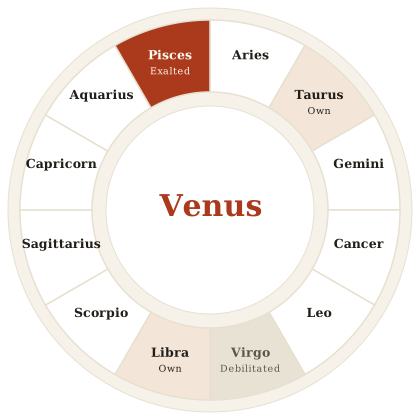
| Own sign | Taurus and Libra | Venus at home; beauty and relationship blossom naturally |
| Exalted | Pisces (deepest at 27 degrees) | Held to be the strongest placement; love dissolved in devotion and compassion |
| Moola-trikona | Libra 0-15 degrees | Exaltation-like, slightly milder beneficence |
| Debilitated | Virgo (deepest at 27 degrees) | Over-analysis in love; rasa lost in bookkeeping |
The symbolic reason is beautiful. Pisces is Jupiter's compassionate sign: when love (Venus) meets compassion it becomes selfless, and the tradition calls this the height of love. Virgo is Mercury's calculating sign; there Venus's rasa gets tied up in weighing and measuring, hence the debilitation. These placements, with their degrees, come from the classical dignity tables whose sources are given in the last section.
Venus in the twelve houses
The core rule: Venus adds comfort and beauty to the house it occupies. The traditional outline in brief:
| House | Venus's traditional effect |
|---|---|
| 1st (lagna) | A pleasant personality, sweet speech, love of art; an attractive presence |
| 2nd | A tendency to accumulate wealth, sweet speech, fortune on the beautiful side of life |
| 3rd | Courage in the arts; sweet ties with siblings, literary interest |
| 4th | A beautiful home and vehicle, the mother's affection, a contented mind |
| 5th | Creative talent, happiness through children, talk of love marriage |
| 6th | Victory in competition through diplomacy; advised care against sourness in relationships |
| 7th | Indications of a beautiful, loving spouse; happiness in partnerships |
| 8th | Talk of longevity; a bent toward hidden knowledge and sudden gains |
| 9th | Rising fortune, a marriage of dharma and art, beautiful journeys |
| 10th | Respect in the arts, media, design and beauty fields |
| 11th | Many sources of income; popularity among friends and society |
| 12th | A tendency to spend on luxuries; the tradition also gives a mark of devotion and moksha |
As with every planet, Venus's house result never runs alone: sign, aspects, conjunctions and dasha keep reshaping the picture. Venus in the twelfth is "luxurious spending" in one chart and "devotional love" in another; the difference is the rest of the chart.
Venus in the signs: the traditional love-temperament
Venus never strays more than 48 degrees from the Sun, so it is never far from the birth sign. Even so, its sign is held to describe the love-language:
| Sign | Traditional love-temperament |
|---|---|
| Aries | Enthusiastic, instant love; a warning of quick attraction cooling fast |
| Taurus (own) | Steady, sensuous, loyal love; love of comfort |
| Gemini | Love in conversation; light-hearted, intelligent relating |
| Cancer | Emotional, caring love; home-centred happiness |
| Leo | Dramatic, generous love; a hunger for admiration |
| Virgo (debilitated) | Scrutiny and accounting in love; love expressed through small acts of service |
| Libra (own) | Balanced, beauty-loving, diplomatic relating |
| Scorpio | Deep, intense, possessive love |
| Sagittarius | Open, philosophical love; partnership with freedom |
| Capricorn | Practical love that ripens slowly; a respectable partner |
| Aquarius | Friendship-based love; an unconventional relating style |
| Pisces (exalted) | Selfless, compassionate, imaginative love |
Signs of a strong and a weak Venus
The tradition counts Venus strong when it is:
- in its own sign or exalted,
- in a kendra or trikona house,
- joined or aspected by benefics,
- directionally strong: Venus gets dig-bala in the fourth house,
- not combust and free of harsh malefic influence.
The traditional signs of a weak Venus: debilitation (Virgo), an enemy sign, combustion by the Sun, and harsh association with Rahu, Ketu, Saturn or Mars. One special point: Venus often stays close to the Sun, so a combust Venus is common, and many teachers in the tradition do not count it as harmful as combustion of other planets, since for Venus it is a nearly routine event. As always, these are tendency-indicators; the full chart is what is held to be decisive.
The Venus mahadasha: 20 years
In the Vimshottari system the Venus mahadasha runs 20 years, the longest of the nine. The tradition views this period as the season when comforts, art and relationships ripen, especially when Venus is strong in the chart. The traditional lengths and characters of the sub-periods:
| Sub-period | Length | Traditional character |
|---|---|---|
| Venus-Venus | 3 years 4 months | Expansion of comfort, practice of art, talk of marriage yoga |
| Venus-Sun | 1 year | A balance of prestige and comfort; benefit from authority |
| Venus-Moon | 1 year 8 months | Mental ease, a beautiful home, public popularity |
| Venus-Mars | 1 year 2 months | Passion and energy; a test of intensity in relationships |
| Venus-Rahu | 3 years | A test of temptation and attraction; talk of unconventional ties or foreign comforts |
| Venus-Jupiter | 2 years 8 months | A meeting of wealth and wisdom; auspicious events, happiness through children |
| Venus-Saturn | 3 years 2 months | Solid comfort through hard work; the lesson of responsibility in relationships |
| Venus-Mercury | 2 years 10 months | A happy union of art and intellect; writing, trade |
| Venus-Ketu | 1 year 2 months | From luxury toward inwardness; spiritual rasa |
Remember, dasha results are not fixed: Venus-Rahu is a warning of confusion in relationships in one chart and a door to success in a foreign art-world in another. Context decides.
Retrograde and combust Venus
Venus turns retrograde about once every eighteen months, for roughly forty days. Astronomically this is the apparent reversal of motion seen from the earth. The tradition calls a retrograde Venus "rasa turned inward": such natives write their own definition of pleasure and walk a little apart from the crowd's fashions and customs. In love matters there is a popular saying about old connections returning during Venus retrograde. A combust Venus, very close to the Sun, is called "scorched rasa"; but as noted above, combustion is nearly routine for Venus, so many teachers count it as less harmful than for other planets. In both states the result keeps changing with house, sign and dasha.
Malavya yoga and other Venus combinations
Among the five mahapurusha yogas, Malavya yoga forms when Venus sits in a kendra house in its own or exalted sign. The tradition counts it among the finest combinations for beauty, comfort and artistic talent. Venus joined with Mercury is described as a meeting of art and intellect, with talent discussed in both music and writing. Venus-Mars conjunction is tied to passion and creative energy. With every yoga the same caution applies: one yoga is not a whole chart; strength, cancellations and dasha together fix the result.
Venus in love, marriage and matchmaking
Venus plays a double role in matchmaking. First, together with the seventh house and its lord, Venus's placement gives the traditional indications for marital happiness. Second, the mutual compatibility of the two charts' Venuses is examined: whether the two "love-languages" meet. Venus aspecting the seventh house is said to add sweetness to the relationship. An honest warning is needed here: rejecting a match in the name of a weak Venus, or marrying without discernment because Venus is strong, are both against the tradition's own spirit, because matching weighs ashtakoota points, houses and dashas together.
Art, beauty and livelihood
The fields the tradition assigns to Venus: music, dance, acting, painting, fashion and design, jewellery, perfume and cosmetics, media and entertainment, hotels and hospitality, the vehicle trade, and diplomacy. When Venus ties to the tenth house or its lord, standing in these fields is discussed. This is a tendency-indicator, not a job guarantee; talent, training and hard work hold their own place. It is worth noting that the modern "creative economy" of content, design and entertainment is, in the tradition's language, simply an expansion of Venus.
Venus in the panchang and in transit
Friday is dedicated to Venus; the custom of Lakshmi worship and white-item remedies on that day grew from this. In muhurta shastra, when choosing a wedding muhurta, Venus must specifically not be combust; the custom of postponing weddings during a combust Venus comes from here. In transit Venus stays about a month in a sign; the tradition calls Venus's auspicious placements from the birth sign a season of art, wealth and happiness in relationships. Transit results are collective tendencies; for a personal result the birth chart and dasha are the accepted basis.
Classical correspondences
| Subject | Venus |
|---|---|
| Day | Friday |
| Direction | South-east (agneya) |
| Colour | White; bright and mixed colours |
| Metal | Silver |
| Gemstone | Diamond, opal or zircon (wear only after showing the kundli) |
| Deity | Lakshmi |
| Dasha length | 20 years (Vimshottari) |
| Element | Water |
| Greatest distance from the Sun | About 48 degrees |
Shukracharya, teacher of the asuras
In the Puranas Shukracharya is a great sage of the Bhrigu line and the guru of the daityas. His most famed knowledge is the Sanjivani, the mantra that revives the dead, said to have been won from Shiva through penance. In the wars of gods and asuras, where Brihaspati made strategy for the gods, Shukracharya was the power of revival for the asuras. Another famous story: during King Bali's gift to the Vamana avatar, Shukracharya tried to stop him because he had seen through the divine play; as the story goes, Bali kept his word of giving above his guru's word. The astrological symbol of these stories is that Venus is not only pleasure but also "the knowledge of keeping things alive": relationships, art, and the rasa of life itself.
The simple remedies
The tradition's remedies for a weak Venus:
- Fasting and charity: a Friday fast; donating white items, rice, white sweets, fragrance and clothing, especially to women or artists.
- Mantra: chanting "Om Sham Shukraya Namah"; Lakshmi hymns are also linked to Venus.
- Conduct: respect for women, cleanliness and fragrance, honour for the arts; the tradition files Venus's remedies under "beauty and respect".
- Gemstone: diamond, opal or zircon are considered Venus's stones; show your kundli before wearing one, since Venus is not judged benefic for every chart.
Keep in mind that remedies are a support within the tradition, not a guaranteed fix. Decisions about relationships, money or health belong first with qualified specialists.
Venus's lesson for our times
In an age when beautiful things are free on a screen but joy is expensive, Venus's symbol is deeply relevant. In the tradition's language, Venus-strength means "the capacity to truly enjoy what is good". Its modern form: pausing between achievements to taste them, investing beauty and sweetness into relationships, and telling real pleasure apart from the advertising of luxury. Venus's warnings apply just as much today: rasa turned into bookkeeping (the lesson of debilitated Venus) and bookkeeping turned into rasa (greed) both call for care. A balanced Venus is the one that receives joy and shares it too.
An honest note
Astrology is a traditional system, not laboratory science. The meanings attached to Venus rest on centuries of symbolism and remembered experience. Take decisions about relationships, money and health with qualified specialists and your own judgment; treat astrology as context, never the only basis. Sources consulted for the traditional placements and correspondences here: the dignity tables of own sign, exaltation and debilitation with degrees, from the Saravali translation at saravali.github.io/astrology/dignities.html and the table at astropal.app/learn/planets; the graha correspondence reference (day, direction, colour, gemstone, deity, dasha years) at satyori.com/reference/grahas/; and the Vimshottari dasha year-table at panchangtime.com/methodology/vimshottari-dasha. These present the classical Parashari framework; where traditions disagree, the text above says so. Our aim is to explain the tradition in plain words, not to sell fear.
Questions on this article
In which sign is Venus exalted?
Venus is exalted in Pisces (deep exaltation at 27 degrees) and debilitated in Virgo. Taurus and Libra are its own signs.
How long does the Venus mahadasha last?
In the Vimshottari system the Venus mahadasha lasts 20 years, the longest of the nine.
What is Malavya yoga?
When Venus sits in a kendra house (1, 4, 7, 10) in its own or exalted sign, it forms Malavya yoga, one of the five mahapurusha yogas. The tradition counts it an auspicious combination for beauty, artistic talent and comfort.
What are the remedies for a weak Venus?
Traditional remedies include a Friday fast, donating white items and rice, respect for women, and chanting "Om Sham Shukraya Namah". Show your full kundli before wearing a diamond or opal.


