Viparita Raja Yoga: When the Difficult Houses Cancel Each Other
When the lords of the three hardest houses sit in each other's houses, the tradition reads a yoga of reversal; the rule, the textual warrant, and one computation most software skips.
One of the most counterintuitive rules of astrology is this: when the lords of the chart's three hardest houses, the sixth (enemies, disease, debt), the eighth (sudden upheaval) and the twelfth (loss, expense), sit in each other's houses, the tradition says that difficulty cancels difficulty. Today this is called Viparita Raja Yoga. The first honest remark concerns the name itself: according to satyori.com's audit, the Phaladeepika (6.57) names the three separately, Harsha, Sarala, Vimala, and the umbrella name "Viparita Raja Yoga" appears in the example charts of B. V. Raman's How to Judge a Horoscope; on that audit's reading the umbrella title looks like a modern-era grouping, while the textual references are of three separate yogas. The second remark concerns magnitude: this is not an ordinary Raja Yoga. Its benefit arrives through reversal; the native must first pass through the dusthana experience, and only then does the structure turn in their favor. This article opens the rule, the distinct characters of the three yogas, the textual warrant, and one computation most software skips.
Three yogas, three characters
Phaladeepika 6.57 names twelve yogas for the twelve houses; for the sixth, eighth and twelfth the names are Harsha, Sarala and Vimala. Raman (Three Hundred Important Combinations, yogas 109-111) states the rules: the lord of the sixth in the sixth, eighth or twelfth, Harsha; the lord of the eighth in the same, Sarala; the lord of the twelfth in the same, Vimala. Note that in this form the own house is included; some modern readings separate the own house out, and this definitional split returns below. satyori describes their characters as distinct: Harsha is active and confrontational, a life pattern of repeatedly defeating enemies, disease and disputes; Sarala is transformative and often sudden, tied to fearlessness and sudden gains; Vimala is subtractive and cumulative, tied to control of expenditure, practice and quietly accumulating capacity. The results the tradition attaches divide along the same lines: from Harsha, happiness, a sound constitution, victory over difficulties, friendship with eminent people; from Sarala, fearlessness, resolve, learning; from Vimala, restraint and slowly growing purity. Calling all three one "raja yoga" is the third common misreading: each has its own life domain and its own timing track.
The textual warrant: where the rule comes from
The main warrant is the Phaladeepika (of Mantreswara) 6.57, which gives these three names in its list of twelve house yogas. Raman gave them rule form as 109-111 in his three-hundred-combinations book, and the umbrella name spread from the example charts of his other book. A parallel rule sits in BPHS 39.20 (Santhanam translation): if the lords of the sixth, eighth and twelfth are debilitated, in inimical signs or combust, while the lagna lord in its own or exaltation sign aspects the lagna, there is a raja yoga; this is a different rule from Harsha-Sarala-Vimala, but the underlying idea is the same, the dusthana lords subdued. Chapter 41 of the Saravali is also available under the title "Vipareeta Raja Yoga (the lords of the 6th, 8th, 12th)". Note well: we have not opened the original Sanskrit of any of these texts ourselves; we are citing translations available on the web and modern books (Raman), and the source list at the end says exactly this.
The reversal mechanism: cancellation, not rescue
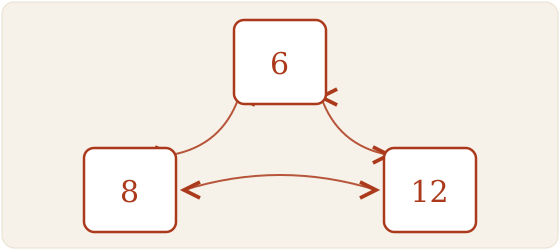
Viparita yoga must be understood apart from Neecha Bhanga. In Neecha Bhanga a debilitated planet is structurally rescued; in Viparita no planet is rescued at all, the dusthana lords cancel one another's damage. The figure above shows exactly this structure: the three dusthanas and the mutual exchange of their lords. The strongest form of the mechanism combines with exchange: the sixth lord in the eighth and the eighth lord in the sixth is at once a Parivartana Yoga and a double Viparita, and the tradition treats this as the most powerful form of the combination. From this a boundary rule follows: where the dusthana lord is itself weak, combust or afflicted, the capacity for reversal also shrinks; satyori's example is the sixth lord in the twelfth with Rahu in close conjunction, producing deceptive enemies and victories that erode. So the principle of our earlier articles applies here too: the combination is structure, condition decides its potency; weakened, not cancelled.
The computation software skips: the purity of dual lordship
satyori's most practical warning: most software labels any "dusthana lord in a dusthana" as Viparita, but never checks whether the same planet also owns a benefic house. If the sixth lord also owns an angle or a trine, the reversal drags that house's damage in with it, and the yoga is no longer "pure". We computed this for all twelve lagnas from the standard lordship rules: for each lagna, the lords of the sixth, eighth and twelfth, and whether each also owns an angle (1, 4, 7, 10) or a trine (5, 9). The result: in eleven of the twelve lagnas at least one dusthana lord also holds angle or trine ownership; only for Pisces lagna are all three (the Sun, Venus-plus-third, Saturn-plus-eleventh) free of angle and trine ownership. The Sun and Moon each own a single house, so wherever they are dusthana lords (Cancer-lagna's twelfth Moon, Aquarius-lagna's sixth Moon) they are always pure. And one special case: for Aries and Libra lagnas the eighth lord is the lagna lord itself (Mars or Venus); there "the eighth lord in a dusthana" also means the lagna lord entering a dusthana, which the texts treat separately. This table is our own computation, not quoted from any text; the lordship rules are standard, but in any reading it should be re-checked with that reading's own method.
The meanings of the names: viparita, harsha, sarala, vimala
The whole teaching sits inside these names. "Viparita" joins vi with par, meaning reversed, inverted; the yoga's very name states its mechanism, the turning of difficulty's direction. "Harsha" means joy, delight; the name of the victory that comes through the sixth house's battles. "Sarala" means straight, without crookedness; the name of standing straight after passing through the eighth house's tangles, or the fearlessness of one who stays upright after upheaval. "Vimala" joins vi with mala, free of stain; the name of becoming pure through the twelfth house's expenditure and loss. This etymology is useful for two reasons. First, it shows that the text-authors thought of these not as a "raja yoga" but as three specific life qualities, each with its own name; that subtlety dissolves into the umbrella title. Second, the names are also a memory device: the sixth is battle, so Harsha is the joy of victory; the eighth is the tangle, so Sarala is standing straight; the twelfth is expenditure, so Vimala is purification through restraint.
A worked example: a Sarala structure in a Sagittarius-lagna chart
Take a hypothetical Sagittarius-lagna chart. In this lagna the eighth house is Cancer, whose lord is the Moon; and by our purity table the Moon, owning only one house, is always pure. Suppose the Moon sits in the twelfth house, Scorpio: the eighth lord in a dusthana, so Sarala Yoga is present. Now the real reading's staircase. Step one: the Moon in Scorpio is debilitated; by satyori's principle the capacity for reversal is reduced, because the reversing planet is itself weak. Step two: the twelfth house is itself a dusthana, so the lord sitting there is entering a dusthana even heavier than its own; some commentators read this as stronger cancellation, some as excessive erosion. Step three: if Mars (the lord of Scorpio) stands strong in an angle, a Neecha-Bhanga-like supporting structure attaches, but remember, that is a mechanism distinct from Viparita, and the two can run together. Step four: within the tradition, the result timing ties to the dasha of the Moon or Mars. This example shows that between the line "Sarala Yoga is present" and its reading stand at least four decision points; and the report market's one-line announcement stops at the first of them.
The context of the Raman era
The consulted audit traces the umbrella name to the example charts of Raman's book; how the name spread from there is our own interpretation, not a documented fact. When, in the middle of the twentieth century, astrology reached every home through books and magazines, the need to organize yogas grew: readers began asking "what is in my chart", and answerers had to bind the texts' scattered lists into memorable headings. If the audit's trace is right, "Viparita Raja Yoga" looks like a product of this organizing; that is not wrong, but it would then be an editorial construction, not a sentence of the texts. The practical meaning: when a report or an app uses this name, understand that you are reading a modern classification whose roots lie in the Phaladeepika and Raman; and when two sources state different rules under this name, do not be surprised, because under the umbrella sit at least three textual rules and one modern definitional dispute.
The base rate: a bounded model estimate
Unlike the Dhana Yoga article, the sources we consulted did not provide a measured rate here, so we offer only a model estimate with explicit assumptions, not a measured figure. Assumptions: planetary placement uniform and independent across the twelve houses (which is not actually true; combustion and retrograde clustering skew the distribution). Then: one given dusthana lord in any dusthana (its own house included) is 3/12 = 25 percent; at least one of the three lords in a dusthana is 1-(9/12) cubed, about 58 percent; if the own house is excluded, 2/12 per lord and about 42 percent for at least one. The exact mutual exchange of the sixth and eighth lords: 1/144, about 0.7 percent. Now add the purity computation above: on average fewer than one and a half of the three dusthana lords are free of angle-trine ownership, so the estimate for a "pure" Viparita sits lower still. The direction of the conclusion matches the Dhana Yoga article: some dusthana reversal or other will be found somewhere in most charts; the rare thing is being pure, strong and active at the right time.
Common confusions
First confusion: Viparita Raja Yoga equals an ordinary Raja Yoga. No; satyori calls this the first misreading. Its benefit comes through reversal, the native reaches the position only by passing through the difficulty; presenting it as "a raja yoga quietly sitting there" is false to both the native's experience and the texts. Second confusion: the three forms are interchangeable. No; Harsha is active, Sarala sudden, Vimala cumulative, and the timing differs. Third confusion: the software label is final. See the purity computation above; a label without a dual-lordship check is incomplete. Fourth confusion: sitting in the own house counts as Viparita. The definition splits: Raman's rule includes the own house, some modern readings separate it; first ask which definition the speaker is using. Fifth confusion: a Viparita yoga means no remedy is needed, or that many remedies are needed. Both extremes are inconsistent: within the tradition the answer is testing the lord's strength and the dasha timing; spending pressure is again the warning sign.
Practical use
First, in testing a reading: on hearing "your chart has a Viparita Raja Yoga", ask four questions: which lord (sixth, eighth or twelfth), in which dusthana, does that planet also own an angle or trine, and what is its condition (combust, debilitated, afflicted). Second, in expectation: this yoga's story is "pressure first, then advancement through the very channel of that pressure"; a report that announces only success and skips the sequence of the reversal is not speaking the yoga's real language. Third, in timing: within the tradition the yoga is considered active in the dasha of the lord involved; saying "a Viparita Raja Yoga is running" without a dasha reference is incomplete. Fourth, for Aries and Libra lagnas: there the eighth lord is the lagna lord, so weigh a Sarala-like structure on a different scale, because the lagna lord's move into a dusthana is a separate topic in the texts.
Sources and an honest note
The three yogas' names and the Phaladeepika 6.57 reference, Raman's rule form (Three Hundred Important Combinations 109-111), the Raman source of the umbrella name, the parallel BPHS 39.20 rule, the description of the three characters, the dual-lordship warning, the priority of the parivartana double-Viparita and the distinction from Neecha Bhanga all come from satyori.com's Viparita Raja Yoga article; the title-level warrant of Saravali chapter 41 from astro-fusion.com's Saravali book series; definitions and worked examples from vedic-astrology.in and epandit.in. We have not opened the original text of any classical work ourselves; the Phaladeepika and BPHS references belong to these sources. The absence of a measured rate is scoped to the sources we consulted; we did not search further. The twelve-lagna angle-trine purity table and all percentages are our own computation or model estimates, with assumptions stated above; they are not measured figures. Everything tied to effects is presented as a claim of the tradition; no measured connection between any yoga and a life outcome is established. This article is educational.