Virgo (Kanya): The Craft of the Zodiac
Kanya is the tilled earth, worked and reworked toward a better yield: Mercury’s own sign, where the same planet is exalted too, and a devotion that would rather mend your roof than say the word. From the classical verse to the modern sign profile, the art of discrimination and the challenge of perfectionism, with sources, and with an honest-limits note.
Every throne needs someone who keeps the palace running. The fifth sign ruled from its seat; the sixth sign, Kanya, picks up the tools. Virgo is thirty degrees of mutable earth, the maiden of the zodiac, and the sign Satyori's Kanya guide describes as the analytical mind at its most refined, the capacity to discriminate, organize and perfect. This article audits that craft in full: the sign's structure, the classical verse on a Virgo Moon, the ruler who is doubly at home here, the traditional tendencies in personality, career, relationships and health, and at the end an honest-limits note.
Everything below comes from sources fetched on 31 October 2026: Satyori's Kanya rashi guide, the seventeenth chapter of the Brihat Jataka as published at VedicPupil, which we read directly in that page's English translation, Wikipedia's Virgo article for the tropical-sidereal gap and the maiden's mythology, and Panchangtime's Vimshottari dasha guide for Mercury's period. Where a claim belongs to one of them, we say so; where a note is ours, we mark it. Sign description is the tradition's framework; we give it as description, not diagnosis.
The sixth cell: the structure
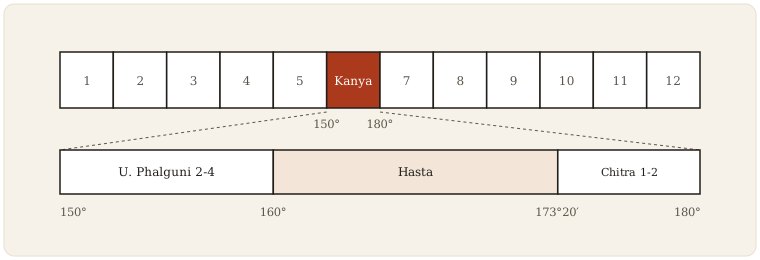
Kanya is the sixth sign of the zodiac, from 150 to 180 degrees. Its symbol is the maiden, and the Satyori page reads the symbol precisely: the maiden represents purity of intention, the desire to refine and purify rather than to accumulate or display. This is the sign of the craftsperson, the healer and the editor. Its element is earth, its character Dwisvabhava, mutable, and its ruler is Mercury. In the Vedic mapping of the Kalapurusha, the cosmic person of time across whose body the twelve signs lie, Kanya is the waist and the intestines: the part that sorts what the body keeps from what it lets go. A mutable earth sign bends without breaking; where Taurus, the fixed earth, holds its ground, Kanya's earth is the tilled field, worked and reworked toward a better yield. The same guide draws the contrast with Mercury's other sign: where Mithuna uses Mercury's energy to gather and communicate, Kanya uses it to analyze and improve.
Three nakshatra segments fall within Kanya: the second, third and fourth padas of Uttara Phalguni, all of Hasta, and the first two padas of Chitra. Each nakshatra spans 13 degrees 20 minutes of the zodiac, so Uttara Phalguni's remaining three quarters run from 150 to 160 degrees, Hasta from there to 173 degrees 20 minutes, and Chitra's first half to 180; the arithmetic is ours from the standard nakshatra division. So two people both called Kanya may carry different nakshatras inside the same rashi, and the nakshatra has its own weight in a reading. This collection carries detailed introductions to all twenty-seven nakshatras, including Uttara Phalguni, Hasta and Chitra; here it is enough that the rashi sets the frame and the nakshatra the finer shading within it.
One more boundary line matters. In Indian usage the word rashi usually means the Moon sign, the sign the Moon occupied at the birth moment. The classical chapter we quote below is titled exactly that, Chandrarashishila, the natures of the Moon signs. For Kanya there is a quiet aptness in this: the chapter is about the mind, and this is the sign whose whole art is discrimination. A chart also holds the lagna, the sign rising on the horizon, and the Sun's sign; the three carry different significations. And Satyori adds in its own line that the condition of Mercury in your chart strongly influences how Kanya expresses in your life. A rashi is one axis, not the whole picture.
Kanya and Virgo: two scales, one sky
In Western astrology Virgo is the same sixth sign: the maiden, the earth element, the mutable quality, Mercury as ruler; per Wikipedia's table, the Sun transits tropical Virgo from 23 August to 23 September in 2026, and between 24 August and 23 September on average. But the tropical zodiac is tied to the equinox point, while the Vedic sidereal zodiac is tied to the stars. Satyori puts the ayanamsha gap between them at about 24 degrees. The practical result: a person whose Western sun sign is Virgo may have Kanya as their Vedic rashi, or Simha; it is not the date that changes but the scale. This article speaks of the Vedic Kanya, and for date boundaries rely on your own panchang or chart calculation.
The maiden's story is a story of departure. Per Wikipedia, Greek telling associates the constellation with Astraea, the last immortal to abandon Earth at the end of the Silver Age, when the gods fled to Olympus; she later became the constellation Virgo. In most myths the figure is a virgin maiden associated with wheat: Greek and Roman tradition ties her to Demeter, goddess of the harvest, or her daughter Persephone; another tale names Erigone, the Athenian maiden placed in the sky after her grief; and in Egyptian telling the Sun's presence in Virgo marked the beginning of the wheat harvest. A maiden who leaves a corrupted age, carrying grain: purity that will not compromise, and nourishment that must be sorted from the husk. The pattern's own reading stays close to the symbol, and Wikipedia notes that Hindu astrology's comparable sign is Kanya, which also means maiden.
The classical Virgo Moon: Brihat Jataka
Varahamihira's Brihat Jataka, a mid-first-millennium Jyotish text, devotes its seventeenth chapter to the natures of the Moon signs, and its line for Kanya reads: with the Moon in Virgo, the person has eyes and gait slow with modesty and charming, drooping shoulders and arms, is happy, refined, truthful, skilled in the arts, learned in scripture, religious, intelligent and fond of love-making, enjoys others' houses and wealth, lives abroad, speaks sweetly, and has daughters and few sons.
In plain terms: this is the series' gentlest portrait so far. Where the Leo Moon was a hero the verse itself kept wounding, flattered by swindlers and angry, the Virgo Moon is given modesty first: the Sanskrit opens with vrida, a becoming shyness, and closes with a pun the translation cannot carry, kanyayam, in Virgo, answered by kanya-praja, blessed with daughters. The marks that follow are of a piece: refinement, truthfulness, skill in the arts, scriptural learning, sweet speech. Two marks sit oddly and are worth keeping odd: this modest native enjoys others' houses and wealth, and lives abroad. The verse does not explain; perhaps the helpful guest is simply welcome everywhere. We leave both standing.
Unlike the Leo verse, which carried two translator's textual notes, this verse carries none on the fetched page; the text is straightforward, and we say so because the series has made a habit of showing the notes where they exist. And the same chapter already holds the most useful hedge inside itself, the one we have quoted before in this series: verse 17.13, which says these twelve Moon-sign natures hold when no other planet or condition in the chart affects that sign; otherwise the marks change. The tradition said first that its portraits are not verdicts. The twelve Moon-sign verses are twenty-eight lines among the chapter's four hundred and nine; that says how old these figures are, and also how much else the book contains.
The doubly housed ruler: Mercury
Kanya's ruler is Mercury, and here the exaltation table does something singular: per Satyori's Kanya guide, Mercury is exalted in this sign at 15 degrees, which is Mercury's own sign. Every other exaltation this series has met placed a planet in someone else's house: the Sun exalted in Aries, the Moon in Taurus, Jupiter in Cancer. Mercury alone is exalted at home. The guide's reading is that the exaltation highlights the perfection of analytical intelligence, the ability to see what is wrong and know how to fix it; in Mithuna the same planet gathers, in Kanya it refines. And Venus is debilitated here at 27 degrees, with the reason given in temperament: Venus's desire for pleasure, romance and aesthetic enjoyment is constrained by Kanya's critical, discerning nature; beauty in Kanya must serve a function, and indulgence feels wasteful. Per Panchangtime's Vimshottari table, Mercury's mahadasha runs 17 years, among the longest, set against the Sun's 6, the Moon's 10, Mars's 7, Jupiter's 16 and Venus's 20: a long, fine-toothed period, like the planet itself.
Temperament, work and relationships: the tradition's map
The descriptive tradition seats Kanya at the workbench, and names the price of sitting there. Satyori's traits: observant, methodical and genuinely helpful, the one who notices what needs fixing and quietly attends to it; and the same analytical gift becomes a burden when turned inward as self-criticism or outward as fault-finding with others. These natives hold themselves to impossibly high standards and can struggle with a perfectionism that prevents them from finishing or sharing their work; their humility is real but can shade into self-deprecation that undersells considerable abilities. In careers the descriptive tradition places them in healthcare, editing, accounting, data analysis, quality assurance, nutrition, herbalism and administrative roles that require precision; they make outstanding diagnosticians, researchers and technical writers, and perform best in structured environments where attention to detail is appreciated rather than seen as fussiness. Satyori's own hedge stands here too: career outcomes depend on the tenth-house lord, planetary periods and overall chart strength.
In relationships this earth shows love by tilling. Satyori's account: Kanya natives show love through practical service, remembering your preferences, organizing your space, attending to the details of daily life; their challenge is expressing warmth and affection verbally or physically, since they default to being helpful rather than romantic, and partners may feel analyzed rather than loved if the critical nature goes unchecked. They need a partner who appreciates their quiet devotion and does not interpret reserve as coldness. The classical verse had already sketched the same figure from another angle: slow and charming of eye and gait, sweet-spoken, refined, fond of love. Between the two portraits lies the whole sign: devotion that would rather mend your roof than say the word.
On health the descriptive tradition ties Kanya to the digestive system, the intestines and the nervous system, with tendencies toward digestive disorders such as IBS, food sensitivities and malabsorption, anxiety and stress-related conditions; Satyori adds that these natives often have strong health awareness that can become hypochondria, noticing every sensation and fearing the worst. Its dosha note gives Kanya a vata-pitta dual affinity, vata from Mercury's mobile, nervous energy and the mutable quality, pitta from the earth element's digestive connection and analytical intensity, and suggests warm, nourishing, easily digestible foods, regular meal times and practices that quiet the analytical mind. All of this is that source's Ayurvedic framing, given in its name; this article offers no medical advice, and for any symptom the doctor is the authority. If you are pregnant, ill, elderly or on medication, any regimen the tradition mentions is not for you without a doctor's word.
The honest limits
Sign description is the tradition's framework, not measured psychology. Everything above is what the texts and one modern guide say about Kanya, recorded with their names and their dates; it is not what we measured in any person. The Brihat Jataka itself conditions every mark on the rest of the chart not disturbing the sign, and Satyori itself conditions career on the tenth lord and the dashas. A rashi is one thread of a chart and no thread of your worth. Do not measure anyone else by their sign, and do not pour yourself into one either; being Kanya is not being only this.
Keep one practical test as well: if some description here does not fit you at all, that is no fault of yours and none of the tradition's; the text laid down beforehand that these portraits are general. And if a description does fit, do not make it your ceiling; the most important part of the maiden's story is that she sorts grain from husk, and sorting is a skill, which means it can be learned, by practice, not by sign.
Short answers
What is the difference between Kanya and Virgo? A matter of scale: Vedic sidereal Kanya is tied to the stars, tropical Virgo to the equinox, and a gap of about 24 degrees separates them; one birth date can therefore fall in different signs in the two systems. Why is Mercury both ruler and exalted here? Satyori's table places Mercury's exaltation at 15 degrees of Kanya, its own sign, and reads it as the perfection of analytical intelligence; of the exaltations named in this series, Mercury's is the one that falls at home. Are Virgo people really fault-finding? The tradition frames criticism as the analytical gift turned outward, and the classical verse calls the same native sweet-spoken, truthful and refined; the text itself says the marks change with the rest of the chart. Is reading personality from a sign scientific? No; it is the tradition's descriptive framework, presented here as exactly that, with sources.
Questions on this article
What is the difference between Kanya and Virgo?
They are two names for the zodiac’s sixth 30 degrees: Kanya in the Vedic (sidereal) tradition and Virgo in the Western (tropical) one. The difference is that the tropical zodiac is tied to the equinox point and the sidereal to the stars; an ayanamsha gap of about 24 degrees separates them, so your Western sun sign and your Vedic rashi can differ. Per Wikipedia, the Sun transits tropical Virgo from 23 August to 23 September in 2026; Vedic Kanya is computed from the panchang.
How is Mercury both the ruler and exalted in Kanya?
Per Satyori’s Kanya guide, Mercury’s exaltation falls at 15 degrees of this very sign, and the sign’s ruler is also Mercury; this is Mercury doubly housed. The other exaltations this series has met, the Sun in Aries, the Moon in Taurus, Jupiter in Cancer, all placed a planet in someone else’s house. The page’s reading is that analytical intelligence here reaches its perfection: seeing what is wrong and knowing how to fix it.
Are Virgo people really fault-finding?
The tradition frames fault-finding as the analytical gift turned outward: per Satyori, the same intelligence can also turn inward as self-criticism, and both are this sign’s tests, not its identity. The Brihat Jataka’s Virgo-Moon verse calls the same native modest, refined, truthful, skilled in the arts and sweet-spoken. And the text itself (17.13) says these marks change with the rest of the chart. Do not mould or measure any person by their sign.
Is reading personality from a sign scientifically established?
No, and this article makes no such claim. Sign description is the framework of the Jyotish tradition, carried through texts and practising astrologers over centuries; we present it as exactly that, with sources. Do not treat it as a substitute for psychology or medicine; as a way of reflecting on oneself it can be a cultural mirror, not a measuring instrument.