What Astrology Can and Cannot Do
A clear boundary between symbolic meaning and reliable knowledge.
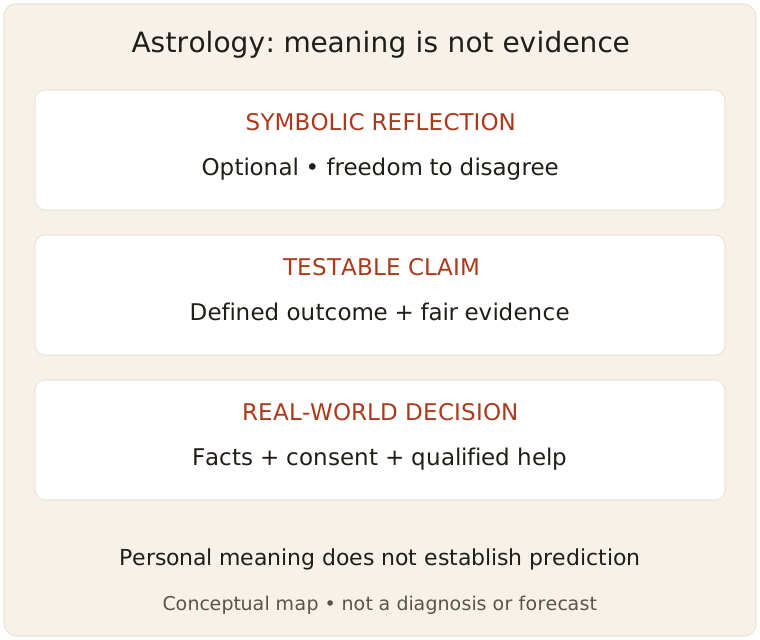
A useful boundary begins with the kind of question
Astrology can offer a language for discussing experience, a link with family traditions, and a set of symbols that some people find meaningful. Those uses are different from reliably discovering a person's character, predicting an event, diagnosing an illness, or deciding whom someone should marry. Meaning is something a person can describe for themselves. Predictive accuracy is a claim about the world and needs evidence beyond the feeling that a reading fits. Keeping that difference visible makes room for cultural interest without handing a chart authority it has not earned.
This guide is about responsible use, not a personalised forecast. It explains what a consultation might reasonably be used for, where scientific support is lacking, and which decisions should stay grounded in real information and qualified advice. It does not promise that a careful astrologer can remove uncertainty. Nor does it require a reader to give up every ritual or family observance. The aim is a clear boundary: an optional symbolic practice must not overrule safety, consent, evidence, or the people whose lives are involved.
Separate a calculation from its interpretation
A chart may contain carefully calculated positions and a precisely recorded birth time. That can establish what a particular charting method produces from particular inputs. It does not establish that the interpretation predicts personality or events. The accuracy of the astronomical input and the validity of the astrological inference are separate questions. A neat diagram, decimal precision, or sophisticated software cannot close that gap. Ask which claim is being made before deciding what evidence would support it.
Astrological systems also use different conventions. A reader should name the method being discussed rather than treating every chart as interchangeable. If the birth time is uncertain, say so; do not present a guessed input as a recovered fact. But improving an input does not by itself prove the interpretive theory. The question remains whether the claimed result has been demonstrated under a fair test. Technical detail can explain a tradition without becoming a certificate of predictive power.
What reflection can mean without becoming a diagnosis
A symbolic description can be used as a prompt: How do I respond to conflict? What kind of routine helps me? What have I been avoiding? These are questions a person can explore through their actual experiences. An answer should remain open to disagreement. If a description does not fit, the reader does not need to invent hidden traits or accept that the astrologer knows their inner life better than they do. Reflection is useful only while the person remains free to reject the frame.
Astrology.com's practitioner introduction describes astrology as a philosophy and says that a chart need not fix a person into one way of being. That is an account of how a commercial astrology site presents its practice, not independent evidence that planetary indications reveal personality. The same page also uses scientific language and proposes gravitational explanations. This guide does not adopt those explanations. A practitioner source can show what practitioners claim; it cannot independently validate its own claims.
Cultural value is not a forecast
A family may enjoy learning the names of nakshatras, comparing calendar traditions, or marking a festival together. Someone may like the art of a chart or the language of a familiar story. Those are possible reasons to participate without claiming that a planet caused an argument or guaranteed success. People can describe their own cultural attachment honestly. There is no need to manufacture a scientific endorsement to make an observance personally meaningful.
The reverse boundary matters too. Personal attachment does not require another person to participate. A partner may agree to a small ceremony but decline a chart reading. A child should not be labelled unlucky because an adult dislikes a configuration. A respectful family discussion can separate what someone wishes to observe from what others are expected to believe. The practice stays optional, and practical arrangements remain negotiable rather than becoming a test of loyalty.
What scientific assessment asks for
UC Berkeley's Understanding Science uses astrology to explain the difference between scientific-looking detail and scientific practice. Its assessment says that the evidence from careful tests discussed there does not support astrological ideas, and that a scientific approach should respond to contradictory results. The relevant standard is not whether a reading contains mathematics. It is whether its claims can be tested and whether the explanation changes when the evidence does not support it.
Some statements are too elastic to fail: a challenge may arrive, an opportunity may appear, or an important relationship may change. If every possible outcome counts as confirmation, the statement cannot discriminate between a correct forecast and an incorrect one. A genuinely testable claim needs a defined outcome, a period, and a fair comparison. A reassuring story can still be a story. It should not be sold as demonstrated knowledge simply because it is difficult to disprove after the event.
A full-chart test and its limits
Clearer Thinking's published account describes a study of 152 astrologers who expected to do better than chance. Participants matched information about real people to one of five natal charts across twelve questions. The authors report that the group did no better than chance and that no participant answered more than five correctly. This was not merely a comparison of newspaper sun-sign paragraphs: the task used full charts and information about people's lives.
The scope must remain visible. The researchers restricted the task to Western variants, showing Placidus and Whole Signs charts. This particular study is not a direct test of every Jyotisha technique, ritual, or timing claim. It is a public research report from the organisation conducting the test, not a universal verdict on every possible practice. Even so, its negative result is not evidence for an untested system. A different claim needs its own positive evidence rather than borrowing an exemption from another study's limits.
Why a reading can feel unusually accurate
The APA Dictionary defines the Barnum effect as the tendency to see vague predictions or general personality descriptions as applying specifically to oneself. A sentence such as wanting independence while also needing support can fit many people. Its emotional force may be real even when it is not a distinctive discovery. This does not mean a person is foolish for recognising themselves in it. It means the feeling of recognition cannot, on its own, measure the method's accuracy.
The APA's definition of confirmation bias concerns gathering supporting evidence while dismissing or failing to seek contrary evidence. A reader might remember a forecast that seemed correct and forget several that failed. The same risk affects enthusiastic supporters and critics of a claim. A fair review records both hits and misses, keeps the original wording, and avoids changing the definition of success afterwards. These concepts describe common reasoning risks; they do not diagnose every individual who enjoys astrology.
Keep a record instead of reconstructing a success
If you want to examine a prediction, write it down before the outcome. Record the exact wording, the time window, what would count as a failure, and what would probably happen without the prediction. Keep the full set, including vague statements and wrong ones. Do not turn a forecast about work into a forecast about family only after an event occurs. Retelling makes a story easier to fit than the original claim may have been.
A personal notebook is not a controlled scientific study. It can still help you notice how much interpretation you are adding. Avoid testing a forecast by taking dangerous action or withholding care. You do not need to gamble, provoke an argument, or skip an appointment to see whether a prediction comes true. If the record leaves the claim uncertain, keep it uncertain. The honest conclusion can be that the account was interesting but did not establish reliable foresight.
Health needs a different source of authority
A chart should not be used to diagnose disease, rule out an illness, predict death, select a drug, or decide when treatment can safely wait. NCCIH advises against using an unproven product or practice as a substitute for conventional treatment or a reason to postpone seeing a health care provider. Its advice is general guidance about health approaches, not an evaluation of a particular horoscope. The relevant boundary here is straightforward: symbolic reassurance cannot establish medical safety.
If someone recommends an herb, supplement, fast, or physical practice during a consultation, that is no longer only a symbolic interpretation. Ask a qualified health professional about its risks and possible interactions before using it. Tell the care team what you are taking or doing. A family prayer may accompany care when it is safe and welcome, but it should not become a condition for receiving care. Do not change prescribed treatment because a chart describes a favourable or unfavourable period.
Money, work, and legal decisions need actual facts
A reading cannot establish whether a contract is fair, whether a job offer is genuine, or whether an investment suits your finances. Those questions require documents, risks, costs, and relevant professional advice. A symbolic date preference can be considered after the practical conditions are settled, but it must not conceal a missed deadline or an unaffordable commitment. No chart should be treated as a guarantee of returns or permission to ignore a loss.
For a career question, replace a fate verdict with concrete work: compare responsibilities, pay, learning opportunities, working conditions, and the effect on family life. These are planning suggestions, not claims that a horoscope can measure them. If a reading helps someone name a concern, check the concern against the real situation. The useful next step may be a conversation with a manager, a budget, or more information rather than another paid reading.
Relationships are not a chart score
A compatibility interpretation cannot establish a person's honesty, consent, safety, or readiness for marriage. Ask about behaviour, respect, communication, and shared plans. A disagreement between charts is not evidence that a partner is harmful; a favourable match is not evidence that harmful behaviour is safe. People should not be pressured into staying together or separating solely because of an astrological label. The people involved remain the decision makers.
Take special care with third-party readings. A birth detail is not permission to analyse someone publicly, accuse them of infidelity, or publish claims about their health. If another person wants their information kept private, respect that boundary. A family consultation should not become a way to judge a child, exclude a relative, or override an adult's choice. Uncertainty about a relationship is a reason for honest conversation, not an excuse to invent private facts from a chart.
How to judge a consultation's boundaries
Before paying, ask what the session covers, what it costs, how long it lasts, and whether any further purchase will be proposed. Ask whether the reader will acknowledge uncertainty and accept that you may disagree. Be cautious when an explanation becomes a threat followed by a paid remedy, a guaranteed outcome, or a demand for secrecy. These are reasons to pause the purchase; they do not require you to argue about your entire cultural tradition.
A family's devotional objects are distinct from a seller's product claims. You can keep a meaningful object without accepting that an expensive new item is necessary to prevent harm. Set a spending limit before the session and keep time to think. If you feel pressured, stop. A responsible boundary leaves you able to decline, seek another view, or choose no consultation at all without being told that refusal itself will cause misfortune.
Privacy and uncertainty belong in the conversation
Ask why each piece of information is needed. A general explanation of a tradition does not require copies of identity documents, full family records, or unrelated medical reports. Before sharing another person's details, ask their permission. Consider where the information will be stored and whether the session will be recorded or posted. An attractive website or a confident reader does not answer those questions automatically. Share only what is needed for the purpose you actually chose.
End with a modest summary: what was a traditional interpretation, what was your own reflection, what still needs checking, and what action you freely choose. A good boundary allows you to leave without a new dependency. Astrology may remain a cultural interest or a language for reflection. It has not earned the role of a reliable decision engine in the evidence discussed here. Keep your agency, use qualified help where stakes require it, and let uncertainty remain visible rather than purchasing certainty that nobody can honestly provide.
Sources consulted
- Astrology.com: practitioner framing, not validation
- UC Berkeley: scientific assessment
- Clearer Thinking: Western full-chart matching study
- APA Dictionary: Barnum effect
- APA Dictionary: confirmation bias
- NCCIH: health decision boundaries


