Yantra: The Word, the Grammar of the Figure, Its Three Uses, the Antiquity Claims, and the Market Layer
A diagram that is a deity's seat: a four-layer grammar, the "empty diagram without mantra" principle, a three-level audit of the antiquity claims, and a sales page where the answer to "it did not work" is the next product.
Tantra, mantra, yantra: the three words rhyme because all three carry the same Sanskrit suffix, -tra, "that by which something is done." tantravidya defines the three plainly: tantra is the tradition, a body of scriptures with the initiated lineages, rituals and philosophy built on them; a mantra is a formula of sacred sound; and a yantra is a geometric diagram that serves as the seat of a deity. The system, its sound, and its form. In this article we open the yantra like the machine its name says it is: where the word comes from, what the grammar of the figure is, what its three uses are, what the consecration question is, how its claims of antiquity audit, and how the "energized yantra" sells in the remedy market.
The word first: yantra means that which holds
In Rigvedic Sanskrit, Wikipedia's etymology note records, yantra meant an instrument for restraining or fastening: a prop, a support, a barrier; from the root yam, "to hold, restrain," with the instrumental suffix -tra. That root sense is still alive in Sushruta's medical terminology, where yantra names blunt surgical instruments such as tweezers or a vice, and in modern Hindi, where a yantra is simply a machine. The "mystical or occult diagram" sense, per the same note, arises in the medieval period, in the Kathasaritsagara and the Pancharatra literature. tantravidya carries the same word into the language of worship: in ordinary Sanskrit a yantra is just a device; in worship, what the device holds is a presence. The whole theory is folded into the name: an instrument for holding the deity's form.
The grammar of the figure: from the outside in
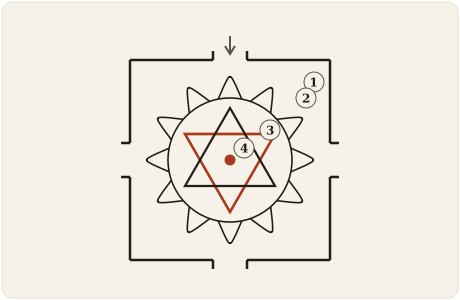
tantravidya writes that most yantras share a grammar, and Wikipedia's structural list confirms it piece by piece. Outermost is the bhupura: a square enclosure with four gates, one to each direction; this is the diagram's boundary, the emblem of the earth plane. Inside it, rings of lotus petals and circles: the lotus stands for purity and transcendence, and petal counts in the texts run 2, 4, 8, 10, 12, 16, 24, 32, 100, 1000 and more; many yantras also show three concentric circles near the centre. Then the triangles: the downward-pointing triangle represents Shakti, the upward-pointing Shiva; two opposed triangles interlock into a hexagram, the union of the feminine and masculine aspects. And at the very centre, the bindu: the undivided point from which the whole figure, and symbolically the whole cosmos, unfolds; Wikipedia notes the bindu may be drawn as a dot or small circle, or left invisible. Colour is not decoration either: on Madhu Khanna's authority, the white-red-black triad stands for the three gunas of nature, sattva, rajas and tamas, and not all texts give the same colours; aesthetics without the symbolism is meaningless, in the same citation's own line. The direction of worship is the same as the grammar's: from the gates inward to the bindu, honouring the attendant deities of each enclosure on the way.
Yantra and mandala: neighbours, not twins
One confusion is worth removing at the start: a yantra is not a mandala. tantravidya's distinction: both are ritual diagrams organised around a centre, but a yantra tends to be smaller, abstract and linear, built of triangles, lotus rings and an enclosing square, and is often engraved on metal for repeated worship; a mandala is typically larger and more pictorial, and in Buddhist practice is often built and dissolved for a single rite. Wikipedia likewise describes the yantra as smaller than the mandala and traditionally less colourful. So the decorative circle sold as "mandala art" and the copper Sri Yantra in a puja room are objects of two different traditions, however concentric both may be.
The fullest example: the Sri Yantra and its nine enclosures
The Sri Yantra is this grammar's most developed expression, the central diagram of the Sri Vidya tradition. Per Wikipedia's Sri Yantra page, it consists of nine interlocking triangles: four upward-pointing for Shiva, five downward-pointing for Shakti; hence its other name, the Navayoni Chakra. The triangles vary in size and intersect to form 43 smaller triangles, organised in concentric levels; around them run two lotus rings of eight and sixteen petals, and outermost the bhupura with its four doors, described as a temple with openings onto the regions of the universe. The same page records the traditional names of the nine enclosures, outside in: Trailokya Mohana, the bhupura; Sarva Aasa Paripuraka, the sixteen-petal lotus; Sarva Sankshobahana, the eight-petal lotus; Sarva Saubhagyadayaka, fourteen triangles; Sara Arthasadhaka, ten triangles; Sarva Rakshakara, ten triangles; Sarva Rogahara, eight triangles; Sarva Siddhiprada, a single triangle; and at the centre Sarva Anandamaya, the bindu. One more traditional count on the same page: the twelve sides of the four upward triangles are associated with the Sun's twelve sidereal zodiac signs, and the fifteen sides of the five downward triangles with the Moon's fifteen nityas; that is the tradition's number-symbolism, recorded as such, not arithmetic proof. The two-dimensional figure projected into three dimensions is called the Maha Meru, and the Sri Vidya statement recorded there is that the formless Tripurasundari is worshipped through this diagram together with the fifteen-syllabled Panchadashakshari mantra. We did not open the Lalita Sahasranama or the Tripura Rahasya ourselves; this presentation is that page's information.
Three uses: foundation, worship, desire
Wikipedia records Gudrun Bühnemann's threefold classification, and it is the tidiest list this layer has. The first type: yantras used as foundations for ritual implements such as lamps or vessels; simple geometric shapes on which the implements are placed. The second: yantras used in regular worship, such as the Sri Yantra; geometric diagrams energized with mantras to the deity, sometimes including written mantras in the design; these are often engraved on copper or silver so that repeated worship is possible. The third: yantras made for specific desire-oriented rites, often drawn on birch bark or paper, and sometimes incorporating special materials such as flowers, rice paste or ashes. Above these sits a fourth practice: wearing the yantra as a talisman; Wikipedia writes that as a talisman the yantra is viewed as representing a deity who can be called on at will by the user, and that consecration by a priest with the deity's mantras is traditional.
The consecration question: the diagram and its mantra
Both scholarly sources record the same principle, and it is this layer's real substance. tantravidya: a mantra is the deity in sound, a yantra the deity in form; the two are modes of one presence and are used together in practice; the yantra is drawn or installed, and it is mantra that consecrates and animates it; in traditional terms, a yantra without its mantra is an empty diagram. Wikipedia records nearly the same line from the practitioner's side: practitioners believe that a yantra not energized with a mantra is lifeless. tantravidya's five-step worship sequence turns the principle into process: preparation (purification of the body's elements and placing mantras on the body), installation (the yantra consecrated with mantra and the deity invoked into it), inward worship (enclosure by enclosure), japa (mantra repetition with the yantra holding the attention), and finally antar-yaga, in which the whole rite is performed in meditation and the practitioner's own body is identified with the yantra. That last step is the point of the whole structure: the diagram is a map of the cosmos, the mantra is its sound, and the practitioner is meant to discover both within themselves.
The antiquity claims audited
Three different kinds of claim sit in one page-family here, and weighing them separately is essential. First, the archaeological claim: Wikipedia writes that the Baghor stone, found in an Upper Paleolithic context in the Son River valley, with triangular engravings on one face and daubed with ochre, is considered an early yantra-like example by G. R. Sharma, who was involved in its excavation and dated it to 25,000-20,000 BCE; Kenoyer, also involved, associated it with Shakti. That is the excavators' interpretation, not a measured conclusion; and the Sri Yantra page's "11,000-10,000 BCE" line belongs to the same presentational class. Second, the tradition's claim: the earliest Sri Yantra drawings are associated with Adi Shankaracharya; and Subhash Kak's argument that the Sri Yantra's description matches a yantra in the Shri Sukta or the Shvetashvatara Upanishad, beside which Wikipedia itself places an editorial "how?" marker. Third, the scholarly dating: tantravidya writes that scholars date the surviving Tantric scriptures roughly from the fifth to seventh centuries CE onward, and Wikipedia's etymology note places the "mystical diagram" meaning in medieval texts. All three lines are set side by side; the conclusion is not ours, the comparison is: archaeological possibility, traditional association, and textual dating are three different levels of evidence.
The market layer: how an "energized Navagraha Yantra" sells
Now examine the structure of one real sales page in the remedy market, askganesha's Navagraha Yantra page, which we opened in full. Its structure: a combined yantra divided into nine squares, each holding a talisman for one planet; then a benefits list including "removes all planetary doshas," "attracts and safeguards wealth," and "helps in healing health issues caused by malefic planets"; then the advice to worship it lifelong so that the planets' maximum advantage is always ensured; and then the price, starting from USD 40. The page's most instructive element is its review layer: the very first testimonial has a buyer writing that he had kept a Navagraha yantra before and it "didn't work too well," but this one worked, "may be because they energise and purify the yantra before sending it." Notice the structure: when a remedy does not work, the market's ready answer is always available, the shortfall was not in the object but in its energising; and that very answer is on sale on the same page as a paid feature, "energized (Pran Pratishta) by learned purohits." The line "no side effects on anyone" belongs to the same sales page. The rudraksha article's lesson applies in full: suspicion is owed to the claims attached to the object, not to the object; and where diagnosis and cure come from the same shop, apply the remedy-map article's market test.
Limits
This layer's limits are explicit. None of the sources we consulted offered measured physical evidence for any fruit of any yantra; the benefit lists are either the tradition's encouragement sentences or a vendor's marketing sentences. tantravidya's own boundary line: no mantra or yantra should be treated as a guaranteed cure or outcome. Health: a yantra is not a medical treatment; a promise like "diseases caused by malefic planets will heal" is a sales page's claim, and delaying or replacing treatment on the strength of a diagram is this category's worst use; a qualified doctor names the illness, not a diagram. And the state of the antiquity claims is recorded above: archaeological interpretation and traditional association do not stand at the same evidential level as textual dating.
Three questions for any yantra page or shop
First, which layer is speaking: the grammar of the figure, a lineage's practice, an archaeological claim, or a shop's benefit list? All four can sit on one page; the Baghor stone claim is its excavators' interpretation, the "11,000 BCE" line is of the same class, while the fifth-to-seventh-century dating of the texts is a different level. Second, is "energising" being sold as the missing ingredient? When a previous yantra "did not work" and the answer is "it was not energised," remember that in the tradition mantra-accompaniment is part of the worship method, while in a vendor's hands it is also the ready answer to every complaint; both can be true at once, and the difference is exactly which sentence is doing which work. Third, does the promise name a measurable outcome: "all doshas removed," "diseases will heal," "lifelong advantage"? In none of the sources we consulted is there measured evidence for any such outcome; and keep tantravidya's line in view, no mantra or yantra is a guaranteed outcome.
Source note: this article has four sources, all opened in full. tantravidya (tantravidya.in/tantra-mantra-yantra, 18 September 2026): the tantra-mantra-yantra definitions, the -tra suffix, the yantra grammar (bhupura, lotus rings, triangles, bindu), the mantra-yantra identity principle with the "empty diagram without mantra" line, the five-step worship sequence, the scholarly dating of the Tantric scriptures (roughly fifth to seventh centuries CE onward), and the "no guaranteed cure or outcome" boundary line. Wikipedia's Yantra page: the Rigvedic and Sushruta senses, the medieval "mystical diagram" meaning (Kathasaritsagara, Pancharatra), Bühnemann's threefold classification, the structural-elements list and the colour symbolism (on Madhu Khanna's authority; not all texts give the same colours), the talisman use and the practitioners' "lifeless without energising" belief, and the excavators' interpretation of the Baghor stone. Wikipedia's Sri Yantra page: the nine triangles, the 43 smaller triangles, the Navayoni Chakra, the eight- and sixteen-petal lotuses, the nine enclosures' names, the Maha Meru projection, the Sri Vidya context, the Shankaracharya association and Kak's arguments (carrying that page's own "how?" marker), and the "11,000-10,000 BCE" line. askganesha (askganesha.com/yantra/navgraha-yantra): the nine-square structure, the benefits list, the lifelong-worship advice, the paid Pran Pratishta feature, the "previous yantra didn't work" testimonial, the "no side effects" line, and the starting price of USD 40. We did not open the Lalita Sahasranama, the Tripura Rahasya, the Shri Sukta or the Shvetashvatara Upanishad ourselves; their contexts are indirect quotations via the cited pages. In none of the consulted sources did we find measured physical evidence for any fruit of any yantra; all effect language is presented as the tradition's belief or a vendor's claim.


