Amavasya: Significance, 2027 Dates, Somvati and Shani Amavasya
The new moon, the calendar's full stop: the exact 2027 Delhi computation, from ancestor rites to Diwali night, the Somvati and Shani named days, the four double months, with sources, and an honest-limits note.
Once a month the moon disappears, and the Hindu calendar treats the disappearance as a day of its own. Amavasya, the new moon, is the thirtieth tithi, the night the sun and moon dwell together and the moon shows the earth nothing at all. It is not a festival, though festivals are pinned to it; not a fast, though millions fast on it; not an anniversary, though it returns twelve or thirteen times a year. It is closer to a foundation: the day on which the lunar month ends, on which the ancestors are fed, and on which some of the biggest dates of the year, Diwali among them, are built. This guide walks the observance as the sources give it: the word and the astronomy, the two calendar systems that decide what the month is called, the day's meanings and rites, the named Amavasyas of the week, the full New Delhi list for 2027 including the year's four strange double months, the festivals that stand on Amavasya dates, and an honest-limits note at the end.
The backbone is two sources, both fetched directly for this article: Wikipedia's Amavasya article for the etymology, the calendar mechanics, the beliefs and the festival map, and drikpanchang's 2027 Amavasya dates page for New Delhi for every date and tithi span here. Where the sources disagree, or where a source disagrees with itself, the disagreement is kept standing and named; one such case, a swapped pair of glosses in the Wikipedia article, is flagged in its own section rather than silently corrected.
The word and the astronomy
The Sanskrit is a small lesson in itself. Amavasya comes from ama, together, and vasya, to dwell or cohabit: the dwelling-together of the sun and the moon, their conjunction in the same ecliptic longitude. A folk reading, which Wikipedia also records, takes it as na plus ma plus asya, no-moon-there, the day the moon is not visible from the earth. Both readings describe the same night from two sides, the astronomical one and the sky-watcher's one. The technical definition the article cites from the Jyotish Digest is precise: Amavasya is the period when the moon is within twelve degrees of angular distance from the sun before their conjunction. In the tithi counting of the lunar calendar it is the last tithi of the month, and each lunar month runs twenty-nine or thirty days, so the new moon arrives on a different civil date each month, drifting backward through the seasons at the rate of the lunar year.
Two calendars, one moon: amanta and purnimanta
Which month an Amavasya belongs to depends on which of the two Hindu lunar systems you follow, and both sources put the fork at the centre of the picture. In the amanta system, followed mostly in South India and officially by the Indian national calendar, the month ends on the new moon day: Amavasya is the month's last day. In the purnimanta system, followed mostly in North India, the month ends on the full moon instead, and Amavasya falls mid-month. The consequence Wikipedia spells out is the one this collection has met before: the bright fortnight belongs to the same month in both traditions, but the dark fortnight, and with it every Amavasya, carries different month-names in the two systems, the purnimanta name running one month ahead. When drikpanchang's New Delhi list calls 29 October 2027 Kartika Amavasya and Wikipedia says Diwali's Lakshmi Puja falls on the Amavasya of Ashvin, they are naming the same night under the two conventions, and this guide keeps both labels standing rather than choosing one.
A flag on the source: the swapped glosses
One passage of the Wikipedia article deserves a flag, and we fly it rather than fix it. The article glosses the two fortnights as Shukla Paksha, waning moon, and Krishna Paksha, waxing moon, and its own footnote repeats the same assignment. The standard meaning is the other way round: Shukla is the bright, waxing fortnight from new moon to full, and Krishna is the dark, waning fortnight from full moon to new, which is also what the article's own narrative requires when it says the amanta month ends on Amavasya after its dark fortnight. We report the article's glosses as printed, note that they sit crosswise with the universal usage, and use the standard meanings throughout the rest of this guide. A source with a visible seam is more useful, not less: it teaches the reader to check, and it changes nothing about the dates, which come from the almanac in any case.
What the day is for: ancestors first
If Amavasya has a centre of gravity, both sources agree it is the ancestors. Wikipedia records that the day is particularly associated with the worship of the pitrs, the departed forefathers: people take holy dips in rivers and perform special pujas, and it is the time for shraddha, the memorial rites, tarpana, the water oblation, and the offering of pinda, balls of cooked rice and flour mixed with ghee and black sesame seeds, made for the departed souls. Drikpanchang's New Delhi page puts it in a single flat sentence: all Amavasya days are appropriate to perform Shraddha rituals to appease ancestors, and the day is also appropriate for the Kalasarpa Dosha puja. The dark fortnight of Bhadrapada, Wikipedia says, is Pitru Paksha, the fortnight reserved for the veneration of the dead, and it ends on Mahalaya Amavasya, when homage is paid through special offerings with the grace of Yama; the same Bhadrapada Amavasya is Kush Amavasya, when the sacred kusha grass used in Hindu rituals is collected. In the almanac's New Delhi 2027 list, that same tithi is labelled Ashwina Krishna Amavasya, 29 and 30 September, which is the amanta-purnimanta fork again, and we keep both names. In Tamil Nadu the article names two more ancestor Amavasyas: Aadi Amavasai in the Tamil month of Aadi, July to August, and Thai Amavasai in the month of Thai, January to February, both marked by the same family of rituals. Amavasai and Amavas are simply how the word is spelled and pronounced in the South, as drikpanchang notes.
Somvati and Shani: the named Amavasyas of the week
Two weekdays give the new moon a name of its own, and the sources divide the honour: Wikipedia records that a new moon falling on a Monday is observed as Somvati Amavasya, when married women fast and pray to Lord Shiva for the well-being of their husbands, and drikpanchang adds the Saturday twin, Shani Amavasya. New Delhi's 2027 calendar is evenly stocked with both. The year holds three Somvati Amavasyas: Monday, 8 March, the Phalguna new moon; Monday, 2 August, the Shravana one; and Monday, 27 December, which closes the year. It also holds three Shani Amavasyas: Saturday, 6 February, the Magha new moon; Saturday, 3 July; and Saturday, 27 November. The almanac's page adds one more belief in plain terms, which we report as the page's words: fasting on Amavasya is kept with the belief that all desires could be fulfilled. That is the tradition's promise, attributed, not this site's.
2027, New Delhi: the year in sixteen entries
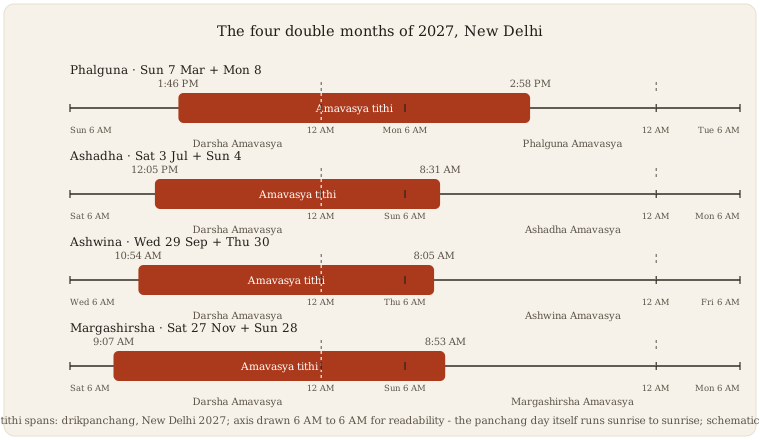
These are drikpanchang's 2027 Amavasya dates for New Delhi, with the tithi spans the almanac prints. The year opens on Thursday, 7 January, the Pausha Amavasya, with the tithi running from 11:13 PM on 6 January to 1:53 AM on 8 January. Saturday, 6 February brings the Magha Amavasya, the year's first Shani Amavasya, tithi from 7:05 PM on the 5th to 9:25 PM on the 6th. March then shows the year's first oddity: the almanac prints two days for one new moon, Sunday the 7th as Darsha Amavasya and Monday the 8th as Phalguna Amavasya, the year's first Somvati, with a single tithi span behind both, 1:46 PM on the 7th to 2:58 PM on the 8th. April's is Tuesday the 6th, Chaitra Amavasya, 5:40 AM to 5:20 AM the next morning; May's is Thursday the 6th, Vaishakha, 6:16 PM on the 5th to 4:27 PM; June's is Friday the 4th, Jyeshtha Amavasya, 4:05 AM to 1:09 AM the next night.
The second half of the year repeats the pattern and doubles it. July prints another pair: Saturday the 3rd as Darsha Amavasya, a Shani Amavasya, and Sunday the 4th as Ashadha Amavasya, tithi 12:05 PM to 8:31 AM. Monday, 2 August is the Shravana Amavasya and the year's second Somvati, 7:19 PM on the 1st to 3:34 PM; Tuesday, 31 August is Bhadrapada, a rare same-day tithi, 2:40 AM to 11:10 PM. September prints the third pair: Wednesday the 29th as Darsha Amavasya and Thursday the 30th as Ashwina Amavasya, the tithi, 10:54 AM to 8:05 AM, that the ancestor fortnight closes on. Friday, 29 October is Kartika Amavasya, 8:47 PM the previous evening to 7:05 PM, and this is the night the festival calendar knows as Diwali's Lakshmi Puja. November gives the fourth pair: Saturday the 27th as Darsha Amavasya, the year's third Shani Amavasya, and Sunday the 28th as Margashirsha, 9:07 AM to 8:53 AM. And the year closes on Monday, 27 December, the Pausha Amavasya and the third Somvati, tithi from 12:22 AM on the 27th to 1:41 AM on the 28th.
The four double months, and the sunrise rule
Those four pairs, March, July, September and November, are the year's most instructive entries, and the diagram on this page draws all four. The astronomy behind them is printed at the foot of the almanac's page: in the panchang, the day starts and ends with sunrise. A tithi is an astronomical span that can begin and end at any hour, while the observance day is a civil, sunrise-bounded day, so when the new moon's span strides across two mornings, as it does four times in 2027, one tithi legitimately touches two days, and the almanac prints both, labelling the first Darsha Amavasya and the second by the month's name. The page itself does not explain the two labels on this list, and we do not invent an explanation; the split itself, and the sunrise rule, are printed facts. The practical reading is the one the almanac's own structure suggests: look at the list, note both days, and follow your family tradition for which one carries the year's shraddha.
The monthly hinge
Set beside the year's other lunar observances, Amavasya is the hinge the whole calendar swings on. Ekadashi comes twice a month and Pradosha twice, Sankashti once, Purnima once, but each of those days is counted from the two great hinges, the new moon and the full, and only the new moon closes the month itself in the amanta half of the country. The sources' picture of it matches that structural role. Wikipedia's article is not about a festival at all; it is about a lunar phase and what a civilisation hung on it: a monthly fast, a monthly remembrance of the dead, two named weekday intensifications, a fortnight of ancestor worship that ends on it, a harvest festival, a Saturn birth-observance, and the night of lights itself. Drikpanchang's page is a working list of dates and tithi spans with the sunrise rule printed at the foot. Neither makes the day loud. Amavasya works quietly, once a month, as the calendar's full stop: the month ends, the ancestors are fed, the lamps wait for the darkest night of the year to do their work.
Two practical threads from the sources are worth keeping because they shape real observance. First, the drift: the tithi spans in the 2027 list land at every hour of the clock, from the 12:22 AM start of 27 December to the 8:47 PM start of 29 October, so the new moon is not an evening observance the way Pradosha is; it is a day, bounded by sunrise, and the almanac's note says exactly that. Second, the naming: when you read a festival date in one source and an Amavasya name in another, Ashvin versus Kartika for the Diwali night, Bhadrapada versus Ashwina for the ancestor fortnight, you are almost always looking at the two calendar conventions, not at a disagreement about the sky. The moon is the same moon; the month-name is the convention's.
The festivals that stand on a new moon
Amavasya's quietest property is how much of the festival year it carries. The biggest is Diwali: Wikipedia records that Lakshmi Puja, the central act of the five-day festival of lights, is celebrated on the Amavasya of the month of Ashvin, dedicated to welcoming prosperity by worshipping Lakshmi and Ganesha, with lamps, crackers and pujas. In the almanac's New Delhi 2027 list that night is Friday, 29 October, labelled Kartika Amavasya, the two names being the two calendar conventions on the same tithi. The same article maps three more: Shani Jayanti, the birth observance of Shani, Saturn among the navagrahas, on the Amavasya of Jyeshtha, which in the 2027 list is Friday, 4 June; Dashama Vrata, dedicated to Momai and observed in Gujarat, on the Amavasya of Ashadha, in 2027 Sunday, 4 July; and Sohrai, the harvest festival of tribal communities in Jharkhand and West Bengal, on the Amavasya of Kartika, honouring cattle and agricultural land, paying tribute to the ancestors and gathering for community feasting, with homes cleaned and decorated, livestock bathed and offered special meals, and the walls of houses adorned with Sohrai art. The new moon, the darkest night of the month, is where the calendar parks both its dead and its brightest lights; the sources report that juxtaposition without finding it strange, and neither do we.
Honest limits, and a few practical notes
This section is our own addition, not the sources'. Everything above is description: the beliefs about desire-fulfilment, the well-being of husbands, the grace of Yama reaching departed souls, are the tradition's words, reported as belief, never as outcomes we vouch for. The calendar facts are one almanac's computation for one city in one year; another city, or another panchang, can shift a tithi span or a day, and the sunrise rule means the observance day is always local. The amanta-purnimanta month-names are left unreconciled because the two conventions genuinely coexist, and the Wikipedia article's swapped paksha glosses are flagged as printed rather than corrected away. On practice: if you keep an Amavasya fast, the usual common-sense exclusions apply, and anyone pregnant, ill, elderly or on medication should take a doctor's advice first; the shraddha and tarpana rites belong to the family tradition and the family priest, not to any website. And on the sources' character: Wikipedia's Amavasya article is short and partly stitched from news pieces, and drikpanchang is a calendar service, not a scripture. What both agree on, the astronomy, the ancestor centre, the named days, is solid ground; what either says beyond that, we have kept under its own name.
Questions on this article
What is Amavasya?
The new moon day of the Hindu lunar calendar, the month's final tithi. The word joins ama, together, with vasya, to dwell: the sun and moon dwelling in the same ecliptic longitude, which is why the moon is invisible that night. In the amanta system the month ends on Amavasya; in the purnimanta system it ends on the full moon instead.
What is Somvati Amavasya?
An Amavasya that falls on a Monday. Wikipedia records that married women fast on it and pray to Lord Shiva for the well-being of their husbands; the Saturday new moon is likewise called Shani Amavasya. New Delhi's 2027 calendar holds three of each: Somvati on 8 March, 2 August and 27 December, and Shani on 6 February, 3 July and 27 November.
Why does drikpanchang list two Amavasya days in some months?
Because the tithi and the civil day are different clocks. The new moon's span can cross a midnight and touch two sunrise-bounded days, the panchang day starts and ends with sunrise, as the almanac notes, so four months of 2027 print two entries: a Darsha Amavasya and the month-named Amavasya on the following day. The page does not explain the two labels on this list, and we report the split as printed.
Which festivals fall on Amavasya?
The biggest is Diwali: its central Lakshmi Puja is celebrated on the new moon night, Friday, 29 October in New Delhi's 2027 list. Wikipedia also maps Shani Jayanti to the Jyeshtha Amavasya, Gujarat's Dashama Vrata to the Ashadha Amavasya, and the tribal harvest festival Sohrai to the Kartika Amavasya, while the ancestor fortnight of Pitru Paksha closes on Mahalaya Amavasya.


