Capricorn (Makara): The Climb of the Zodiac
Makara is the cardinal earth that climbs: Saturn’s own sign, the sea-goat at home in water and on rock, where Mars is raised and Jupiter must earn his keep. From the classical verse to the modern sign profile, the art of the long game and the challenge of control, with sources, and with an honest-limits note.
The arrow has found its mark, and past the mark a mountain rises. The tenth sign, Makara, is thirty degrees of cardinal earth, the sea-goat of the zodiac, and the sign Satyori's Makara guide calls the principle of structure, discipline and worldly achievement through sustained effort. This article audits that climb in full: the sign's structure, the classical verse on a Capricorn Moon, the ruler of time and the two planets whose exaltation and fall are pinned to this sign's exact degrees, the traditional tendencies in personality, career, relationships and health, and at the end an honest-limits note.
The sources are the usual four, each fetched for this article: Satyori's Makara rashi guide, a modern Jyotish reference last reviewed in May 2026; Wikipedia's Capricorn article for the tropical frame and its Capricornus article for the mythology; the Brihat Jataka's seventeenth chapter as republished in English translation at VedicPupil, which we read directly; and Panchangtime's Vimshottari dasha methodology table. Where the sources hedge or disagree, the hedge stays standing.
The tenth cell: the structure
Makara is the tenth sign of the zodiac, from 270 to 300 degrees. Its symbol is the makara itself, the crocodile of Indian waters, which the Western figure renders as the sea-goat; Satyori keeps both, naming the sign Crocodile with Sea-Goat in brackets, and reads the creature as one at home in both water and land, capable of navigating emotional depths while climbing to material heights. Its element is earth, its character Chara, cardinal, and its ruler is Saturn; a cardinal earth sign initiates through strategic, methodical action, and the guide sets it against the first sign: where Mesha initiates impulsively, Makara initiates with a plan, every step calculated, every resource accounted for. In the Vedic mapping of the Kalapurusha, the cosmic person of time across whose body the twelve signs lie, Makara is the knees: the joints that bear the whole body's weight and decide whether the climb continues. The figures the page names for this sign are the administrator, the builder and the authority figure.
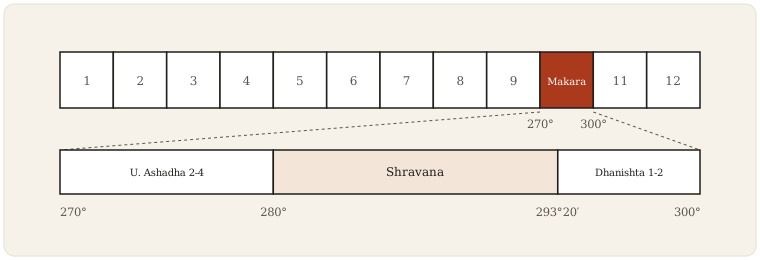
Three nakshatra segments fall within Makara: the second, third and fourth padas of Uttara Ashadha, all of Shravana, and the first two padas of Dhanishta. Each nakshatra spans 13 degrees 20 minutes of the zodiac, so Uttara Ashadha's remaining three quarters run from 270 to 280 degrees, Shravana from there to 293 degrees 20 minutes, and Dhanishta's first half to 300; the arithmetic is ours from the standard nakshatra division. Two people both called Makara may therefore carry different nakshatras inside the same rashi, and in Jyotish the nakshatra carries its own weight. This collection carries a separate guide for each of the twenty-seven nakshatras, including Uttara Ashadha, Shravana and Dhanishta; here it is enough that the rashi sets the frame and the nakshatra paints the finer shade within it.
The reference tables add the smaller certainties. Wikipedia lists Capricorn as one of the three earth signs alongside Virgo and Taurus, a negative, which is to say feminine-receptive, polarity sign, and one of the four cardinal signs, with Cancer as its opposite across the wheel. Satyori's quick-facts panel agrees on each point, earth, cardinal, feminine, 270 to 300 degrees, and adds the dosha column to which we return in the health note below.
Makara and Capricorn: two scales, one sky
They are two names for the zodiac's tenth 30 degrees: Makara in the Vedic sidereal tradition and Capricorn in the Western tropical one. The tropical zodiac is tied to the equinox point and the sidereal to the stars, and an ayanamsha gap of about 24 degrees separates them, the figure Satyori's own FAQ gives, so your Western sun sign and your Vedic rashi can differ. On dates, Wikipedia's Capricorn page disagrees with itself by a day: its summary table gives 21 December to 20 January for 2026, citing the US Naval Observatory's almanac, while its body text says the Sun transits tropical Capricorn from around 22 December to 20 January. We keep both readings standing, as we have throughout this series; the observatory's own note adds that the year stated applies to the December date and that the January date falls in the year greater. Vedic Makara is computed from the panchang, not from these tropical dates.
The goat-fish: the oldest image
The creature beneath this sign is among the oldest in the sky. Wikipedia's Capricornus article records that the constellation has been consistently represented as a hybrid of a goat and a fish since the Middle Bronze Age, when the Babylonians wrote it MUL.SUḪUR.MAŠ, the Goat-Fish, as a symbol of their god Ea. In Greek mythology the constellation is sometimes identified as Amalthea, the goat that suckled the infant Zeus after his mother Rhea saved him from being devoured by his father Cronos; Amalthea's broken horn became the cornucopia, the horn of plenty. It is also sometimes identified as Pan, the god with a goat's horns and legs, who saved himself from the monster Typhon by giving himself a fish's tail and diving into a river. Two candidates, each held by the source under its own "sometimes"; we keep them the same way. The same article notes that the Tropic of Capricorn still names the line on Earth where the Sun stands directly overhead at local noon on the December solstice, and that Neptune was discovered near the star Deneb Algedi on 23 September 1846. The old image holds the sign's double nature in one body: a goat built for the rock face, a fish built for the deep.
The text's Makara Moon: Brihat Jataka
The Brihat Jataka's seventeenth chapter gives each Moon sign a verse-portrait, and we quote the Makara verse from the English translation at VedicPupil, fetched and read directly for this article. Moon in Capricorn: always cherishes his wife and children, makes a show of piety, dharmadhvaja, lean in the lower body, with fine eyes and a slender waist, one who takes advice, or, as the translator's own bracket offers, whose word is accepted, fortunate, lazy, sensitive to cold, a wanderer, of strong spirit, sattva, a poet, greedy, drawn to unsuitable and older women, careless of modesty and lacking in compassion, aghrina. The site itself reduces the verse to a simple meaning: devoted to family, strong-spirited, poetic; laziness, greed and relationships need care. We keep the translator's bracketed alternative exactly as printed, "one who takes advice" with "whose word is accepted" beside it; the two readings pull the portrait in opposite directions, and the translation itself declines to choose. The same chapter holds its own hedge in verse 17.13, which says these twelve Moon-sign natures hold when no other planet or condition in the chart affects that sign; otherwise the marks change. The tradition said first that its portraits are not verdicts. The twelve Moon-sign verses are twenty-eight lines among the chapter's four hundred and nine; that says how old these figures are, and also how much else the book contains.
Saturn's own house, where Mars is raised
Makara is Saturn's own sign, and the exaltation table makes this sign the exact meeting point of effort and its limits. Mars is exalted here, at 28 degrees, and Satyori gives the reason in full: Mars finds exaltation in Makara because disciplined action, energy directed by strategy rather than impulse, is Mars at its most effective. Jupiter is debilitated here, at 5 degrees, because Makara's pragmatism constrains Jupiter's expansive optimism and faith; in Makara, the guide says, vision must be earned through effort, and grace alone is insufficient. Wikipedia's table adds a third entry: the Moon is in detriment in this sign. And the dasha table gives the ruler his due in time: per Panchangtime's Vimshottari methodology, Saturn's mahadasha runs 19 years, second only to Venus's 20 and ahead of Mercury's 17, Jupiter's 16, the Moon's 10, Mars's 7 and the Sun's 6. The slowest visible planet keeps the second-longest watch; the sign of the long game is ruled by the planet that has the most time.
Temperament, work and relationships: the tradition's map
Satyori's portrait: Makara natives are disciplined, responsible and quietly ambitious, with a dry sense of humour that emerges once they feel comfortable. They carry a seriousness from an early age that often comes from early responsibility or difficult childhood circumstances. Their patience is legendary; the guide says they will work for decades toward a goal others abandon in months. And the named challenge: learning that control is not safety, and that vulnerability does not equal weakness. The same page ties the sign to the tenth house of career, karma and public standing, which is why its descriptions keep returning to work, structure and reputation.
In careers the descriptive tradition places them in government, administration, engineering, architecture, banking, project management and corporate leadership; they are the long-game strategists who build institutions and empires through patience and structure, who manage complex systems and navigate bureaucracies, who advance steadily rather than through lucky breaks and earn respect through competence rather than charisma. Satyori's own hedge stands here too: career outcomes depend on the tenth-house lord, planetary periods and overall chart strength.
In relationships, Makara natives are loyal, dependable and deeply committed once they choose a partner, but they choose slowly and cautiously. Emotional expression does not come naturally to them; they show love through providing, protecting and building a stable life. Partners may initially find them reserved or emotionally unavailable, but beneath the Saturn exterior, the guide says, lies a capacity for profound devotion; they need partners patient enough to earn their trust and who value stability over excitement. The classical verse had already given the pattern its first line: the Makara Moon who always cherishes his wife and children.
On health the descriptive tradition ties Makara to the knees, joints, bones, teeth and skin, with tendencies toward arthritis, joint stiffness, dental problems and conditions that worsen with age if not addressed early; Satyori adds that Saturn's influence creates a constitution that often improves with time, so that natives who struggle with health in youth may find their constitution strengthening after the age of thirty to thirty-five, and recommends weight-bearing exercise, adequate calcium and consistent joint care. Its dosha note gives Makara a Vata affinity through Saturn's cold, dry nature despite the earth element, tending toward dryness, coldness and rigidity in joints and in thinking, and suggests warm, nourishing, oily foods, sesame-oil massage, warmth in the environment and practices that introduce flexibility and softness into the naturally rigid structure. All of this is that source's Ayurvedic framing, given in its name; this article offers no medical advice, and for any symptom the doctor is the authority. If you are pregnant, ill, elderly or on medication, any regimen the tradition mentions is not for you without a doctor's word.
The honest limits
Sign description is the tradition's framework, not measured psychology. Everything above is what the texts and one modern guide say about Makara, recorded with their names and their dates; it is not what we measured in any person. The Brihat Jataka itself conditions every mark on the rest of the chart not disturbing the sign, and Satyori itself conditions career on the tenth lord and the dashas. A rashi is one thread of a chart and no thread of your worth. Do not measure anyone else by their sign, and do not pour yourself into one either; being Makara is not being only this.
Keep one practical test as well: if some description here does not fit you at all, that is no fault of yours and none of the tradition's; the text laid down beforehand that these portraits are general. And if a description does fit, do not make it your ceiling; the tradition itself gave this sign two elements in one body, earth to climb and water to swim, and which one a life uses is practised, not fated, by effort, not by sign.
Short answers
What is the difference between Makara and Capricorn? A matter of scale: Vedic sidereal Makara is tied to the stars, tropical Capricorn to the equinox, and a gap of about 24 degrees separates them; one birth date can therefore fall in different signs in the two systems. Why is Mars exalted in Makara? Because, per Satyori, disciplined action is Mars at its most effective: the sign of strategy raises the planet of energy to 28 degrees, while Jupiter, whose grace must here be earned, falls at 5. Are Capricorn people really cold? The tradition frames the reserve as the price of the patience, and the classical verse's very first mark is a man who always cherishes his wife and children; the text itself says the marks change with the rest of the chart. Is reading personality from a sign scientific? No; it is the tradition's descriptive framework, presented here as exactly that, with sources.
Questions on this article
What is the difference between Makara and Capricorn?
They are two names for the zodiac’s tenth 30 degrees: Makara in the Vedic (sidereal) tradition and Capricorn in the Western (tropical) one. The difference is that the tropical zodiac is tied to the equinox point and the sidereal to the stars; an ayanamsha gap of about 24 degrees separates them, so your Western sun sign and your Vedic rashi can differ. Wikipedia’s table gives 21 December to 20 January for tropical Capricorn in 2026 while its body text says around 22 December to 20 January; Vedic Makara is computed from the panchang.
Which planets are exalted or debilitated in Makara?
Mars is exalted in Makara at 28 degrees and Jupiter debilitated at 5; Satyori gives both reasons: disciplined action is Mars at its most effective, and Makara’s pragmatism constrains Jupiter’s optimism because here vision must be earned through effort. Wikipedia’s table adds that the Moon is in detriment in this sign.
Are Capricorn people really unemotional?
The tradition frames the reserve not as absence of feeling but as the price of patience: per Satyori, beneath the Saturn exterior lies a capacity for profound devotion, and Makara natives show love through providing, protecting and building a stable life. The Brihat Jataka’s Capricorn-Moon verse gives as its very first mark a native who always cherishes his wife and children. And the text itself (17.13) says these marks change with the rest of the chart. Do not mould or measure any person by their sign.
Is reading personality from a sign scientifically established?
No, and this article makes no such claim. Sign description is the framework of the Jyotish tradition, carried through texts and practising astrologers over centuries; we present it as exactly that, with sources. Do not treat it as a substitute for psychology or medicine; as a way of reflecting on oneself it can be a cultural mirror, not a measuring instrument.


