Chhath Puja 2027: Date, Timings, Vidhi and the Full Four-Day Story
The great sun festival: the exact 2027 Delhi timings, the full four-day vidhi, both arghyas to the setting and rising sun, the legends with sources, and an honest-limits note on the thirty-six-hour fast without water.
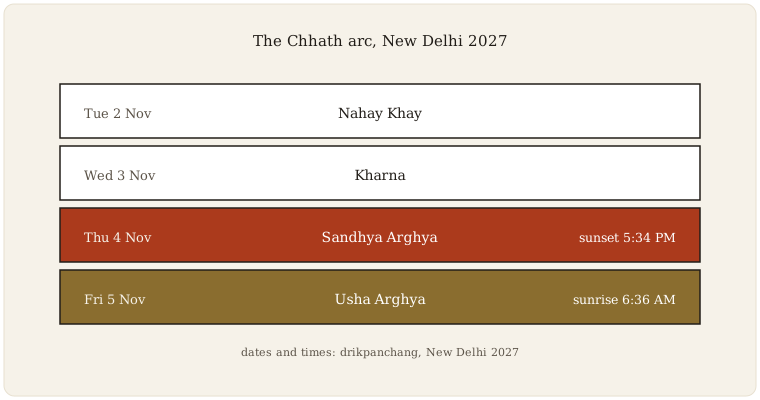
Most festivals look up at gods who live in stories; this one looks straight at the sun. Chhath is the great sun-worship of Bihar, Jharkhand, eastern Uttar Pradesh and the Madhesh of Nepal, four days in which the devotees, the parvaitin, fast, bathe, stand in river water up to the waist, and offer arghya twice: once to the setting sun, and once, the next dawn, to the rising one. Drikpanchang pauses on the first of those offerings because of how unusual it is: this, the almanac says, is the only time of the year when arghya is given to the setting sun. In 2027 the heart of the festival falls on Thursday, 4 November, and this guide walks the whole arc as the sources give it: the exact New Delhi timings, the four days and their vidhi as the tradition prescribes them, the legends the epics and Puranas attach to the festival, the way it has travelled from the Ganga ghats to temporary ponds in Delhi and diaspora riversides abroad, and an honest-limits note at the end.
The backbone of this article is three sources, each fetched directly for it: Wikipedia's Chhath article for the festival's shape, legends, food and geography, and two drikpanchang pages for New Delhi 2027, the Chhath Puja timings page and the four-day Chhath calendar page. Every timing in this guide is drikpanchang's computation for New Delhi 2027; other cities and other years will differ. Where the sources disagree with each other or hedge themselves, the disagreement is kept standing and named.
The date: Shashthi of the bright Kartika
Chhath is pinned to the lunar calendar: it begins on Kartik Shukla Chaturthi, the fourth day of the bright half of Kartika, and ends on Saptami, the seventh, with the worship peaking on Shashthi, the sixth, which is why the festival is also called Surya Shashthi, the sun's sixth. Wikipedia notes it comes six days after Deepavali, and drikpanchang's New Delhi listing for 2027 lands exactly there: Deepavali's Lakshmi Puja is Friday, 29 October, and the Chhath day is Thursday, 4 November. The Shashthi tithi itself begins at 7:31 PM on 3 November and ends at 9:37 PM on 4 November, so the tithi straddles the main day. On that main day the sun rises at 6:35 AM and sets at 5:34 PM, and those two instants are the festival: everything in Chhath is organised around meeting the sun at its two thresholds.
Here is the four-row New Delhi listing for 2027, from drikpanchang's calendar page. Day one, Tuesday 2 November, Chaturthi: Nahay Khay, with sunset at 5:35 PM. Day two, Wednesday 3 November, Panchami: Lohanda and Kharna, sunset again 5:35 PM. Day three, Thursday 4 November: Chhath Puja and the Sandhya Arghya, sunrise 6:35 AM, sunset 5:34 PM. Day four, Friday 5 November, Saptami: the Usha Arghya, sunrise 6:36 AM, sunset 5:33 PM. The festival's own names are worth listing once, because the sources hand out several: Wikipedia's table gives Chhaith, Chhath Parva, Dala Chhath, Dala Puja and Surya Shashthi, and drikpanchang adds Chhathi and Pratihar. Dala is the bamboo basket in which the offerings are carried, and Chhath is simply the Maithili and Bhojpuri word for sixth.
One more calendar fact changes how the festival feels: it comes twice a year. Wikipedia records a Chaiti Chhath in the month of Chaitra, in spring, alongside the Kartik Chhath that is celebrated at a very large scale. When people say Chhath without a qualifier, they mean the Kartik one, the autumn festival that this guide describes.
Who keeps it, and for whom
Wikipedia's summary table names the communities who have always kept this festival: the Maithils, Bhojpuriyas, Magahis and Tharus, in Bihar, Jharkhand and eastern Uttar Pradesh, and across Nepal's Koshi, Gandaki, Bagmati, Lumbini and Madhesh provinces. The main worshippers, called parvaitin, from the Sanskrit parva, occasion, are usually women, and drikpanchang says the fasting is mainly observed by women for the well-being of sons and the happiness of the family. That is the almanac's own framing, and Wikipedia complicates it in the same breath: Chhath, it says, citing reporting on the men who keep the fast, is not a gender-specific festival. Both stand. The parvaitin pray for the well-being of their family and the prosperity of their children, and the object of the worship is double: Surya, the sun, visible to every being and the basis of the life of all creatures, and Chhathi Maiya, the sixth form of Prakriti, who is described as Surya's sister and, in the words of the Vedic-astrology tradition Wikipedia cites, the goddess who grants children long life and good health by shielding them from illness.
There is also a custom of continuity that gives the festival its grip on families. In some communities, Wikipedia records, once a family member starts performing Chhath, they are duty-bound to perform it every year and to pass it on to the following generations; the festival is skipped only if there is a death in the family that year, and if the person stops the ritual in any particular year, it stops permanently and cannot be resumed. In other communities, the same sentence continues, this is not mandatory. We report the custom as the source gives it, with both community readings intact; nobody is bound by a website.
The four days, as the tradition prescribes them
Everything in this section is the tradition's own vidhi, described, not prescribed; both sources walk the four days in the same order, and where they differ in detail we say so.
Day one: Nahay Khay, the bath and the meal
The first day is Nahay Khay, literally bathe-and-eat. The parvaitin takes a holy bath, in the Ganga where that is possible, and afterwards the entire house, its surroundings and the pathways to the ghat are thoroughly cleaned. Then the one meal of the day is cooked: sattvik lauki bhaat, bottle gourd and Bengal gram lentil with Arva rice, served in the afternoon to the deity as bhog before the parvaitin eats it. Wikipedia adds the meaning the tradition attaches to that meal: it is eaten to protect the mind from thoughts of vengeance, and it is the parvaitin's last full meal of the festival. Drikpanchang's calendar page compresses the same day into one line: women who observe Chhath take only a single meal on this day.
Day two: Kharna, the first fast without water
The second day is Kharna, also known, Wikipedia says, as Rasiaav-roti or Lohanda, a naming it flags as needing citation; drikpanchang's calendar keeps Lohanda and Kharna together on the day. On this day, as an act of worship, the devotees do not drink even a single drop of water. Drikpanchang gives the fast its clock: without water from sunrise to sunset, broken just after sunset after the food offering is made to the Sun God. In the evening the parvaitin eats gur ke kheer, kheer made with jaggery, called rasiaav, together with roti or sohari. And then, drikpanchang warns, the third day's fasting begins after that prasad: the kheer is the last thing tasted before the long fast.
Day three: Sandhya Arghya, the offering to the setting sun
The third day is the festival's great day, and it begins in the kitchen. The prasada is prepared at home: thekua, the fried wheat-and-jaggery biscuit that is the festival's iconic offering, rice laddu, khajuria, tikri, kasar, and fruits, chiefly sugarcane, sweet lime, coconut, banana and seasonal fruit, all carried in small bamboo baskets. The food is strictly vegetarian, cooked without salt, onions or garlic, and Wikipedia stresses the emphasis placed on the purity of the cooking. In the evening the entire household accompanies the parvaitin to a riverbank, a pond or another large body of water, and where there is no river or pond, an indoor setup such as a tank or fountain is used; Wikipedia notes that in certain places there are restrictions, Mumbai's municipal body, for instance, has barred Chhath celebrations on beaches. Standing in the water, the parvaitin offers arghya to the setting sun: Gangajal is offered to Surya, and Chhathi Maiya is worshipped with the prasada. After the worship, the night is given to Chhath songs and the reading of the Vrat katha. Back home, the family performs kosi bharai: five to seven sugarcanes are tied together to form a mandap, beneath which twelve to twenty-four diyas are burnt and thekua and seasonal fruits are offered, and the same ritual is repeated the next morning between 3 and 4 AM. Through all of this the fast holds: drikpanchang states that the third day is a full-day fast without water, continuing throughout the night.
Day four: Usha Arghya and the parana
At dawn on the fourth day the worshippers return to the riverbank for the Usha Arghya, the offering to the rising sun. After the arghya, Wikipedia says, parents pray to Chhathi Maiya for their children's protection and for the happiness and peace of the whole family, and then comes the Paran or Parana, the completion of the fast with a small amount of prasada and water. Drikpanchang puts a number to the ordeal that ends there: the fast that began after the Kharna meal is a thirty-six-hour fast, and it is broken after the arghya is given to the sun. Wikipedia describes the rite as a symbol of thanksgiving and spiritual closure, the family circle completed at the water's edge.
The prasad, and what it carries
Chhath cooking is sattvic and specific, and Wikipedia gives the four preparations it calls the most important. Thekua, the crisp sweet of wheat flour, jaggery and ghee, deep-fried, is the most iconic offering of the festival. Rasabali is a dessert of flattened rice soaked in sweetened milk, flavoured with cardamom and dry fruits. Kasar, the laddoo of powdered rice or wheat flour with jaggery, is shaped into small balls and counted a holy offering. And the rice laddu or peethha, a steamed or fried dumpling filled with jaggery and coconut, is especially common in Bihar and eastern Uttar Pradesh. All of it is cooked without onion or garlic, and the recipes, the article notes, are passed down through generations, which is the same mechanism as the fast itself: a festival transmitted hand to hand, not read from books.
The legends: epics, Puranas and living places
The sources attach Chhath to both epics and to a Puranic lineage, and we keep each attribution with its source. Wikipedia says the festival is mentioned in both major epics. In the Ramayana reading, when Rama and Sita returned to Ayodhya the people celebrated Deepavali, and on its sixth day the Ramarajya was established; on that day Rama and Sita fasted and Sita performed the Surya Shashthi puja, and she was blessed with Lava and Kusha as sons. In Champaran in Bihar and the Madhesh Province of Nepal there is a further local belief: after leaving Ayodhya, Sita stayed in the Valmiki Ashram on the edge of the Narayani river in Chitwan, on the present India-Nepal border, and celebrated the Chhath Mahaparva there. The Mahabharata reading says Kunti performed Chhath after she and the Pandavas escaped the Lakshagriha, the house of lac, and it is also believed that Karna, the son of Surya and Kunti, was conceived after Kunti performed the puja. Draupadi, the same tradition says, performed it for the Pandavas to win the Kurukshetra war, near a spring in Nagdi village in Ranchi, and in that village the festival is still performed near the spring rather than a river or pond. The Brahma Vaivarta Purana mentions Chhathi Maiya's worship in the festival, and the Kashi Khanda holds that Chhath began in Varanasi under the Gahadavala dynasty and spread from there. One more legend is carried with Wikipedia's own citation-needed flag still on it: King Priyavrata, son of the first Manu, had a son born lifeless, and when the king prayed, Mata Shashthi revealed herself in the sky, declared herself the sixth form of Prakriti who protects the children of the world, and blessed the child back to life. And at Buxar the belief is that the rishi Kashyapa and Aditi had their ashram there, that Aditi gave birth to Surya on the sixth day of Kartika, and that Chhath is therefore also the sun god's birth anniversary. In Munger the festival gathers around Sita manpatthar, Sita's footsteps: the Sitacharan Temple stands on a boulder in the middle of the Ganges, the main centre of public faith for Chhath there.
From the Ganga to the world
Chhath's geography has widened without thinning. Wikipedia lists the urban centres where the diaspora keeps it to preserve its cultural heritage, Delhi, Mumbai, Kolkata, Janakpur and Kathmandu, and the countries where it is now celebrated: the United States, Australia, Singapore, Malaysia, the United Arab Emirates, Canada, Mauritius, Japan and the United Kingdom. Delhi's celebration is large enough to be photographed as news: lakhs of devotees offering Sandhya Arghya, and temporary ponds built for devotees in Shahdara where no riverbank serves. Mumbai's municipal restriction on beach celebrations stands on the other side of the ledger. In West Bengal's Howrah district the festival has grown in recent decades around named ghats, Ramkestopur, Katliya, Jagacha and Japanigate. Some devotees still make the journey to the riverbank as a prostration march, measuring the distance with their bodies. And the equality of the gathering is part of the reporting: the same prasada prepared by all devotees, rich and poor side by side at the water. The worship itself needs only sun, water and a basket.
An honest note on limits
Everything above is description: three fetched pages, two from drikpanchang and one from Wikipedia, attributed throughout, and this paragraph is ours. The vidhi and the fast are the tradition's instructions; we describe them, we do not prescribe them. The timings are one almanac's computation for one city in one year; your city's sunrise and sunset will differ, and the tithi windows shift with geography, so look up your own panchang before planning. The sources' framing that the fast is mainly kept by women for sons and family is reported as their framing; the tradition itself, in the same sources, includes men who keep the fast, and no website decides who may worship. Above all, the Chhath fast is one of the most demanding in the calendar: two stretches without water, the second running about thirty-six hours across a day and a night, ending in cold November river water at dawn. That is a genuine physical strain, not a metaphor. If you are pregnant, ill, elderly, or on any medication, do not attempt this fast, in any form, without your doctor's explicit agreement, and no observance described here carries a guarantee of any outcome, spiritual or medical. The festival's own deepest custom says it is kept for the well-being of the family; keeping the family well is also what doctors are for.
Questions on this article
When is Chhath Puja in 2027?
The main day, with the Sandhya Arghya to the setting sun, is Thursday, 4 November 2027. For New Delhi, drikpanchang gives the Shashthi tithi from 7:31 PM on 3 November to 9:37 PM on 4 November, sunrise on the main day at 6:35 AM and sunset at 5:34 PM. The four days run Tuesday 2 November, Nahay Khay, through Friday 5 November, the Usha Arghya at dawn. Timings for other cities differ; check your own panchang.
Why is arghya offered to the setting sun?
Because the tradition honours the sun at both of its daily thresholds, dusk and dawn, the departing light and the returning one. Drikpanchang underlines how rare the first of those is: it calls the Sandhya Arghya of Chhath the only time of the year when arghya is given to the setting sun. The pair of offerings, evening and morning, is what makes Chhath structurally unique among Hindu festivals, and the night of songs and vigil between them is part of the same arc.
Is Chhath only observed by women?
The sources say two things at once, and we keep both. Drikpanchang describes the fasting as mainly observed by women for the well-being of sons and the happiness of the family, and Wikipedia notes the main worshippers, the parvaitin, are usually women. The same Wikipedia article, citing reporting on male devotees, states flatly that Chhath is not a gender-specific festival and that men also observe it. Family tradition decides who keeps the fast in any given home; the sources describe, they do not assign.
Is the 36-hour fast without water safe?
That is a medical question, not a devotional one, and no website should answer it for you. Drikpanchang itself spells out the arc: no water from the Kharna evening meal until after the Usha Arghya, roughly thirty-six hours across a day, a night and a cold November dawn in the water. If you are pregnant, ill, elderly or on medication, ask your doctor before attempting any part of this fast. This guide describes the observance; it does not prescribe it, and it guarantees no outcome.


