Choghadiya: The Four-Ghadi Timetable Whose Classical Pedigree Two Sources Still Dispute
Choghadiya cuts day and night into eight named parts each; the construction rule, the night’s separate door, two sources openly split over its classical pedigree, and the checks any reader can run on any printed table.
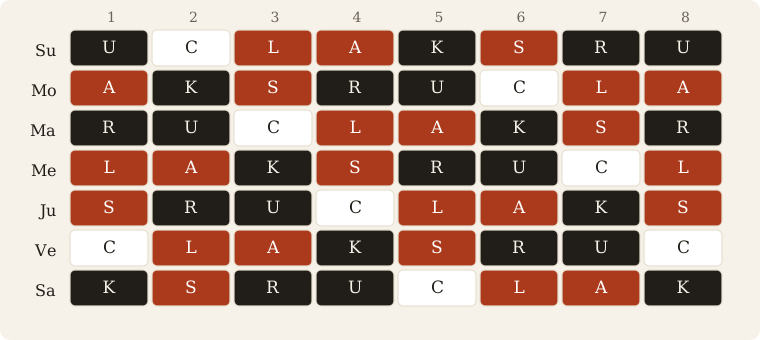
In many homes in Gujarat, Rajasthan, Madhya Pradesh and Maharashtra, no shop opens, no vehicle comes home and no journey begins without one question: which choghadiya is running right now? It is the most democratic muhurta in the whole system, needing no birth chart, no priest and no full panchang, just the day's table. And it carries a quiet surprise. When we went to check its classical pedigree, we found the sources openly disagreeing about whether it has one: one methodology page names the great muhurta digest Muhurta Chintamani among its foundations, while another states flatly that choghadiya appears in no classical muhurta text they know. Both statements are on record below, unresolved. First, the system itself, which no source disputes.
Everything here comes from five sources fetched on 31 October 2026, named at every step. Engine scores, forum posts and one encyclopedia's internal slip are each flagged for what they are.
Four ghadis, eight slots
The name is arithmetic. A ghati, the old Indian unit now remembered in the Hindi word for a clock, is 24 minutes; chau-ghadiya is four of them, about 96 minutes, a little over an hour and a half. ePandit and Wikipedia both give this etymology. Wikipedia's own lead sentence, however, calls a choghadiya an auspicious period of ninety-eight minutes, which matches neither its own etymology section (four times 24 is 96) nor the division rule it then explains; we flag the 98 as the encyclopedia's internal slip, our check, not a variant tradition. The true rule needs no fixed minutes at all: take the daylight from sunrise to sunset and cut it into eight equal parts, then do the same for the night from sunset to the next sunrise. Each part is one choghadiya, which is why the real length breathes with the season: in summer a day choghadiya runs longer than an hour and a half and a night one shorter, and in winter the reverse, as ePandit explains. Another city's times will never fit your city, because both are built from local sunrise and sunset.
Wikipedia works one example in full, and we re-did the arithmetic. With sunrise at 6:00 am and sunset at 6:01 pm, the daylight is 721 minutes and each day choghadiya is 721 divided by 8, that is 90.125 minutes or 1 hour 30 minutes 7.5 seconds; the night of 719 minutes gives 89.875 minutes or 1 hour 29 minutes 52.5 seconds per slot. Both figures check out exactly. Notice what the example quietly demonstrates: even a one-minute difference in day length shifts every slot boundary, so a printed national table is always an approximation for one chosen place.
Seven names, seven planets
Every slot carries one of seven names, and each name belongs to a planet whose nature the slot inherits. The table is identical across panchangtime, ePandit and the StackExchange reference tables we compared: Amrit belongs to the Moon and is the most auspicious; Shubh to Jupiter, auspicious; Labh to Mercury, gain; Char or Chal to Venus, good and especially favoured for travel; Rog to Mars, avoided, linked with illness and conflict; Kaal to Saturn, avoided for new beginnings; Udveg to the Sun, avoided, linked with anxiety. Four names are favourable, three are not, and Char sits in between as the traveller's slot.
The cycle that assigns names to slots never changes order: Sun, Venus, Mercury, Moon, Saturn, Jupiter, Mars, and round again, which is the same planetary cycle the hora system uses. In name terms that reads Udveg, Char, Labh, Amrit, Kaal, Shubh, Rog, repeat. The day's first slot belongs to the weekday's own lord: Sunday opens on the Sun's Udveg, Monday on the Moon's Amrit, Tuesday on Rog, Wednesday on Labh, Thursday on Shubh, Friday on Char, Saturday on Kaal. Seven names into eight slots means the eighth slot repeats the first, so every daylight begins and ends on the same name, a fact you can see at a glance in the grid below. AskSoma adds a neat observation: each weekday opens three places further along the cycle than the day before, the same plus-three rhythm that governs the hora sequence, which is why the openers walk Udveg, Amrit, Rog, Labh, Shubh, Char, Kaal down the week rather than in the cycle's own order.
The night follows a different door
The night table is not the day table continued. Two sources state the rule in two phrasings that turn out to be the same rule, and we verified they agree. Panchangtime says the night's first slot starts five places further along the cycle; ePandit says the first night part belongs to the lord of the fifth weekday counted from the day. Try Sunday: five places on from the Sun in the cycle lands on Jupiter, and the fifth weekday counting from Sunday is Thursday, Jupiter's day, so both rules give the same opener, Shubh. Sunday night then runs Shubh, Amrit, Char, Rog, Kaal, Labh, Udveg, and Shubh again, matching the StackExchange night table column for Sunday exactly. The practical consequence: a good evening slot is not found by extending the afternoon's sequence, and apps that show both halves are computing two separate eighths with two separate starting points.
The pedigree dispute
Now the surprise we opened with, because it is exactly the kind of disagreement a careful reader deserves to see. Panchangtime's methodology page lists its foundations as Muhurta Chintamani by Daivajna Ramacharya, the choghadiya tradition of western and northern India, and the Drik-Ganita panchang computation. ePandit, which tags every statement on its page with its source, labels the entire choghadiya system as parampara, tradition, and states plainly: choghadiya is a later, regional tradition, not found in classical muhurta texts such as the Muhurta-cintamani. One page claims the digest as a foundation; the other says the digest does not contain it. We did not fetch Muhurta Chintamani itself, so we cannot settle which is right, and we record the contradiction exactly as published. What can be said honestly: the mechanism choghadiya uses, planetary rulership of time divisions, is genuinely classical, while the named eight-slot scheme itself may be a later regional layering on top of it. That reading reconciles both sources, but it is our inference, not a sourced claim.
Two smaller disagreements ride along. Wikipedia spells the Venus slot Char where most Hindi tables print Chal, and Amrit appears as Amrut in several Gujarati sources; these are spelling variants of the same words, not different slots. And ePandit records a genuinely regional exception: some families treat the Sun's Udveg as acceptable for government work, on the Sun's association with authority. Small local differences like this exist in every region, as that page says, and they are worth knowing before you correct someone else's family table.
Choghadiya is not hora
Because both systems run on the same planetary cycle, readers regularly confuse them, and panchangtime's own explainer takes the trouble to separate them. The hora divides the day into twelve parts and the choghadiya into eight; they name and judge their slots differently, so the two charts run on different rhythms and rarely line up. The same clock time can sit inside a good choghadiya and a neutral hora at once, and neither fact cancels the other, because the two systems answer two different questions: hora asks which planet's hour is running, choghadiya asks which named eighth of the daylight is running. If your app shows both, read them as two independent dials, not as one dial contradicting itself.
Reading the grid like a table-maker
One page we read, AskSoma, does something unusual: instead of stopping at the labels, it scores each name with its own muhurta engine and then checks what the eight-slot structure does to the week. The scores are the site's own, not tradition, and we say so plainly; but the arithmetic they expose belongs to the table itself and is worth following. Add the seven subscores and you get 4.45; every weekday's daylight contains all seven names exactly once plus a repeat of its opener, so each day's total is 4.45 plus its opener's score, and nothing else varies between weekdays. Monday, opening on the highest-scoring Amrit, lands at a mean of 0.675; Saturday, opening on Kaal, lands at 0.596. The gap between the best and worst daylight of the week is 0.079 on their scale, real but far smaller than the folklore about bad days implies. Their practical reading deserves quoting: no weekday is short of usable daytime slots, the worst still carries four favourable ones out of eight, and if you are choosing between Tuesday morning and Wednesday morning, the choghadiya difference is a tiebreaker, not a verdict.
You can verify the shape of that claim without any engine at all, straight from the grid above. Count the favourable letters, A, S, L and C, in each row: Monday, Wednesday, Thursday and Friday hold five of the eight slots, Sunday, Tuesday and Saturday hold four. The three avoided names can never occupy more than half of any daylight, because the fixed cycle deals all seven names before any repeats. That much is structure, not opinion, and it is the kind of check any reader can run on any printed choghadiya table: if a row does not begin and end on the same letter, or a weekday does not open on its lord's name, the table has been misprinted.
A word about where the full seven-by-eight tables in this article's comparison come from, because provenance matters more than polish. The day and night grids we cross-checked were published in an answer on the Hinduism StackExchange, citing a practitioner blog, astroadvise.co.in; a second answer on the same page reconstructs the cycle from planetary revolution periods, Saturn's thirty years down to the Moon's twenty-eight days, which is a neat mnemonic but a forum member's reconstruction, not a citation from any text. We verified those community tables against the construction rules stated independently by panchangtime and ePandit, including the fifth-weekday night opener, and every row and column agreed. That is the right order of trust: rules from identified methodology pages first, community tables accepted only where the rules regenerate them.
What it is for, and what it is not
The sources are unanimous about scale. Choghadiya is a quick, standalone read for everyday starts: travel, shopping, a small new task, filing, a first meeting. Panchangtime's own caution is to pick an auspicious choghadiya that is also clear of Rahu Kalam, Yamaganda and Gulika when the work matters, which tells you where it sits in the hierarchy: a fast daily filter, not a substitute for a full muhurta election, and certainly not for marriage-level decisions. AskSoma makes the same point numerically, and we flag the numbers as that site's own engine rather than tradition: scoring the names Amrit 0.95, Shubh 0.88, Labh 0.85, Char 0.72, it finds every weekday still carries at least four favourable day slots out of eight, and calls the difference between weekdays a tiebreaker, not a verdict. The tradition's own version of that thought is the Char rule: the Venus slot is good for what moves and unremarkable for what begins.
Epandit's closing counsel is the most level-headed line we found, and it deserves quoting in spirit: choghadiya is followed with affection by millions of families, and whether to follow it is entirely your family's choice. A system this old and this regional does not need defending or debunking; it needs reading correctly. Know that the slot is an eighth of your own daylight, know which name is running, know the four you may use and the three you may skip, and know that when the work is large, the choghadiya is the beginning of the question, not the end of it.
And when two apps disagree about what is running at this minute, do not assume one is broken. Check the sunrise and sunset each has taken for your city, because a two-minute difference there moves every boundary; check whether one shows the day table past sunset, when the night table with its different opener has already taken over; and check the spelling before the substance, since Char and Chal, Amrit and Amrut are the same names in different clothes. The system is small enough that every disagreement you will ever meet has a findable cause.
Questions on this article
Is choghadiya written in any classical text?
The sources split, and we recorded the split unresolved: one methodology page counts Muhurta Chintamani among its foundations, while ePandit, which tags every statement with its source, says the scheme is found in no classical text in their library, the Muhurta-cintamani included, and should be read as a later regional tradition. The planetary-rulership machinery is classical; the named eight-slot scheme may be a later layer on it, but that reconciliation is our inference, not a sourced fact.
Why are the day and night choghadiya tables different?
The day count opens from sunrise on the weekday’s own lord, while the night opens from sunset on the lord of the fifth weekday counted from the day, so Sunday night opens on Jupiter’s Shubh. Each half is also its own eighth of its own span, so the lengths differ too. An evening slot is never found by continuing the afternoon’s sequence.
How many minutes is one choghadiya?
No fixed count. The name comes from four ghadis, about 96 minutes, but the real rule is one-eighth of the daylight or the night, so the length changes with city and season: the day slot runs longer than an hour and a half in summer, shorter in winter, the night slot the reverse. Read the computation for your city on that date; Wikipedia’s lead sentence saying 98 minutes matches not even its own 96-minute etymology, and we flagged it as a slip.
Which choghadiya is best for travel?
Char or Chal, Venus’s slot, is the traveller’s slot in the tradition: good for what moves, unremarkable for what begins. Amrit, Shubh and Labh are also favourable for good beginnings including journeys. Where the work matters, panchangtime’s advice is to pick a slot that is also clear of Rahu Kalam, Yamaganda and Gulika.


