Diwali 2027: Date, Lakshmi Puja Vidhi, Muhurat and the Full Five-Day Sequence
The festival of lights: the exact 2027 Delhi timings, the full six-day sequence, the Lakshmi Puja vidhi and muhurat, the stories behind all five days, with sources, both readings kept standing where sources conflict, and an honest-limits note.
Twenty days after Vijayadashami, when the moon wanes to nothing, India lights its rows of lamps. Diwali, from the Sanskrit Dipavali, deepa plus aavali, a row or series of lights, is the festival of the year's darkest night answered with fire: five days, six in some regions, rising to the Lakshmi Puja on the new-moon night. In 2027 that night is Friday, 29 October, and this guide walks the whole arc as the sources give it: the six-day calendar, the legends each community lays under the lamps, the puja vidhi and the altar's arrangement, the exact New Delhi muhurat for 2027, the fast question on which the sources genuinely disagree, the festival's long paper trail from Harsha's plays to a UNESCO listing, and at the end an honest-limits note.
Three sources carry this article, each fetched directly for it: Wikipedia's Diwali article for the festival's shape, history, legends and regional variety; drikpanchang's 2027 Diwali Puja calendar for New Delhi for the day-by-day dates; and drikpanchang's 2027 Lakshmi Puja timings page for New Delhi for the muhurat, the tithi window and the puja vidhi. Every timing is drikpanchang's computation for New Delhi in 2027; other cities differ. Where the two sources disagree, and on fasting they do, both readings stand and the disagreement is named.
The six days of 2027
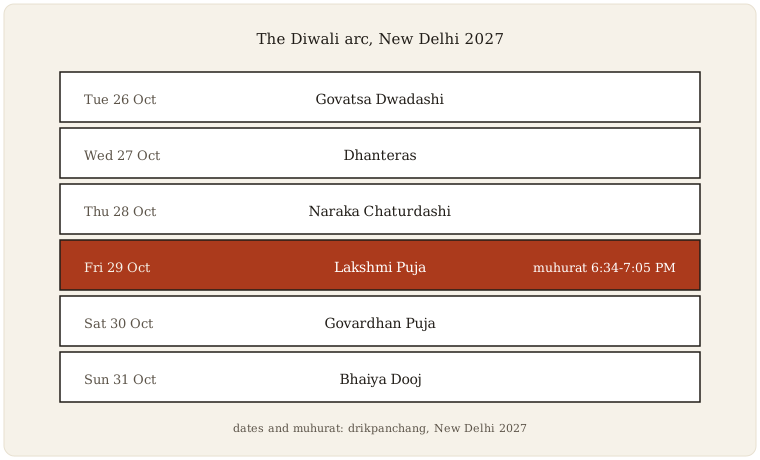
The standard arc is five days, and drikpanchang's own calendar page says so: the five-day festivity begins on Dhanteras and ends on Bhaiya Dooj. But the same page's 2027 New Delhi listing prints six rows, because in Maharashtra the festivities begin one day earlier on Govatsa Dwadashi, while in Gujarat they begin two days earlier on Agyaras and culminate on Labh Panchami. Both shapes are the sources'; here is the six-row New Delhi listing for 2027. Day one, Tuesday 26 October: Govatsa Dwadashi, Vasu Baras. Day two, Wednesday 27 October, Trayodashi: Dhanteras, Dhantrayodashi, Dhanvantari Trayodashi, Yama Deepam, and on this page Kali Chaudas and Hanuman Puja are grouped here too. Day three, Thursday 28 October, listed under Narak Chaturdashi and Abhyang Snan. Day four, Friday 29 October, the Amavasya: Lakshmi Puja, Diwali proper, Kedar Gauri Vrat, Chopda Puja, Sharda Puja, Diwali Snan and Devpuja. Day five, Saturday 30 October, Pratipada: Govardhan Puja, Annakut, Bali Pratipada, Dyuta Krida and the Gujarati New Year. Day six, Sunday 31 October: Bhaiya Dooj, Bhau Beej, Yama Dwitiya and Chitragupta Puja. One wrinkle worth keeping visible: Wikipedia's account places Hanuman Puja and Kali Chaudas on the second day of its five-day model, the Chaturdashi, while drikpanchang's 2027 calendar groups them with Trayodashi; the two sources are describing regional practice differently, and we leave both as printed. Underneath the Gregorian dates run the tithis, which Wikipedia's table gives exactly: Ashwin Krishna Trayodashi, Chaturdashi, Amavasya, then Kartik Shukla Pratipada and Dwitiya.
The name of the thing: Dipavali, a compound of deepa, lamp, light, that which glows or illuminates, and aavali, a row, range or continuous line. The festival's newest honour sits oddly late in its long life: in 2025 UNESCO inscribed Deepavali on its Representative List of the Intangible Cultural Heritage of Humanity, reference 02312, at the twentieth session. The row of lamps is now, formally, world heritage.
Which victory: the legends, kept plural
Ask what Diwali celebrates and the honest answer is a list. Wikipedia's survey: one tradition makes it the day Rama returned to Ayodhya with Sita, Lakshmana and Hanuman after fourteen years of exile and the defeat of Ravana. Another, strong in Braj, Assam and southern Tamil and Telugu communities, makes it Krishna's killing of the demon king Narakasura and the freeing of sixteen thousand captives, with the day before remembered as Naraka Chaturdashi. Per the scholar Tracy Pintchman, some popular contemporary sources begin the five days with Lakshmi's birth from the Samudra Manthana, the churning of the ocean of milk, and make the Diwali night the night Lakshmi chose and wed Vishnu. In eastern India and Bangladesh the festival belongs to Kali. Trade and merchant families add Saraswati, who embodies music, literature and learning, and Kubera, who symbolises book-keeping, treasury and wealth management; in Gujarat and certain northern communities the festival also opens the new year. And the festival crosses faiths with the same lamps and different stories: Jains keep it as Mahavira Nirvana Divas, the final liberation of the twenty-fourth Tirthankar, and the Jain tradition dates the lamp-lighting to 527 BCE, when eighteen kings gathered for Mahavira's final teaching proclaimed lamps in remembrance of the great light; Sikhs keep Bandi Chhor Divas for Guru Hargobind's release from the Gwalior Fort prison and his arrival at the Golden Temple, though the scholar J.S. Grewal notes the Sikh Diwali is older than that legend, and Ray Colledge ties it to three events, the founding of Amritsar in 1577, the release, and Bhai Mani Singh's martyrdom in 1738; Newar Buddhists of Nepal celebrate by worshipping Lakshmi, which some observers read not as syncretism but as the Mahayana freedom to worship any deity for worldly betterment. The common focus, per the Indologist Lindsey Harlan, is righteousness, self-inquiry and the importance of knowledge, the path to overcoming the darkness of ignorance. We keep every thread standing as its source told it.
An old, well-documented night
Few festivals carry this much paper. Wikipedia's history section: the festival is mentioned in early Sanskrit texts such as the Padma Purana and the Skanda Purana, composed between the seventh and tenth centuries. Emperor Harsha's seventh-century play Nagananda names it Dipapratipadotsava, the festival of the first day of lamps, where lamps were lit and newly engaged couples received gifts. Rajasekhara's ninth-century Kavyamimamsa calls it Dipamalika and records whitewashed homes, streets and markets decorated with oil lamps at night. The travellers follow: the Persian scholar Al-Biruni's eleventh-century memoir places Deepavali on the new moon of Kartika; the Venetian Niccolò de' Conti in the early fifteenth century describes temples and roofs fixed with an innumerable number of oil lamps kept burning day and night, families in new garments singing, dancing and feasting; the Portuguese Domingo Paes saw it in sixteenth-century Vijayanagara, homes and temples lit. The Mughal record splits: Akbar welcomed and participated in the festivities, while Aurangzeb banned Diwali and Holi in 1665. And in 1799 Sir William Jones, writing on the lunar year of the Hindus, listed four of the five days and called the middle one Lacshmipuja dipanwita, a great festival at night, in honour of Lakshmi, with illuminations on trees and houses. The epigraphy goes deeper still: a tenth-century Rashtrakuta copper plate of Krishna III, dated 939 to 967 CE, mentions Dipotsava; and the thirteenth-century Ranganatha temple inscription of the Venad king Ravivarman Samgramadhira, in Kielhorn's translation, calls it the auspicious festival of lights which disperses the most profound darkness, celebrated in former days by the kings Ila, Kartavirya and Sagara. Two millennia of witnesses, and the row of lamps is the same row.
The vidhi: fast, house, altar, books
Now the practice, as drikpanchang's Lakshmi Puja page prescribes it, and here we hit the sources' real disagreement. Wikipedia states plainly that unlike some other festivals, Hindus typically do not fast during the five days of Diwali, including Lakshmi Pujan; they feast and share the season's bounty. Drikpanchang states, just as plainly, that most puja is traditionally performed after keeping a day-long fast, and that devotees of Goddess Lakshmi observe a day-long fast on the day of Lakshmi Puja, broken after the evening puja. Both are printed, both stand; practice varies by family and region, and your own tradition settles it for you. The rest of the page's vidhi runs so: rise early, pay tribute to the ancestors and the family gods, and, the day being Amavasya, perform Shradh for the ancestors. Decorate the home and office with marigold flowers and Ashoka, mango and banana leaves; keep a Mangalik Kalash covered with an unpeeled coconut at both sides of the main entrance. For the altar: place a red cloth on a raised platform at the right-hand side and install the idols of Goddess Lakshmi and Lord Ganesha on it, adorned in silk clothes and jewellery; place a white cloth on a raised platform at the left-hand side for the Navgraha; prepare nine slots of Akshata, unbroken rice, for the Navgraha on the white cloth, and sixteen slots of wheat or wheat flour on the red cloth. For business families the page adds the commerce of devotion: many communities, especially Gujarati businessmen, perform Chopda Pujan, inaugurating new account books before Goddess Lakshmi to seek her blessing for the next financial year, and its companion page on the calendar names the older implements too: the ink bottle and pen, Davat and Lekhani, sanctified by worshipping Maha Kali upon them, and the new account books, the Bahi-Khate, sanctified by worshipping Saraswati. The page closes its vidhi with the Shri Suktam, quoted in full, as the hymn whose regular recitation pleases the goddess.
Wikipedia's account of the day itself fills in the social texture. The morning's preparations have been running for days: cleaning, renovating, decorating with diyas and rangoli, Dhanteras shopping for utensils, home equipment and gold, and on Chhoti Diwali the great sweet-making, laddus, barfis, halwa, karanji, shankarpali, some wrapped in edible silver foil. As evening approaches on the main day, celebrants wear new clothes or their best; at dusk the family gathers for the Lakshmi Pujan, with prayers also offered to Ganesha, Saraswati, Rama, Sita, Hanuman or Kubera as the household keeps them. The lamps from the puja then light more lamps, set in rows along the parapets of temples and houses, while some diyas are set adrift on rivers and streams. After the puja come the fireworks, the family feast and the mithai. In Bengal the same night belongs to Kali Puja; the scholar Rachel Fell McDermott notes that textual evidence suggests Bengali Hindus worshipped Lakshmi before the colonial era, and that the Kali puja is the more recent phenomenon. And the day after, the arc continues: Govardhan Puja with its cow-dung hill miniatures, Annakut's mountains of food, the Gujarati New Year, and finally Bhai Dooj for the sister-brother bond.
The 2027 muhurat, and the page's own opinions
For New Delhi in 2027, drikpanchang computes the muhurat as follows. Amavasya tithi begins at 8:47 PM on 28 October and ends at 7:05 PM on 29 October. The Pradosh Kaal on the 29th runs 5:39 PM to 8:13 PM, the Vrishabha Kaal 6:34 PM to 8:30 PM, and the Lakshmi Puja Muhurat, the overlap the page actually recommends, is 6:34 PM to 7:05 PM, thirty-one minutes. The rule underneath: the Diwali Puja day is decided when Amavasya tithi prevails during Pradosh, the period after sunset, and the page holds that no other puja muhurat is as good as one during Pradosh, even if it is available for only one ghati, approximately twenty-four minutes. Two more windows are listed and then, unusually, set aside. The Mahanishita Kaal runs 11:39 PM to 12:31 AM and the Simha Kaal 1:05 AM to 3:22 AM, but in 2027 the page notes that Amavasya tithi does not overlap with Nishita, and prints the Mahanishita puja muhurat as None. On who should want the midnight window anyway, the page gives its own opinion, and we attribute it exactly: in its view the Mahanishita Kaal is best suited for the Tantrik community and practicing Pandits who know the specificities of Lakshmi Puja at that hour, while for common people it proposes the Pradosh Kaal muhurat. It likewise advises against using the Choghadiya muhurats for Lakshmi Puja, holding those good only for travelling. And it explains the logic of the recommendation: the best time is Pradosh Kaal when Sthir Lagna prevails, sthir meaning fixed, not moveable; Vrishabha Lagna is considered Sthir and mostly overlaps with Pradosh during Diwali, and if the puja is done in Sthir Lagna, Lakshmiji will stay in your home. All of this is the page's counsel, given in its voice; the arithmetic is its New Delhi computation, and your city will differ, which is why the page itself tells you to select your city before noting down timings.
Lamps at the border, smoke in the air
The festival's modern scale deserves two honest paragraphs, both from Wikipedia. The first is about reach. The main day is an official holiday in Fiji, Guyana, India, Malaysia, Mauritius, Myanmar, Nepal, Pakistan, Singapore, Sri Lanka, Suriname and Trinidad and Tobago; as of October 2025 it is also an official holiday in three American states, California, Connecticut and Pennsylvania, California's made official in October 2025. The British Prime Minister's residence has hosted Diwali every year since 2009; the White House first celebrated it under George W. Bush in 2003, and Barack Obama became the first president to attend in 2009. And every year, Indian soldiers approach the Pakistani border posts bearing boxes of traditional confectionery, and the Pakistani soldiers return the gesture with Pakistani sweets; the festival of lights holds even at the Line of Control.
The second paragraph is about the smoke, and it belongs in an honest guide. Wikipedia's hazards section records that firecrackers raise the concentration of dust and pollutants, that the fine particles settle on surfaces packed with chemicals like copper, zinc, sodium, lead, magnesium and cadmium, that colour effects use carcinogenic and poisonous elements, and that the smoke can hang as smog for days. During the 2023 celebration New Delhi briefly took the top spot in the world for air pollution, with an air quality index of 680 on one night. Enjoy the diyas; the row of clay lamps was the original plan. If you or someone in your home has asthma or another respiratory condition, treat the cracker smoke as the medical question it is, and let a doctor, not the festive mood, decide what exposure is safe.
An honest note on limits
Everything above is description: two fetched pages from drikpanchang and one from Wikipedia, attributed throughout, and this paragraph is ours. The vidhi, the muhurat and the fast are the tradition's instructions; we describe them, we do not prescribe them. The muhurat is one almanac's computation for one city in one year, and the same page offers windows it then argues against; where it opines, we have said it opines. On fasting the sources openly disagree, Wikipedia saying Diwali is typically not a fasting festival, drikpanchang prescribing a day-long fast broken after the evening puja, and we resolve nothing; your family tradition and, where health is concerned, your doctor outrank both. If you are pregnant, ill, elderly or on medication, any fast, including this one, is a question for your doctor first. No observance described here comes with a guarantee, spiritual or medical; the lamps are lit, as they have been since Harsha's players named them, for light's own sake.
Questions on this article
When is Diwali in 2027?
Friday, 29 October 2027 for the main day, the Lakshmi Puja; Wikipedia's table and both drikpanchang pages agree. For New Delhi, drikpanchang's puja muhurat is 6:34 PM to 7:05 PM, within Pradosh Kaal 5:39 to 8:13 PM; Amavasya tithi runs from 8:47 PM on 28 October to 7:05 PM on the 29th. The full arc runs 26 October, Govatsa Dwadashi, to 31 October, Bhaiya Dooj, in the six-row Delhi listing. Other cities' timings differ.
Why does Diwali's date move every year?
Because it is pinned to the lunar calendar, not the solar one. The festival's apex is the Amavasya, the new-moon night, of the Ashwin or Kartika month depending on the reckoning, and a lunar year runs about eleven days shorter than a solar one, so the Gregorian date drifts. Drikpanchang's New Delhi list shows the drift: 2024 on 1 November, 2025 on 20 October, 2026 on 8 November, 2027 on 29 October, 2028 on 17 October.
Should the puja be done in Pradosh Kaal or Mahanishita Kaal?
Drikpanchang's own answer: Pradosh for common people, Mahanishita for the Tantrik community and practicing Pandits, that is the page's stated opinion, not a neutral rule. Its muhurat rule is that the puja belongs in Pradosh Kaal when Sthir Lagna, the fixed ascendant, prevails, and Vrishabha Lagna usually overlaps Pradosh on Diwali. In 2027 the Mahanishita option is moot anyway: the page notes Amavasya does not overlap Nishita that year and lists the midnight muhurat as None.
Do you fast on Diwali or feast?
The sources genuinely disagree. Wikipedia: unlike some other festivals, Hindus typically do not fast during the five days of Diwali, including Lakshmi Pujan; they feast and share the season's bounty. Drikpanchang: most puja is traditionally performed after a day-long fast, and Lakshmi's devotees fast on the day, breaking the fast after the evening puja. Practice varies by family and region; follow your own tradition, and if health is in play, ask your doctor, not a website.


