Yamaganda and Gulika: The Deal of Seven Lords onto Eight Chairs, Where Rahu Gets No Chair at All
Yamaganda and Gulika are not tables to memorise: deal seven lords onto eight chairs and Jupiter’s chair is Yamaganda, Saturn’s is Gulika; four sources, one recorded variant, and Gulika’s second life inside the chart.
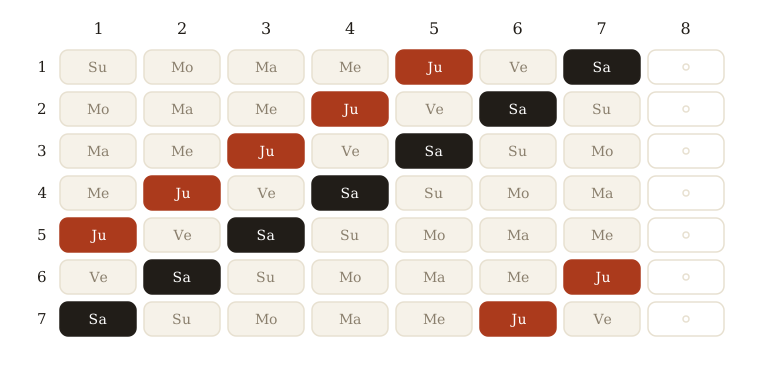
Ask a panchang for today's bad hours and it will usually print three: Rahu kaal, Yamaganda and Gulika. The previous article in this cluster took apart the first of them, the famous one, and found a single machine underneath: divide the daylight into eight equal parts and let the weekday pick the part. This article takes apart the other two, and the surprise is that they do not need their own rules at all. Yamaganda and Gulika fall out of the same eight parts the moment you ask one more question: whose part is it? Deal the seven planetary lords of the weekdays onto the eight parts, and Jupiter's share is Yamaganda, Saturn's share is Gulika, every day of the week without exception. The memorised tables turn out to be arithmetic in disguise.
The rule: seven lords, eight chairs
The dealing rule is old. jyotishya.date, in its source review of these windows, traces it to the Brihat Parashara Hora Shastra as printed, chapter 3, verses 66 to 69 in R. Santhanam's translation: the day is divided into eight equal parts, and the first seven are given to the planets in weekday order, Sun, Moon, Mars, Mercury, Jupiter, Venus, Saturn, starting with the lord of that weekday. The eighth part gets no lord. Saturn's part is named Gulika, and Jupiter's part is named Yamaghantaka. We have not opened BPHS ourselves for this article; that is jyotishya's reading of the printed text, recorded here as an indirect citation, and the same page names its editions openly.
Watch the rule run. On Sunday the day's lord is the Sun, so the parts are dealt Sun 1, Moon 2, Mars 3, Mercury 4, Jupiter 5, Venus 6, Saturn 7, and the eighth part stands empty. Jupiter sits at part 5, Saturn at part 7, and the traditional tables say exactly that: Yamaganda on Sunday is the fifth part, Gulika the seventh. On Monday the count starts from the Moon, so every planet shifts one chair forward: Jupiter lands at part 4, Saturn at part 6, and the lordless chair is part 1. On Tuesday, starting from Mars, Jupiter is at 3 and Saturn at 5. Wednesday: Jupiter 2, Saturn 4. Thursday, Jupiter's own day, puts Jupiter at part 1 and Saturn at part 3. Then the deal wraps: Friday starts from Venus, so Jupiter is at part 7 and Saturn at part 2; Saturday starts from Saturn, putting Saturn at part 1 and Jupiter at part 6. The whole Yamaganda table, 5, 4, 3, 2, 1, 7, 6, and the whole Gulika table, 7, 6, 5, 4, 3, 2, 1, come out of one dealing rule. mahadasha.com, which presents this as the single question behind the Yamaganda table, says it checked the rule against its own engine for all seven days; panchangguru.com prints the same tables from its own engine's numbers; panchangtime's methodology table matches as well. Four independent sites, one rule.
Yamaganda: Jupiter's chair
The Yamaganda table reads 5, 4, 3, 2, 1 on Sunday through Thursday, then jumps to 7 on Friday and 6 on Saturday. That jump is what makes it look arbitrary on a printed card, and it is exactly what the dealing rule predicts: after Thursday the starting lord has advanced five days, so Jupiter, sitting four places ahead in the cycle, wraps around past the eighth chair and re-enters from the far end. A descending staircase with one wrap. panchangguru states the same table in words: Yamaganda starts with the fifth part on Sunday and moves one part earlier each day down to the first on Thursday, then wraps to the seventh on Friday and the sixth on Saturday.
Once the part is known, the clock arithmetic is the cluster's shared machine, so we run it once and flag it as our own computation. Take an imaginary Thursday with sunrise at 6:24 and sunset at 18:12, a day of 11 hours 48 minutes, 708 minutes. One eighth is 88.5 minutes. Thursday's Yamaganda is the first part, so it runs from sunrise itself, 6:24 to 7:52:30. Thursday's Gulika is the third part, starting after two parts, 177 minutes: 9:21 to 10:49:30. This example is our own arithmetic on an invented day, included so the reader can test the method, not a quotation from any almanac.
Why does a benefic get the bad window?
Jupiter is the great benefic of the tradition, the graha everyone wants strong. Why should Jupiter's part of the day be a window to avoid? Here our sources offer two different readings of the name itself, and we record both rather than choose. jyotishya reports that BPHS spells the word yamaghantaka, from yama and ghanta, a bell, citing Monier-Williams; on that reading the common spelling with ganda is the later form, often read as Yama's danger. mahadasha reads ganda as a knot or critical juncture, the same root that names the Ganda and Atiganda yogas, and draws from it a coherent interpretation: a juncture in the day, and perhaps the caution that a benefic's hour sets things in motion most easily, wrong things included. mahadasha itself adds the honest caveat that the tradition does not explain itself here and the texts simply assign the window. panchangtime's one-line gloss stays with function: work begun in Yamaganda is said to bear no lasting fruit, so key tasks are postponed. What all three agree on is the practice, not the story: no new auspicious undertaking in this part.
Gulika: Saturn's chair, the straightest table in the panchang
Gulika's table is 7, 6, 5, 4, 3, 2, 1 from Sunday to Saturday, a clean countdown. mahadasha shows the one-line formula behind it: number the weekdays with Sunday as 1, and Gulika's part is simply 8 minus the weekday number. Sunday, day 1, gives part 7; Saturday, day 7, gives part 1. No other daily window has a table this tidy, and the reason is structural, not decorative: Saturn is the last planet in the weekday order, so as each day advances the starting lord by one, Saturn arrives one chair earlier, and the count drops by exactly one. On Saturday, Saturn's own day, Gulika is the very first part after sunrise. panchangtime's table and jyotishya's table agree with this reading in full.
Saturn's ownership also makes the window's character the least surprising of the three. Saturn is the natural significator of delay, obstruction and labour in the tradition, so its part being unfavourable for beginnings is exactly what the symbolism predicts. mahadasha notes the traditional restriction runs slightly wider here: beyond the usual bar on journeys, purchases and ceremonies, Gulika is avoided for anything intended to be permanent, on the reasoning that what begins under Saturn's window inherits Saturn's tendency to stall, and marriage muhurat calculations exclude it firmly. The same page records the mirror exception: work directed at Saturn, including remedial measures concerning him, is held to suit the hour rather than clash with it.
The one-part-earlier variant
Not every source prints these tables. jyotishya's review says every modern panchang it checked uses the tables above, except one site that moves Yamaganda and Gulika one part earlier; on that reading Sunday's Yamaganda would be the fourth part instead of the fifth. We found exactly such a reading in our own sampling: sahikundli.com's methodology page describes Gulika on the seventh part on Sunday, matching the mainstream, but places Yamaganda on the fourth on Sunday, one part earlier than the other four sources. jyotishya adds a pointed note about such variants: since the dealing rule of BPHS reproduces the mainstream tables exactly, a table moved one part earlier disagrees with that chapter. We record the divergence unresolved, as we do elsewhere in this series: the majority reading is 5, 4, 3, 2, 1, 7, 6 for Yamaganda, a minority prints it one part earlier, and the practical consequence is the usual one for this cluster: when a printed card and your app disagree, the difference is often a convention, not an error, and the only safe habit is to know which convention your source follows.
Gulika's second life: from window to chart point
Of the three windows, Gulika alone leads a double life, and this is the half that most daily tables leave out. Rahu kaal and Yamaganda exist only on the clock: the part passes and they are gone. Gulika also becomes a point in the birth chart. The method, as mahadasha describes it: take the moment Gulika's part begins on the day of birth, cast the ascendant for that instant, and the resulting position is placed in the chart as Gulika, an upagraha, a constructed shadow point rather than a body, classed alongside points such as Dhuma and Vyatipata. A related calculation from the end of the segment gives Mandi, and the two names are often used interchangeably, though schools differ on whether the beginning, the end or the midpoint of the segment is taken, so two sources can place the point a little apart. Once placed, the point is read as a marker of obstruction in the house it occupies, and its conjunctions are taken seriously. Because it derives from sunrise and sunset, it needs a birth time and place like any angular calculation; two people born the same day in different cities carry Gulika in different houses.
There is a night reckoning too, and mahadasha flags it as the usual cause when two sources give completely different Gulika positions for one birth. For a birth after sunset the segment is taken from the night: the span from sunset to the next sunrise is divided into eight, and the parts are dealt starting not from the weekday's own lord but from the lord of the fifth weekday counted forward, the same shift the Choghadiya night sequence uses. A day birth and a night birth on the same date therefore produce Gulika in unrelated places, and a calculator that implements only the day version will quietly return a daytime answer for a midnight birth. The night half exists for chart construction, not for avoidance, which is why almanacs print the daylight window only.
The Wednesday stack: when two windows touch
One more consequence of the tables is worth seeing, because it is visible in any almanac and rarely explained. mahadasha works a real example: Delhi, Wednesday 5 August 2026, sunrise 05:45:50, sunset 19:08:12, eight parts of 100.3 minutes each; Wednesday's Gulika is the fourth part, 10:46:43 to 12:27:01, and the same page notes that Rahu kaal begins at 12:27:01, the very second Gulika ends. On a Wednesday the fourth and fifth parts are consecutive, so Gulika and Rahu kaal stack into a continuous flagged stretch of about three hours and twenty minutes from mid-morning to early afternoon. We verified the arithmetic of this example against the rule ourselves: 13 hours 22 minutes 22 seconds of daylight is 802.37 minutes, an eighth is 100.3 minutes, three full parts end 300.9 minutes after 05:45:50, that is 10:46:44, matching the source within rounding. No other weekday produces this adjacency, because no other weekday puts the two windows on neighbouring parts; the reader can test each day against the table above.
Rahu's anomaly: no chair at all
The dealing rule also explains something the previous article had to leave as a bare memorised table. Rahu owns no weekday and no hora, so in the deal of seven lords onto eight chairs Rahu gets nothing. jyotishya checks this against the BPHS scheme: on Sunday Rahu kaal's eighth part is the lordless one, on Monday its second part is actually Mars's, on Tuesday its seventh part is the Moon's; Rahu kaal matches no single planet's share. The same page reports a textual search: no rule for Rahu kaal was found in BPHS, Phaladeepika, Jataka Parijata, Muhurta Chintamani or Muhurta Martanda; the earliest mention located is a passing one in the Uttara Kalamrita, Kanda 2, verse 29, whose translator P. S. Sastri dates the text after the sixteenth century and notes the observance is especially Tamil Nadu, Karnataka and Kerala's, unmentioned in the standard texts; the weekday table itself appears in twentieth-century books by N. P. Subramania Iyer and B. V. Raman without a stated source. All of this is jyotishya's audit, cited indirectly here; we record it because it marks the exact depth of the written record for the most famous window of the three. Yamaganda and Gulika, ironically, have the older paperwork.
For memory, panchangguru passes on the English sentence in which Rahu kaal moves one part later through a fixed weekday sequence: Monday the 2nd part, Saturday the 3rd, Friday the 4th, Wednesday the 5th, Thursday the 6th, Tuesday the 7th, Sunday the 8th, remembered as "Mother Saw Father Wearing The Turban Suddenly." Yamaganda and Gulika need no sentence: one is Jupiter's chair, the other is 8 minus the weekday number.
What is avoided, and the counter-readings
The scope of all three windows is the scope this cluster has seen before: new beginnings. panchangguru states it plainly: these are practices of tradition, and work already under way, routine duties and anything urgent are not stopped for them. Within that shared frame each window carries its own flavour. Rahu kaal is the most widely observed, especially in the South, for any important start. Yamaganda, linked to Yama, is avoided for auspicious beginnings and especially for travel, and panchangtime's gloss says work begun in it is said to bear no lasting fruit. Gulika carries the widest spread of opinion: commonly avoided, firmly excluded from marriage muhurats, and yet panchangguru records a counter-tradition in which what is begun in Gulika tends to repeat, so the window is actually used for things one wants repeated; panchangtime likewise notes that specialised electional work uses Gulika's rising moment, and mahadasha records the Saturn-remedy exception. A reader meeting a practitioner who schedules something into Gulika on purpose is not necessarily watching a mistake; they may be watching the repetition reading at work.
How to read these windows: three checks
First check: which table is your source using? For Yamaganda, Sunday's part answers the question at a glance: 5 means the mainstream BPHS-consistent table, 4 means the one-part-earlier variant, and the two will disagree every day of the week. Second check: is the clock time computed from your own place and date? As with Rahu kaal, these parts are fractions of real daylight, so a table without a city is an approximation and a table without a date is a guess. Third check: what is the window being used for? As daily avoidance all three concern beginnings only; as chart construction, Gulika is a different instrument altogether, with its day and night reckonings and its begin-versus-end school difference, and a printed daily window tells you nothing about where your own Gulika sits. Keep the three questions separate and the three windows stop being three superstitions and become one machine with three dials, which is what the sources, read closely, have been saying all along.
Questions on this article
Are Yamaganda and Gulika the same thing?
No. Both are single parts of the day’s eight, but different ones: Yamaganda is Jupiter’s part (the fifth on Sunday, one earlier each day, wrapping to the seventh on Friday) and Gulika is Saturn’s (the seventh on Sunday, stepping straight down to the first on Saturday). Both are avoided for new beginnings, but Gulika alone has a second life as a point in the birth chart.
Do these windows occur at night as well?
Not in the common reckoning: Rahu kaal, Yamaganda and Gulika divide the daylight, sunrise to sunset, into eight. But for Gulika’s chart point a night reckoning is also on record, in which the night from sunset to the next sunrise is divided into eight and the deal starts from the lord of the fifth weekday forward; that half serves chart construction, not avoidance, which is why almanacs print the daylight window only.
Why does my app show a different Yamaganda time from the newspaper?
Two common causes. First, place and date: the part is a fraction of daylight, so the clock time shifts with city and season, and a newspaper’s table is computed for its own place. Second, a convention difference: a minority reading moves Yamaganda and Gulika one part earlier, which disagrees with the BPHS deal; tell them apart by Sunday’s part, 5 versus 4. Both sources can be correct within their own rule; check which convention each follows.
Are Gulika and Mandi the same point?
Both are derived from the same segment of the day and are often used interchangeably, but schools differ on whether the segment’s beginning, end or midpoint is taken, so two sources can place them a little apart. Jataka Parijata calls Gulika the son of Saturn (indirect citation), and both are upagrahas, constructed shadow points, not bodies.


