Janmashtami: Two Calendars, One Midnight
Janmashtami appears on two dates in many years because the Smarta and Vaishnava sampradayas pick the day by different rules; 2027 is a single shared day for both, Wednesday 25 August. The rules, the birth legend, the midnight puja, the parana, the regional rites and an honest note on the fast, with sources.
This is a midnight festival. A day of fasting, bhajans and vigil, and then exactly at midnight, the hour at which tradition places Krishna’s birth, the image of the infant is bathed, dressed and laid in a cradle, and the fast opens. Yet this same festival appears in calendars on two dates in many years, and the reason is no printing error: two sampradayas choose the day by different ancient rules. This article opens the full structure of Janmashtami: the name and the tithi, the arithmetic of the two calendars, the birth legend, the midnight puja and the parana, the regional rites, and the 2027 date and timings.
Everything below comes from sources fetched on 31 October 2026: Drik Panchang’s Janmashtami 2027 page for New Delhi (Smarta), the same site’s ISKCON Janmashtami 2027 page for New Delhi, and Wikipedia’s Krishna Janmashtami article. Where a classical text is mentioned through these, such as the Dharmasindhu or the Nirnaysindhu, that is an indirect citation and is marked as one; we did not open those texts ourselves. Where Drik Panchang offers its own editorial opinion, it is recorded as that page’s opinion. All dates and times are for New Delhi; the panchang changes with the city.
The date hidden in the name
Janmashtami is built of two words: janma, birth, and ashtami, the eighth. Per Wikipedia it is the festival of Krishna’s birth, kept on the eighth tithi of the dark fortnight of Bhadrapada by the purnimanta convention, or Shravana by the amanta convention; the two conventions give the same single lunar day two different month names, so the day itself does not change. In the Gregorian calendar it falls in August or September. The festival goes by several names, and both Drik Panchang and Wikipedia record them: Krishnashtami, Gokulashtami, Ashtami Rohini, Srikrishna Jayanti and Sree Jayanthi. In Kashmir it is Zaram Satam, that is Janam Saptami, which reflects the Kashmiri Pandits’ own tithi reckoning. Drik Panchang’s 2027 page calls this year the 5254th birth anniversary of Krishna; that is the page’s count, and we give it in the page’s name.
The ashtami belongs to the Krishna Paksha, the eighth tithi of the waning moon after the full moon. So the moon on Janmashtami night is not full; what matters in the tradition that night is not the sight of the moon but the hour: Nishita Kaal, the midnight period in Vedic time-keeping.
Two calendars: Smarta and Vaishnava
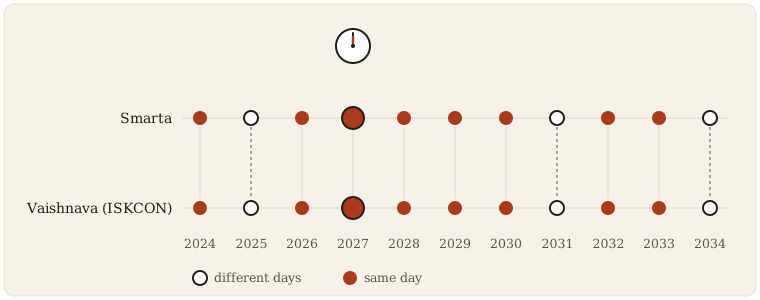
In most years Janmashtami is listed on two consecutive days. Drik Panchang explains that the first date is for the Smarta sampradaya and the later one for the Vaishnava sampradaya; where a single date is printed, both observe the same day. The two rule-sets differ. The Vaishnava rules give preference to the Ashtami tithi and the Rohini nakshatra, never accept Saptami tithi, and a Vaishnava Janmashtami always falls on Ashtami or Navami. The Smarta rules are more intricate: priority goes to Nishita Kaal, and the chosen day is the one, Saptami or Ashtami, on which the Ashtami tithi prevails at Nishita, with further rules folding in the Rohini nakshatra; a Smarta Janmashtami falls on Saptami or Ashtami. Drik Panchang writes that texts like the Dharmasindhu and the Nirnaysindhu define these rules precisely; this is an indirect citation, we have not seen those texts ourselves.
This is not an abstraction. Drik Panchang’s own New Delhi lists display it: in 2025 the Smarta Janmashtami is Friday 15 August and the ISKCON one Saturday 16 August; in 2031, 9 and 10 August; in 2034, 5 and 6 September. Meanwhile 2024, 2026, 2027, 2028, 2029, 2030, 2032 and 2033 give both lists the same day. The year 2027 is such a year: 25 August, a Wednesday, one day for both sampradayas.
Drik Panchang also makes an editorial remark on this page, which we record as its own: it says that the visible unanimity in North India results from the ISKCON institution’s reach and promotion, and that many people who are not followers of Vaishnavism take ISKCON’s day to be Janmashtami, although the day appropriate for them may differ. This is that website’s own view; we carry it as a source’s opinion, not as fact. The practical takeaway is simple: know the tradition of your sampradaya or your temple, and check the panchang for your city.
2027: date and timings, New Delhi
Per Drik Panchang’s New Delhi panchang, the 2027 calculation runs as follows. Janmashtami falls on 25 August, a Wednesday. The Ashtami tithi begins at 8:24 PM on 24 August and ends at 7:19 PM on 25 August. The Rohini nakshatra runs from 12:27 PM on 25 August to 11:42 AM on 26 August. The Nishita puja window, the period in which the main puja is performed, runs from 12:01 AM to 12:45 AM on the night of 26 August, 44 minutes in all; the midnight moment is 12:23 AM. Moonrise is at 11:41 PM on 25 August. Dahi Handi is the next day, Thursday 26 August.
Three parana calculations are given on the page. Per Dharma Shastra the parana comes after 11:42 AM on 26 August, because on that day the Ashtami ends before sunrise and the Rohini nakshatra ends at 11:42 AM. An alternate shastra parana after 5:56 AM that morning, after sunrise and after the deva puja and visarjan, is also valid. And by the modern social custom the parana is done in many places right after Nishita, that is after 12:45 AM on 26 August. These times are for New Delhi; for other cities a difference of minutes is possible.
The birth legend: from the prison across the Yamuna
Per Wikipedia, information about Krishna’s life is found in the Mahabharata, the Puranas and the Bhagavata Purana, and he is known as the eighth avatar of Vishnu. The legend runs this way. Krishna was the eighth son of Devaki and Vasudeva. At Devaki’s wedding a celestial voice warned Kansa that Devaki’s eighth son would cause his death. Kansa imprisoned his sister and her husband and had their first six newborns killed. On the night Krishna was born, the guards fell asleep and the cell doors opened by themselves. Vasudeva carried the newborn across the Yamuna to Gokul, where Krishna was raised by Yashoda and Nanda. In remembrance of this legend people keep fasts, sing devotional songs of love for Krishna and keep vigil into the night. In Krishna’s childhood his half-brother Balarama was a constant companion, and the Braj plays of butter-stealing and calf-herding are sung and enacted at this festival.
The rite of the night: fast, puja, parana
Drik Panchang lays out the fast’s procedure. On the day before Janmashtami, take only a single meal. On the fasting day, after the morning rituals, a sankalpa is taken: that the day-long fast will be kept and broken the next day. The parana comes when both the Rohini nakshatra and the Ashtami tithi have passed; some break the fast when either of the two has passed. No grains are eaten during the fast, and every rule of Ekadashi fasting applies to it. The main puja is performed in Nishita Kaal, the midnight of Vedic time-keeping, and it is a shodashopachara puja, sixteen steps in due form, offered to Balakrishna, the infant Krishna.
The parana rules are also given in detail. The parana should happen the next day after sunrise, once Ashtami and Rohini have both passed. If both have not passed by sunset, then when either one has. If neither has passed by sunset, or even by Nishita, one waits for them to pass. From this arises the rare case in which the fast runs two full days; Drik Panchang, citing the Dharmasindhu, writes that those unable to keep a two-day fast may break it the next day after sunrise, an indirect citation. Wikipedia adds the domestic picture of this night: after midnight the infant Krishna’s image is bathed, clothed and placed in a cradle, and devotees break the fast by sharing food and sweets; tiny footprints are drawn at the door and the kitchen, walking towards the house, as if Krishna himself were entering the home.
An honest note on the fast (this section is ours)
What is written above is the tradition’s description, not our advice. We have recorded the fast’s rules from the sources, but no source gives health exemptions, so we write this note ourselves. A day without grains, and in some traditions without water, does not fall the same on every body. For anyone pregnant, ill, elderly, on regular medication, or told by a doctor not to fast, the doctor’s advice is the authority, not any festival page. No one may demand a fast of anyone, not in a family, not in a relationship. And to those who do fast we make no guarantee of outcome; the tales speak the language of faith, and we print them as faith. Anyone who wishes can take full part in the festival through its bhajans, its story, its tableaux and its shared food; the tradition has room for that too.
Region by region: one festival, many forms
Per Wikipedia, Janmashtami is the largest festival of the Braj region: Mathura, where Krishnaism holds Krishna was born, and Vrindavan, where he grew up. The Raslila, the play of rasa, begins there as dance-drama days in advance, and the Braj bhasha poetry of the fifteenth and sixteenth centuries, above all the Sursagar of Surdas, is sung again in this season. Scholars such as Christian Roy read the Radha-Krishna love stories as symbolism for the human soul’s longing for the divine; that is the scholars’ reading. In the Jammu region the festival is called Thogre or Thakure da Vrat: a phalaahari fast, phalaahari dhaams and bhandaras in the streets, and the kite-flying season begins on this day; women dye their palms with teera, grains are donated to ancestors in the Deyaa Parna rite, the jand tree is worshipped and special rotis called draupads are offered to cows and deities. In Kashmir the Kashmiri Pandits keep Zaram Satam: a day’s vrat, abhishek and bhajans at midnight in the thokur kuth, the Krishna temple, and fast-appropriate food such as gaer or singhada lapsi made from water-chestnut flour.
In Maharashtra the festival is known as Dahi Handi, in Mumbai, Latur, Nagpur and Pune. Youth groups form human pyramids to break a pot of curd and buttermilk hung high above the street; the spilled contents are taken as prasada, and Wikipedia calls it a facilitator of social oneness. It is the butter-thief’s childhood play enacted in the open. In Gujarat, Dwarka keeps Makhan Handi, garba and raas are danced, Kutch farmers take out processions of decorated bullock carts, and the day is special for the Pushtimarg and Swaminarayan traditions; the bhajans of Narsinh Mehta, Dayaram and Mirabai return in this season. In Kerala, Janmashtami is celebrated in September, by the Malayalam calendar. In Tamil Nadu homes are decorated with kolams, the Geetha Govindam is sung, an infant’s footprints are drawn from the threshold to the puja room, and dishes like seedai and verkadalai urundai are offered; most people keep a strict fast and the celebration is in the evening. In Andhra Pradesh and Telangana, shloka recitation and devotional songs mark the day, young boys dressed as Krishna visit neighbours and friends, and chakodi, murukku and seedai are offered.
In Odisha and West Bengal, around Puri and Nabadwip, the festival is called Sri Krishna Jayanti or simply Sri Jayanti. The tenth chapter of the Bhagavata Purana is read, a grand abhisheka is performed at midnight, the next day is kept as Nanda Ucchhaba, the joy of Nanda’s household, and Puri’s Jagannath Temple holds a Ratha Yatra on Janmashtami itself. In the Northeast the imprint is of the fifteenth- and sixteenth-century teachers Sankardeva and Chaitanya Mahaprabhu: Sankardeva’s Borgeet, Ankia Naat and Sattriya traditions in Assam and Bengal, and in Manipur the Raslila in the Manipuri dance style is the festival’s signature; children of the Meetei Krishnaite community play the Likol Sannaba game, and in Assam the nam-singing and puja happen in the Namghars. Beyond India, Janmashtami is a national holiday in Nepal, where most people fast until midnight; it is a national holiday in Bangladesh too, and the procession from Dhaka’s Dhakeshwari Temple has run since 1902, halted in 1948 and resumed in 1989; in Fiji, Krishna Ashtami lasts eight days, with mandalis reading the Bhagavata Purana night after night; and in Pakistan, bhajans and sermons are held at Karachi’s Swaminarayan Mandir, where it is an optional holiday.
The next day: Nandotsava and Dahi Handi
The celebration of the birth spills into the next day. In North India the following day is Nandotsava, the joy of Nanda and Yashoda’s house; in Odisha and Bengal it is called Nanda Ucchhaba. In Maharashtra, and now in many other cities, the next day belongs to Dahi Handi; Drik Panchang lists it for 2027 on 26 August, a Thursday. The festival’s structure is thus clear: one night for the birth, and one day for the joy of that birth, in which the butter-thief’s play comes down to the streets.
In sum
Three things are enough to understand Janmashtami. The date is hidden in the name: janma and ashtami, the eighth tithi of the dark fortnight of Bhadrapada or Shravana. The day is chosen by two rule-sets, Smarta and Vaishnava, and that is why some years print two dates; in 2027 the two are one, 25 August. And the festival’s centre is midnight, Nishita Kaal, when the legend says the prison doors opened and the Yamuna was crossed. For 2027 in New Delhi the Nishita puja runs 12:01 to 12:45 AM; check the panchang for your own city, and whether or not you keep the fast, joining the night’s bhajans and the story is full part of the festival.
Questions on this article
When is Krishna Janmashtami in 2027?
Wednesday 25 August 2027, per Drik Panchang’s New Delhi panchang. The Nishita puja window runs 12:01 to 12:45 AM on the night of 26 August, and this year both the Smarta and Vaishnava (ISKCON) sampradayas observe the same day. Dahi Handi falls on Thursday 26 August. Tithi boundaries shift with the city, so check the panchang for your own city.
Why does Janmashtami show two dates?
Because the Smarta and Vaishnava sampradayas choose the day by different rules. Per Drik Panchang, the Smarta rules give priority to Nishita Kaal and the day can fall on Saptami or Ashtami tithi; the Vaishnava rules never take Saptami, the day falls on Ashtami or Navami, and the Rohini nakshatra carries heavy weight. When the two calculations yield different days the calendar prints two dates, as in 2025, 2031 and 2034; in 2027 the calculation yields one day.
When is the Janmashtami fast broken?
By the traditional rule the parana comes the next day after sunrise, once both the Ashtami tithi and the Rohini nakshatra have passed; if both have not passed by sunset, then when either one has; and in many places the fast is broken right after Nishita, the midnight itself. Drik Panchang, citing the Dharmasindhu, writes that the fast can run two full days when the tithi and nakshatra persist, and those unable to keep that may break it the next day after sunrise; an indirect citation. For 2027 in New Delhi: the shastra parana after 11:42 AM on 26 August, the alternate sunrise parana after 5:56 AM, and the modern custom after 12:45 AM.
Is fasting on Janmashtami required?
This article describes the fast, it does not prescribe it. The tradition holds a day-long upavasa, no grains, broken after midnight or the next morning; but for anyone pregnant, ill, elderly or on regular medication the doctor’s advice is the authority, not any festival page. No one may demand a fast of anyone. Joining through bhajans, the story, the tableaux and the shared food is full participation too; the tradition has room for that.


