Karana: Half a Tithi, Sixty Halves and Eleven Names
The tithi's half, the karana: sixty halves, eleven names, four at Amavasya's door and seven turning eight rounds; the computation, the Bhadra tradition, the animal names and roots near 500 BCE.
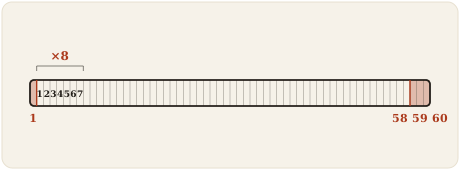
The panchang's fifth limb, the karana, is at once its simplest limb and its most strangely named one. Simplest, because it is exactly half a tithi, and anyone who knows the tithi grasps its measure in a single line. Strangest, because a lunar month holds sixty karana halves but only eleven names. The definition on Wikipedia's Karaṇa (pañcāṅga) page: a karana is half of a tithi, the duration in which the difference of the longitudes of the Sun and the Moon increases by 6 degrees; a lunar month has 30 tithis and therefore 60 karanas, and these sixty are not individually named, the originators of the concept chose eleven names to be associated with the karanas, which means several karanas share the same name. This article audits that arrangement: the measure, the map of the names, the source's method for finding which karana is running with a worked example, the tradition of avoiding Bhadra and the sources' divergence over it, the Malayalam tradition's animal names, and the old history of the karana concept.
The measure: half a tithi, six degrees
The tithi is a 12-degree unit of the elongation between the Moon and the Sun; the karana is a 6-degree unit of the same elongation. Every tithi holds two karanas, a first half and a second half; every paksha holds fifteen tithis, that is thirty karanas, and the whole month sixty. shastrapanchangam's karana method page adds a subtle but central caution: half a tithi means half its angular interval, not necessarily half its duration in hours, because the Moon's speed varies; that is why karana ending times are calculated separately at each six-degree boundary. On the daily panchang page the karana's name is printed with its ending time, and shastrapanchangam says the daily page identifies the karana present at sunrise along with its ending time. The reading habit is the tithi's own: the name states a condition, the time states its limit.
On the ladder of the panchang's angular units the karana sits squarely in the middle: the nakshatra and the yoga are 13-degree-20-minute intervals, the tithi is 12 degrees, the karana 6 degrees, and the nakshatra pada 3 degrees 20 minutes. So one nakshatra sector holds a little more than two tithis, one tithi holds two karanas, and one karana holds about two padas; once this ladder is understood, the units of all five limbs nest into one another, and the karana is the link between the tithi and the pada.
Sixty halves, eleven names
Now the map of the names, as Wikipedia gives it. The eleven names fall into two classes. The first class: four fixed names, each bound to a single half in the month, Kimstughna to the first half of Shukla Pratipada, Shakuni to the second half of Krishna Chaturdashi, Chatushpada to the first half of Amavasya, and Naga to the second half of Amavasya. The second class: seven movable names, Bava, Balava, Kaulava, Taitila, Gara, Vanij and Vishti, which rotate in that order over the 56 halves from the second half of Shukla Pratipada through the first half of Krishna Chaturdashi; the sequence repeats eight times, so every movable name attaches to eight different halves in the month. Look at where the fixed four sit: three at the end of the month, at and just before Amavasya, and one at the month's start, right after Amavasya; shastrapanchangam describes them in brief as near the new moon. So the name alone tells you where in the month you are: hearing Kimstughna means a new lunar month has begun, hearing Shakuni, Chatushpada or Naga means the month is at its door, and the other seven names are the turning wheel of the 56 halves in between.
Walk the first cycle slowly; the table is from Wikipedia's assignment table: the second half of Shukla Pratipada is Bava, the first half of Dwitiya is Balava, its second half Kaulava, the first half of Tritiya Taitila, its second half Gara, the first half of Chaturthi Vanij, its second half Vishti; and there the seven complete, so the first half of Panchami is Bava again and the wheel starts turning afresh. Since each tithi's two halves take the next names in order, the march of names is fully determined: to know the name of any half you need no table, only its serial number in the month and division by seven. The eighth cycle ends with Vishti on the first half of Krishna Chaturdashi, and right after it the door of the fixed names begins: the second half of Chaturdashi is Shakuni, the first half of Amavasya Chatushpada, its second half Naga, and the first half of the new month's Pratipada Kimstughna. Count it with a finger: 56 halves make eight cycles of seven names, plus the four fixed, sixty in all; why the originators chose only eleven names, the pages we consulted do not explain; what they record is this arithmetic fit, and that a scheme of eleven names was chosen over naming all sixty halves separately.
Which karana now: the source's method, our arithmetic
Wikipedia also gives the method for finding the karana, written in two forms. The simple form: take the longitudes of the Sun and the Moon, S and M; compute the difference D, adding 360 if M is smaller; divide D by 6 degrees, the integer quotient is K; if K is 0, 57, 58 or 59 the karana is respectively Kimstughna, Shakuni, Chatushpada or Naga; otherwise subtract the nearest multiple of 7 from K to get N, and the N-th name in the list of seven movable names is the karana. The mathematical form: K equals the floor of 60 times the elongation fraction, and the name follows from K modulo 60 and then modulo 7; both forms yield the same name. Run it over an invented moment: suppose the elongation is 200 degrees. K equals 200 divided by 6, that is 33; it is not among the four fixed numbers; subtracting the multiple of 7, 28, leaves 5; the fifth movable name in the list is Gara; so Gara karana is running at that moment. By the mathematical form too, 33 modulo 7 is 5, and its list likewise assigns the fifth place to Gara. This whole example is our own arithmetic re-running the source's method; it is not a moment quoted from any panchang page.
Run one more check on the same example: which half of which tithi is 200 degrees? A tithi is 12 degrees, so 200 divided by 12 is 16.67, meaning the seventeenth tithi is running; the seventeenth tithi is Krishna Dwitiya, and 8 degrees have elapsed past 192, the boundary of sixteen tithis, that is more than six, so it is Dwitiya's second half. Now check through the assignment table's march: count the halves in order from the second half, the one after Kimstughna, apply the cycle of seven up to the 33rd half, and the same Gara comes out. The two paths, the angular method and the table's march, meet at the same name; this cross-check is a home method for testing any panchang table's correctness.
Avoiding Bhadra, and the divergence over the inauspicious column
The karana's most famous name is Vishti, also called Bhadra. shastrapanchangam writes that in traditional muhurta selection this period is generally avoided for auspicious beginnings; kaalpanchang likewise calls Vishti inauspicious and records the name Bhadra. A divergence must be recorded here: kaalpanchang's list calls four karanas inauspicious, Vishti plus three of the fixed names, Shakuni, Chatushpada and Naga, while shastrapanchangam's method page mentions only the avoidance of Vishti-Bhadra and says nothing of the kind about the other fixed names. Both texts are recorded as they stand; on how long the avoidance list runs, our sources do not speak with one voice. And the column's status is the one recorded in our yoga article: the classification is tradition's assessment, not an output of the arithmetic; the counting that builds six-degree boundaries has no input telling it which half is inauspicious, and within the muhurta method the karana too is one factor alongside the other limbs, not a lone verdict.
Practically, avoiding Bhadra is a matter of a time window, not a day-long boycott. Vishti is a movable karana, it comes eight times in a month, and each time it lasts only its own six-degree half; as shastrapanchangam explains, the daily page shows the karana running at sunrise and its ending time, so if Bhadra is running, one can look up its ending time and plan the rest of the day. This is the same reading style that came up in the tithi and yoga articles: the panchang is a list of boundaries and times rather than of days, and an avoidance too is an avoidance up to a time boundary.
A second layer of names: the Malayalam animal names
A regional layer of the eleven names is also on record. Wikipedia states that in Malayalam astronomical literature the eleven karanas are assigned names that are words for various animals, and gives the table citing Pappootty's work: Shakuni the shikra, Chatushpada the quadruped, Naga the snake, Kimstughna the worm, Bava the lion, Balava the tiger, Kaulava the pig, Taitila the donkey, Gara the elephant, Vanij the cow, and Vishti the dog. This table shows two things. First: the same counting unit carries name-layers language by language; the Sanskrit tradition's names differ from Malayalam's animal names, but the map of the sixty halves is the same. Second: the names are a memory technique; the animal forms serve as recall aids for readers inside that tradition, much as the nakshatra symbols do for us. This layer too we place in the same category as the whole naming layer: a list of tradition, not arithmetic.
One transparency note: the source table prints the original Malayalam-script word beside each animal name; here we have repeated only the English equivalents Wikipedia gives, and the originals can be seen on that same source page. And notice a symmetry: some of the eleven form pairs of neighboring animals, lion and tiger, donkey and elephant, cow and dog; such pairings match old techniques of sequence memory, where successive items are bound to a familiar pair so the order sticks. This symmetry remark is ours; the source supplies only the table of names.
Where it came from: the halved lunar day
The history of the karana concept recorded on Wikipedia runs exactly opposite to the history in our yoga article, and that contrast is the most instructive fact of this cluster. The yoga entered the panchang last, around 700 CE; the karana's roots lie in the oldest layers. Per the page, the karana concept most probably arose almost simultaneously with the concept of the tithi: before the modern tithi, the concept of a lunar day was in vogue, the time from one moonrise to the next; and just as the savana day, one sunrise to the next sunrise, was divided into two parts, sunrise to sunset and sunset to sunrise, the lunar day too split into two halves, moonrise to moonset and moonset to moonrise. The karana concept originated in this two-part division; later, when the modern concept of the tithi got established, those two halves of the lunar day were replaced by the artificial concept of half-tithis. The evidence layer: per the page, works of the Vedanga period, the Atharva Jyotisha and the Rik-parishishta, mention the karanas, so the origination of the concept can be traced to as early as the period of the Vedanga Jyotisha, around 500 BCE; this conclusion rests on the Dikshit and Sharma studies the page cites. So among the panchang's five limbs the karana's claim reaches into the oldest layers, while the yoga's claim belongs to the newest; treating both as the same age is a common mistake of panchang history.
This history carries a practical lesson too. The karana's roots lie in a period when day-counting ran on visible events like moonrise and moonset; the modern karana is the angular-arithmetic descendant of that same old two-part division, now a 6-degree boundary of the Sun-Moon elongation. So the unit once measured by watching the sky now comes out of a computation; the name is the same, the way of measuring has changed. That layer shift is the story of every panchang limb, but it shows most clearly in the karana, because its naming map, four fixed and seven movable, still runs that same old two-halves frame over the month's sixty boundaries.
How to read a karana: three questions
Reading the karana entry on a panchang page is a matter of three questions. First: which karana is running and what is its ending time? The ending time is the limit, and it is computed separately at each six-degree boundary; assuming that half a tithi is half in hours is a mistake, because the Moon's speed varies. Second: let the name tell you where in the month you are; the four fixed names mark the hours around Amavasya, and the seven movable names are the turning sequence of the 56 halves in between; Kimstughna is the new beginning, Shakuni, Chatushpada and Naga the door of the ending. Third: how long an avoidance list does your source run? One source avoids only Vishti-Bhadra, another calls the three fixed names inauspicious as well; both texts are recorded above, and both are tradition's assessments, not arithmetic. Only after these three does muhurta thinking begin, and there the karana is one factor alongside tithi, vara, nakshatra and yoga.
In sum, the karana is the tithi's half unit, a six-degree boundary, wearing an efficient naming layer of eleven names over sixty halves: four names standing at Amavasya's door, seven names turning eight rounds. Its computation is a single line, its history reaches the Vedanga period, and its inauspicious column belongs to tradition; identify the three layers separately, and reading the karana becomes clear.


