Karva Chauth: A Pot, a Sieve, and the Wait for the Moon
Karva Chauth reads through three things: the clay karwa, the sieve and the moon. Origins, sargi, the feris, the tales, today’s debate, an honest note on the fast, and the 2027 date, with sources.
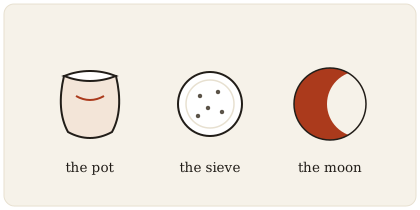
Some fasts begin in the calendar; this one begins in the kitchen. Karva Chauth opens with a box sent by a mother-in-law, the sargi eaten in the dark hours before dawn, and it ends at night with a moon peered at through a sieve. The whole day between is a wait, and that wait has its own rules, its own songs and its own stories. This piece opens the fast up completely: the date hidden in its name, the origins of the clay pot, the rites from sargi to the feris, the three famous tales, the debate around its modern form, and the 2027 date.
Everything below comes from two sources fetched on 31 October 2026: Wikipedia's Karva Chauth article and Drik Panchang's Karva Chauth 2027 page for New Delhi. Where Wikipedia's own line carries a citation-needed flag, we flag it too. Read the tales as tales; this piece promises no outcome for any fast.
The date is hidden in the name
In the Sanskrit scriptures the festival is called Karaka Chaturthi, Wikipedia notes: karaka, an earthen water pitcher, and chaturthi, the fourth day of the lunar month. The day is the Chaturthi of the dark fortnight, of Kartik by the Purnimanta reckoning. But here is a panchang subtlety that readers of our Amanta-Purnimanta piece will recognise: Drik Panchang writes that in the Amanta convention followed in Gujarat, Maharashtra and southern India, the month current on that day is Ashwin, not Kartik, and then says plainly that only the month's name differs, Karva Chauth falls on the same day in every state. Two calendars, two month names, one date.
The same day carries one more thread: per Drik Panchang, Karva Chauth coincides with Sankashti Chaturthi, the fasting day of Ganesha, and Ganesha finds his place in the puja alongside Shiva's family, which is why the story-reading in many regions naturally includes him.
Where the pot came from
The word karva means a small earthen water pot, and Wikipedia lays out two or three accounts of its origin, none final. One account ties it to the Rajput campaigns: men from the northwest's households went away to distant wars, and their wives prayed for their safe return. A second account belongs to the season: the festival falls at wheat-sowing time, the start of the Rabi crop cycle, and the large earthen pots in which wheat was stored were also called karvas, so the fast may have begun as a prayer for a good harvest in this wheat-eating region. Both readings are Wikipedia's; we have no further evidence to weigh them.
A third story is social, and Wikipedia flags it as needing citation: a newly married woman arrived alone in her in-laws' house, so at the wedding itself she was given a friend for life, a kangan-saheli or dharam-behn, close in age, married into the same village, and unrelated to the in-laws so no conflict of interest could arise. The festival is said to have grown to celebrate this bond of friendship. A custom belongs with that story: before the festival, married women bought new karvas, painted them outside, filled them with bangles, ribbons, sweets and make-up, and exchanged them on the day. This detail is also flagged uncited, but the exchange of karvas still echoes in the festival's songs.
About the karva itself Wikipedia keeps a concrete detail: the traditional karva is a spherical clay pot, seven to nine inches across and holding two to three litres. And Drik Panchang adds that the karwa is not only the vessel of the offering but an object of giving: it is significant in the puja and is then given as dan to a Brahmin or an eligible woman. So the pot that opens the day leaves the house as a gift, and the custom completes the object's cycle: bought, painted, filled, exchanged, offered and given away.
Sargi: the morning before the morning
The fast's first station comes before the fast. In the Punjabi tradition, per Wikipedia, the fasting women wake and eat and drink just before sunrise, and this meal is the sargi, which always includes fenia. The giving of the sargi is the mother-in-law's part: she sends it or prepares it. In Uttar Pradesh, on the eve of the festival, soot feni is eaten with milk in sugar; it is said, and Wikipedia gives it only as "it is said", that this helps one go without water the next day. Both customs show the same frame: the fast's plate is laid with love, and the hand that lays it is someone else's.
The rites of the day
The day is one of dressing up: the fasting women wear their finery and mehndi, and the home or temple readies for the evening puja. Wikipedia notes that the beauty rituals are part of why the festival bonds women together. The fast's character is described as strict: Drik Panchang writes that it is kept without food and without even a drop of water from after sunrise until the moon is sighted. We record that here as the tradition's description; our honest note on it comes below.
The evening circle: puja, story and feris
In the evening the fasting women sit in a circle, each with her own puja thali. Depending on region and community, some version of the Karva Chauth story is narrated, with regular pauses, and the storyteller is usually an older woman or a priest if one is present. The Karva Chauth puja song is sung together. In some parts of Uttar Pradesh the pauses are filled with feris: the women pass their thalis around the circle; in other parts they hold rice or food in their hands while listening.
The song's construction is worth a look. Wikipedia explains that the first six feris list the fast's restrictions and the seventh lifts them. The forbidden acts include weaving cloth, pleading with or trying to please anyone, and waking anyone who sleeps; for six feris these are sung with a "no", and in the seventh the same lines turn with a "yes", the fast complete, the bindings loosened. In one melody both the fast's boundary and its release are written.
The regions add their own colours. In Uttar Pradesh and Rajasthan the women exchange kharvas, a milk pudding, seven times between themselves. In Rajasthan, before the water offering is made seven times, the fasting woman is asked "Dhapi ki Ni Dhapi?", are you satiated, and she answers, "Jal se Dhapi, Suhaag se na Dhapi", satiated by water, but not by love. One Uttar Pradesh rite worships gaur mata, the mother earth: a little soil is taken, sprinkled with water and marked with kumkum as the sign of the fertile earth; in earlier times the Gaur Mata idol was made of earth and cow dung, now an idol of Parvati has taken its place.
The sieve and the moon
After the feris comes the last stretch of the wait: watching for the moonrise. Per Wikipedia, once the moon is visible, depending on region and community, the fasting woman views the moon, or its reflection in a vessel of water, through a sieve or through the cloth of a dupatta, and then looks at her husband's face through the same sieve. Water, the arka, is offered to the moon, to Chandra the lunar deity, for its blessing. In some regions a short prayer for the husband's life is said at this point, and the belief is recorded that at this stage the woman, spiritually strengthened by her fast, can confront and defeat death itself, Yama; that is the description of a belief, not our promise. In Rajasthan the women say: like the gold necklace and the pearl bracelet, just like the moon may my suhaag always shine brightly.
Three tales
Three tales circulate in the story-reading, and Wikipedia records all three. The first is Queen Veeravati's: the only sister of seven loving brothers, keeping her first Karva Chauth at her parents' house. By evening she was faint with thirst, and the brothers, unable to watch, made a mirror in a pipal tree look like the risen moon; Veeravati broke her fast, and with the third morsel came the news of her husband's death. Instructed by a goddess, she repeated the fast with full devotion, and the tale says Yama was forced to restore her husband to life. The second is of a woman named Karva: her husband, bathing in a river, was seized by a crocodile; Karva bound the crocodile with cotton yarn and demanded that Yama send it to hell, and by the strength of her devotion won her husband a long life. The third ties the fast to the Mahabharata: when Arjuna had gone to the Nilgiris and troubles pressed the Pandavas, Draupadi asked Krishna for help; Krishna reminded her that in similar circumstances Shiva had taught Parvati the fast of Karva Chauth, Draupadi kept it, and the Pandavas' troubles lifted. In some tellings Shiva narrates the Veeravati story itself to Parvati; the tales are woven into one another. We record all three as folklore, not as evidence.
The festival today, and the debate beside it
Wikipedia's modern section shows the festival's changed image. In present-day North India Karva Chauth is seen as a romantic festival, a symbol of the love between husband and wife; advertising runs on it, and Hindi cinema carried it into every home: in Dilwale Dulhania Le Jayenge an unmarried woman keeps the fast for her beloved and he secretly fasts in answer, in Baghban a separated husband persuades his elderly wife over the telephone to break her fast. Groups of unmarried women also keep the fast, in friendship or as a prayer for a future husband, and the festival has spread to communities that never traditionally observed it, to Gujarat and to migrant circles in Mumbai. A distinctive tradition in parts of Bengal, the Northeast and Bhutan has teenage boys join the fasting alongside married women. The article also records that for unattached women the festival's romantic image can be felt acutely as absence. We record all of this without taking sides; how the festival feels belongs both to those who keep it and to those who do not.
An honest note on the fast
This section is ours, not the sources'. The description above is the tradition's: a nirjala fast, no food and no water from sunrise to moonrise, as Drik Panchang writes. We record it as description, not as advice. A long waterless day does not fall the same on every body: for anyone pregnant, ill, elderly, on regular medication, or told by a doctor not to fast, this page is no authority at all; the doctor's advice is. No one may demand a fast of anyone, not in a marriage, not in a family. And to those who do keep it we make no guarantee of outcome: the tales speak the language of faith, and we print them as faith. Anyone who wishes can belong to the festival through its songs, its stories and its shared meal without the fast at all; the tradition has room for that too.
The 2027 date and times
From Drik Panchang's New Delhi calendar: Karva Chauth is on Monday, 18 October 2027. The puja muhurat runs 5:49 to 7:04 PM, the upavasa window from 6:23 AM to 7:35 PM, thirteen hours and eleven minutes, and the moonrise that day is at 7:35 PM. The Chaturthi tithi begins at 5:51 PM on 18 October and lasts until 4:42 PM on 19 October. These times are New Delhi's; the moon rises on your own city's horizon, so for your moonrise and puja muhurat read that day's local panchang.
The date has a pattern worth seeing too. In Wikipedia's annual table Karva Chauth fell on 4 November in 2020 and on 24 October in 2021, and in 2027 it stands on 18 October. This drift is no error: a lunar tithi is shorter or longer than a civil day and is not bound to the solar year, so the festival slides up and down an October-November window. That is why Karva Chauth's date is read from the panchang every year rather than remembered.
The pot, the sieve, the moon
Three things are enough to understand Karva Chauth. The pot, which gives the name and holds the water of the offering, and whose origin is found variously in prayers against war's separation, in the wheat store, and in the hands of sworn friends. The sieve, which comes between the moon and the face, as if even love must be seen through a weave. And the moon, which arrives not by the calendar but over the horizon, which is why every city breaks the fast at its own hour. The day between belongs to songs, thalis and seven feris, and the restrictions of the first six feris open in the seventh. For the one who fasts the day is long; for the one who does not, the day still says something: that waiting can be a rite too, when it has songs in it.
Questions on this article
When is Karva Chauth in 2027?
Per Drik Panchang’s New Delhi calendar, Monday, 18 October 2027. The puja muhurat is 5:49 to 7:04 PM, the upavasa window runs 6:23 AM to 7:35 PM, and moonrise that day is at 7:35 PM. Tithis and cities shift these times, so read your own city’s panchang.
In which month does Karva Chauth fall?
Both answers are right. It falls on the Krishna Paksha Chaturthi: in the Purnimanta convention that is the month of Kartik, and in the Amanta convention followed in Gujarat, Maharashtra and southern India it is Ashwin. Drik Panchang notes that only the month’s name differs; Karva Chauth is observed on the same day in every state.
Do unmarried women also keep this fast?
Traditionally the fast belongs to married women, but Wikipedia records that today groups of unmarried women in urban areas also keep it, out of friendship or as a prayer for a loving future husband, and that this is far from universal. Its observance has also spread to communities that did not traditionally celebrate it.
Is it true that even water is not taken on Karva Chauth?
That is the tradition’s description: Drik Panchang writes that the fast is strict, kept without food or even a drop of water from after sunrise until the moon is sighted. We record this as description, not advice. A waterless day is not safe for every body; in pregnancy, illness, old age or on medication, follow your doctor, not a festival page, and no one owes anyone a fast.


