Kundli Matching Beyond Points: Reports, People and Consent
A longer report is not stronger evidence. Keep chart methods separate from people’s wishes, conduct and decisions.
Looking beyond a guna score can mean two very different things. A practitioner may add more astrological factors: the seventh house, its lord, Venus, Mars, Navamsa and period systems. A couple may instead look at the information a lunar table never collected: whether both want the relationship, how they handle disagreement, their plans and their safety. These are different expansions. Adding more chart interpretation does not turn it into evidence of future marital success.
This article separates those layers so that a longer report does not quietly acquire more authority than a shorter one. It explains common report headings, method disagreements and input uncertainty, then offers a practical conversation framework. It does not read a real couple, approve a marriage or predict separation. No score, planet or consultation entitles anyone to override a person's refusal. Cultural study is optional; free and informed decisions belong to the people whose lives are involved.
Three layers that should stay distinct
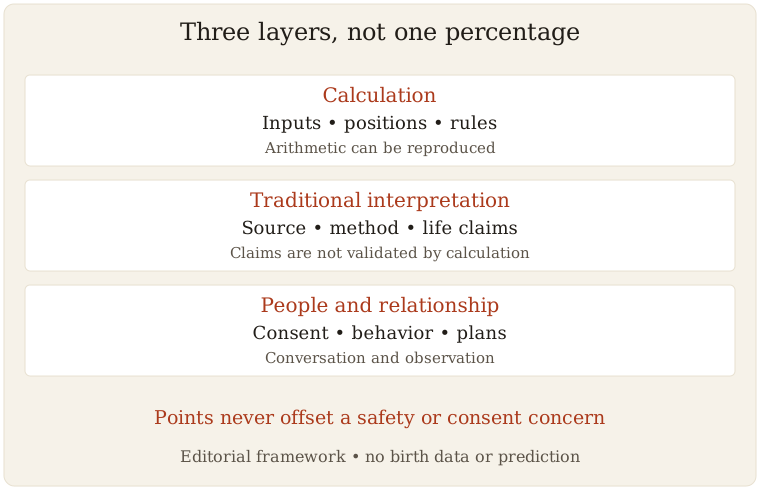
First comes calculation: the birth inputs, astronomical positions and declared classification rules. Second comes traditional interpretation: what a school says those positions signify. Third comes the relationship itself: people's wishes, conduct, circumstances and decisions. A calculation can be reproduced without validating its interpretation. An interpretation can be elaborate without observing actual behavior. Keeping three separate headings is more useful than merging everything under the word compatibility.
Our diagram illustrates that separation. It has no weights and no arrows implying that chart factors cause behavior. A lunar score belongs to the calculation column; a claimed marriage meaning belongs to interpretation; consent and actual agreements belong to direct conversation and observation. These are not three ingredients to average into a final percentage. A safety concern cannot be offset by adding astrological points in another column.
What a full astrological report may add
The consulted Acharya Anand website article describes a reading that goes from the eight-koota table to the seventh house and lord, Venus, Mars conditions and cancellations, D9 Navamsa, and both people's Vimshottari periods. We report that as the website's method, not a universal specification for every practitioner. Its proposed consultation duration is a service description, not evidence that spending longer makes a prediction reliable.
The page rejects deciding by a single total but makes strong claims that a lower score with particular placements can outlast a higher one. It also presents a consultation anecdote as support. Those are the author's assertions, not an outcome study established here. A more detailed story does not independently demonstrate that the added chart factors explain a relationship. We preserve the source's caution about totals without adopting its replacement promises.
The seventh house is a reference, not a character investigation
In the consulted practitioner method, the seventh house and its ruler are read for marriage topics. If you study that vocabulary, ask which chart and house convention are being used. A D1 seventh-house statement is not automatically a D9 seventh-house statement. An occupant, the sign on a house and that sign's traditional ruler are separate facts. A careful explanation identifies the factor rather than announcing that the marriage house is good or bad.
None of those labels establishes honesty, kindness or readiness for marriage. An empty seventh house means no displayed graha occupies it, not that a person cannot have a partner. A challenging-looking configuration does not identify an abusive person; a favorable-looking one does not establish safety. Those conclusions require real information about conduct. Do not use a chart to investigate someone in secret and then treat its story as their own testimony.
Navamsa does not reveal a hidden spouse dossier
D9 is a derived arrangement of natal positions under a declared mapping. It is not a second observation of a person's private life. A change in the natal coordinate can cross a division boundary, and uncertain birth time can affect the derived lagna and house references. Repeating an interpretation in D1 and D9 does not create two independent observations of relationship behavior. Both may come from the same original input and interpretive tradition.
The Acharya Anand article gives D9 substantial interpretive authority and describes it as revealing more than the surface score. We keep that claim attributed rather than calling it verified hidden knowledge. No derived chart establishes a future partner's sexual history, reproductive capacity, fidelity or moral worth. Questions about privacy and trust should not be answered by inventing a dossier from symbols. People are entitled to speak for themselves and to retain appropriate boundaries.
Mars matching is outside the thirty-six
Mokshology's method guide explicitly places Mars's house beside, rather than inside, its lunar comparisons. A broad report may therefore contain both an Ashtakoota total and a separate Mars section. This is a distinction in report structure. A high lunar total does not mathematically include a Mars calculation, and adding a Mars heading does not create a ninth koota or change the maximum from thirty-six.
Which houses and reference points count varies by method. Doosri Rai's comparison describes differing house lists, reference points, cancellation rules and software conventions across its selected traditions. This article does not choose a universal list or reproduce its population statistics as verified findings. Ask what the particular report used. A label such as Manglik is a traditional classification, not evidence that someone is dangerous or that a partner will be harmed.
Cancellations change a traditional reading, not biology
Practitioners sometimes call an exception a cancellation or parihara. It may alter a score, a warning or a verbal conclusion depending on the method. Keep those changes visible. If the raw points remain zero but the explanation says an exception applies, the report has not necessarily made an arithmetic error. It may be showing two layers. The reader should not have to guess whether the number or only the interpretation changed.
Sources disagree about which exceptions apply and how broadly. The Acharya Anand page presents Nadi exceptions confidently; Doosri Rai describes variation in cancellation traditions. We do not reconcile those into one mandatory rule. More importantly, none of these exceptions establishes removal of a genetic or fertility risk. A lunar category never constituted a clinical diagnosis. A medical question needs qualified care based on actual health and family-history information, with consent to discuss it.
Timing is another claim, not another guarantee
A report may compare dasha periods or discuss a wedding muhurta. Those are traditional time frameworks, not evidence that a relationship must begin, improve or end in a specified window. The consulted practitioner page proposes looking at several years of periods; that is its interpretive scope. It does not supply an independently checked prediction record here. A named period should not be mistaken for a contract, a deadline or permission from either person.
Keep real planning dates separate: availability, travel, notice periods, finances and any applicable legal requirements should be checked with their actual sources. Do not rush an engagement, abandon an opportunity or spend on a ceremony solely to fit a claimed favorable interval. If either person wants more time, that is a real decision input. It cannot be overruled by saying the calendar will not offer another chance.
Method labels matter more than confident typography
Two reports can disagree because they start with different birth inputs, ayanamsas or lunar categories. They can also agree on the positions and disagree on the interpretation. Preserve that distinction. Check the actual sign, nakshatra, pada and relevant coordinates before comparing totals. Then ask which table, house reference and exceptions were used. A red stamp or elegant PDF does not make an undisclosed rule more authoritative.
Mokshology acknowledges regional and edition differences and states which tables its service chooses. Doosri Rai compares several named rule sets, including software conventions. These are useful leads for understanding why output differs, not proof that every claimed lineage or historical attribution has been independently verified by us. A report that names its method is more inspectable. Inspectable does not mean scientifically validated; those are separate standards.
Uncertainty should not disappear during consultation
If birth time is approximate, keep the plausible interval in the record. Identify which calculations remain stable and which are unresolved instead of selecting one exact minute to fit a desired story. A retrospective narrative can be compelling without independently confirming a birth time. If the same events are used to choose the time and then validate the reading, the apparent confirmation is circular. Say what information remains missing.
Do not assume every planet changes its derived sign at the same rate as the ascendant. Nor should a rough average time scale become a universal boundary guarantee. Input sensitivity is a reason to qualify a result, not to demand costly precision without a supported route. A practitioner should be able to explain the uncertainty in plain words. A result marked uncertain may be more honest than a precise-looking verdict.
Actual relationship information asks different questions
Love is respect's green-flags guide describes communication, respect, honesty, trust, equality, boundaries and consent. These concern behavior people can discuss and observe. Equality includes having a say in major decisions; boundaries include respecting time and space apart. A chart score does not establish any of these. A favorable report cannot compensate for someone repeatedly ignoring a stated boundary.
The guide also notes that relationships and people's needs differ. This is not an invitation to excuse coercion as a different style. It means a couple should discuss what works for each of them rather than impose one template. Our suggestion is to record concrete examples: how a disagreement was handled, whether a no was accepted, how responsibilities were shared. Avoid replacing observation with either an astrological label or an idealized description of the partner.
Consent is specific and can change
The same organization's consent guide stresses communication, no assumptions and the ability to stop even after earlier agreement. Silence, uncertainty, pressure and fear are not a freely given yes. A relationship or previous intimacy does not supply permanent consent. Neither a family agreement nor a positive kundli report changes that principle. People remain free to set limits and change their minds.
A marriage decision and consent to a particular intimate activity are also different decisions. Saying yes to meeting a proposal does not mean agreeing to marry. Agreeing to marry does not mean consenting to every disclosure, purchase or sexual activity. Ask the person about the actual step rather than using a broad label such as the match is approved. Consent belongs to the person, not the report or the family member holding it.
Talk about daily life before treating the match as settled
The Gottman Institute's premarital conversation article suggests discussing romance, social life, work and money. Its prompts include children, beliefs, chores, competing work demands and financial goals. Use such questions voluntarily and at a pace both people can manage. A conversation list is not a diagnostic test, and answering it does not guarantee a lasting relationship. Its value here is making unspoken expectations discussable.
Our editorial worksheet separates shared plans, differences needing work and decisions not yet made. Where would you live? What happens if work requires a move? How would you handle caregiving or unequal income? Which family involvement is welcome and which is not? Do not turn every difference into a failure. The useful distinction is whether both can discuss it respectfully and whether an acceptable plan exists, not whether they give identical answers.
Privacy and family participation need permission
Birth records and relationship concerns may be personal. Ask before sending a partner's details to a practitioner or posting a report in a family group. Share only the information needed for the agreed purpose. A person may agree to a private cultural consultation without agreeing to public labels about fertility or character. Permission for one audience is not permission for every relative or a social-media post.
If families disagree about methods, name the disagreement without making the couple prove their worth. One household may follow a different reference point or an exception the other does not use. Explaining that difference can reduce confusion, but no calculation is required before a person can refuse a proposal. An optional consultation should remain optional. Pressure to buy a remedy or keep a concern secret is not made acceptable by a traditional label.
A longer report still needs honest limits
Before paying for a service, ask its scope, fees, privacy terms and what it cannot establish. Do not accept a guaranteed cure for a threatened marriage or a claim that delaying payment endangers a partner. If threats, monitoring or coercion are present, seek trusted support rather than another score. The relationship resources cited here are US-based; use appropriate local support for urgent safety or legal needs rather than assuming their contact routes serve every country.
Berkeley's Understanding Science reports that careful tests of specific astrological expectations did not support validity. More chart layers do not erase that evidence boundary. Read cultural methods if you wish, with clear inputs, attribution and uncertainty. Beyond points should finally mean more attention to the people, not more ways to overrule them. Their consent, actual conduct and choices remain essential even when every chart heading is filled.
Questions on this article
Does adding D9 validate marriage prediction?
No. D9 is derived from natal positions. Another chart layer is not independent evidence of relationship behavior or future outcomes.
Is Mars matching inside36 points?
No. The consulted methods discuss it separately from the eight-koota lunar total. A separate heading does not create a ninth koota.
Can a cancellation remove genetic risk?
No. A traditional exception changes a traditional reading, not a clinical finding. Lunar categories are not genetic or fertility tests.
Can a good report replace consent?
No. Consent is specific, voluntary and can change. A family agreement, score or earlier yes does not authorize every later step.


