Mangal Dosh Matching: Compare the Rules Before the Verdict
Five-house and six-house tests are not interchangeable. Keep the initial flag, exceptions and pairwise interpretation separate.
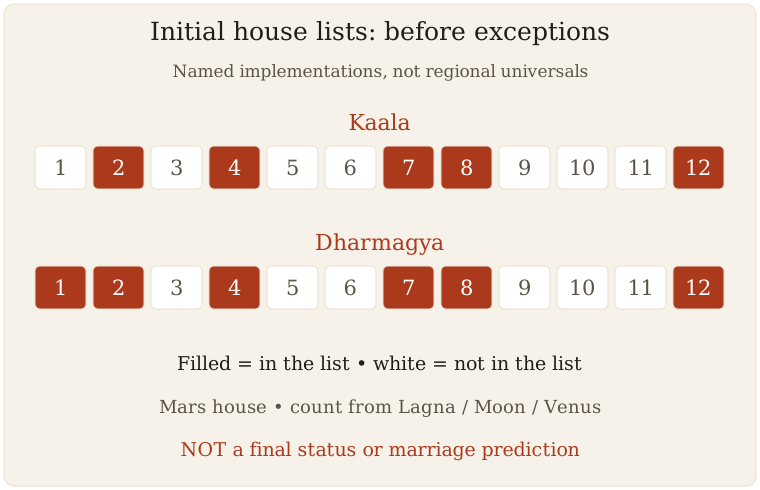
Mangal dosh matching is not the same question as finding Mars in a birth chart. A placement is an input; a Manglik label is the result of a chosen rule; a couple's compatibility is a further interpretation. Confusing those stages makes a calculator look more decisive than it is. This guide compares four modern explanations and implementations, keeps their disagreements visible, and shows how to read a matching report without turning a traditional condition into a verdict on a person. It complements our introductory Mangal dosh article. Nothing here calculates your chart, establishes a future spouse's health, or gives permission to pressure someone into marriage.
Start with the rulebook, not the label
Ask which houses are tested, where the count begins, what cancels a result, and whether the displayed status belongs to one chart or a pair. These are separate questions. Kaala Panchang's explanation checks five houses from Lagna, Moon and Venus. Dharmagya's software documentation includes six houses and implements its own stated cancellation set. A disagreement between their outputs need not mean the birth data changed. It may mean the rules changed. Neither output becomes a scientifically validated marriage prediction simply because its calculation is internally consistent.
A useful report therefore begins with its method in plain language. A badge saying only severe, partial or cancelled leaves important information hidden. Before sharing that badge with family, obtain the underlying placements and the exact reason for it. The reader should be able to distinguish a changed input from a changed interpretation.
Five houses and six houses are different tests
Kaala names the second, fourth, seventh, eighth and twelfth houses, explicitly excluding the first from its calculation. It attributes this choice to B. V. Raman's Muhurtha and a Kerala verse. Dharmagya lists the first, second, fourth, seventh, eighth and twelfth from Lagna, Moon and Venus. The difference is not a minor spelling preference: a first-house placement can enter one initial test and not the other. Our diagram compares only these published house lists. It does not compare every rule of either service or reproduce either service's complete output.
ePandit separately labels the first-house rule as North-Indian usage and its second-house row as Raman/South-Indian usage. These are that site's classifications, not a survey we conducted of every regional tradition. Avoid saying that everyone in a city or region follows one uniform rule. A named implementation is a firmer reference than a sweeping regional stereotype.
Count from an explicitly named starting point
In whole-sign counting, the reference sign is counted as one and the count proceeds through the signs. Lagna, Moon and Venus need not occupy the same sign, so Mars can have three different relative house numbers. Write each number beside its reference point. A report saying Mars is seventh without naming the reference is incomplete for this comparison. The numbering is relative to the selected starting sign; it does not mean Mars moved when the report switched from Lagna to Moon.
The formula used in our teaching arithmetic is the forward sign-index difference modulo twelve, plus one. This reproduces inclusive counting; it is not an ephemeris or a calculation of the ascendant. Birth time, place, zodiac convention and planetary coordinates are upstream inputs. If those inputs are unknown, a neat count cannot repair them. Keep uncertainty visible rather than filling a convenient time and presenting the result as known.
A small example that tests the house list only
Stipulate a reference point in Aries and Mars in Aries. Inclusive whole-sign counting gives house one. The five-house list printed by Kaala does not include that number; the six-house list printed by Dharmagya does. Now stipulate Mars in Taurus while keeping the reference in Aries: the number is two, included by both lists. If Mars is in Gemini, the number is three, included by neither. These three cases are arithmetic fixtures, not anyone's birth chart or a claim about an actual sky at a named moment.
Do not jump from the first fixture to a final Manglik verdict. Mars in Aries may also trigger an exception under a particular implementation. The example deliberately stops before exceptions so the difference between the initial house tests remains visible. A demonstration that silently applies a cancellation halfway through would fail to isolate what it claims to teach.
Cancellation rules must travel with their conditions
Kaala lists house-specific sign exceptions: the second in Gemini or Virgo, twelfth in Taurus or Libra, fourth in Aries or Scorpio, seventh in Capricorn or Cancer, and eighth in Sagittarius or Pisces. It also lists Mars in Leo or Aquarius as exempt in any house under the rules it attributes to Raman. These are reported traditional exceptions, not evidence that those placements protect a marriage. The house and sign belong together. Taking a sign from a seventh-house exception and applying it everywhere changes the rule.
ePandit helps expose this distinction by labelling its broader own-sign, exaltation or Jupiter-sign exception as an engine synthesis, looser than the classical sources it cites. That disclosure matters. An implemented convenience should not be described as an exact quotation from a book. A reader may choose to study the broader method, but should know that the extension is an extension.
A Jupiter aspect is a real implementation difference
Kaala explicitly says it does not apply aspect-only cancellations, including Jupiter's aspect without conjunction. ePandit's table includes a Jupiter-aspect cancellation but identifies it as engine synthesis, not Raman. Dharmagya's documented set also includes Jupiter's fifth, seventh or ninth sign-aspect. These are materially different instructions for a calculation. We preserve them without deciding that one website has established the universal rule.
When two reports differ, request the actual trigger line: a conjunction, an aspect, a house-sign exception or a pairwise rule. Do not accept the generic explanation that the whole chart was considered when the practical question is which condition changed the displayed status. A detailed explanation can be respectful of tradition while remaining inspectable. Reproducibility means another person can follow the stated procedure; it does not by itself demonstrate predictive accuracy.
Both partners Manglik: retain both individual records
Kaala describes a both-partners cancellation and attributes it to Raman. Dharmagya explicitly separates its single-chart function from its pairwise compatibility function: its example has two individually afflicted charts but an unafflicted pair result. That difference is useful for reading software. A pair result does not rewrite the original location of Mars in either chart. Keep both individual records alongside the comparison and the cancellation reason.
Nor does a traditional pairwise cancellation prove that two people will communicate well, want the same life or behave safely. A software field describing a pair as clean is vocabulary inside that implementation. It is not a medical clearance, a moral certificate or a reason to disregard either person's refusal. The matching process should never require one person to become an acceptable remedy for another person's chart.
Severity can be calculated before cancellation
Dharmagya states that its severity is computed before cancellations, so a chart may report purna while ultimately being unafflicted. A reader who sees only the severity word could misunderstand the final state. Ask whether a displayed grade is raw, post-exception, or pairwise. The same label can occupy a different stage in another service, so do not compare words alone as though they were standard units.
A clear report can use four separate lines: initial placement test, exceptions applied, individual final status, and pairwise result. This is our suggested reading format, not a claim that all traditions use those four headings. It makes intermediate calculations visible and prevents an alarming early-stage label from being circulated without the qualification printed later. If the provider cannot explain its stages, retain the uncertainty rather than inventing a meaning for the grade.
The consulted pages disagree about textual presence
ePandit makes a strong absence claim: it says a full-text review of both volumes of the Santhanam edition of Brihat Parashara Hora Shastra found no Kuja-dosha rule or associated house set. Skybond's explainer, however, attributes a Mars rule to chapter eighty, verse forty-seven of Santhanam's translation, with the twelfth, fourth, seventh and eighth houses from Lagna and a benefic qualification. These claims conflict at the level of the consulted modern pages.
We have not fetched and compared the underlying editions or manuscripts for this article. We therefore cannot resolve the conflict, declare the doctrine absent from every version, or present Skybond's attribution as our own direct reading. Preserve both source claims and the limit of our consultation. A confident page title or a numbered verse reference is a lead to verification, not proof that the other page has been disproved.
How to compare reports without shopping for reassurance
Collect the same birth inputs, the same reference-point positions, the house lists, and the cancellation reasons from each report. Then compare one stage at a time. If the planetary signs differ, investigate the inputs and calculation conventions before discussing interpretation. If the signs agree but the initial flag differs, compare the house lists. If the initial flag agrees but the final status differs, examine exceptions and pairwise conditions.
This method is more useful than obtaining more and more verdicts until one feels comfortable. It can reveal that the reports answer different questions rather than establish that one has uniquely discovered your future. Set a stopping point for the comparison. Repeated checking should not replace a conversation with the person involved or become a reason to keep postponing an otherwise wanted decision.
A frequency estimate is not an outcome study
ePandit reports sampling six thousand charts across ten Indian cities and gives different flagged proportions before and after its exception sets. Those are the site's reported simulation results. We did not rerun its sample, inspect its code, or independently verify the percentages. More importantly, counting how many charts satisfy a rule is different from testing whether that rule predicts marital outcomes. A common placement can be common without being harmful, and a rare placement can be rare without being protective.
For that reason we do not convert any reported prevalence into a risk of separation, violence or illness. Berkeley's Understanding Science discusses the gap between astrology's scientific-looking tools and evidence supporting its predictions. Our arithmetic diagram checks a rule definition. It supplies no missing outcome study and no probability of a successful marriage.
Use observed relationship behavior for relationship questions
Loveisrespect's green-flags guide emphasizes communication, respect, trust, honesty, equality, boundaries and consent. These are things people can discuss and observe. Do both people have an equal say about major decisions? Can either raise a concern without fear? Are boundaries respected when they are inconvenient? Those questions should not disappear because a chart comparison is favourable or because a traditional cancellation was found.
The resource is US-based; its contact details are not presented here as Indian local services. We use its relationship principles, not a claim that one website can assess your relationship remotely. If there is controlling or threatening behavior, describe the behavior itself. Do not excuse it as Mars, or assume that a non-Manglik label rules it out. A person's conduct remains their responsibility.
Consent cannot be supplied by a matching report
Loveisrespect's consent explanation concerns ongoing communication and freely respected boundaries. Pressure, guilt, fear and a claimed debt are not substitutes for permission. Applying that principle to marriage discussions, neither a family agreement nor a favourable chart replaces the people involved saying what they want. A person can decline a proposal even when every traditional calculation is favourable.
Likewise, agreeing to a chart reading is not agreeing to have private birth details circulated widely, to undergo a ritual, or to marry someone selected as a counterbalance. Ask separately before sharing personal data. A matching discussion is better when both people can stop it, ask questions and choose how much cultural practice they wish to include without being shamed for their answer.
Keep optional rituals separate from promised results
This article recommends no gemstone, paid ritual, symbolic marriage or purchase. The consulted rule explanations do not establish that paying for a remedy changes a future marriage outcome. If a family wants a harmless devotional observance for its own meaning, distinguish that preference from a demand made under fear. Ask what is being proposed, what it costs, whether participation is voluntary, and whether anyone is claiming a guarantee they cannot support.
No one should be hurried into spending because a report uses severe language. Nor should a ritual be made a condition for treating someone with dignity. The same caution applies to free-looking consultations that lead to escalating paid requirements. These are our consumer and consent cautions, not a new astrological cancellation list. The decision to spend or participate belongs to the person affected.
A careful conclusion is smaller than a verdict
A good summary might say: this named method checked these houses from these references; these exceptions fired; this is the individual status; this is the pairwise interpretation; these inputs remain uncertain. It should then stop short of asserting a spouse's fate or a guaranteed relationship outcome. That is a more honest answer than a single permanent label placed on a person.
For broader context, read our matching beyond points guide. Mangal dosh can be studied as a traditional rule system without giving it authority over someone's worth. The practical aim of comparison is to make assumptions visible, not to remove the couple's choices. Keep the rulebook open, the evidence boundary clear, and the people at the centre of the decision.


