Navratri: The Year Has Four Doors, and Nine Nights Stand Behind Each One
Navratri comes not once but four times a year; the nine-goddess list changes with region and sampradaya, the sources collide on day colours, and every region keeps its own rite. The four doors, the nine nights, the regional rites and the 2027 dates, with sources.
Nobody misses the nine nights of October, when pandals rise in the neighbourhoods, the garba beat carries through the streets, and an unbroken lamp burns in homes. But that is not the whole story. The tradition counts four cycles of nine nights in a year, not one; there is no single list of nine goddesses but several; and the day one source paints yellow, another paints royal blue. This piece opens up the full structure of Navratri: the year's four doors, the goddess lists of the nine nights and their disagreements, the order of rites from Ghatasthapana to Vijayadashami, the regional ways of keeping it, and the 2027 dates.
Everything below comes from four sources fetched on 31 October 2026: Drik Panchang's Navratri information page, the same site's Chaitra Navratri 2027 and Shardiya Navratri 2027 calendars for New Delhi, and Wikipedia's Navaratri article. Where a classical book is mentioned through one of them, such as the Mahakala Samhita or the Devi Mahatmya, that is an indirect citation and is marked as such; we did not open those books ourselves. Where two sources collide, both readings are given and the disagreement is left unresolved.
The year with four doors
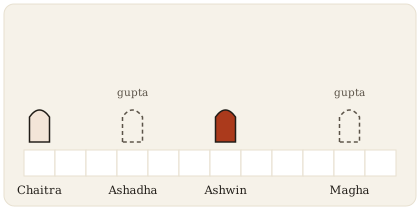
Navratri means nine nights, and the festival runs nine nights and ten days. But which nine nights? Drik Panchang, citing the Mahakala Samhita, writes that the Hindu calendar holds four Navratris: Sharad Navratri, Chaitra Navratri, Magha Gupta Navratri and Ashadha Gupta Navratri. That is the text's claim reaching us through Drik Panchang's page, an indirect citation. Wikipedia confirms the same frame: theoretically there are four seasonal Navaratris, in Magha (January-February), Chaitra (March-April), Ashadha (June-July) and Ashwin (September-October), but in practice it is the post-monsoon autumn Navratri of Ashwin, called Sharada Navaratri, that is celebrated with great pomp. Of the two gupta Navratris Wikipedia says they are observed regionally or by individuals; gupta simply means hidden, and these are Navratris of personal practice rather than public festivity.
Drik Panchang adds a curious ordering, again through the Mahakala Samhita: in each yuga a different Navratri leads. In Satya Yuga the spring Chaitra Navratri, in Treta the gupta Navratri of Ashadha, in Dvapara the gupta Navratri of Magha, and in Kali Yuga the Sharad Navratri of Ashwin. It can read strangely that the biggest festival today belongs to the most recent yuga, but that is precisely the text's explanation for why Sharad Navratri stands highest now. Both sources we read agree that of the four doors, the fourth is the one the whole country walks through today.
Nine nights, one goddess, several lists
That the nine nights belong to nine forms is clear in both sources. But which nine forms is something the tradition does not settle with one list. Drik Panchang first gives the list of the Shaiva sampradaya, the one mostly followed in North India, with a presiding deity for each tithi from Pratipada to Navami: Shailaputri, Brahmacharini, Chandraghanta, Kushmanda, Skandamata, Katyayani, Kalaratri, Mahagauri and Siddhidatri. This is the order printed in North India's calendars and puja books, and Wikipedia's day-by-day section walks exactly this sequence.
Now the part that ordinary introductions skip. On the same page Drik Panchang prints the list followed in South India: Vanadurga, Shoolini, Jataveda, Shanti, Shabari, Jwaladurga, Lavanadurga, Asuridurga and Deepdurga. Not one name overlaps with the northern list. And the page adds that the Vaishnava sampradaya and the Madhva sampradaya follow their own lists of nine deities worshipped during Navratri. In the source's own words, the list of goddesses worshipped during Navratri might differ depending on the region and the sampradaya. We do not try here to crown one of two lists as the real one; both are printed traditions, and the disagreement is recorded as it stands. The list that runs in your family is your list.
Wikipedia brings a few forms of the northern sequence into close view. The first day's Shailaputri, daughter of the mountain, is Parvati as the daughter of Himavan, riding the bull Nandi with a trishula in her right hand and a lotus in her left; the article also calls her a reincarnation of Sati. The seventh day's Kalaratri is the most ferocious form; the legend says Parvati shed her pale skin to kill the asuras Shumbha and Nishumbha. The ninth day's Siddhidatri sits on a lotus with four hands and is believed to bestow all eight siddhis, anima, mahima, garima, laghima, prapti, prakamya, isitva and vasitva, and is linked to the Ardhanarishvara form. This day-wise portraiture is Wikipedia's; several of its lines there are marked as needing citation, so read it as a popular introduction, not as verified textual description.
The matter of colours, where the sources collide
The day colours of Navratri are a favourite of calendars and social media these days, and here we found a clean collision of sources. Wikipedia's day-by-day section gives the first day, Shailaputri's day, the colour yellow, depicting action and vigor. Drik Panchang's Chaitra Navratri 2027 calendar prints for that same first day, 7 April 2027, the day of Ghatasthapana and Shailputri Puja, the colour royal blue. Same goddess, same tithi sequence, two different colours. And the sequences do not converge later either: Wikipedia assigns the seventh day, Kalaratri's, royal blue, while Drik Panchang's 2027 calendar marks Maha Saptami, 13 April, as red.
Both lists are honest in their own place, and there are probably different conventions behind them, one tying colours to the goddess of the day and another following a running calendar convention, but the pages we read do not state the source of their colour order, and several of Wikipedia's colour sentences carry a citation-needed flag. So we do not force a resolution here: if you keep the custom of wearing the day's colour, know that this is a modern popular layer, and that two major sources can name different colours for the same day. Whichever convention you follow, read its calendar.
The three Kalpa accounts of Mahishasura, and the Akal Bodhan
The founding story of Navratri is the slaying of Mahishasura, but here too the texts do not speak in one voice. Drik Panchang writes that different religious texts name a different form of Durga as the slayer: as per the Rambha Kalpa, the eighteen-handed Ugrachandi killed Mahishasura; as per the Neelalohita Kalpa, the sixteen-handed Bhadrakali; and as per the Shwetavaraha Kalpa, the ten-handed Katyayani. Three Kalpa texts, three forms. The page goes on to say that most texts agree it was Mahishasura who was killed by one of the ferocious forms of Durga, and that this is why Navratri is celebrated as the victory of good over evil. All of these Kalpa references reach us indirectly, through Drik Panchang.
From the same page comes the second story, the one that became the soul of Bengal's Durga Puja. It is believed that Lord Rama worshipped Goddess Durga during Sharad Navratri: on the advice of Brahma, before waging war on Ravana, he invoked the goddess and sought her blessings. Because this invocation came during her sleeping period, ahead of her time, the untimely awakening of Durga in Sharad Navratri has since been known as the Akal Bodhan of the goddess. Wikipedia shows the Akal Bodhan still inscribed in the Shashthi rites of Bengal's Durga Puja today.
The beginning: Ghatasthapana
The first rite of Navratri is Ghatasthapana, and in Drik Panchang's 2027 calendars both Chaitra and Sharad Navratri open with it on day one. From Wikipedia's Uttar Pradesh section comes the household picture of the rite: a clay or metal pot is filled with water, topped with a coconut and mango leaves or barley, and set on a small platform covered with soil in which barley seeds are sown. Beside the pot an akhand jyot, an oil lamp, is lit and kept burning continuously for nine days. The pot is described as a representation of the universe, the flame as the sign of Durga's eternal energy.
In Bihar, Jharkhand and Purvanchal the first day has its own form of the same rite, the Kalash Yatra: devotees travel to a temple or a sacred river to collect water in a kalash, rice and grains are placed on a banana leaf, a mound of soil and sand is raised and soaked barley sown in it, and the filled kalash is carried home on the head. A daily homa across the nine days is recorded there too. This is the same Ghatasthapana, spoken in the region's own dialect. And the barley sown on day one returns on day ten: in the Bihari tradition, on Dussehra morning the grown barley is cut, bundled, and tied into the hair of men and boys as jayanti, and only then does the ban on travel lift, which is why Dussehra there is also called Jatra, the journey.
The eighth, ninth and tenth days
The closing stretch of Navratri thickens over three days. In Drik Panchang's Chaitra 2027 calendar, the eighth day, 14 April, carries several names at once: Durga Ashtami, Mahagauri Puja, Annapurna Ashtami and Sandhi Puja, whose time that day is marked from 2:59 PM to 3:47 PM. Sandhi Puja is the worship of the junction, the seam between Ashtami and Navami, and it holds a special place in the Bengali tradition. On Ashtami or Navami comes the Kanya Puja, also called Kumari Puja: Drik Panchang counts it, with the Jyoti Kalash, among the chief Navratri rituals.
In Punjab the same rite is called kanjak, and Wikipedia's description gives it flesh: on the eighth day young girls are invited home, usually nine of them, standing for the nine forms of Durga, and they are fed a prasad of puri, kala chana and sooji halwa. The hosts tie a sacred red thread on the girls' wrists and gift red bangles, a red bindi and the veil called mata di chunni, and themselves fast that day, breaking it only after the girls have been fed and gifted. The same Kanya Puja is recorded in Bihar as Kumari Bhojan on the eighth day.
Then the tenth day, Vijayadashami. Per Wikipedia, in the southern, eastern, northeastern and some northern states this is the day Durga Puja ends, the remembrance of Durga's victory over Mahishasura and the restoration of dharma; after the sindoor khela and an emotional farewell the images are immersed in a river or the sea. In the north the same day burns the effigy of Ravana with fireworks, the sign of evil destroyed. In Karnataka the ninth day is Ayudha Puja, in which, per Drik Panchang, weapons were once worshipped and today vehicles and tools receive the rite in symbolic form. And keep one difference of sequence in mind: Chaitra Navratri closes on Rama Navami, as Wikipedia states plainly, so the spring cycle's peak is not a farewell to Durga but the celebration of Rama's birth; Drik Panchang's 2027 calendar marks 15 April as Rama Navami.
Every region keeps it in its own way
In Gujarat the heart of Navratri is the garba that follows the arti, and Wikipedia's description circles the garbo around which the dance turns: a symbolic clay pot, described as a remembrance of the womb of the family and the universe. Traditional garbo pots carry twenty-seven holes arranged in three rows of nine, standing for the twenty-seven nakshatras, with the total of one hundred and eight reached through the four charans of each; the lamp burning inside scatters its light through the holes, which is read as the many souls coming from the one Atman. It is a lovely thing that a festival that never enters nakshatra-counting carries the whole nakshatra wheel inside its dancing pot. The same article records Gujarat's fasting rite too: some keep a day, some a partial fast across the nine, giving up grains or taking only liquid foods. We record the fast only in the form the sources describe it; there are no health or outcome promises here.
In the east and northeast, Navratri's other name is Durga Puja itself. Per Wikipedia the festival begins with Mahalaya, when Bengali, Assamese and Odia families remember their dead and prepare for the advent of the warrior goddess. On Shashthi the goddess is welcomed, on Saptami, Ashtami and Navami Durga is worshipped with Lakshmi, Saraswati, Ganesha and Kartikeya, and at the centre of the recitation stand the Durga legends of the Devi Mahatmya, this reference too is indirect, we did not open the Devi Mahatmya ourselves. The clay images are worked on for months, the potters of Kolkata's Kumortuli are renowned for the craft, and on Vijayadashami, after the immersion procession, married women play the sindoor khela, anointing each other's faces with vermilion and exchanging sweets.
In Uttar Pradesh the stage of Navratri is the Ramlila: in Braj, Doab, Kannauj and Awadh, episodes of the Rama-Ravana story are enacted by teams of artists, and Wikipedia records that this tradition of festive performance was inscribed by UNESCO in 2008 as Intangible Cultural Heritage of Humanity, with songs, narration, recital and dialogue based on the Ramcharitmanas. In the south the rite is altogether different: per Drik Panchang, Navratri in South India is synonymous with Bommala Koluvu or golu, the festival of dolls, where dolls are displayed on stepped platforms, and the nine days split into three equal parts, the first three for Durga as Kali, the next three for Lakshmi, the last three for Saraswati.
The 2027 dates
From Drik Panchang's New Delhi panchang, the dates of both open Navratris in 2027. Chaitra Navratri: Ghatasthapana on 7 April 2027, a Wednesday, and the ninth day, Rama Navami, on 15 April, a Thursday. Shardiya Navratri: Ghatasthapana on 1 October 2027, a Friday, Navami on 8 October, and Vijayadashami on 9 October, a Saturday. We did not fetch the dates of the gupta Navratris this time, so we do not print them here. And the standing caution: a tithi is bound to the motion of the Sun and Moon, not to the calendar day, so a change of panchang or city can shift any of these by a day. Your own town's panchang is the final paper.
A year with four doors
Reading Navratri through, one thing becomes plain: it is not a festival but a system. Four times a year the same nine-night fortnight arrives, twice in the open, twice in hiding. The one goddess has so many forms that the northern and southern lists share not a single name, and yet both lists are of nine, and both are of Durga. Two major sources name different colours for the same day, and the festival does not stop for it. The regions change so much that in one place dolls are arranged on steps, in another clay images sink into the river, in a third Ravana burns, and in a fourth the night is danced away around a pot with twenty-seven holes, and everywhere it is the same nine nights. Perhaps that is why the tradition gave it not one door but four: whatever you miss returns with the next season.
Questions on this article
How many times does Navratri come in a year?
Four times. Drik Panchang, citing the Mahakala Samhita, counts four: Sharad (Ashwin), Chaitra, Magha Gupta and Ashadha Gupta, and Wikipedia records the same four seasonal Navaratris. In practice the autumn Sharad Navratri is the one celebrated at scale; the two gupta Navratris belong to regional or individual practice.
Is the list of the nine goddesses the same everywhere?
No. The Shaiva list current in North India runs from Shailaputri to Siddhidatri, but Drik Panchang gives an entirely different southern list, Vanadurga through Deepdurga, and notes that the Vaishnava and Madhva sampradayas keep their own lists as well. The source itself says the list varies by region and sampradaya; we recorded the disagreement unresolved.
When is Navratri in 2027?
Per Drik Panchang’s New Delhi calendar, Chaitra Navratri runs 7 April 2027 (Wednesday, Ghatasthapana) to 15 April (Rama Navami), and Sharad Navratri begins 1 October 2027 (Friday, Ghatasthapana) with Vijayadashami on 9 October (Saturday). Tithi boundaries can shift a date by a day between panchangs and cities, so read your own city’s panchang.
Why is a tenth day added after the nine nights?
The tenth day is Vijayadashami. Per Wikipedia, in the south, east and northeast it marks Durga’s victory over Mahishasura and the close of Durga Puja, when the images are immersed; in the north the rite is the burning of Ravana. Chaitra Navratri closes on Rama Navami instead, so the spring cycle’s tenth colour is different.