Yoga: The Sun-Moon Sum, the Panchang's Latest-Arriving Limb
Where the tithi subtracts, the yoga adds: the arithmetic of this 27-part counting unit, its late arrival in the almanac, the twenty-seven names, the truth about the auspicious column, and a separate twenty-eight-yoga world.
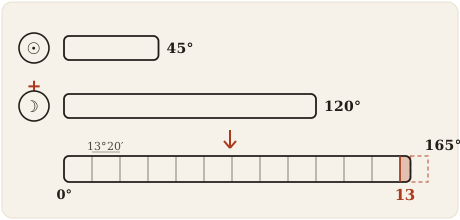
Four of the panchang's five limbs are direct astronomical measurements: the tithi is the difference between the Moon's and the Sun's longitudes, the nakshatra is the Moon's position, the vara is a count of days, and the karana is half a tithi. The fifth limb, the yoga, stands apart, because it is the only limb produced by addition rather than subtraction. The definition on Wikipedia's Panchangam page is plain: the yoga is the ending moment of an angular relationship between the Sun and the Moon in which their longitudes are added, apparent Moon plus apparent Sun; one yoga equals a sum of 13 degrees 20 minutes, and exactly 27 yogas fit into 360 degrees. So where the tithi asks how far the Moon has pulled ahead of the Sun, the yoga asks how much road the two have covered together.
This article is the full story of that single addition: how the number is produced, a worked example, then an unusually honest admission written plainly in our sources, that this sum does not point at anything real in the sky; then the natural question of when the fifth limb entered the panchang, because its history begins centuries after the other four; the complete table of the twenty-seven names with their meanings; the true status of the auspicious-inauspicious column; how long each yoga lasts; and finally a separate, twenty-eight-yoga system printed alongside in some almanacs that is deliberately disconnected from astronomy.
What the number actually is
The computation has three steps. Step one: take the nirayana, that is sidereal, longitudes of the Sun and the Moon. Step two: add them; if the sum comes to 360 degrees or more, subtract 360 so the figure stays between 0 and 360. Step three: place this sum inside one of 27 equal intervals of 13 degrees 20 minutes; whichever interval holds the figure is the running yoga, beginning with Vishkambha and ending with Vaidhriti. This is the method on shastrapanchangam's yoga page, and Wikipedia's Nityayoga page carries the same definition, writing 13 degrees 20 minutes also as 800 minutes. Since 27 times 13 degrees 20 minutes makes exactly 360 degrees, the sum returns to zero at the ending moment of the twenty-seventh yoga and the count starts afresh from Vishkambha.
Two technical points deserve recording here. First: ayanamsha is applied to both longitudes before they are added; shastrapanchangam writes explicitly that a different ayanamsha convention can change the yoga's ending time, so comparisons between calendars should use the same convention. Second: a yoga's change is a moment, not a day. As the Sun and the Moon move, their combined longitude enters the next interval; that crossing is the ending time the daily panchang page prints. That is why a clock time always appears beside the yoga's name in the almanac: the name states a condition, the time states its limit.
A worked example, our own arithmetic
Run the rule over an invented moment. Suppose at some instant the Sun's sidereal longitude is 45 degrees and the Moon's is 120 degrees. The yoga sum: 45 plus 120, that is 165 degrees; below 360, so nothing to subtract. Now divide 165 into the 13-degree-20-minute intervals: twelve full intervals carry us to 160 degrees, the thirteenth interval spans 160 to 173 degrees 20 minutes, and 165 falls inside it. The thirteenth yoga in the list is Vyaghata, so Vyaghata yoga is running at that instant. Another 8 degrees 20 minutes remain before the thirteenth interval closes; the combined sky speed of the Sun and the Moon is about fourteen and a half degrees per day, so this yoga would end roughly fourteen hours later. This whole example, its figures and its hour estimate, is our own arithmetic re-running the rule stated in the sources above; it is not a real moment quoted from any panchang page.
An honest admission: where is this in the sky?
Compare the tithi: the new moon and the full moon are visible in the sky; the nakshatra is the star group in front of the Moon. The yoga has no such object. Wikipedia's Nityayoga page states this with unusual openness: the astronomical yogas appear to be in no way related to any astronomical phenomena, and it quotes S. B. Dikshit's Bharatiya Jyotish Shastra observing that it is not known what planetary position in the sky is indicated by yoga, and that it is useful only in astrology. In other words, both bodies in the addition are real, but their sum rests on no point in the sky; that combined angle of 165 degrees gestures at no star, no planet, no event. It is a counting device, a reckoning grid, and our sources do not hide this. That is the healthiest starting point for reading the yoga: understand it not as an event of astronomy but as a counting unit of tradition, whose role is defined inside the method of muhurta selection.
The limb that arrived last
The yoga's history breaks one assumption about the panchang: its five limbs are not the same age. The audit given on Wikipedia's Nityayoga page, resting on Dikshit's study, runs as follows. Varahamihira's Pancha-siddhantika, composed around 505 CE, gives methods for calculating nakshatras and tithis but no method for yogas; his Brihat Samhita discusses the effects of nakshatras at length yet stays silent on the effects of yogas. From these signals the page concludes that the yoga concept did not exist in Varahamihira's time. Further on: the single verse referring to yoga in Brahmagupta's Brahmasphutasiddhanta of about 628 CE is shown by internal evidence to be a much later interpolation; the couplet on yoga in his Khandakhadyaka of about 665 CE has likewise been determined a later interpolation. The first detailed mention appears in Lalla's Shishyadhivriddhidatantra, composed around 720 to 790 CE; and the Surya Siddhanta, dated to the fourth or fifth century but believed to have undergone a substantial revision around 800 CE, presents the same list of all 27 yogas, with calculation methods, that modern panchangs use. From all this the page concludes: the yoga concept arose sometime around 700 CE and became an integral part of the panchang only after that, centuries later than the other four limbs.
Where the idea came from: two hypotheses
So late an arrival lifted the idea from somewhere, and the Nityayoga page records two hypotheses, both unresolved. The first is the mahapata hypothesis: the page explains that when the Sun and the Moon stand in parallel declination, the sum of their longitudes is 180 degrees; this happens twice in every lunar month, and those two moments are called vyatipata and vaidhriti, the two mahapatas. Finding these mahapatas already required computing the sum of the longitudes; per Dikshit's review, that very exercise led to the yoga concept, just as computing the difference had produced the tithi. The page adds a subtle piece of evidence: the word vyatipata occurs in two verses of the Brahmasphutasiddhanta, but the context makes clear it means this mahapata moment, not the seventeenth yoga of the list. The second hypothesis belongs to Shakti Dhara Sharma's 1998 study, under which the astronomical yoga was born from attempts to predict eclipses. Which of the two is right, the page does not decide; neither do we.
The twenty-seven names and their meanings
The list of yogas is a list of names, and the names are mostly ordinary Sanskrit words. The table below gives Wikipedia's Nityayoga list with that page's own glosses; the order is the order of the computed intervals, from Vishkambha in the first interval to Vaidhriti in the twenty-seventh.
| No. | Yoga | Literal meaning |
|---|---|---|
| 1 | Vishkambha | Support or obstacle |
| 2 | Priti | Kindness, fondness |
| 3 | Ayushman | Long lived |
| 4 | Saubhagya | Good fortune |
| 5 | Shobhana | Prosperity, splendor |
| 6 | Atiganda | Having large cheeks or temples |
| 7 | Sukarma | Virtuous |
| 8 | Dhriti | Courage, determination |
| 9 | Shula | Spear, pike |
| 10 | Ganda | Spot, mark, pimple |
| 11 | Vriddhi | Growth |
| 12 | Dhruva | Unchangeable, constant |
| 13 | Vyaghata | Hindrance, defeat |
| 14 | Harshana | Thrilling |
| 15 | Vajra | Diamond, thunderbolt |
| 16 | Siddhi | Success |
| 17 | Vyatipata | Calamity |
| 18 | Variyana | Very welcome |
| 19 | Parigha | Obstacle |
| 20 | Shiva | Benign, gracious |
| 21 | Siddha | Accomplished |
| 22 | Sadhya | Amenable |
| 23 | Shubha | Auspicious |
| 24 | Shukla | White substance |
| 25 | Brahma | Supreme spirit, priest |
| 26 | Indra | Chief |
| 27 | Vaidhriti | Great calamity |
One caution while reading the meaning column: these glosses are source-specific. For Atiganda, Wikipedia writes having large cheeks or temples, while kaalpanchang's list explains it as great danger; for Vishkambha one page says support or obstacle, the other pillar; for Ganda one says spot or mark, the other knot or danger; for Variyana one says very welcome, the other comfort and ease. These divergences are natural for polysemous Sanskrit words, and neither source explains its choice; both readings are recorded as they stand.
Who attached the auspicious-inauspicious column
On panchang pages every yoga name carries an auspicious or inauspicious stamp; kaalpanchang's list labels each yoga explicitly, calling Priti, Ayushman, Saubhagya, Shobhana, Sukarma, Dhriti, Vriddhi, Dhruva, Harshana, Siddhi, Variyana, Shiva, Siddha, Sadhya, Shubha, Shukla, Brahma and Indra auspicious, and Vishkambha, Atiganda, Shula, Ganda, Vyaghata, Vajra, Vyatipata, Parigha and Vaidhriti inauspicious. The status of this column needs understanding. Nowhere does the computation carry this distinction: the arithmetic that builds the 13-degree-20-minute intervals has no input telling it which interval is auspicious; the classification is tradition's assessment, not an output of the sky math. Vajra offers a glimpse of this: its literal meanings are diamond and thunderbolt, both positive-sounding things, yet kaalpanchang tags it inauspicious; the column follows tradition's own list, not the word's meaning. shastrapanchangam also states the limit of use: in traditional muhurta selection, yoga is considered together with the other limbs of the panchang and the nature of the intended activity, never alone. So treating one inauspicious yoga as the verdict on a day misuses the very method the list belongs to.
How long does a yoga last
A yoga is not a fixed, day-like span. Wikipedia reproduces the length table from Sewell and Dikshit's The Indian Calendar: the mean length of a yoga is 22 hours 35 minutes 44.7 seconds, the greatest 24 hours 36 minutes 24 seconds, and the least 20 hours 52 minutes 58 seconds; and the full 27-yoga cycle totals 26 days 10 hours 12 minutes 47 seconds. So a yoga runs a little short of a day on average, yet any single yoga can run some two and a half hours shorter or longer. The table does not say why the length varies; our explanation is that the sky speeds of the Sun and the Moon are not constant, so the growth rate of their sum keeps changing, and that remark is ours, while the source supplies only the measurements. The practical consequence matches the tithi's: a yoga can turn at any hour of the day, and the printed ending time is the real information to read.
Another system exists: twenty-eight yogas
A second, entirely separate yoga system is current in India, and confusing the two is a common panchang-reading mistake. Per Wikipedia, this system has 28 yogas instead of 27, beginning with Ananda, with different names and different rules, given by Sripati's Jyotisha Ratnamala. Its rule runs on the weekday and the nakshatra, not on any astronomical sum: it assumes a cycle of 28 nakshatras that includes the twenty-eighth nakshatra Abhijit; for instance, on a Sunday with Ashwini nakshatra the yoga is Ananda, with Bharani it is Kaladanda, and so on in sequence; on Monday the count begins from Mrigashira, and each weekday starts from a different nakshatra position. The page itself states plainly that this system has absolutely no connection whatsoever with astronomical phenomena, because the week has no definable relation to the motion of the Sun or the Moon, the same fact that stood at the center of our vara article; and this system finds no mention in the Surya Siddhanta. Some Hindu calendars print the yogas of both systems side by side, and in the page's own words these twenty-eight are only of astrological interest. The reading lesson: when a panchang page shows a yoga, first check whether the listing is the twenty-seven-name sidereal-sum system or the weekday-based twenty-eight; the two share some names, Vajra, Siddhi and Shubha appear in both, but their order and meaning machinery differ.
How to read the yoga on a panchang page
Practical reading is three questions. First: which yoga is running right now and what is its ending time? The time printed beside the name is the limit; after it, the next yoga begins. Second: if you are comparing yoga times across two almanacs or two websites, do both use the same ayanamsha? shastrapanchangam warns that an ayanamsha difference can shift the ending time, and panchangya writes on its method page that every value there is computed at the moment you ask, from an open-source engine based on the VSOP87 planetary theory, not copied from printed tables; so two sites can legitimately differ by a few minutes through a difference of convention, and that difference is a matter of convention, not of error. Third: which system is the page showing, the twenty-seven or the twenty-eight? As shown above, the two are separate worlds. Only after these three comes the fourth, astrological question, the auspicious-inauspicious column; and there too, remember that within the muhurta method the yoga is not a lone factor but one factor alongside tithi, vara, nakshatra and karana, and the nature of that column is set by tradition, not by arithmetic.
In sum, the yoga is the panchang's most openly artificial limb, and that is exactly its lesson: a counting unit that displays no object in the sky, that entered the almanac centuries after its companions, and whose value lies within the method that uses it. Learn the computation, read the ending time, identify the system; the rest belongs to tradition and to your own judgment.


