Purnima: Significance, 2027 Dates, Fasting Rule and Festivals
The full moon, the festival year's summit: the exact 2027 Delhi computation, the Madhyahna fasting rule, every month's festival from Holi to Kartika, with sources, and an honest-limits note.
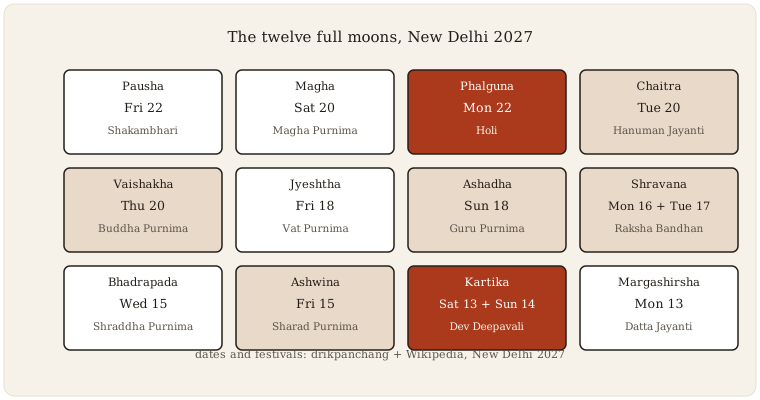
Once a month the moon fills its circle, and the Hindu calendar treats the fullness as a summit. Purnima, the full moon, is the fifteenth tithi of the bright fortnight, the night the moon shows the earth everything it has. Where Amavasya is the month's full stop, Purnima is its crest: the day the purnimanta month ends, the day the Satyanarayana katha is heard, and the day on which a remarkable share of the festival year, Holi, Guru Purnima, Raksha Bandhan, Sharad Purnima, Kartik Purnima, Buddha Purnima, is pinned. This guide walks the observance as the sources give it: the word and the astronomy, the two calendar systems and one flagged seam in the source, the full moon's rites and its own almanac rule, the complete New Delhi list for 2027 with its two double months, the festival map month by month, the kathas the almanac carries, and an honest-limits note at the end.
The backbone is two sources, both fetched directly for this article: Wikipedia's Purnima article for the etymology, the astronomy and the festival map, and drikpanchang's 2027 Purnima dates page for New Delhi for every date, tithi span and fasting rule here. Where the sources disagree with the reader's expectation, or with themselves, the disagreement is kept standing and named.
The word and the astronomy
The Sanskrit is transparent: purni, full or complete, plus ma, moon. The astronomy behind it, as Wikipedia lays out, is the mirror of the new moon's: at Purnima the sun, earth and moon stand in syzygy with the earth in the middle, the sun and moon opposed at one hundred eighty degrees of ecliptic longitude, so the lunar disk shows one hundred percent illumination. The same alignment pulls the oceans into spring tides, the article notes, and when the alignment is exact it can produce a lunar eclipse, the earth's shadow falling on the full moon's face. In the tithi counting of the lunar calendar, Purnima is the fifteenth tithi of the Shukla Paksha, and each lunar month runs twenty-nine or thirty days, so the full moon, like the new, drifts through the civil calendar month by month.
Two calendars again, and the same flagged seam
The amanta-purnimanta fork of this collection's Amavasya guide returns here from the other side. In the purnimanta system, followed mostly in North India, the month ends on the full moon day: Purnima is the month's last day. In the amanta system, followed mostly in the South and officially by the Indian national calendar, the month ends on the new moon, and Purnima falls mid-month. The month-names therefore sit one apart between the systems for every full moon, exactly as they do for every new moon, and this guide keeps both conventions standing rather than choosing one.
And the Wikipedia article carries the same seam its Amavasya twin carries: it glosses the fortnights as Shukla Paksha, waning moon, and Krishna Paksha, waxing moon, which is the reverse of the standard meaning. Shukla is the bright, waxing fortnight that Purnima crowns; Krishna is the dark, waning one that Amavasya closes. As in the Amavasya guide, we report the article's gloss as printed, note that it sits crosswise with the universal usage, and use the standard meanings throughout. The dates are unaffected, since they come from the almanac.
The almanac's own rule: Madhyahna and the polluted tithi
Drikpanchang's page carries a fasting rule specific to the full moon, stated with unusual firmness, and it deserves quoting in full sense. Purnima fasting, the page says, might be observed either on the Purnima day or one day before it, on Chaturdashi, depending on when the tithi starts. The rule: the fast moves to Chaturdashi only when the Purnima tithi begins during the Madhyahna period, midday, on the previous day. If Chaturdashi prevails beyond Madhyahna it is held to pollute the Purnima tithi, and that Chaturdashi should not be taken for the fast even if Purnima prevails during the evening. There are no two opinions on this rule, the page says, and DrikPanchang lists its Purnima fasting days accordingly. The same page adds a practitioner's caveat: this list of Purnima days may not be suitable for the Shri Satyanarayana Puja, which might be observed on the same day or one day before, and it points the reader to its own Satyanarayana fasting list. It also names the southern form: in South India the day is Pournami or Pournima, the fast is Pournami Vratam, observed from sunrise until the sighting of the moon, and the fasting days might not be the same for two locations, so the location should be set before noting dates. All of that is the almanac speaking, and we attribute it to the almanac.
What the day carries: katha, shraddha and the moon
The observances the sources attach to the day form three strands. First, the fast and its story: drikpanchang records the Purnima Vrat Katha of the Brahmin Dharmadatta of the city of Vidisha, a story from the Bhavishya Purana recited during the Battisi Purnima Vrat, the vow of thirty-two full moons, and notes that the katha is recited and heard to receive the full benefit of the fast. Second, the ancestors: the full moon, like the new, takes a shraddha. Drikpanchang lists the Kutup Muhurta, the Rohina Muhurta and the Aparahna Kaal for the Purnima Shraddha, and names the day Shraddhi Purnima or Proshthapadi Purnima Shraddha; Wikipedia adds that in the month of Bhadrapada the day is Shraddha Purnima, when the Uma Maheshvara Vrata is performed for Shiva and Parvati, seeking marital harmony and spiritual merit, and the Shakra Vrata for Indra, for prosperity and the well-being of children. Third, the moon itself: on Sharad Poornima, the Ashvin full moon that ends the monsoon, Wikipedia records that the gods are worshipped along with Chandra, the moon deity, and offered flowers and sweets, and drikpanchang carries the Sharad Purnima legend of the two sisters, the elder who kept the fast with full devotion and the younger who did not, whose children did not survive until the glory of the fast restored them. That is the almanac's summary of the katha, reported as such.
2027, New Delhi: the year in twelve full moons
These are drikpanchang's 2027 Purnima dates for New Delhi, with the tithi spans the almanac prints. The year opens on Friday, 22 January, the Pausha Purnima, tithi from 9:29 PM on the 21st to 5:46 PM on the 22nd, the full moon of Shakambhari Purnima, the culmination of the nine-day Shakambhari Navaratri. Saturday, 20 February is the Magha Purnima, 7:59 AM to 4:52 AM the next morning. Monday, 22 March is the Phalguna Purnima, 6:21 PM the previous evening to 4:13 PM, and this is the full moon of Holi, the night of Holika Dahan before the colours. Tuesday, 20 April is the Chaitra Purnima, 4:51 AM to 3:56 AM the next day, Hanuman Jayanti. Thursday, 20 May is the Vaishakha Purnima, 4:02 PM on the 19th to 4:28 PM, Buddha Purnima. Friday, 18 June is the Jyeshtha Purnima, 4:34 AM to 6:13 AM the next morning, Vat Purnima, the day of Savitri's banyan.
Sunday, 18 July is the Ashadha Purnima, 6:48 PM the previous evening to 9:14 PM, Guru Purnima, Vyasa Purnima, the day of teachers. August then prints the year's first double: Monday the 16th and Tuesday the 17th are both listed for the Shravana Purnima, one tithi span, 10:28 AM on the 16th to 12:58 PM on the 17th, behind both, and this is the full moon of Raksha Bandhan, of Upakarma and the changing of the sacred thread, of Narali Poornima's coconuts offered to Varuna on the western coast. Wednesday, 15 September is the Bhadrapada Purnima, 2:48 AM to 4:32 AM the next morning, the Shraddha Purnima and the Buddhist Madhu Purnima. Friday, 15 October is the Ashwina Purnima, 6:49 PM the previous evening to 7:16 PM, Sharad Purnima, the full moon that ends the monsoon, when the moon itself is worshipped. November prints the second double: Saturday the 13th and Sunday the 14th for the Kartika Purnima, tithi 9:55 AM on the 13th to 8:55 AM on the 14th, the full moon of Dev Deepavali, of Karthika Deepam, of Guru Nanak Jayanti and the Jain commemoration of Mahavira's nirvana. And the year closes on Monday, 13 December, the Margashirsha Purnima, 11:54 PM on the 12th to 9:38 PM, Datta Jayanti, the birth of Dattatreya.
The festival map: every month has its full moon
Wikipedia's month-by-month catalogue shows how much of the year the full moon carries. In Phalguna, Holi: the bonfire of Holika Dahan the night before, the story of Prahalada saved from the fire the demoness Holika burned in instead, and the next day's coloured powders, each colour with its meaning; in Tamil country the same season holds Panguni Uthiram, when the Uttiram nakshatra meets the Purnima of the month of Panguni and the temples celebrate the divine marriages of Shiva and Parvati, Murugan and Deivanai, Vishnu and Lakshmi. In Chaitra, Hanuman Jayanti, and the Tamil Chitra Pournami for Chitragupta, the divine accountant, with holy baths in rivers and temple tanks. In Vaishakha, Buddha Purnima, Vesakha, the birth of Siddhartha Gautama. In Jyeshtha, Vat Purnima, when women tie threads around the banyan and honour Savitri, who won her husband Satyavan back from Yama by intelligence and devotion. In Ashadha, Guru Purnima, named also for Vyasa, the author of the Mahabharata.
Shravana's full moon is the year's busiest: Raksha Bandhan, the sister's thread on the brother's wrist, observed as Salono in Haryana and Punjab, where priests tie amulets for protection; Upakarma, when Brahmin men change the sacred thread; Narali Poornima on the western coast, coconuts offered to Varuna as the fishing season opens; Balarama's birthday; Odisha's Gamha Purnima, when cows and bullocks are decorated and worshipped and the swing festival of Jhulan ends; Kajari Purnima across Madhya Pradesh, Chhattisgarh and Jharkhand; and Gujarat's Pavitropana, when cotton threads soaked in panchagavya are tied around the Shiva lingam. Bhadrapada holds Madhu Purnima, the Buddhist day of charity to monasteries, and the Shraddha Purnima described above. Ashvin holds Sharad Poornima. Kartika holds Dev Deepavali, the gods' own Diwali of lamps, fairs, pilgrimages and river bathing; Tripuri Purnima at Sabarimala; the Tamil Karthika Deepam for Kartikeya, deepams lit inside and outside the homes; the Jain commemoration of Mahavira's nirvana; and Guru Nanak Jayanti. Margashirsha holds Datta Jayanti, for Dattatreya, the combined avatar of Brahma, Vishnu and Shiva, whose worship is believed to bestow wisdom, remove obstacles and mitigate Pitru Dosha; that belief is the article's, reported as belief. And Pausha closes the circle with Shakambhari Purnima, the descent of the goddess Shakambhari, a form of Durga.
The two doubles of 2027, and the drifting span
Two months of the 2027 list print two days for one full moon, Shravana on 16 and 17 August, and Kartika on 13 and 14 November, and they are the year's most instructive entries for the same reason the Amavasya doubles are. The tithi is an astronomical span, beginning and ending at any hour; the observance day is a civil day bounded by sunrise, as the almanac's footnote states. When the full moon's span strides across a midnight it touches two days, and the almanac prints both, without this page explaining the choice between them; the Madhyahna rule above governs the fast, and the festival, Raksha Bandhan on the Shravana pair, Dev Deepavali on the Kartika pair, follows the family tradition. The same note lists a third quiet fact in the spans themselves: the full moon's window drifts across the clock through the year, from the 11:54 PM start of the Margashirsha tithi in December to the 7:59 AM start of the Magha one in February and the 10:28 AM start of the Shravana one, so the full moon is not an evening observance by construction, even though the moonrise is what the fast's ending waits for in the southern Pournami Vratam. The moon is full for a span of hours; the day is the calendar's choice.
The mirror of the new moon
Read against this collection's Amavasya guide, Purnima is the same mechanism at the opposite phase, and the symmetry is worth stating plainly because the sources themselves assume it. Both days are defined by syzygy, the new moon with the moon between earth and sun, the full with the earth between; both are monthly; both take a shraddha for the ancestors, the new moon as the year's standing memorial day, the full moon with its own Kutup and Rohina muhurtas; both can print two days for one tithi span, the four double months of the 2027 Amavasya list matched by the two of the Purnima list; and both almanac pages print the same closing note, that the panchang day starts and ends with sunrise. The difference is in what the two days carry. Amavasya is weighted toward the ancestors and the dark; Purnima toward celebration and the light: of the two dozen festivals Wikipedia maps to the full moon, most are feasts, Holi's colours, Raksha Bandhan's threads, Sharad Purnima's moon-worship, Dev Deepavali's lamps. The calendar keeps its grief at the dark of the moon and its festivals at the full.
Honest limits, and a few practical notes
This section is our own addition, not the sources'. Everything above is description: the kathas' promises, the belief that Dattatreya's worship mitigates Pitru Dosha, the glory of the Sharad Purnima fast in the two-sisters legend, are the tradition's words, reported as belief, never as outcomes we vouch for. The calendar facts are one almanac's computation for one city in one year; drikpanchang itself says the fasting days may differ between two locations, and its Madhyahna rule means the observed fast day can be the Chaturdashi before the tithi day, so the Satyanarayana Puja in particular should be planned from the almanac's own Satyanarayana list, not this one, which is the page's own caveat. The amanta-purnimanta month-names are left unreconciled, and the Wikipedia article's swapped paksha glosses are flagged as printed, exactly as in the Amavasya guide. On practice: anyone pregnant, ill, elderly or on medication should take a doctor's advice before fasting, and the pujas and vratas belong to the family tradition and the family priest. On the sources' character: Wikipedia's article is a catalogue stitched from many small reports, and drikpanchang is a calendar service, not a scripture. What both agree on, the astronomy, the monthly rhythm, the festival anchors, is solid ground; beyond that, each claim stands under its source's name.
Questions on this article
What is Purnima?
The full moon day of the Hindu lunar calendar, the fifteenth tithi of the bright fortnight. The word joins purni, full or complete, with ma, moon. In the purnimanta system the month ends on Purnima; in the amanta system the month ends on the new moon instead, so the full moon's month-name can differ between the two conventions.
When is the Purnima fast observed?
Drikpanchang's rule: the fast falls on the Purnima day or one day earlier, on Chaturdashi, depending on when the tithi starts. It moves to Chaturdashi only when the Purnima tithi begins during Madhyahna, midday, on the previous day; a Chaturdashi prevailing beyond midday is held to pollute the tithi and is not used. The page says there are no two opinions on this rule, and notes the Satyanarayana Puja may follow its own list.
Which festivals fall on Purnima?
Many of the year's biggest: Holi on the Phalguna full moon, Hanuman Jayanti on Chaitra, Buddha Purnima on Vaishakha, Vat Purnima on Jyeshtha, Guru Purnima on Ashadha, Raksha Bandhan on Shravana, Sharad Purnima on Ashwin, and Dev Deepavali, Karthika Deepam and Guru Nanak Jayanti on Kartika. In New Delhi's 2027 list these run from 22 March, Holi, to 13-14 November, the Kartika full moon.
Why do some 2027 months show two Purnima days?
Because the tithi and the civil day are different clocks. When the full moon's span crosses a midnight it touches two sunrise-bounded days, and the almanac prints both, as it does for Shravana, 16-17 August, and Kartika, 13-14 November, in the 2027 New Delhi list. The panchang day starts and ends with sunrise, so which day carries the observance is a matter for the family tradition and the fasting rule above.


