Sankashti Chaturthi: Vidhi, 2027 Dates, Moonrise Timings and Angarki
The monthly Ganesha vrata: the exact 2027 Delhi computation, the sunrise-to-moonrise fast and its vidhi, the Angarki Tuesday, the thirteen names and stories, with sources, and an honest-limits note.
Every lunar month has a day when the fast ends only when the moon deigns to rise. Sankashti Chaturthi, the fourth tithi of the dark fortnight, is Ganesha's monthly vrata: a sunrise-to-moonrise fast kept for the remover of obstacles, broken at night after the moon is sighted and the prayers are said. It needs no temple, no priest and no season, only a lunar calendar and a horizon. This guide walks the observance as the sources give it: what the day is and how its date is actually decided, the vidhi of the fast and its food rules, the thirteen monthly names and stories, the full New Delhi list for 2027 with its moonrise times and its one Angarki Tuesday, the legend of Angaraka, the regional forms from Sakat Chauth to the Tamil Sankatahara Chaturthi, and an honest-limits note at the end.
The backbone is two sources, both fetched directly for this article: Wikipedia's Sankashti Chaturthi article for the shape of the observance, the thirteen-name table and the legend, and drikpanchang's New Delhi 2027 Sankashti dates page for every date, moonrise time and tithi window in this guide. Every timing is drikpanchang's computation for New Delhi 2027; other cities will differ, and as this article will show, that difference is not a footnote but part of the rule itself. Where the two sources disagree, the disagreement is kept standing and named.
What the day is: the moon's fourth night, waning
Each lunar month carries two Chaturthis, and drikpanchang draws the line cleanly: the one after Purnimasi, the full moon, falling in the Krishna Paksha, is Sankashti Chaturthi, and the one after Amavasya, the new moon, in the Shukla Paksha, is Ganesha Chaturthi. The bright-fortnight Chaturthi is the one that balloons into the birthday festival in Bhadrapada; the dark-fortnight Chaturthi is the monthly fast. The name is a promise: Sankashti, both sources agree, means deliverance during troubled times, and the Tamil form, Sankatahara Chaturthi, says it even more plainly, the Chaturthi that destroys trouble. Ganesha, the supreme lord of intelligence and remover of all obstacles, is the deity, and the belief the sources record is that observing the fast removes obstacles. Wikipedia adds one more etymological thread worth keeping: the observance is also called simply Sankashti, and among Dogras its Magha form travels under the name Bhugga.
Now the part most festival pages skip, and drikpanchang insists on: the fasting day is decided by the moonrise, not by the tithi alone. The rule, in the almanac's own words, is that Sankashti is observed on the day when there is moonrise while Chaturthi tithi is prevailing. Because moonrise is a local event, the fasting day can differ between two cities inside the same state, and it can even fall on Tritiya, one day before Chaturthi proper. Drikpanchang is blunt about why this is rarely said: generating location-based dates is time-consuming, and most sources publish a single list for all Indian cities. That is the page talking about itself, and we attribute it to the page; but the underlying astronomy is simply true, and it is why this guide prints New Delhi's list rather than an all-India one.
Wikipedia's table is worth printing in full, because the thirteen names are the year's litany. Chaitra: Vikata Maha Ganapati, on the Vinayaka Peeta. Vaishakha: ChakraRaja Ekadanta Ganapathi, on the Srichakra Peeta. Jyeshtha: Krishna Pingala Maha Ganapati, on the Sri Shakthi Ganapathi Peeta. Ashadha: Gajaanana Ganapati, on the Vishnu Peeta. Shravana: Heramba Maha Ganapati, on the Ganapathi Peeta. Bhadrapada: Vignaraja Maha Ganapati, on the Vigneshwara Peeta. Ashwayuja: Vakrathunda Maha Ganapati, on the Bhuvaneshwari Peeta. Karthika: Ganadipa Maha Ganapati, on the Shiva Peeta. Margashira: Akuratha Maha Ganapati, on the Durga Peeta. Pushya: Lambodara Maha Ganapati, on the Soura Peeta. Magha: Dwijapriya Maha Ganapati, on the Samanya deva Peeta. Phalguna: Balachandra Maha Ganapati, on the Agama Peeta. And the intercalary month, adhika: Vibhuvana Palaka Maha Ganapati, on the Doorva Bilva Patra Peeta, the seat of durva grass and bilva leaf, the two offerings Ganesha is never without. Drikpanchang's list, to repeat the point without resolving it, names the same deities one month earlier, and where the two meet, Vikata, Vakratunda, Heramba, Gajanana, they agree on the deity and differ only on which month-name hangs above him.
One distinction the almanac draws deserves its own sentence, because it keeps the festival map straight. The bright-fortnight Chaturthi after Amavasya is Vinayaka Chaturthi, and its Bhadrapada occurrence is Ganesha Chaturthi itself, the birthday festival celebrated, in drikpanchang's words, by Hindus all over the world. Sankashti is the same tithi on the waning side, smaller, monthly, domestic, and in the almanac's framing the more disciplined of the two: a fast rather than a festival, kept at home and finished at the window or the terrace where the moon finally shows.
The vidhi: sunrise to moonrise
The fast runs from sunrise to moonrise, and it is meant to be strict. Drikpanchang's rule for what may be eaten is short: fruits, roots, meaning the part of a plant below ground, and vegetable products. The staple plate it names is sabudana khichdi, potato and peanuts, the classic vrat kitchen of western India. In the evening the devotees perform the Ganesha puja, and before the moonlight, Wikipedia records, the Ganapati Atharvasheersha is recited to invoke the deity's blessings. Then, when the moon rises and is sighted, the fast is broken. On the late-rising nights of the dark fortnight's fourth day this can mean a genuinely long day: in New Delhi's 2027 list the moonrise ranges from 7:35 PM in October to 10:32 PM in April.
The structure around the fast is story. Each vrata has a purpose explained by a Vrata Katha, and Sankashti has thirteen of them, Wikipedia says, one for each month and a thirteenth for the adhika maas, the intercalary month the lunar calendar adds roughly every three years; the story of the current month is the one recited. And each month worships Ganesha under a different name and peeta, a different seat. Here the two sources hand us one of those discrepancies that are really lessons, and we keep both tables standing rather than smoothing them into one. Wikipedia's table begins the year at Chaitra with Vikata Maha Ganapati on the Vinayaka Peeta and ends at Phalguna with Balachandra Maha Ganapati on the Agama Peeta, with Lambodara in Pushya and Dwijapriya in Magha. Drikpanchang's 2027 New Delhi list attaches the same family of names one month earlier: Lambodara in Magha, Dwijapriya in Phalguna, Bhalachandra in Chaitra, Vikata in Vaishakha, and so on round the year, ending with Akhuratha in Pausha. The shift is not an error in either source; it is the amanta and purnimanta month-naming difference that this collection has met before, and drikpanchang itself names the same fork when it says the most significant Sankashti of the year falls in Magha according to the purnimanta school and in Pausha according to the amanta school. Same nights, two month-names; we leave the two tables unreconciled, each under its source's name.
Angarki: when the fourth falls on a Tuesday
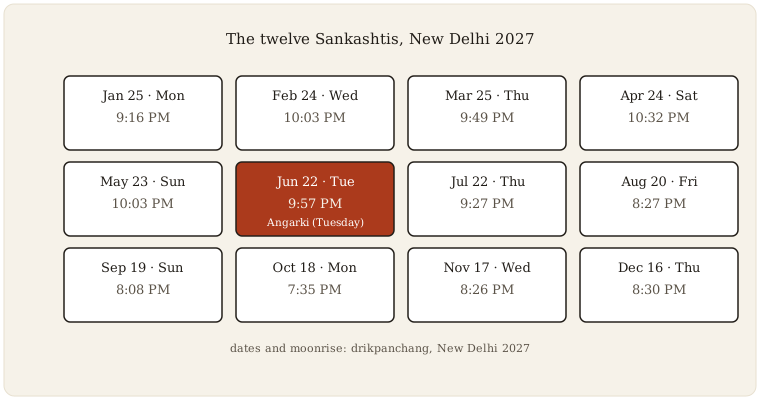
Once in a while the Sankashti day lands on a Tuesday, and then it takes a special name: Angaraki Sankashti Chaturthi, also shortened to Angaraki Chaturthi, Angaraki or Angarika. Both sources call it the most auspicious Sankashti of all, and Wikipedia unpacks the word: angarak in Sanskrit means red like burning coal embers, and refers to the planet Mars, after whom Tuesday, Mangalvar, is named. In New Delhi's 2027 list it happens exactly once: Tuesday, 22 June, the Krishnapingala Sankashti of drikpanchang's table, when the Ashadha Krishna Chaturthi runs from 1:07 PM that day to 3:42 PM the next and the moon rises at 9:57 PM. Wikipedia records the tradition's own habit on this point: the Sankashti fast is generally started from an Angarika Sankashti Chaturthi, so a single Tuesday can begin a years-long monthly practice.
The legend attached to the day is Angaraka's own story, as Wikipedia tells it. Angaraka, the son of the earth goddess Prithvi, was an accomplished rishi and a great devotee of Ganesha. He worshipped Ganesha and sought his blessings, and on a Magha Krishna Chaturthi that fell on a Tuesday, Ganesha blessed him and asked him to name a wish. Angaraka asked for one thing only: to be associated with Ganesha's name forever. The deity granted it, and proclaimed that whoever worships Ganesha on Angarika Chaturthi will be granted all that they pray for; from that day, Magha Krishna Chaturthi came to be known as Angarak Chaturthi. We retell it as the legend the source records, not as history.
Regional forms: Sakat Chauth, Bhugga, Sankatahara
The same lunar night wears regional clothes, and the sources name several. In North India, both agree, the Magha-month Sankashti is known as Sakat Chauth; drikpanchang's 2027 list indeed labels 25 January, the Magha entry, as Sakat Chauth alongside its Lambodara name. Wikipedia's North and Central India paragraph gives the custom its texture: on the fourth day of Magha's Krishna Paksha, women perform arghya to Chandrama, the moon, at night, and Bhugga, a sesame-and-jaggery mixture, and radish are donated and eaten to complete the fast; it is one of the main rituals of the Lodhi Rajputs. In the South, the Tamil name is Sankatahara Chaturthi or Ganesh Sankatahara, which drikpanchang also gives. And drikpanchang adds the geographical centre of gravity: the fast is mostly observed in Western and Southern India, especially Maharashtra and Tamil Nadu, the two lands whose Ganesha devotion needs no introduction. The moonrise that ends the fast is the same moon everywhere; the plate that follows it is regional.
One more thread from Wikipedia deserves to be kept exactly as it stands, flag and all: the article says the observance is said to have started around 700 BC as an obstacle-removal ritual, attributing the teaching to an Abhisheka Maharishi instructing his pupil Aishwarya, and Wikipedia itself marks that sentence citation needed. We report it with the flag flying, neither as fact nor as fiction, because the honest state of the record is that the claim exists and is unverified.
The year of moons: New Delhi 2027, month by month
Here is the complete New Delhi list for 2027, from drikpanchang, every date's weekday verified against the calendar. 25 January, Monday: Sakat Chauth, the Lambodara Sankashti, moonrise 9:16 PM, with Magha Krishna Chaturthi from 8:10 AM that morning to 6:00 AM the next. 24 February, Wednesday: Dwijapriya, moonrise 10:03 PM, Phalguna Chaturthi from 9:48 PM on the 23rd to 8:39 PM. 25 March, Thursday: Bhalachandra, moonrise 9:49 PM, Chaitra Chaturthi from 12:37 PM to 12:43 PM the next day. 24 April, Saturday: Vikata, moonrise 10:32 PM, Vaishakha Chaturthi from 4:20 AM to 5:41 AM the next morning. 23 May, Sunday: Ekadanta, moonrise 10:03 PM, Jyeshtha Chaturthi from 8:41 PM to 10:58 PM the next night. 22 June, Tuesday: Krishnapingala, the year's Angarki, moonrise 9:57 PM, Ashadha Chaturthi from 1:07 PM to 3:42 PM the next day. 22 July, Thursday: Gajanana, moonrise 9:27 PM, Shravana Chaturthi from 4:46 AM to 6:56 AM the next morning. 20 August, Friday: Heramba, moonrise 8:27 PM, Bhadrapada Chaturthi from 6:53 PM to 8:04 PM the next evening. 19 September, Sunday: Vighnaraja, moonrise 8:08 PM, Ashwina Chaturthi running a neat 7:08 AM to 7:08 AM. 18 October, Monday: Vakratunda, which the list shares with Karwa Chauth, moonrise 7:35 PM, the year's earliest, Kartika Chaturthi from 5:51 PM to 4:42 PM the next day. 17 November, Wednesday: Ganadhipa, moonrise 8:26 PM, Margashirsha Chaturthi from 3:41 AM to 1:35 AM the next night. And 16 December, Thursday: Akhuratha, moonrise 8:30 PM, Pausha Chaturthi from 1:21 PM to 10:34 AM the next morning.
Read the moonrise column as the shape of the year: it begins deep in the evening, 9:16 PM in January, climbs later and later through spring to the 10:32 PM of April, then walks back through the monsoon and autumn until October's merciful 7:35 PM. The fast is the same vow every month; its length is set by astronomy, and 2027's April fast is the longest of the year for New Delhi while October's is the shortest. Your city's list will differ, sometimes by a day, which is the whole point of the moonrise rule above.
An honest note on limits
Everything above is description: two fetched sources, attributed throughout, and this paragraph is ours. The fast, the food rules and the kathas are the tradition's instructions; we describe them, we do not prescribe them. The dates and moonrises are one almanac's computation for one city in one year, and the almanac itself says the fasting day can shift by city; before you keep the vrata, look up your own location's list. The two month-name tables are left unreconciled because the sources genuinely differ by the amanta-purnimanta convention, and the 700 BC origin sentence is kept with Wikipedia's own citation-needed flag on it. The tradition's promises, deliverance from trouble, the granting of wishes on Angarika, are reported as belief, which is what the sources themselves say they are; no observance described here carries a guarantee of any outcome. And the fast itself, sunrise to a moonrise that can fall past ten at night, is a real physical strain for some bodies: if you are pregnant, ill, elderly or on medication, ask your doctor before keeping it, especially through the long evenings of spring. The deity of this vrata is the lord of intelligence; using yours is part of the worship.
Questions on this article
Is there a Sankashti Chaturthi every month?
Yes. Every lunar month has a Krishna Paksha Chaturthi, the fourth tithi after the full moon, and that is Sankashti. The month after Amavasya has the other Chaturthi, the Shukla one, which is Ganesha or Vinayaka Chaturthi. In New Delhi's 2027 calendar the twelve Sankashtis run from 25 January to 16 December, each with its own name in the monthly cycle and its own moonrise time, and every thirteen months or so the lunar calendar adds an adhika month, which is why the vrata katha cycle has thirteen stories.
What is Angarki Chaturthi?
A Sankashti Chaturthi that falls on a Tuesday. Angarak means red like burning coal embers in Sanskrit and refers to Mars, the planet Tuesday is named for, and both sources call the Tuesday Sankashti the most auspicious of all. The legend attached to it is the story of Angaraka, the rishi son of Prithvi, whose only wish was to be joined to Ganesha's name forever. In New Delhi's 2027 list the year's only Angarki is Tuesday, 22 June. The tradition also generally begins a fresh Sankashti practice from an Angarika day.
Why does the Sankashti date differ between cities?
Because the rule is tied to moonrise, and moonrise is local. Drikpanchang states the rule directly: the fast is observed on the day when moonrise prevails while Chaturthi tithi lasts, so two cities in the same state can legitimately fast on different days, and the day can even be Tritiya rather than Chaturthi. The same page faults single all-India lists for ignoring this, which is its own claim and we attribute it to the page; the practical consequence stands either way: check the list for your city.
Is the Sankashti fast safe for everyone?
That is a medical question, and no website should answer it for you. The fast is strict, running from sunrise to a moonrise that in New Delhi's 2027 list falls between 7:35 PM and 10:32 PM, with only fruits, roots and vegetables permitted. Many people keep it comfortably for decades; for some bodies it is a strain. If you are pregnant, ill, elderly or on medication, ask your doctor first. This guide describes the observance; it does not prescribe it.