What a Tithi Is: The 12-Degree Angle, the Sunrise Rule, Kshaya and Vriddhi, and Why Two Panchangs Disagree
A tithi is an angle, not a day count: the twelfth part of the Moon's journey away from the Sun; the sunrise rule, the kshaya and vriddhi anomalies, immunity from the ayanamsha quarrel, and the real reasons two panchangs disagree.
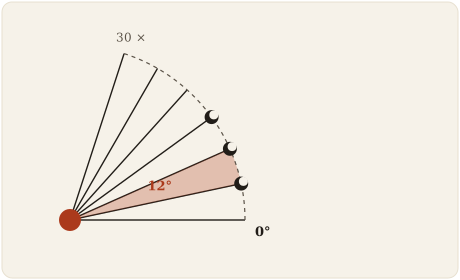
Of the panchang's five limbs, the tithi is the one everyday speech simply calls "the date"; but its precise definition is not a day count, it is an angle. The first line of shastrapanchangam's method page: a tithi is a lunar day, and it changes each time the Moon's longitude relative to the Sun increases by 12 degrees. The tithi is a unit of geometry before it is a unit of the clock: the widening angle between the Sun and the Moon in the sky. This article follows that order: what the unit is, why its length varies, how a day's tithi is decided, what the two anomalies kshaya and vriddhi are, what the thirty names are, how the count shifts between the two month systems, and why two panchangs give different answers.
The unit: a 12-degree angle
The method, in shastrapanchangam's words: take the longitudes of the Moon and the Sun along the zodiac in degrees, subtract the Sun's longitude from the Moon's, and read the result between 0 and 360 degrees; each 12-degree interval is one tithi, and thirty tithis make a lunar month. At zero the two bodies stand in the same direction, the moment of amavasya; at 180 they stand opposite, purnima. The journey from 0 to 180 is the shukla paksha, the waxing half; from 180 to 360 the krishna paksha, the waning half. That is why the tithi is called the lunar date: it is really a fifteenth-part measure of the Moon's separation from the Sun, not of the Earth's turning. Wikipedia's definition is the same: the time taken for the longitudinal angle between the Moon and the Sun to increase by 12 degrees.
Why the length varies
If the Moon and the Sun moved at constant speeds, every tithi would last the same number of hours. But Wikipedia cites their elliptical orbits and the Moon's non-uniform motion, and gives the figures: the average tithi is about 23 hours 37 minutes, while actual durations run from about 19 hours 59 minutes to 26 hours 47 minutes. The same non-uniformity is what treatises such as the Surya Siddhanta computed with their motion models, and modern astronomy confirms it, per that page's citation. The practical consequence: a tithi can begin or end at any hour of the day, not necessarily at 6 in the morning. That is why, shastrapanchangam writes, panchang pages print the ending time alongside the tithi's name; the ending time is the real information, not the date label next to the name.
Which tithi is today: the sunrise rule
Here sits a subtle but central point. A tithi's change is an astronomical instant: in the geocentric calculation, shastrapanchangam says, that instant is the same for the whole Earth, not different for Delhi and for Tehran. But the answer to "what is today's tithi" depends on place, because daily panchang pages show the tithi present at local sunrise. Two cities see sunrise at different times; panchangya writes on its method page that sunrise differs by nearly an hour across India, so every time window there is counted from sunrise in your city. So when reading a tithi listing, look at two things: the tithi's name and its ending time; if the tithi ends before the next sunrise, the rest of the day belongs to the next tithi. Vrats and festivals bind to exactly this "which tithi at which hour" question; the Ekadashi and Pradosham clocks in our fasting article open on this same rule.
Tithi versus the civil date
Keeping two calendars apart is half this article's substance. The civil date is made by the Earth's rotation: midnight to midnight, roughly 24 hours everywhere, never 19 or 27. The tithi is made by the Moon-Sun angle: it does not care about midnight, it can begin and end at any hour, and its length shifts slightly every time. That is why one civil day can hold two tithis, and one tithi can touch three civil dates, even though the sunrise rule attaches its name to a single day. Wikipedia notes that in Nepal Bhasa the tithi is called milalya; that name too belongs to a lunar-phase duration, not to the day. The commonest practical use of the distinction: birthdays. Families who observe a birth tithi look up each year in the panchang the tithi in which the birth occurred; it usually falls a few days off the Gregorian birthday, because the two calendars run on different clocks. For the same reason, shraddha and annual memorial rites also run on the tithi, not the civil date.
The two anomalies: kshaya and vriddhi
Because a tithi can run anywhere between 19 and 27 hours while sunrise arrives every 24, two opposite anomalies occur naturally. First: a tithi may begin after one sunrise and end before the next; then it becomes no day's "sunrise tithi" at all. This is called a kshaya tithi, the name in both sources. panchangya adds in its transparency note: a skipped tithi is still shown, not quietly dropped from the list. The second anomaly is the reverse: a long tithi may be present at two successive sunrises. Here the sources' names differ, and we record the discrepancy as it stands: panchangya calls it vriddhi, while Wikipedia gives adhika or ahoratra tithi for the same phenomenon. We opened both; both namings are in circulation, and this article keeps panchangya's term with Wikipedia's alternatives in brackets. panchangya's method note is tidy: neither case needs a special rule; compute each tithi's real start and end and check which one is running at sunrise, and both outcomes fall out on their own.
The thirty names
The names of the thirty tithis, from Wikipedia's table, keep the same order in both pakshas; the difference is only in the fifteenth. Pratipada (the first), Dvitiya, Tritiya, Chaturthi, Panchami, Shashthi, Saptami, Ashtami, Navami, Dashami, Ekadashi, Dvadashi, Trayodashi, Chaturdashi; and the fifteenth is Purnima in the shukla paksha, Amavasya in the krishna paksha. So "Dvitiya" alone is incomplete information; the full name forms with the paksha, shukla dvitiya or krishna dvitiya. Panchang pages and fasting lists run in this full form: shukla ekadashi, krishna ashtami. Some of these names carry separate weight in the vrat-festival calendar: the ekadashi of each paksha is a fasting tithi, krishna chaturthi binds to Sankashti, shukla chaturthi to the Vinayaka vrat, and purnima and amavasya stand at the centre of their own monthly rites; which vrat binds to which tithi opens in our fasting article and the festival cluster.
Where the count starts: amanta and purnimanta
The same tithi sequence starts from different points in the two month systems. Per Wikipedia, amanta lunar calendars begin the count at shukla pratipada, that is, the month starts the day after amavasya; purnimanta calendars begin at krishna pratipada, the day after purnima. The consequence is that in some months the same tithi attaches to different month names in the two systems. This difference is the subject of this cluster's forthcoming amanta-vs-purnimanta article; here it is enough to record that a tithi name demands the context of its paksha and its month system, and a bare name can point to different months at two reading desks.
A rare stability: no ayanamsha effect
The most contested decision in panchang computation is the choice of ayanamsha; panchangya writes that two panchangs can give different festival dates for this reason alone. But the tithi stands outside that quarrel. Both sources give the same reason: the ayanamsha enters both longitudes, the Sun's and the Moon's, identically, and the tithi is built from their difference; taking the difference cancels the equal offset. In shastrapanchangam's words: subtracting the same offset from both longitudes leaves their difference unchanged, so it does not change the tithi. panchangya counts it among the few things in a panchang that the choice of coordinates cannot change. So if two panchangs' tithis disagree, the cause is not the ayanamsha; look elsewhere.
The tithi's place among the five angas
Per Wikipedia, the panchang's five limbs are tithi, vara, nakshatra, yoga and karana. Of these, tithi and vara are quoted the most, and their natures are opposites: the vara is a fixed seven-day cycle, free of eclipse arithmetic; the tithi is a pure sky-measure that changes its length every month. In muhurta selection the two work together: Wikipedia writes that tithi and nakshatra together take part in choosing muhurtas for daily and special activities, and some tithis are considered more propitious than others for some purposes; that is its general presentation, whose fuller treatment belongs to this cluster's how-to-choose-muhurat article. The next articles of this cluster open these limbs one by one: vara, yoga, karana, and then the time-slice layers, Rahu Kaal, choghadiya, hora.
So why do two panchangs disagree
The list of real causes in our sources has three main entries. First, the calculation method: per Wikipedia, traditional panchangs often derive tithi boundaries from the mean motions of the Sun and Moon given in the Surya Siddhanta and later siddhantic texts, while modern almanacs take true longitudes from high-precision ephemerides such as the NASA JPL DE series; the two answers can differ by several minutes, and in rare cases up to an hour. Second, Drik and Vakya: shastrapanchangam writes that almanacs following the Vakya tables print tithi endings later than Drik ones, often by half an hour or more; that is its own comparison. Third, the transparency of the ephemeris source: panchangya lays its method open, an open-source engine called astronomy-engine built on the VSOP87 planetary theory, and every value is computed from positions at the moment of asking, not copied from a printed table. That is the modern benchmark: if a panchang does not say how it calculates, the reader cannot know the cause of its differences. Within the scope of the consulted sources, this much can be said: the difference comes from the calculation method and the table tradition, not from the ayanamsha.
A worked example
Suppose a city's panchang page reads: krishna trayodashi, ending 1:12 PM. The way to read it: trayodashi was running at sunrise, so the day is named trayodashi; at 1:12 trayodashi ends and chaturdashi begins, and the evening puja falls in chaturdashi. If the question is the Pradosham vrat, which binds to the trayodashi evening, this very ending time decides on which day the fast is kept; that is why festival dates are checked year by year, city by city, from the panchang. A second example: if in some month a tithi, say shukla shashthi, begins after one sunrise and ends before the next, the name will appear missing from the calendar rows; the missingness is not an error, it is kshaya, and a method like panchangya's holds that showing it in the list is the correct behaviour. A third example: if a long ekadashi stands at two sunrises, both days will read ekadashi; which day the fast falls on is decided by sectarian rules, which are outside this article's scope.
Three questions for any tithi listing
First, which tradition is the calculation: Drik or Vakya, mean motion or true longitude? By shastrapanchangam's comparison, Vakya almanacs print ending times often half an hour or more late; read the method if the listing states one. Second, which city's sunrise: a tithi's change is one instant for the whole Earth, but "today's tithi" is decided by local sunrise, and sunrise differs by nearly an hour across India; do not measure your city by another city's listing. Third, is any tithi kshaya or vriddhi (adhika/ahoratra) this month: if a tithi name is missing from the calendar or appears twice, first check whether the panchang has recorded the anomaly or dropped it; an honest listing shows both situations.
Source note: this article has three sources, all opened in full. shastrapanchangam (shastrapanchangam.com/en/method/tithi/): the tithi definition and the subtraction method, the duration variation from the Moon's non-uniform speed, the reason ending times are printed, the sunrise rule, the kshaya tithi definition, the geocentric instant's worldwide simultaneity, the ayanamsha independence, and the Vakya-versus-Drik comparison (Vakya endings often half an hour or more later). Wikipedia's Tithi page: the 12-degree definition, the average of 23 hours 37 minutes and the range from 19 hours 59 minutes to 26 hours 47 minutes, the Surya Siddhanta mean-motion versus modern true-longitude methods and their difference (minutes, rarely an hour), the kshaya and adhika/ahoratra tithi definitions, the thirty-name table, the amanta and purnimanta counting starts, the tithi's place among the panchang's five angas, and the Nepal Bhasa name milalya. panchangya (panchangya.com/en/methodology): tithi as a 12-degree elongation, the ayanamsha's exact cancellation in the difference, the kshaya/vriddhi naming (vriddhi is its own term; the discrepancy with Wikipedia's adhika/ahoratra is recorded), the principle of showing skipped tithis, city-wise sunrise (nearly an hour's difference across India), and the astronomy-engine/VSOP87 ephemeris source with the Lahiri ayanamsha details. The repeated tithi's naming differs between the two sources (vriddhi versus adhika/ahoratra); the discrepancy is recorded as it stands and we do not certify either naming. We did not open the Surya Siddhanta itself; its context is an indirect quotation via Wikipedia.


