Vastu Remedies Without Demolition: Fix What Moves, Manage the Rest
Room-use swaps, bed and stove orientation, furniture weight, light, clutter and entrance care are reversible and free. Walls are a certified-professional matter, not a remedy.
Told your home is "wrong"? Start without fear
Many people first hear about a Vastu concern in passing. A relative visits, a video appears in a feed, and suddenly a comfortable home feels suspect: the kitchen is in the North-East, the main door faces the "wrong" way, a toilet sits where it should not. Nothing about the flat has changed. Only the story about it has.
Delhi-based consultant Sunil Tripathi opens his own page on this subject with an unusual admission for his field: one of the biggest problems in modern Vastu practice is fear. People are told their house is completely wrong, that a direction will destroy their finances, that they must demolish something immediately. His reply is blunt: a consultant should create clarity, not fear; not every deviation is a defect; not every defect requires demolition; and not every problem in life originates from Vastu. This guide follows the same line. It describes what practitioners commonly recommend for an existing home, names where the sources disagree, and does not claim that any change brings health, wealth or luck. There is no scientific evidence for those outcomes; people follow these practices as tradition. The building and safety points below are sourced separately and apply whatever you believe.
Why demolition is usually not even an option
In a flat, the main door opens onto a common lobby, and gas, water and drain lines run through shared shafts. The kitchen and toilets are tied to stacks that serve every floor. In many newer towers the walls themselves cannot be cut: the government's Building Materials and Technology Promotion Council describes monolithic aluminium-formwork construction as walls, floors, slabs, beams and stairs cast together in one operation, and lists as a limitation that post-construction alterations are not possible. Before anyone touches a wall, ask your society for the structural drawings.
Even where alteration is legally possible, it is a regulated process, not a weekend project. Delhi's DDA policy on additions and alterations in its flats is a useful illustration. It condones a specific list without further action, including false ceilings, lofts and shelves made without chases in walls, flooring changes with waterproofing, exhaust-fan or air-conditioner openings up to two and a half by one and three-quarter feet, and the removal of a half-brick (four and a half inch) wall. Larger work, such as interchanging the positions of kitchen, bathroom and WC, is permitted only with drawings certified by a registered architect and a qualified structural engineer, subject to structural safety, with the prior consent of all affected occupants, plus fees and an indemnity bond. The national Model Building Bye-Laws 2016 similarly list interior work that needs no permit when it does not affect structure or fire safety, including flooring, painting, a false ceiling at the permitted height and internal partitions within the bye-laws. These are templates: your city's rules and your society's bye-laws can be stricter. The practical summary is simple. Leave walls alone, and treat "the Vastu consultant said to break this" as a reason to call an architect, not a contractor.
Two lists before any remedy: fixed and fixable
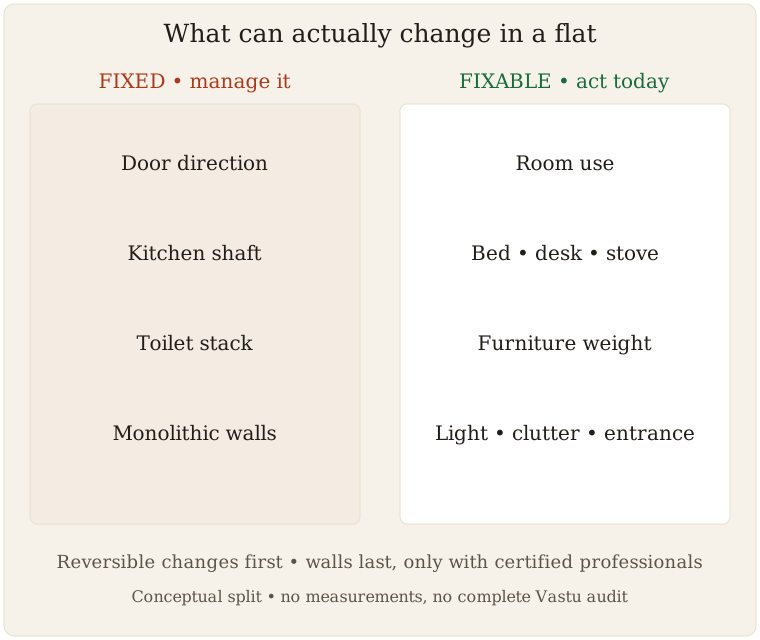
VastuEssentials, a remedies site, suggests sorting every concern into two piles before acting. Fixed issues are the ones you cannot move: the door direction, the toilet position, the kitchen shaft, the lift core. Fixable issues are everything else: clutter, poor lighting, a squeaky door, damp smell, blocked windows, scattered shoes. Most households, it notes, get their relief from the fixable pile. A dark, damp, cluttered home will feel heavy whatever its compass readings, and no symbolic product repairs a leak.
Houseyog, a design practice that writes about post-construction fixes, adds the observation that in real homes the biggest problems are rarely about direction alone. Poor ventilation, overcrowded layouts and missing natural light can make even a Vastu-compliant home feel uncomfortable, while a well-maintained home in a "wrong" layout can feel balanced. Their advice is to fix function first: airflow, light, workflow, maintenance.
Remedy group 1: swap what each room is used for
This is the biggest free change, and the one memberofarchitecture.com (MOA), an architecture platform, puts first. Practitioners commonly suggest the South-West for the head of the household's bedroom, West or North-West for children or guests, North, East or North-East for a study, the North-East for prayer, and the South or South-West for heavy storage. Most flats have two or three similar bedrooms, so these uses can often be shuffled without touching a wall.
Before swapping, MOA lists the practical costs to check: whether the bed and wardrobe physically fit the new room, whether the new room is en suite (a nightly walk to a distant bathroom wears thin), whether AC and TV points sit where the builder's layout put them, and who in the family the South-West room should go to, since practitioners differ on that too. Prayer does not need its own room: practitioners generally accept a pooja unit, niche or shelf in the North-East corner of a living room, kept away from a wall shared with a toilet.
Remedy group 2: turn the bed, the desk and the stove
Bed. The common rule is to sleep with the head to the South, East as second choice, and to avoid the North; MOA notes that some practitioners accept the West. There is no scientific evidence that sleeping direction affects health; people follow it as tradition. On the practical side, avoid a headboard against a window or a wall shared with a lift shaft.
Desk. Practitioners usually suggest facing North or East with a solid wall behind. A window to the side keeps glare off the screen. This costs nothing to try and is easy to reverse.
Stove. The usual rule is that the cook faces East, and Architectural Digest India's makeover guide places the ideal kitchen in the South-East with the stove in that direction and the sink to the North-West. You cannot move a flat's kitchen, but the hob can often shift along the counter at the next kitchen redo. One hard boundary: with piped gas, the pipe and meter are the gas company's installation. Gujarat Gas tells customers never to alter any part of the connection themselves, and the petroleum regulator's consumer FAQ says stove changes on piped gas are made by the company's authorised technician. Book the gas company before the carpenter.
Remedy group 3: move the weight
Practitioners generally want the South, West and South-West to carry the heavy, tall things: almirahs, bookshelves, lofts, stored boxes. The North-East is asked to stay light, low and open. AD India gives the same advice a stability framing: the south and west are traditionally linked with the earth element, so heavier items there are said to create a sense of security and balance. Two cautions override the tradition. Do not block windows: the Model Building Bye-Laws require the window and ventilator area of habitable rooms and kitchens to be at least one-tenth of the floor area, and a wardrobe pushed across a window undoes that. And fix tall loaded units to the wall, because a full almirah can tip.
Remedy group 4: light, colour, curtains and clutter
Practitioners give the centre of the home, the Brahmasthan, special weight: keep it open, uncluttered and well lit. In flats the centre is often the dining area, which quietly collects ironing, bags and parcels. Clearing it costs nothing. VastuEssentials makes maintenance itself the remedy: one weekly round of clearing the entrance, wiping mirrors, checking plants, drying bathrooms and clearing counters, since without maintenance "remedies slowly become decor".
On light, the sources agree: value morning light from the East and North-East, keep those windows clear, use sheer curtains there and thicker ones on harsh South and West sun, and replace flickering bulbs. AD India treats good lighting as a Vastu essential, not just an architectural one. On colour, AD India quotes Mumbai-based Vastukar Manasi Thakkur: when unsure, ivory or off-white is considered a remedial colour for any Vastu dosha in any direction. VastuEssentials adds the renter's version: curtains, cushion covers, bedsheets, rugs and lampshades change a room's colour without touching paint or the lease.
There is some research adjacent to clutter, though none on Vastu itself. In a US study of 60 dual-income couples, wives who described their homes with more clutter and unfinished-project words showed flatter daily cortisol patterns, a profile the authors link with poorer health, and more depressed mood across the day. It is small and correlational: a hint, not proof. On plants, the same honesty applies. Practitioners suggest a tulsi in the North or East and rounded-leaf plants for luck. Enjoy them, but a review of twelve chamber studies estimated you would need 10 to 1,000 potted plants per square metre of floor to match the pollutant removal that ordinary ventilation already provides. Plants are for pleasure, not air purification.
Remedy group 5: entrance care, since the door cannot move
You cannot change which way a flat's door faces. AD India prefers east- or north-facing entrances and warns against three doors in a straight line, but in an existing flat those are facts to manage, not fix. What every source does put weight on is how the entrance is kept: a bright warm light at the door, a clean threshold, a readable nameplate, a toran if your family follows the custom, a door that opens fully without a shoe pile behind it, shoes in a closed ventilated cabinet rather than scattered, and no dustbin beside the door. Houseyog's framing is that the issue is less direction than presentation: a well-lit, uncluttered entry changes how the whole home feels. In a flat, the corridor outside is shared space and an emergency route, so keep racks, planters and idols inside your own door and check society rules before fixing anything to a common wall.
Remedy group 6: a toilet in the "wrong" zone
Of all concerns, Houseyog says this one creates the most anxiety, and it is common in modern flats because plumbing decides toilet positions. A toilet in the North-East cannot be moved; its drain is part of a stack through every floor. The practitioner suggestions are unglamorous: keep the door shut, the floor dry, the room clean and the exhaust running; some add a bowl of rock salt for moisture. The building rules point the same way: the bye-laws require every bathroom or WC to have a window or ventilator of at least 0.3 square metres opening to a shaft or open space, and every such room to have a door that closes the entrance completely. Keep that ventilator clear and fix a door that will not shut. AD India warns that toilets in the North-East may make you "prone to illnesses and financial instability"; we record the claim as attributed tradition, not evidence, and note the practical discomfort people report usually traces to damp, smell and poor ventilation, which are fixable.
Mirrors: the one remedy the sources argue about
Mirrors are the classic quick fix and the sources do not fully agree. AD India, quoting Thakkur, advises against mirrors on the south or west bedroom walls, linking them to sleep problems, and suggests keeping mirrors covered when not in use. MOA's practitioner summary places mirrors on North or East walls and never facing the bed or the main door. Houseyog steps back from wall directions entirely: a mirror is a design tool, and what matters is what it reflects. A mirror doubling daylight is useful; one reflecting the bed at night, a pile of shoes or the toilet door is not. All three agree on the practical core: not opposite the bed, not straight opposite the main door, clean and undistorted. If a fitted wardrobe mirror faces the bed, covering it at night is the zero-cost fix.
Pyramids, crystals, strips and other products
Many products are sold as no-demolition Vastu remedies: pyramid grids, crystal and sphatik items, copper or brass strips and coils meant to "seal" a zone, coloured tapes, salt bowls, "energised" objects. Here the sources genuinely diverge, and we keep the divergence visible rather than picking a winner. MOA states flatly that there is no scientific evidence these products change anything in a home, does not recommend buying them, and advises treating "this dosha can only be fixed with a product I sell" as a sales pitch. VastuEssentials does not reject them but ranks them last: repair, cleanliness, light, air and order come first, and symbols are optional extras that should never add clutter. AD India's makeover guide ends by recommending a wind chime or temple bell in the north or east to "multiply all your good luck", which we record as the author's attributed claim, unverified. What should stay clear of this debate is faith itself: a deity in the pooja unit, a yantra used in worship or a toran at the door is a personal religious choice, not a purchase anyone needs to justify. The narrower point is about spending: light, storage, repair and planning before any product.
Renters and societies: the removable version
Renters get a specific note in VastuEssentials: use remedies that leave with you. Lamps, curtains, plants, storage boxes, furniture placement, cleaning, and colour through fabrics rather than paint. Nothing drilled into a wall the landlord cares about, nothing in common areas the society regulates. The same list doubles as the reversible-first plan for owners: try the free and undoable changes, live with them, and only then consider anything permanent.
When a professional makes sense, and which kind
If room sizes defeat a swap, if you want wardrobes or a pooja unit built, or if you are genuinely tempted to cut a wall, MOA's advice is to bring in an architect or interior designer before a contractor: they can read the structural drawings and plan changes that suit both Vastu and daily life. Sunil Tripathi's order of operations applies throughout: diagnosis before prescription. First understand what is actually bothering the household, then change only what genuinely needs changing. If someone diagnoses a dosha and sells its cure in the same sentence, you already know which professional you are dealing with.
Sources consulted
- MOA: Vastu remedies without demolition, with building-bye-law and gas-safety grounding
- VastuEssentials: 25 no-demolition remedies and a weekly maintenance habit
- Houseyog: practical fixes for existing homes and flats
- Vastu by Sunil: diagnosis before prescription, clarity not fear
- Architectural Digest India: Vastu tips for a home makeover
- DDA: permissible additions and alterations policy


